Peru travel safety 2026: an honest region-by-region guide
Is Peru safe to travel in 2026?
Peru is broadly safe for tourists who take normal urban precautions. The real risks are petty theft and taxi scams in cities, altitude sickness in the Andes, and occasional road blockades during demonstrations — not violent crime against tourists, which remains rare on the standard routes.
How worried should you actually be?
Most travellers arrive in Peru carrying a vague anxiety that turns out to be misdirected. The dramatic risks people imagine — kidnapping, violent assault, drug-cartel crossfire — are not what actually threatens tourists on the well-worn Lima–Cusco–Machu Picchu circuit. What does threaten them is mundane: a phone snatched on a crowded bus, a taxi driver taking the long way and demanding triple the fare, an altitude headache that turns into something worse because nobody acclimatised, or a road blockade that strands them between cities.
This guide is organised around those real risks rather than headlines. It goes region by region, then covers the practical hazards — taxis, scams, altitude, and demonstrations — that apply everywhere. The honest summary is that Peru rewards ordinary urban street-smarts and punishes carelessness, the same as most large countries. Tens of millions of tourist-days pass each year without incident.
| Where | Nationwide; risks vary by region |
| Biggest real risks | Taxi scams, petty theft, altitude sickness |
| Rare risks | Violent crime against tourists on standard routes |
| Avoid | Street-hailed taxis, unlicensed tour agencies |
| Best precaution | App-based taxis + registered operators |
Region by region
Lima
Lima is a city of eleven million and, like any megacity, has sharp internal contrasts. For visitors the relevant districts are safe by Latin American standards. Miraflores, Barranco and San Isidro are well policed, walkable and busy into the evening. The historic centre is fine to visit by day with normal caution but empties and becomes risky after dark. Districts that tourists have no reason to enter — parts of Callao away from the airport, the outer cone neighbourhoods — should be avoided. The practical Lima rule: stay in Miraflores or Barranco, use app taxis, keep your phone pocketed on the street, and you will be fine.
Cusco and the Sacred Valley
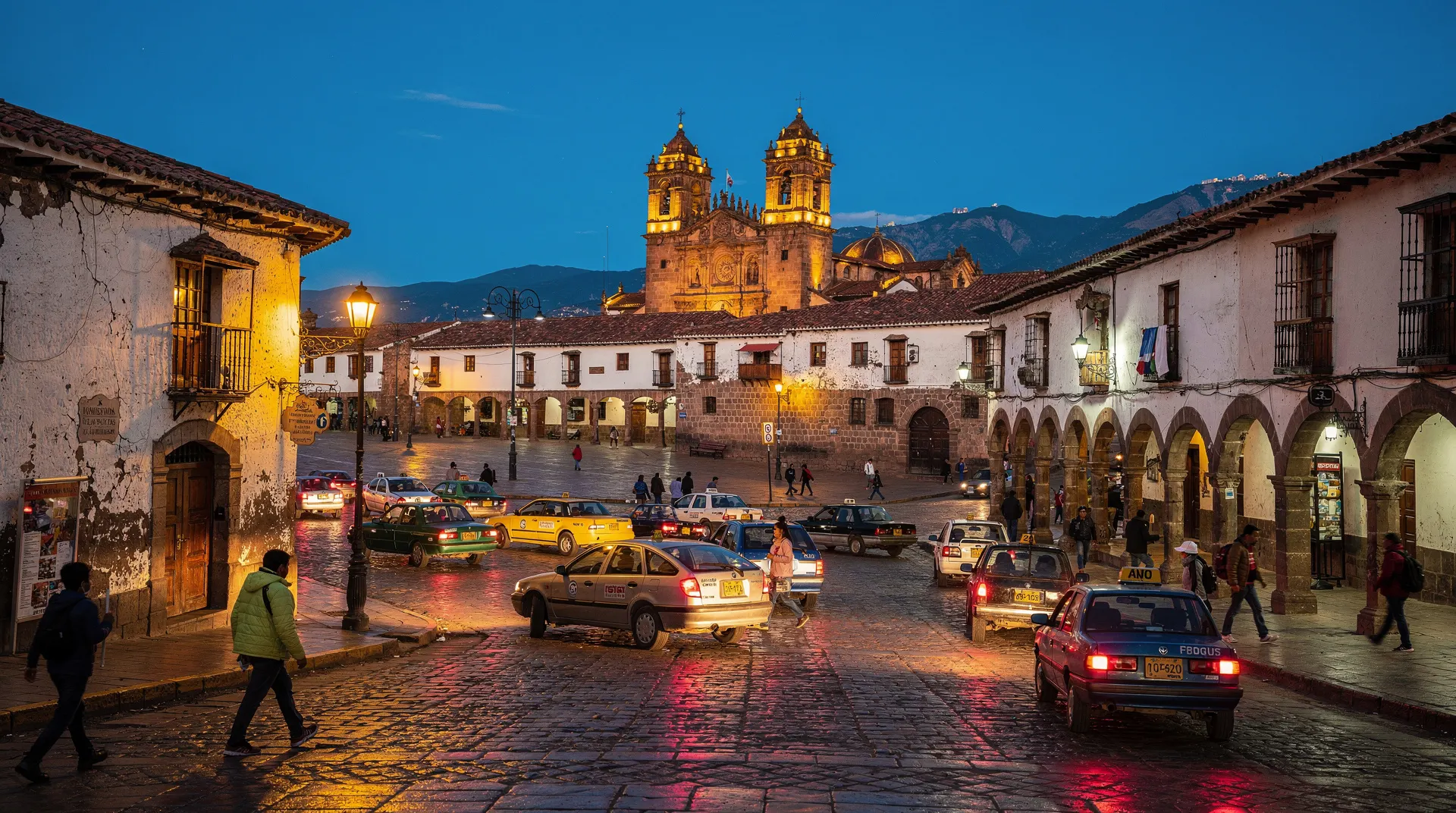
Cusco is heavily touristed and correspondingly well watched, but the crowds also attract pickpockets, especially around the Plaza de Armas, San Pedro market and on packed festival days. The main non-crime risk here is altitude: Cusco sits at 3,400 m and many visitors fly straight up from sea-level Lima. The Sacred Valley towns — Ollantaytambo, Pisac, Urubamba — are calm and lower, which is why many guides recommend sleeping there first to acclimatise.
Arequipa and Colca
Arequipa is relaxed and the historic centre is pleasant to walk. The main caution is taxis at night and the road down into the Colca Canyon, which is long, winding and best done with a reputable operator rather than the cheapest minibus.
Puno and Lake Titicaca
Puno is a rougher-edged town than Cusco or Arequipa, and the bus station and lakefront warrant extra attention to your belongings. The lake excursions to the Uros and Taquile islands are safe and well organised. Puno is also one of the areas most affected by periodic demonstrations.
The Amazon: Iquitos and Puerto Maldonado
Iquitos is a genuine frontier city reachable only by air or river, with its own petty-theft issues around the markets and waterfront. Puerto Maldonado is the gateway to Tambopata and is generally calm; most visitors transfer straight to jungle lodges. In both, the real risks are environmental — sun, insects, river travel — rather than crime. A licensed, reputable operator handles almost all of this risk for you: guides know the safe trails, manage river crossings, and carry basic first aid, which is one more reason to book jungle excursions through registered agencies rather than the cheapest option that turns up on the waterfront.
The north coast and northern highlands
Trujillo, Chiclayo, Mancora and the Chachapoyas region see far fewer tourists and are correspondingly low-key, but the lower tourist infrastructure means less English, fewer app taxis, and more reliance on your own caution. Mancora’s beach-party scene brings the usual coastal-resort theft risk.
Taxis: the number one avoidable risk
If you internalise one safety rule for Peru, make it this: do not hail taxis off the street, especially at airports and bus stations. Unlicensed and “informal” taxis are behind a large share of tourist incidents — overcharging, intimidation, the rare “express kidnapping” where a victim is driven between ATMs. The fix is simple and reliable:
- Use ride apps. Cabify, Uber and InDriver all operate in Lima, Cusco, Arequipa and other cities. They show the driver, plate and fare before you confirm, which removes the haggling and the route-padding.
- At airports, use the official taxi counters inside the terminal. They charge a fixed, posted fare. Ignore the men offering taxis in arrivals.
- Check the plate before you get in. App taxis show the plate; confirm it matches.
- Sit in the back, keep the door locked, and keep bags out of sight in stop-and-go traffic where window-snatching happens.
For the Lima airport run specifically, the Lima airport to city guide covers the official options and realistic fares, and general money-handling and taxi habits across cities are covered in the Cusco taxi and money tips guide.
The scams worth knowing
None of these are unique to Peru, but knowing the local versions helps you spot them.
- The padded fare. A street taxi quotes a price, then “discovers” extra charges or claims not to have change. Counter with app taxis and exact-ish cash.
- Counterfeit and damaged notes. Check large soles notes for the watermark and security strip, and refuse torn or taped notes — shops will refuse them back, leaving you holding worthless paper.
- Fake tour operators. Street touts and unregistered “agencies” sell Machu Picchu, Inca Trail and Rainbow Mountain packages cheaply, then deliver substandard or non-existent service. Book treks and Machu Picchu through registered operators, and buy the Machu Picchu entry through the official government channel. The Inca Trail in particular is permit-controlled — anyone selling last-minute spots is misleading you. The unlicensed tour agencies in Cusco guide and the fake Machu Picchu tickets guide go into the specific red flags in detail, and the Cusco tourist traps guide covers the wider pattern beyond just tour operators.
- Altitude-remedy overselling. A specific Cusco variant: pharmacies and street vendors near tourist areas sometimes push expensive “altitude sickness cures” of dubious value. Coca tea and gentle acclimatisation cost little and work about as well as most paid remedies. The altitude medicine scams guide breaks down what is worth buying and what is not.
- The distraction theft. A spilled drink, a dropped item, a staged argument — while you react, an accomplice lifts your bag or phone. Keep one hand on your belongings in crowds.
- ATM tampering and shoulder-surfing. Use ATMs inside bank branches during the day, cover the keypad, and decline “assistance” from strangers.
- Currency-exchange short-changing. Use established casas de cambio or bank ATMs; count your money before leaving the window.
Altitude is a safety issue, not just a discomfort
More travellers are laid low by altitude than by crime. Cusco (3,400 m), Puno (3,800 m), Rainbow Mountain (over 5,000 m) and the Huaraz treks all sit high enough to cause acute mountain sickness, and in rare cases the life-threatening pulmonary or cerebral forms. The honest precautions:
- Acclimatise gradually. If possible, spend your first nights in the lower Sacred Valley before Cusco, or build a rest day on arrival.
- Hydrate and skip alcohol for the first 24–48 hours at altitude.
- Know the warning signs of severe altitude illness — breathlessness at rest, confusion, a persistent wet cough — and descend immediately if they appear.
- Consider acetazolamide (sold locally as Sorojchi-type pills, or by prescription at home) if you have a history of altitude sensitivity.
The Huaraz acclimatization guide goes into detail for the high trekking routes, and the best time to visit guide explains how season interacts with high-altitude conditions.
Demonstrations, strikes and roadblocks
Peru has an active protest culture, and political demonstrations periodically close roads, airports and the rail line to Machu Picchu, especially in the southern Andes around Cusco and Puno. These are almost never directed at tourists, but they can strand you. The sensible approach:
- Check your government’s travel advisory and local news in the days before you travel, particularly for the Cusco–Puno corridor.
- Build buffer days into tight itineraries so a one-day blockade does not cause you to miss an international flight.
- Do not attempt to cross or film active blockades. Wait them out or reroute.
- Keep some cash, water and snacks if you are on a long road leg in a sensitive region, in case of delays.
For the trade-offs between flying and driving through these regions, see the domestic flights guide and the bus travel guide.
Health, water and the outdoors
- Do not drink the tap water. Use bottled or filtered water everywhere, including for brushing teeth in rural areas.
- Food safety: busy, high-turnover restaurants and markets are usually safer than empty ones. Ceviche is fine at reputable cevicherías at lunch; be cautious with raw fish from dubious sources.
- Sun and insects: the Andean sun is fierce despite cool air, and the Amazon requires serious insect repellent and, depending on your route, consideration of yellow-fever vaccination and malaria prophylaxis. Check current medical advice for jungle destinations.
- Travel insurance that covers high-altitude trekking and helicopter evacuation is worth it if you are doing the Inca Trail, Salkantay, or the Huaraz routes.
Solo and women travellers
Peru is a common and rewarding destination for solo travellers, including solo women, on the standard circuit. The precautions are the familiar ones: app taxis over street taxis, busy streets over empty ones after dark, drinks watched in bars, and accommodation in central, reviewed neighbourhoods. Catcalling occurs but serious incidents against tourists on the main routes are uncommon. Joining group day tours for remote sites (Rainbow Mountain, Colca, Lake Titicaca islands) is both sociable and a sensible safety choice. One traveller’s honest account of altitude sickness catching them off guard, despite normal precautions, is worth reading before you go — see the altitude sickness story.