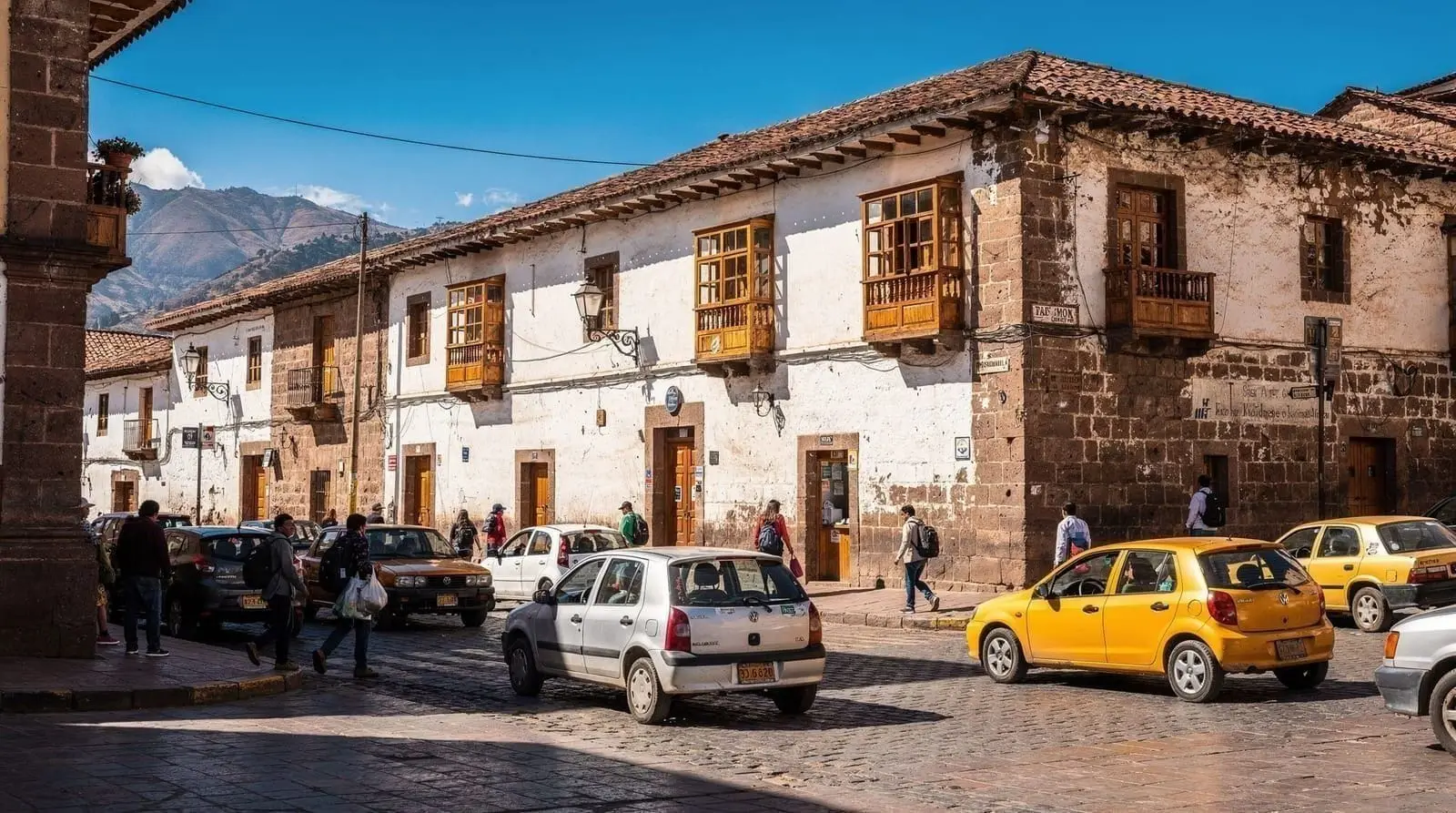
Cusco taxis and money: fares, scams and changing cash
How do taxis and money work in Cusco?
Cusco taxis aren't metered — agree the fare before getting in. Short in-town hops run S/8–12, the airport to the centre S/20–30. Apps like InDriver and Cabify remove the haggling. For money, pay in soles (USD gets a poor rate), withdraw from bank ATMs like BCP or Interbank, and always decline dynamic currency conversion.
The two things first-timers lose money on
In Cusco, the avoidable money leaks aren’t dramatic — no one’s going to clean you out — but they add up, and almost all of them come down to two habits: not agreeing taxi fares before you ride, and paying in US dollars instead of soles. Get those two right and you’ve sidestepped the bulk of the small, steady overcharging that catches first-time visitors. The rest is awareness: a handful of common scams, knowing where to get cash at a fair rate, and carrying the right notes.
This guide covers the practical money-and-transport reality of Cusco — real fares in soles (with the dollar equivalent at roughly S/3.70 to the dollar), how taxis actually work in a city with no meters, where to change and withdraw cash, and the scams worth knowing about. It pairs with the broader Cusco on a budget guide for daily spending and the Peru travel safety guide for the wider picture.
| Taxi fares | S/8–12 in town, S/20–30 airport, no meters |
| Pay in | Soles — dollars get a poor rate |
| Best apps | InDriver, Cabify |
| Cash needed for | Taxis, markets, small eateries, some ticket booths |
| ATMs | BCP, Interbank, Scotiabank — decline dynamic conversion |
Taxis in Cusco: how they actually work
The single most important fact: Cusco taxis are not metered. The fare is whatever you and the driver agree before you set off, which puts the responsibility on you to confirm the price up front. Get in without agreeing, and a tourist-spotting driver will name a higher number at the destination.
What fares should actually be
Real, local-rate fares run roughly:
- Short hop within the centre: S/8–12 (about $2–3).
- Up to the ruins above town (Sacsayhuamán area): around S/15 (about $4).
- Airport (CUZ) to the Plaza de Armas: S/20–30 (about $5–8). The airport is barely 10 minutes from the centre, so anything much higher is a tourist quote.
Drivers waiting outside the airport, the train station and major tourist sites quote higher than drivers you flag on a normal street. If a price sounds high, it probably is — name the local rate, or walk a block and flag a different cab.
The case for ride apps
Apps like InDriver and Cabify operate in Cusco and solve the haggling problem entirely: the fare is set in the app, the driver and plate are recorded, and you don’t need to negotiate in Spanish. InDriver in particular lets you propose a fare. For arrivals, after-dark trips and anyone uncomfortable bargaining, apps are the easiest and often cheapest option. Download and set them up before you arrive.
| App | How it works | Best for |
|---|---|---|
| InDriver | You propose a fare, drivers accept or counter | Budget travellers, negotiating without Spanish |
| Cabify | Fixed fare shown before booking, like a standard ride-hail app | Predictability, no negotiation at all |
| Uber | Smaller presence, less consistent availability | Backup option, not the primary choice |
| Street taxi | Agree fare verbally before getting in | Short hops once you know the local rate |
Taxi safety
Cusco taxis are generally safe, but a few sensible rules hold:
- Avoid unmarked cars late at night — use official taxis or apps after dark.
- Sit in the back and keep your phone and valuables out of sight.
- Have small notes ready; drivers rarely have change for a S/100 bill, and “no change” is sometimes used to round up.
- For the airport on arrival, booking a transfer through your hotel removes the negotiation entirely when you’re tired and altitude-affected.
Money: paying, changing and withdrawing
Pay in soles, not dollars
The Peruvian sol (S/) is the currency to use. US dollars are accepted by many tour operators and some shops, but at a deliberately poor rate — commonly around 3.55 soles to the dollar when the bank rate is nearer 3.70. That gap is money out of your pocket on every transaction. Pay in soles and keep the margin. Carry small notes (S/10, S/20, S/50): markets, taxis and small eateries struggle to break S/100 and S/200 bills.
Withdrawing cash from ATMs
Bank ATMs are the reliable way to get soles. BCP, Interbank and Scotiabank cluster along Avenida El Sol and around the Plaza de Armas, and most dispense soles (some also dollars). Two rules:
- Always decline dynamic currency conversion. When the machine offers to charge you in your home currency “for convenience,” say no and choose soles — the home-currency option bakes in a markup. The same applies to card terminals in shops and restaurants.
- Use bank-branded ATMs over standalone machines in shops, which tend to charge higher fees and offer worse rates.
Changing cash
If you’re carrying cash dollars or euros, licensed casas de cambio (exchange houses) around the centre offer competitive rates with less fuss than banks. The vested street money-changers (cambistas) on Avenida El Sol are a Cusco fixture and can give good rates, but you carry the risk — count the soles carefully, check for torn or counterfeit notes, and only deal with the licensed, ID-badged ones in daylight. When in doubt, a casa de cambio is the safer bet for a small rate difference.
Cards vs cash
Cusco runs on cash more than card-heavy travellers expect. Hotels, larger restaurants and tour agencies take cards, but taxis, market stalls, small eateries and several ticket booths — including some boleto turístico counters — are cash-only. Carry enough soles for the day in small notes and treat cards as a backup, not the default.
The scams and traps worth knowing
None of these are unique to Cusco, but they catch a steady stream of visitors:
- The inflated taxi fare. The classic. Solved entirely by agreeing the price before you ride, or using an app.
- Dynamic currency conversion. The “charge in your home currency?” prompt at ATMs and terminals always costs more. Decline it every time.
- Counterfeit and torn notes in change. Damaged or fake soles are sometimes slipped into change. Check notes you receive; torn or taped notes may be rejected elsewhere, so hand them back.
- “Free” street workshops. Touts around the Plaza de Armas hand out flyers for free chocolate, pisco or cooking sessions that turn into hard-sell shopping stops. They aren’t bargains.
- Balcony restaurant pricing. The restaurants ringing the Plaza de Armas charge a premium for the view; one block off the square is roughly half the price.
- Overpriced “official” boleto sellers. Buy the boleto turístico at the official COSITUC office on Avenida El Sol or at site gates, not from a tout — see the boleto turístico explained guide.
The bigger real-world risk isn’t a scam but pickpocketing in crowded spots — San Pedro market, plaza events and the late-night bar strip around Plateros and Procuradores. Keep your phone out of sight on the street, carry only the cash you need, and use app taxis after dark.
Getting from the airport without overpaying
The airport run is where most visitors have their first money encounter in Cusco, and it sets the tone. Alejandro Velasco Astete airport (CUZ) sits barely 10 minutes from the centre, so the honest fare to the Plaza de Armas is S/20–30 (about $5–8) — yet drivers working the arrivals area routinely quote double or more to travellers stepping off the plane jet-lagged and altitude-woozy.
You have three good options. Book a transfer through your hotel in advance — slightly pricier than a street taxi but zero hassle when you arrive tired, and a fixed, known price. Use a ride app (InDriver, Cabify) from outside the terminal, where the fare is set and recorded. Or walk just past the official airport taxi rank to flag a passing street taxi at the normal rate, agreeing the fare before you get in. Whichever you choose, settle the price before the car moves. And remember the altitude rule: don’t plan anything strenuous on arrival, so a smooth, pre-arranged transfer that drops you at your door to rest is worth the small premium.
How much things cost: a quick reference
To anchor your sense of local prices in soles (roughly S/3.70 to the dollar):
- Short city taxi: S/8–12
- Taxi to the ruins above town: ~S/15
- Airport to centre: S/20–30
- City bus (combi): ~S/1
- Bottle of water: S/2–3
- Set-lunch menú: S/10–18
- Market caldo or fresh juice: S/6–10
- Local SIM with a month of data: S/20–35
- Full boleto turístico: S/130
Keeping these numbers in your head is the best defence against overpaying — when a taxi driver names a number well above the range, you’ll know immediately, and when a vendor quotes in dollars you’ll be able to convert and pay the better soles price instead.
Connectivity and paying for a SIM
A small but practical money note: a local SIM makes the ride apps and the no-haggle payment options possible, so it’s worth sorting early. A Claro or Entel SIM with a month of data runs S/20–35, sold at the airport and in pharmacies around the centre. Bring your passport (required to register a SIM in Peru) and pay in soles. With data, you can run InDriver and Cabify, check the live exchange rate before changing money, and look up the honest fare for any route — all of which quietly protect your budget. eSIM options bought before travel work too and skip the registration queue, though they’re often pricier than a local physical SIM.
A simple money routine that works
To keep it all low-stress, a routine that travellers find reliable:
- Arrive with a small amount of soles (changed at home or at the Lima airport) for the first taxi and meal, so you’re not hunting for an ATM while altitude-woozy.
- Withdraw a few days’ worth from a BCP or Interbank ATM on Avenida El Sol, declining dynamic conversion, and break larger notes early at a hotel or restaurant.
- Carry only the day’s cash in small notes; leave the rest and your spare card secured at your accommodation.
- Default to soles and to apps for taxis. Confirm any cash fare before the ride.
- Count your change and check notes, especially from street changers and taxi drivers.
Getting beyond the city
The same money habits travel with you. Heading to the Sacred Valley, shared colectivos and taxis run on agreed fares, and smaller towns are even more cash-dependent than Cusco, so stock up on soles before you leave the city’s reliable ATMs. For onward travel to Lima or beyond, the same rules apply — soles, small notes, decline dynamic conversion. For the cost side of planning the whole trip, see Cusco on a budget; for personal-safety specifics across the country, the Peru travel safety guide goes deeper.
Setting up before you land
A little prep at home or in Lima saves the first stressful hour in Cusco. Notify your bank of Peru travel dates so foreign withdrawals aren’t flagged and blocked. Download InDriver and Cabify and create an account before arrival — doing it at the airport on unreliable wifi is a worse experience. Withdraw a small amount of soles at the Lima airport if you’re connecting through it, enough for your first Cusco taxi and meal, so you’re not hunting for an ATM while jet-lagged and starting to feel the altitude.
Save your hotel’s address and phone number in Spanish-readable form, since some taxi drivers appreciate a written address more than a spoken one. None of this takes more than twenty minutes, and it removes the single most disorienting part of arriving anywhere new: the first cash-and-transport transaction.
Tipping: where it’s expected and where it isn’t
Money habits in Cusco extend to tipping, which surprises some travellers because it’s lighter than in the US but real in specific places. Taxi drivers are not tipped — the agreed fare is the full payment. Restaurants without a service charge appreciate 10% at sit-down places; casual spots and market stalls don’t expect it, though rounding up is common. Trekking guides, porters and drivers on multi-day trips (Inca Trail, Salkantay) are a different story entirely — tipping here is a genuine, near-obligatory part of the economics, since porter wages are structured around it; budget S/20–40 per porter per day and more for guides, and bring small notes specifically for the end-of-trek tipping ceremony most operators build in.