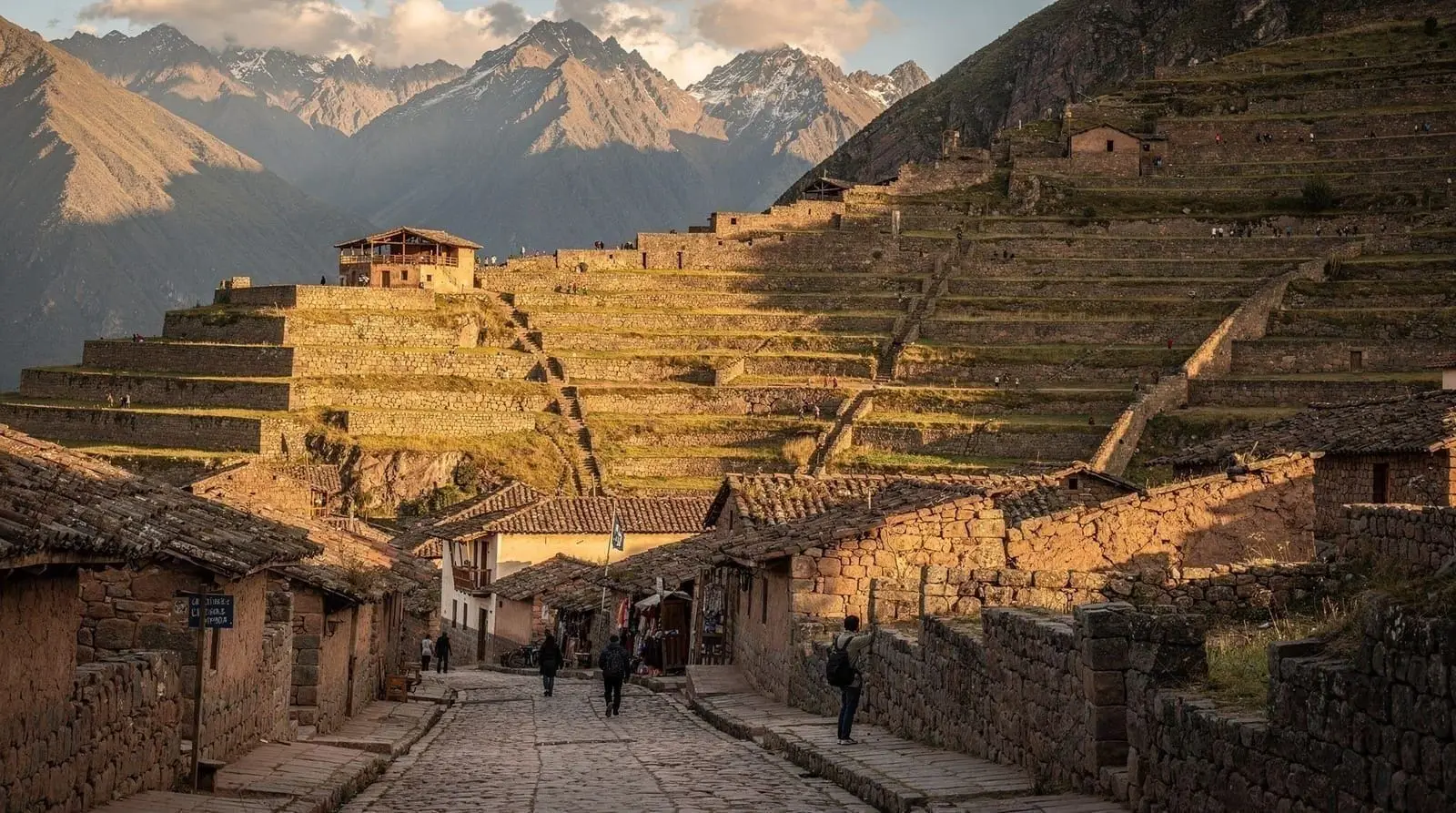
Ollantaytambo
Ollantaytambo done right: the living Inca town, the fortress that beat the Spanish, the Machu Picchu train, boleto tips and where to sleep low.
From Cusco: Sacred Valley Tour with Pisac and Ollantaytambo
Quick facts
- Region
- Sacred Valley, Cusco Department
- Altitude
- 2,792 m / 9,160 ft (lowest of the valley towns)
- Entry (ruins)
- Boleto Turístico (Circuit III S/70 or General S/130)
- Train
- PeruRail & Inca Rail to Aguas Calientes (~1h45)
- Best for
- Inca architecture, living Inca town, Machu Picchu gateway, sleeping low
The only Inca town people still live inside
Ollantaytambo is the closest thing in Peru to a working Inca town. The grid of narrow cobbled lanes below the fortress was laid out in the 15th century, and people still live in the same trapezoidal-doorwayed houses, with the same Inca water channels running down the middle of the streets. Stand in the main square and look up: the temple terraces climb the mountain directly above you, and the whole place still functions as the Inca planned it. No other site in the Sacred Valley gives you that continuity.
| Where | Sacred Valley, 1.5hrs from Cusco, lowest of the valley towns |
| Cost | Boleto Turístico Circuit III S/70 or General S/130; Pinkuylluna free |
| Time needed | Half day for the ruins; a full overnight if catching the train |
| Getting there | Colectivo/taxi from Cusco or Urubamba; trains depart the town station |
| Best time | May–September dry season, ruins at 7am opening |
It is also, for most travellers, the gateway to Machu Picchu. Almost everyone who takes the train boards it here, because the road from Cusco ends and the rails begin in the valley. That makes Ollantaytambo both a destination in its own right and a near-compulsory overnight stop on the Machu Picchu run.
And it has the practical bonus of being the lowest valley town, at 2,792 m (9,160 ft) — a useful place to sleep before going up to altitude.
The fortress that beat the Spanish
The terraced complex above the town is usually called a fortress, and it earned that name in 1537 when Manco Inca defended it against a Spanish cavalry force led by Hernando Pizarro — one of the very few times the Inca won an open battle against the conquistadors. They flooded the plain below to bog down the horses and rained projectiles from the terraces. The Spanish retreated to Cusco.
But the site was primarily a temple, and the unfinished Temple of the Sun at the top is the real wonder. Six colossal blocks of pink rhyolite stand fitted together with paper-thin joints. The astonishing part: the quarry is on the opposite mountainside, across the river and several kilometres away, hundreds of metres up. How the Inca moved blocks weighing dozens of tonnes across a valley and up a mountain remains genuinely unresolved. You can still see “tired stones” — blocks abandoned mid-transport — strewn along the ancient haulage ramp.
Climbing the terraces takes 45-60 minutes up and back at a gentle pace. Go early (the site opens at 7 am) before the day-tour buses arrive from Cusco around 10-11 am and before the sun gets harsh. Entry is by Boleto Turístico only — the Circuit III partial (S/70, valid 2 days) or the General (S/130). Bring cash.
A guide turns the stonework from impressive into astonishing because the engineering story is not obvious from a plaque. The Sacred Valley tour with Písac and Ollantaytambo pairs the two top ruin sites with transport and commentary in a single day.
Wandering the old town
Do not rush off after the ruins. The town itself rewards an hour of slow wandering. Cross the main square to the Cusichaca neighbourhood (Qosqo Ayllu) on the far side — a perfectly preserved grid of Inca canchas (walled compounds), the most intact Inca residential blocks anywhere. The streets are narrow, the original walls are everywhere, and water still runs in the channels.
Look up the mountain across the river from the town and you can also spot the Pinkuylluna storehouses (colcas) clinging to the cliff — Inca granaries positioned to catch the cold wind that preserved grain. You can hike up to them for free (no boleto needed); it is a steep 30-45 minute scramble with the best aerial view of the town and fortress. Wear proper shoes; the path is loose.
The train to Machu Picchu
This is why most people end up here. There is no road to Machu Picchu — you reach Aguas Calientes either by train or by multi-day trek, and the trains start at Ollantaytambo station (a few of the most expensive services start from Poroy near Cusco, but Ollantaytambo is the standard departure).
The essentials:
- Operators: PeruRail and Inca Rail both run the route. Journey time is about 1 hour 45 minutes to Aguas Calientes (also called Machu Picchu Pueblo).
- Booking: Book ahead, especially May-September. Fares range widely — expect roughly $70-130 each way for the standard tourist classes, more for the panoramic and luxury services.
- The station is a 10-15 minute walk (or S/5 mototaxi) from the main square. Arrive at least 30 minutes before departure.
- Strategy: Sleeping in Ollantaytambo the night before lets you catch an early train and reach Machu Picchu in good time, rather than starting with a pre-dawn drive from Cusco.
If you want the whole Machu Picchu leg handled from here, the 2-day Machu Picchu tour from Ollantaytambo bundles the train, the entrance ticket, and the Aguas Calientes overnight, which removes the booking logistics that trip up a lot of independent travellers. See also /destinations/machu-picchu/ and /destinations/aguas-calientes/.
Choosing the right train and class
Since the train is the reason most people pass through, it is worth a closer look because the choices are confusing on first contact.
Two operators. PeruRail and Inca Rail both run Ollantaytambo to Aguas Calientes. Schedules and classes overlap; price and departure time usually matter more than which company you pick.
The classes, roughly bottom to top. PeruRail’s Expedition and Inca Rail’s The Voyager are the standard tourist services — comfortable, panoramic windows, the cheapest sensible option. The mid-tier (PeruRail Vistadome, Inca Rail The 360°) adds bigger glass roofs, onboard snacks and sometimes a small show. At the top, the Hiram Bingham (PeruRail) and Inca Rail’s First Class / Private are luxury services with fine dining and a steep price. For most travellers the standard or mid-tier class is plenty; the view is the same mountains from every carriage.
Booking strategy. Buy ahead — weeks ahead in the May-September peak, when standard departures sell out. Match your return train to your Machu Picchu entry time so you are not stranded for hours in Aguas Calientes, and leave a buffer; trains occasionally run late. Print or screenshot your tickets, as mobile signal at the station is patchy.
One more option to know about. A budget alternative to the train is the road-and-trek route via Santa María and Hidroeléctrica, much cheaper but a long, winding minivan day plus a riverside walk. It is not for everyone, but it exists, and some operators sell it as a “Machu Picchu by car” package.
The simplest path is to let one booking handle the lot. The 2-day Machu Picchu tour from Ollantaytambo includes the train, entry and overnight, sparing you the timed-ticket juggling.
Where to sleep and eat
Because it is the lowest valley town and the train hub, Ollantaytambo has a good spread of accommodation:
- El Albergue — the standout, built right on the station platform, with its own farm-to-table restaurant and a sauna. Ideal for an early train.
- Apu Lodge — relaxed, with garden views up to the ruins.
- Budget hostels cluster around the main square and the streets toward the station.
For food, El Albergue’s restaurant is the reliable quality option (mains S/40-65). Around the plaza, Chuncho does upmarket Andean tasting menus, while cheaper local eateries and pizzerias line the streets toward the station (mains S/20-35). Grab empanadas or sandwiches for the train if you are catching an early service.
Market day and local life
Ollantaytambo’s Sunday and mid-week produce markets, held a short walk from the main square, are worth timing your visit around if you enjoy watching daily life rather than only ruins. Farmers bring potatoes, corn and herbs down from the surrounding terraces, and it is one of the few markets in the valley that still serves locals first and tourists second — smaller and less curated than Pisac’s famous market, but more genuine for it. Combine an early market visit with the fortress climb before the day-tour buses arrive, and you get a fuller picture of the town than the ruins alone provide.
Ollantaytambo vs Urubamba as a base
Travellers often ask whether to sleep in Ollantaytambo or in nearby Urubamba instead. Ollantaytambo wins if you are catching the train, since it saves the transfer and lets you wake up minutes from the station; it also has the more atmospheric old town to wander. Urubamba wins on quieter nights, a wider spread of accommodation styles, and easier access to Maras and Moray without doubling back. Neither is wrong — the deciding factor is usually simply whether Machu Picchu is on your itinerary in the next day or two.
The altitude advantage
At 2,792 m, Ollantaytambo is the lowest of the Sacred Valley towns and noticeably lower than Cusco’s 3,400 m. For acclimatisation, that matters. A common smart sequence: fly into Cusco, transfer straight down to Ollantaytambo or nearby Urubamba, sleep low for a night or two, visit Machu Picchu (which is also lower, around 2,430 m), and only then go up to Cusco. You arrive in Cusco far better adjusted than someone who landed and tried to sightsee at altitude on day one.
Photographing the fortress and old town
The best light on the terraces is in the first hour after the 7am opening, when the sun hits the rhyolite blocks at a low angle and the crowds are thinnest. From the plaza, the classic wide shot takes in the full terraced face of the mountain; climbing partway up and turning around gives a strong view back over the old town’s Inca grid and the surrounding peaks. Across the river, the Pinkuylluna storehouses make a good late-afternoon subject when the light rakes across the cliff face, and the hike up to them (free, no boleto needed) doubles as the best vantage point for photographing the fortress and town together from height. If you only have one window, prioritise the morning for the ruins and save the golden-hour light for Pinkuylluna.
Getting to and from Ollantaytambo
Colectivo: Direct shared vans run from Cusco (about 1.5 hours, S/10-15) or you can hop via Urubamba. From Urubamba, frequent colectivos cover the short hop to Ollantaytambo for a few soles.
Taxi: A private taxi from Cusco is about S/120-150 one way; from Urubamba, S/30-40.
Tour: Most full-day valley loops finish at Ollantaytambo. The full-day Sacred Valley tour from Cusco covers the standard circuit with transport included, though note that day tours return to Cusco — if you are catching the train, you need to stay, not loop back.
Tourist traps and honest warnings
Day tours that “include” Ollantaytambo but return to Cusco. If your plan is to take the train, a standard Sacred Valley day loop does not work — it brings you back to Cusco in the evening. Either book a tour that ends with an Ollantaytambo overnight, or arrange your own transport and stay.
Cutting it fine on the train. Trains leave on time and sell out in high season. Book in advance, arrive 30 minutes early, and do not assume you can buy a same-day ticket in peak months.
Skipping the old town for the ruins. Many visitors climb the fortress and leave. The living Inca grid across the square is free and one of the most remarkable things in Peru — do not miss it.
The boleto does not cover the train or Pinkuylluna. The tourist ticket is only for the main archaeological park. The Pinkuylluna storehouses are free, and the train is a separate (significant) cost.
Frequently asked questions about Ollantaytambo
Do I have to stay overnight in Ollantaytambo for Machu Picchu?
Not strictly, but it makes the trip far easier. Almost all Machu Picchu trains depart from Ollantaytambo, so staying the night before lets you catch an early train without a pre-dawn drive from Cusco. Many travellers visit the ruins in the afternoon, sleep here, and take a morning train.
How do I get from Ollantaytambo to Machu Picchu?
By train to Aguas Calientes (about 1 hour 45 minutes), then a bus or steep walk up to the Machu Picchu citadel. PeruRail and Inca Rail both run the route; book ahead in dry season. There is no road — the train or a multi-day trek are the only ways in.
Do I need the Boleto Turístico for the Ollantaytambo ruins?
Yes. The main fortress-temple complex is only accessible with the Boleto Turístico (Circuit III partial S/70, or General S/130). The Pinkuylluna granaries on the opposite hillside, however, are free and need no ticket. Bring cash for the boleto.
How long do I need in Ollantaytambo?
Half a day covers the fortress and a wander through the old town. If you are catching the train to Machu Picchu, plan a full overnight: arrive in the afternoon, see the ruins, sleep, and take a morning train. Add an hour if you want to hike up to the Pinkuylluna storehouses.
Is Ollantaytambo good for acclimatising?
Yes — at 2,792 m it is the lowest of the Sacred Valley towns and well below Cusco’s 3,400 m. Sleeping here for a night or two before going up to Cusco is one of the best ways to reduce altitude sickness, especially if your trip includes treks or Rainbow Mountain afterwards.
When should I climb the fortress to avoid crowds?
Go right at opening (7 am). Day-tour buses from Cusco typically arrive around 10-11 am, so the early morning is quiet, cooler, and better lit for photos. The midday sun on the unshaded terraces is harsh.
Which train class should I book to Machu Picchu?
For most travellers the standard tourist class (PeruRail Expedition or Inca Rail The Voyager) is perfectly comfortable and the cheapest sensible choice — the scenery is identical from every carriage. The mid-tier (Vistadome, The 360°) adds bigger windows and snacks, and the luxury Hiram Bingham is a special-occasion splurge. Book well ahead in dry season, as standard departures sell out.
Is Ollantaytambo worth visiting if I am not going to Machu Picchu?
Yes. The fortress-temple with its giant rhyolite blocks and the living Inca town below — the only place people still inhabit an original Inca street grid — make it the most rewarding single site in the Sacred Valley regardless of Machu Picchu. Many travellers rate the masonry here above the more famous ruins.
How early should I get to Ollantaytambo station?
Arrive at least 30 minutes before departure. The station is a 10-15 minute walk or a short mototaxi ride from the main square, trains leave on time, and queues form at the platform gate. Factor in that the streets can be congested with luggage-laden visitors before peak departures.
Top experiences
Bookable activities with verified prices and instant confirmation on GetYourGuide.


