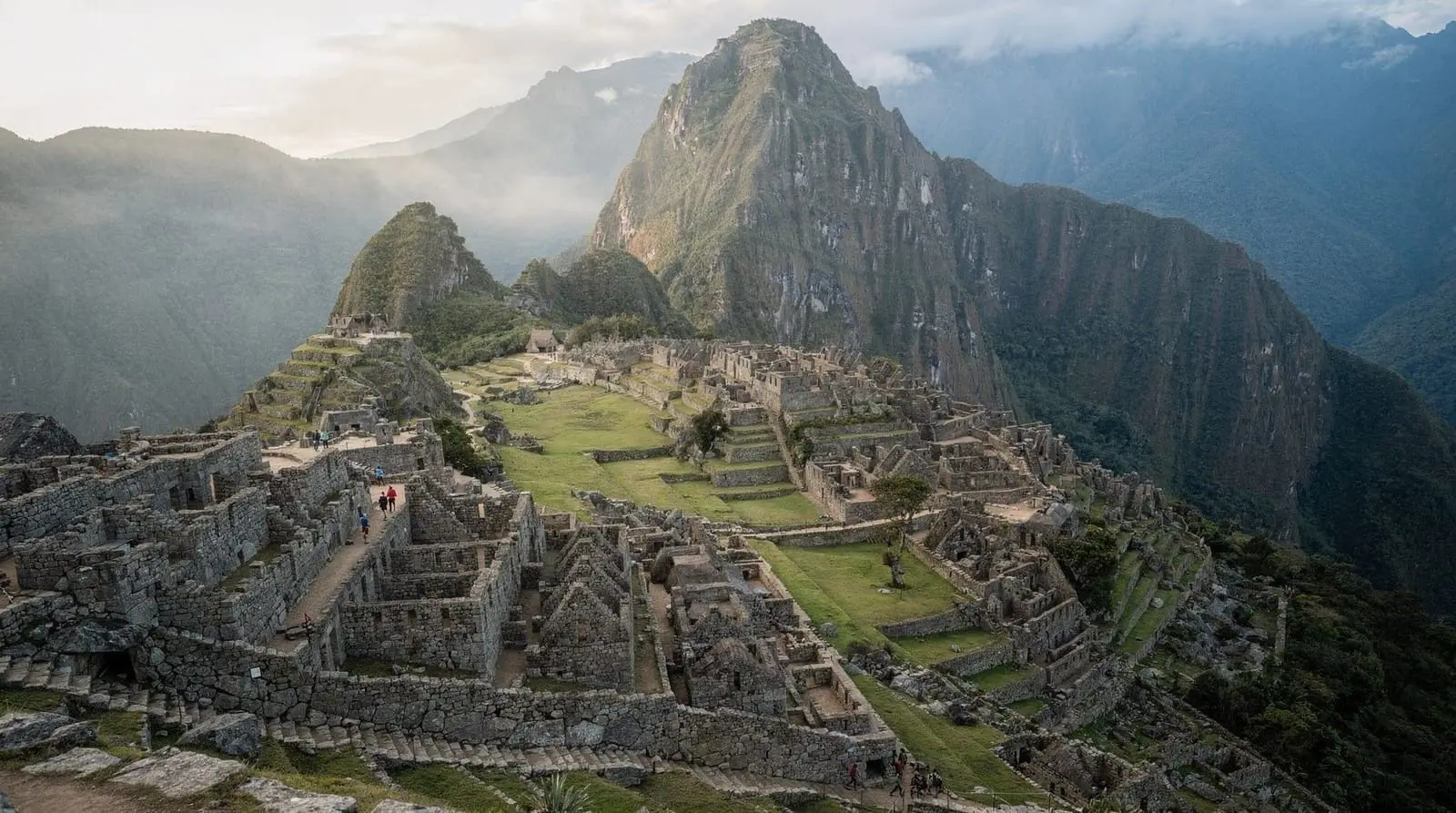
Machu Picchu
Honest Machu Picchu planning: 2024+ circuit ticket system, time slots, PeruRail vs IncaRail trains, the Consettur bus, and how to avoid ticket scams.
Cusco: Machu Picchu + Tourist Train + Entrance Ticket
Quick facts
- Altitude
- 2,430 m / 7,970 ft (lower than Cusco)
- Entry system
- Timed tickets by numbered circuit, sold by the Ministry of Culture
- Daily quota
- ~4,500 visitors (higher caps in peak season)
- Best for
- Inca archaeology, mountain scenery, bucket-list history
Why Machu Picchu needs more planning than any other site in Peru
Machu Picchu is the one place in Peru you genuinely cannot improvise. There is no walk-up gate where you buy a ticket and wander in. Entry is controlled by the Peruvian Ministry of Culture through a system of numbered circuits, fixed entry time slots, and a daily visitor quota. The town at the foot of the mountain, Aguas Calientes, is reachable only by train or on foot — there is no road in. And the only way up the final 400 metres of switchbacks is either a 25-minute shuttle bus or a steep 90-minute climb on foot.
None of this is difficult once you understand it, but every part of it sells out. In high season (June to August), the most popular circuit and the Huayna Picchu add-on can be gone two to three months ahead. Trains on the best afternoon return slots fill up. The bus queue at 5:30 am can run 45 minutes long. This page walks through the whole chain in the order you actually have to book it, so you can assemble a working plan rather than discover the bottlenecks on arrival.
The short version: book your entry ticket first, then your train, then your bus, then your accommodation — in that priority. If you are short on time and want the logistics handled, a packaged Machu Picchu day trip with the tourist train and entrance ticket bundles the train, the bus, and the timed entry into one booking, which removes most of the failure points described below.
| Where | Machu Picchu district, reached via Aguas Calientes |
| Cost | S/152 entry (~$41) + $130–220 train round trip + ~$24 bus |
| Time needed | 1 full day on site; 2 days door-to-door from Cusco |
| Getting there | Road to Ollantaytambo, then train (no road access) |
| Best time | May–September (dry, clearer, busiest); April/October for fewer crowds |
The circuit ticket system, explained
Since 2024 the Ministry of Culture has sold entry under three main circuits, each split into sub-routes. You buy a ticket for one specific circuit and one specific entry time, and you must enter within your slot. You cannot switch circuits inside the site, and you cannot re-enter once you leave.
Circuit 1 (Panoramic / Upper routes) — the high routes along the upper terraces. Sub-route 1-C is the one that reaches the classic postcard viewpoint and the Guardian’s House (Casa del Guardián), where the iconic photo of the citadel with Huayna Picchu behind it is taken. If your priority is that single famous image, you want Circuit 1.
Circuit 2 (Classic / Designed routes) — the most complete walk through the citadel itself. It descends into the urban sector, passing the Temple of the Sun, the Sacred Plaza, the Intihuatana stone, and the Temple of the Condor. This is the circuit most first-timers should pick: it covers the highest number of named structures and still gives a decent overview shot. It is also the one that sells out first.
Circuit 3 (Royal / Lower routes) — the lower routes through the agricultural and urban sectors, generally less crowded. Sub-routes here pair with the two mountain hikes: Circuit 3 is the gateway for the Huayna Picchu climb and for Machu Picchu Mountain. A standalone Machu Picchu Circuit 3 entry ticket is the option to book if you want the quieter lower route or you are planning a mountain add-on.
Prices (2026, foreign adult): the standard citadel ticket is S/152 / about $41. Circuit 3 with Huayna Picchu or with Machu Picchu Mountain costs S/200 / about $54. Peruvian nationals and CAN-community citizens pay roughly half; students with a valid ISIC card get a discount. Children under three are free.
A guide is technically mandatory for first entry, though enforcement varies by gate and season. In practice many people enter with a group; if you want the archaeology explained properly, the Machu Picchu entry with an exclusive guided experience pairs your timed ticket with a licensed guide who walks the circuit with you, which is worth it given how little signage exists on site.
Booking your ticket: where, when, and the scams to avoid
The only official seller is the Ministry of Culture’s portal (tuboleto.cultura.pe). Tickets are released in a rolling window and the popular slots disappear fast. Book as early as you can commit to a date — for June through August, two to three months ahead for Circuit 2 and any mountain add-on.
The scam to know about: street agencies and unofficial websites in Cusco and Aguas Calientes resell entry tickets at a markup, sometimes for slots that do not exist or are already used. There are also fake “official” sites that mirror the government portal. If you book independently, only use the cultura.pe domain or a reputable platform that issues a real Ministry ticket. If a price looks suspiciously cheap or an agent on the street offers a “last available” ticket for cash, walk away. The genuine ticket carries your name and passport number and is checked against ID at the gate — a mismatched name will be refused entry.
Bring the exact passport you booked under. The name and document number on your ticket must match your passport at the entrance, with no exceptions made for typos.
Getting there: the train from Ollantaytambo and Cusco
There is no road to Aguas Calientes. The standard route is by rail, and the railway has two operators: PeruRail and IncaRail. Both run the same gauge line down the Urubamba canyon to Aguas Calientes station, which sits in the middle of the village.
Where to board. Most travellers board at Ollantaytambo in the Sacred Valley rather than Cusco. The Ollantaytambo–Aguas Calientes leg is about 1 hour 40 minutes and is the cheapest, most frequent stretch. The full Cusco (Poroy/San Pedro) departures are far fewer, longer, and pricier, and Poroy service is often suspended — so the realistic plan is to get yourself by road to Ollantaytambo (about 2 hours from Cusco, or a stop on any Sacred Valley day) and pick up the train there.
Train classes and prices (round trip, Ollantaytambo, 2026):
- PeruRail Expedition / IncaRail The Voyager — the standard tourist class with panoramic side windows. Roughly $130–170 round trip.
- PeruRail Vistadome / IncaRail 360 — larger glass-roof panoramic carriages, snacks, and on the return a small dance and fashion show. Around $160–220 round trip.
- Premium services (Hiram Bingham, IncaRail First Class) — fine dining and bar car, $500+ round trip.
Book the train as soon as your entry ticket is confirmed. Match your train arrival to your entry slot: arriving in Aguas Calientes around 90 minutes before your gate time leaves room for the bus queue. For the return, the early-afternoon trains (around 1–3 pm) are the first to sell out because they fit a same-day-back-to-Cusco plan.
If coordinating trains and tickets feels like too much, the two-day packages remove the guesswork. A 2-day Machu Picchu tour from Ollantaytambo handles the train, the overnight in Aguas Calientes, the bus, and the timed entry as a single booking — useful if you are based in the Sacred Valley. From Cusco itself, the Sacred Valley and Machu Picchu 2-day train tour folds the citadel into a Sacred Valley loop.
The Consettur bus from Aguas Calientes to the gate
From Aguas Calientes, the citadel gate is a 25-minute ride up a zigzag dirt road. The shuttle is run by a single concessionaire, Consettur, and there is no other vehicle option.
Fare (2026, foreign adult): about $24 round trip, or $12.50 one way, paid in soles or USD at the booth on Avenida Hermanos Ayar near the river. You can buy bus tickets in advance through the Consettur site or in Cusco, which is sensible in peak season.
The queue. Buses start at 5:30 am for the first entry slots and run continuously. The first-light queue forms before dawn along the riverside road — in June and July it can be 30–45 minutes long. If your entry slot is mid-morning, queue earlier than you think: the gate enforces your slot, not your bus departure, so build in buffer. Walking up instead takes 80–100 minutes of steep stone steps and is only worth it if you are well acclimatised and want to save the fare.
When to go: dry season vs wet season
Machu Picchu sits at 2,430 m in a cloud-forest transition zone, lower and more humid than Cusco. The weather splits sharply by season.
Dry season (May to September) brings the clearest mornings and the reliable postcard views, but also the biggest crowds and the highest prices. June to August is peak: book everything months ahead. May and September are the sweet spot — mostly dry, slightly thinner crowds.
Wet season (November to March) means frequent cloud and afternoon rain. Mornings can still clear, and the ruins under drifting mist have their own atmosphere, but you are gambling on the view. The trade-off is real discounts and space. Note: the classic Inca Trail closes every February for maintenance, though the citadel and the train route stay open.
April and October are shoulder months — decent odds of clear mornings without full peak pricing.
Whatever the season, mornings are clearer than afternoons. An early entry slot gives you the best chance of an unobstructed citadel before cloud builds.
What to see on the mountain
The citadel rewards a slow walk. On Circuit 2 you pass the Temple of the Sun (a curved tower built over a sacred rock), the Intihuatana ritual stone, the Sacred Plaza, and the Temple of the Condor with its carved wings. Circuit 1’s upper route delivers the framed terrace view from near the Guardian’s House.
For those who want to climb, two peaks rise above the site. Huayna Picchu is the steep pinnacle behind the citadel in every photo — a strenuous, exposed 45–75 minute climb requiring a separate permit. Machu Picchu Mountain (Montaña) is the taller, less vertiginous summit opposite, a 1.5–2 hour ascent with a wider trail. Both need a combined ticket booked alongside Circuit 3.
Where to base yourself
Most visitors sleep one night in Aguas Calientes, the only town with the train station and the bus stop. It is unlovely and overpriced for what it is, but staying there lets you catch the first buses and reach the citadel before the day-trip crowds arrive from Cusco. The alternative is a long single day: early train down, citadel, early-afternoon train back — doable but tiring, and you sacrifice the quiet early gate.
Spending the night before in Ollantaytambo is the other smart move: you are already at the train platform and well acclimatised at a lower altitude than Cusco. For a fuller route, see how the citadel fits into a Peru trip at /itineraries/ or browse planning resources at /guides/.
Practical information
Acclimatise first. Machu Picchu itself is lower than Cusco, but most people arrive having spent days at Cusco’s 3,400 m. Spend two to three nights in the Sacred Valley or Cusco before the climb so altitude does not blunt the experience.
Bag rules. Large backpacks are not allowed inside; there is a left-luggage office at the gate. Bring a small daypack with water, a rain layer, sun protection, and your passport. Drones, tripods, walking poles with metal tips (rubber tips are usually fine for those who need them), and selfie sticks are restricted.
Bathrooms and food. There are toilets only at the entrance, not inside the circuit — go before you enter. No food is sold inside; eat beforehand and bring a snack discreetly.
Tickets to keep handy. You will show your passport plus your entry ticket at the gate, your bus ticket at the Consettur booth, and your train ticket at the station. Screenshot all three in case of patchy signal.
Frequently asked questions about Machu Picchu
Do I need to book Machu Picchu tickets in advance?
Yes. There is no walk-up entry. Tickets are sold by the Ministry of Culture under a daily quota and by timed slot, and the popular Circuit 2 and any mountain add-on sell out weeks to months ahead in dry season (June–August). Book your entry ticket first, then your train, then your bus.
Which circuit should a first-time visitor choose?
Circuit 2 gives the most complete walk through the citadel itself, passing the Temple of the Sun, the Intihuatana, and the Temple of the Condor, and still offers a good overview shot. Choose Circuit 1 (sub-route 1-C) if your single priority is the classic postcard photo from the upper terraces. Circuit 3 is the gateway for the Huayna Picchu and Machu Picchu Mountain hikes.
How do I get from Cusco to Machu Picchu?
By road to Ollantaytambo (about 2 hours), then by train down the Urubamba canyon to Aguas Calientes (about 1 hour 40 minutes on PeruRail or IncaRail), then a 25-minute Consettur shuttle bus up to the gate. There is no road to Aguas Calientes — the final stretch is rail or foot only.
How much does it all cost?
Budget roughly: entry ticket S/152 / about $41 (S/200 with a mountain add-on); train $130–220 round trip from Ollantaytambo depending on class; Consettur bus about $24 round trip; plus a guide if you book one. A packaged day trip that bundles train, bus, and entry often works out simpler for similar money.
Can I visit Machu Picchu as a day trip from Cusco?
Yes, but it is a long day: early road transfer to Ollantaytambo, train down, citadel, early-afternoon train back, road to Cusco — roughly 16 hours door to door. Staying one night in Aguas Calientes lets you take the first morning buses and see the citadel before the day-trippers arrive, which most people find worth the extra night.
Is the weather better in the dry or wet season?
The dry season (May to September) gives the clearest mornings and reliable views but the biggest crowds and highest prices. The wet season (November to March) brings cloud and afternoon rain but real discounts and space. Mornings are clearer than afternoons year-round, so an early entry slot maximises your chance of an unobstructed citadel.
Do I really need a guide?
A guide is officially required for first entry, though enforcement varies. Beyond the rule, there is almost no signage inside, so a licensed guide adds a lot of context to what is otherwise a beautiful but unexplained set of stone walls. Booking a guided entry experience is the simplest way to satisfy the requirement and understand what you are looking at.
Top experiences
Bookable activities with verified prices and instant confirmation on GetYourGuide.
