Chiclayo
Discover the Lord of Sipán royal tomb, Túcume's pyramid field, Sicán culture, and the Pómac forest sanctuary near Chiclayo, northern Peru.
Chiclayo: Tomb of the Lord of Sipán & Site Museum Day Tour
Quick facts
- Country
- Peru
- Altitude
- 27 m (89 ft) — coastal desert plain
- Currency
- Peruvian sol (S/) — USD widely used
- Best for
- Royal Moche tombs, pyramid fields, Lambayeque culture
Where the Moche’s greatest ruler was buried
In 1987 a local archaeologist named Walter Alva followed reports of looting at a large platform mound near the town of Sipán, 35 km east of Chiclayo. What he found inside — once he and the Peruvian police had secured the site from tomb raiders — was the best-preserved royal burial in the Americas: a Moche lord interred around 300 CE with hundreds of kilograms of gold, silver, and copper ornaments, three sacrificed servants, a dog, and two llamas. The press called him the Lord of Sipán. The find was compared to Tutankhamun, and it prompted a decade of excavations that uncovered two earlier royal burials beneath the first.
The Chiclayo region is now Peru’s most rewarding destination for anyone interested in pre-Columbian civilisations outside the Inca orbit. Four entirely different cultures — Moche, Lambayeque/Sicán, and Chimú — left monumental sites within an hour of the city, and the museums built to house their finds are genuinely world-class. Yet Chiclayo receives only a fraction of the tourist traffic that flows through Cusco, which means you can stand in front of a golden death mask worth millions with no rope barrier and no other visitors in the room.
| Where | North coast of Peru, 770 km north of Lima |
| Time needed | 1 full day for the core circuit, 2 days for everything |
| Cost | Around S/80–150 (USD 21–40) per person for a guided full-day circuit |
| Getting there | 1h20 flight from Lima, or 3.5–4h bus from Trujillo |
| Best time | May–October (dry season, cooler coastal desert climate) |
Getting to Chiclayo
From Lima, LATAM and Sky Airline fly to Chiclayo’s Capitán FAP José Abelardo Quiñones Gonzales Airport (CIX) in around 1 hour 20 minutes. Advance fares start around S/150–280 (USD 40–75). From Trujillo the journey north is 3.5–4 hours by bus (Cruz del Sur, Oltursa; S/35–60). From Lima by overnight bus the trip takes 12–13 hours (S/90–160 for cama class).
The bus terminal is 3 km from the city centre; taxis cost S/10–15. The airport is 2 km east of centre; taxis S/15–20.
Chiclayo also serves as a gateway east to Cajamarca (5 hours by bus through the Andes) and north toward Máncora (3.5 hours).
The Lord of Sipán: Huaca Rajada and the Tumbas Reales museum
The story of Sipán splits across two sites that work best visited in sequence. Start at Huaca Rajada (the burial mound itself), 35 km east of Chiclayo near the town of Zaña. The platform is a monumental adobe structure typical of Moche construction — a raised ceremonial and administrative centre built over several generations. The active excavations are fenced and partially covered; a walking circuit and Spanish/English signage explain the stratigraphic sequence of tombs. Entrance costs S/10. A licensed guide at the site adds considerable context for around S/30.
Then return to Lambayeque (12 km north of Chiclayo) to spend at least an hour and a half at the Museo Tumbas Reales de Sipán, which opened in 2002 in a building deliberately designed to echo the pyramid mound of the burial itself.
The presentation is exceptional: the Lord of Sipán’s burial is displayed as a full-scale reconstruction, and the actual artefacts — a gold-and-turquoise backflap, a gold peanut necklace of extraordinary technical skill, beaded pectorals, ear ornaments, feather headdresses — are lit and arranged with the kind of care you would expect in a European national museum. This is the finest archaeological museum on Peru’s north coast, and it would hold its own against the best in South America. Admission is S/15 (roughly USD 4).
Photography of the reconstructed burial chamber is permitted without flash, but the small treasury room holding the original gold backflap and headdresses is more tightly controlled — expect a guard nearby and a “no photos” rule in that specific gallery. Go slowly through the final rooms: the museum’s chronological layout means the best pieces come last, and rushed visitors often miss the peanut necklace, widely considered the single finest piece of Moche goldsmithing ever recovered.
For deeper background on the culture that built all of this, the Moche and Chimú civilisations guide explains how Sipán fits the wider chronology, and the dedicated Lord of Sipán guide walks through the tomb’s discovery in more detail than fits here.
Chiclayo: Tomb of the Lord of Sipán & Site Museum Day TourTúcume: the Valley of the Pyramids
Twenty-five kilometres north of Chiclayo, the desert floor becomes a field of 26 large adobe mounds rising up to 30 m from the flat ground. This is Túcume, a centre built by the Lambayeque culture around 1000 CE and later absorbed by the Chimú and then the Inca. The site covers over 200 hectares and took centuries to accumulate — the pyramid complex of Huaca Larga is one of the largest adobe structures in South America, stretching 700 m in length.
Unlike Chan Chan, Túcume is largely unrestored and requires imagination as much as eyes. The site museum, designed with input from the late Thor Heyerdahl (who excavated here in the 1990s), contains wooden carved reliefs, metalwork, and contextual panels that help decode what you are looking at. The best view is from the Mirador Natural, a rock outcrop above the site where you can see all 26 mounds spread across the desert in a single panorama.
Entrance costs S/10. Guided tours in English are available from Chiclayo for around S/80–120 (USD 21–32) per person including transport.
Túcume rewards visitors who read the interpretive panels before climbing to the Mirador Natural rather than after — knowing which mound is Huaca Larga, which is the ceremonial platform, and which is the later Inca administrative addition makes the panorama from the lookout considerably more legible. Bring water and a hat; there is little shade on the walking circuit and the desert sun is intense even in the cooler months.
Pómac Forest Sanctuary and the Sicán culture
Sixteen kilometres south of Chiclayo, the Bosque de Pómac is the last remnant of the algarrobo (carob tree) forest that once covered the entire Lambayeque valley floor. Within it sits the Santuario Histórico Bosque de Pómac, a protected area containing over 30 Sicán culture mounds dating from around 900–1100 CE. The Sicán were a post-Moche civilisation famous for their large-scale production of tumbaga (gold-copper alloy) objects, distributed by trade routes across much of western South America.
The landscape here is unlike anything at Trujillo’s ruins: instead of open desert you walk through living woodland, with pyramid shapes emerging through the grey-green canopy of dry-forest trees. The dry season (May–October) brings migrant birds and the forest is excellent for birdwatching — over 50 species have been recorded including the Peruvian thick-knee and the endemic Peruvian plantcutter. The sanctuary is also home to some of the oldest algarrobo trees in Peru, estimated at over 500 years.
The complementary Museo Nacional de las Culturas Antiguas (Sicán Museum) in Ferreñafe, 18 km northeast of Chiclayo, houses the standout finds from the Sicán tombs — including an inverted royal burial (the Sicán buried their elite lords upside-down, facing east) with golden gloves, masks, and ceremonial knives. Admission is S/10.
Chiclayo: Pómac Forest Sanctuary & Sicán MuseumPlanning a full-day archaeology circuit
The challenge in Chiclayo is distance: Huaca Rajada is 35 km east, Túcume is 25 km north, and Pómac is 16 km south. No public bus connects all three, and colectivos to individual sites exist but are time-consuming. The practical options are an organised full-day tour (S/80–150 / USD 21–40) that covers a curated selection of two or three sites with a guide and transport, or hiring a private taxi for the day (S/150–200 / USD 40–54) and visiting independently with your own research.
Most full-day itineraries combine the Tumbas Reales museum with either Huaca Rajada or Túcume plus Pómac — doing all four in a single day is possible but rushed. If you have two days, split as follows: Day 1 — Sipán (Huaca Rajada + Tumbas Reales museum), Day 2 — Túcume and Pómac with the Sicán museum. The northern Peru route guide describes how to combine Chiclayo with Trujillo over three to four days.
| Site | Culture & period | Distance from Chiclayo | Time needed |
|---|---|---|---|
| Tumbas Reales museum (Lambayeque) | Moche, c. 300 CE | 12 km north | 1.5+ hours |
| Huaca Rajada (Sipán) | Moche, c. 300 CE | 35 km east | 1–1.5 hours |
| Túcume | Lambayeque/Chimú, c. 1000 CE+ | 25 km north | 1.5–2 hours |
| Pómac + Sicán museum | Sicán, c. 900–1100 CE | 16 km south / 18 km northeast | 2–3 hours combined |
If archaeology fatigue is a risk, prioritise Tumbas Reales above all else — it alone justifies the trip to Chiclayo even if you skip every physical site. Travellers continuing to Trujillo afterwards will see Chan Chan’s Chimú architecture as a useful contrast to the earlier Moche and Sicán work seen here; the Chan Chan guide explains how that later empire absorbed the Lambayeque lands you have just visited.
Chiclayo: Túcume Pyramids and Pómac ForestChiclayo city: food, markets, and the Mercado Modelo
Chiclayo is a working commercial city with little colonial architecture — a 1983 earthquake did considerable damage, and much of the centre was rebuilt in undistinguished concrete. The Plaza de Armas is pleasant without being exceptional. What Chiclayo does exceptionally well is food.
The north-coast kitchen is distinct from both Lima’s ceviche culture and the Andean stew traditions of Cusco. Chiclayo’s signature dishes include arroz con leche negro (rice cooked in black molasses), cabrito a la norteña (kid goat in a chicha de jora and ají panca sauce), and king kong, a layered caramel and biscuit confection sold in boxes as a take-home gift across the north coast.
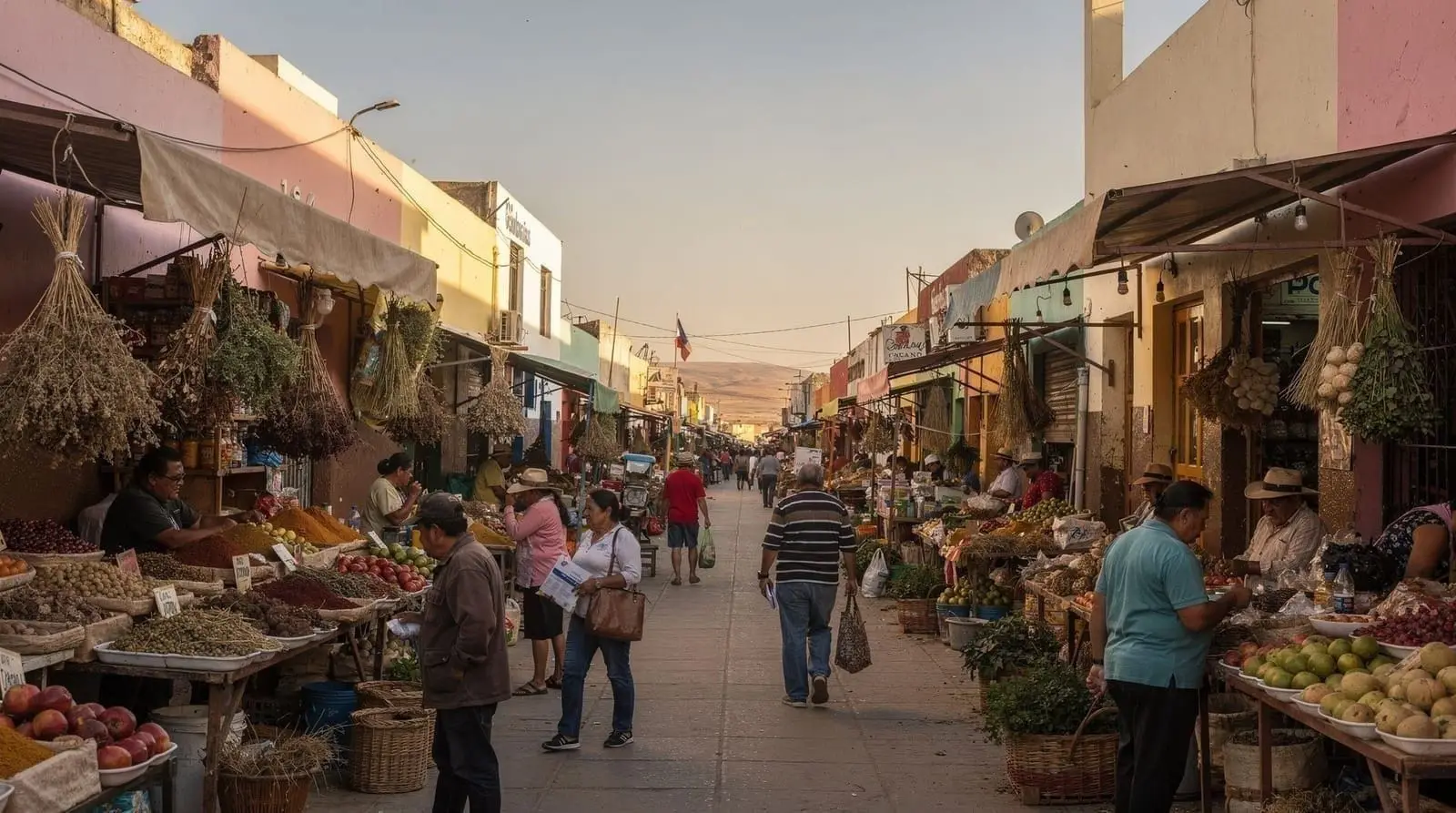
The Mercado Modelo, a 15-minute walk from the plaza, is one of the best traditional markets in northern Peru — stalls sell dried herbs, powders, and healing objects alongside the usual produce. The curanderismo section, where traditional healers sell their San Pedro cactus preparations and dried llama foetuses, is an experience you will not find in Lima’s shopping districts.
Budget S/15–25 for lunch at a local restaurant, S/35–60 at the better tourist-facing spots around the plaza.
Day trips and connections
Beyond the main circuit, Chiclayo sits at the centre of a broader regional network worth knowing if your schedule extends. The town of Zaña (50 km south) is a colonial ghost town partially buried under sand — a reminder of the catastrophic 1720 flood that destroyed one of Peru’s wealthiest port cities. The ruins of its five churches and convents make for an atmospheric half-day trip.
Northward, the road to Máncora passes through Piura, a large regional capital with little to offer tourists beyond logistics. If you are combining Chiclayo with a beach stay, Máncora is a 3.5-hour direct bus north of Chiclayo, or a 4.5-hour journey combining bus to Piura with a shared taxi north.
Eastward, Cajamarca is five hours up a mountain road through dramatic switchbacks as the coast desert gives way to Andean páramo. Cajamarca is where Atahualpa was captured by Pizarro in 1532 — the Room of the Ransom where Atahualpa filled a chamber with gold is preserved in the city.
Practical information
Where to stay: The city centre has a reasonable spread of mid-range hotels (S/80–160 / USD 21–43). Casa Andina and Costa del Sol have established properties near the plaza. Budget hostels exist from S/40 per night. Staying in central Chiclayo is more practical than Lambayeque for archaeology day trips.
Getting around: Within the city, mototaxis cost S/3–6 per short trip. Taxis are S/10–20. For site visits, either join an organised tour or hire a taxi by the day. Colectivos to individual towns run from Terminal Epsel and are cheap (S/3–5) but slower.
Food: The Mercado Modelo has fresh fish stalls operating from 6am–noon. Restaurants El Huaralino and El Rincón del Pato are local institutions for cabrito and ceviche. Budget restaurants near the market serve lunch menús for S/10–15.
Connectivity: Chiclayo is a practical base for a wider northern loop. Combine it with Cajamarca for highland history, or continue to Trujillo to complete a Moche-Chimú archaeology triangle that few Cusco-focused itineraries ever attempt — and that is precisely why the sites feel uncrowded.
Frequently asked questions about Chiclayo
Is the Lord of Sipán tomb worth visiting, and which museum should I prioritise?
The Tumbas Reales de Sipán museum in Lambayeque is the essential stop. It is one of the finest archaeological museums in South America — budget at least 90 minutes. Huaca Rajada itself adds physical context to the burial setting and is worth the extra hour if you have time. Together they make a half-day that will reframe your understanding of pre-Columbian civilisations.
How does Chiclayo compare to Trujillo for north-coast archaeology?
They are complementary rather than competing. Trujillo focuses on the Moche (Huacas del Sol y Luna) and Chimú (Chan Chan), while Chiclayo’s circuit spans the later Lambayeque/Sicán culture at Túcume and Pómac, with Sipán representing an earlier Moche elite tradition. If you care about pre-Columbian Peru, seeing both cities is far more rewarding than choosing one.
Do I need a car or can I use public transport?
Public transport covers each town individually (colectivos to Lambayeque, Sipán area, Ferreñafe) but connecting multiple sites in a day requires either an organised tour or a hired private taxi. For a single-destination day (e.g., Tumbas Reales only) colectivos work fine. For the full circuit, paying for a tour or day-hire taxi is the practical choice.
What is the Sicán Museum in Ferreñafe?
The Museo Nacional de las Culturas Antiguas (Sicán Museum) documents the Lambayeque/Sicán culture (900–1350 CE) with original artefacts from the Pómac royal tombs. The highlight is a reconstruction of an inverted royal burial, complete with the original gold funerary mask and ceremonial objects. Admission is S/10. It pairs naturally with the Pómac Forest Sanctuary, 16 km to the west.
How long does the Túcume site take to visit?
Allow 1.5–2 hours including the on-site museum. The walking circuit through the main mounds plus a climb to the Mirador Natural viewpoint takes about 45 minutes at a comfortable pace. The museum adds 30–40 minutes. It is best visited in the morning before the desert heat peaks.
What is the food like in Chiclayo?
Better than most north-coast cities. Chiclayo’s culinary reputation centres on cabrito (goat) dishes, arroz negro, chupe de mariscos, and the famous king kong caramel biscuit. The Mercado Modelo is excellent for breakfast and early lunch. For a full restaurant meal, expect to pay S/25–50 per person including a drink at a mid-range establishment.
Is Chiclayo safe for tourists?
The city centre and tourist zone are generally safe during the day. Standard precautions apply: keep valuables out of sight, use hotel-recommended taxis rather than hailing at random, and avoid poorly lit side streets at night. The archaeological sites outside the city are supervised and trouble-free in daylight hours.
Top experiences
Bookable activities with verified prices and instant confirmation on GetYourGuide.

