Cusco tourist traps: what to skip, overpay-proof your trip
Cusco: Half-Day City Tour with Sacsayhuaman and Q’enco
What are the main tourist traps in Cusco?
The big ones are balcony restaurants on the Plaza de Armas charging double for the view, 'free' chocolate and pisco workshops that become hard-sell shops, photo-llama women who demand payment after you've shot, unlicensed street agencies selling cheap tours that change on the day, and taxis quoting inflated fares. None are dangerous — they just cost you money.
The trouble with Cusco’s tourist heart
Cusco is not a dangerous city for visitors, and it is not even an expensive one by the standards of a global destination. But its compact historic core funnels almost every traveller through the same few blocks around the Plaza de Armas, and a small economy has grown up there that is engineered to separate first-timers from a little more money than they intended to spend. Almost none of it is criminal. Most of it is soft — a markup here, a pushy seller there, a tour that quietly delivers less than promised.
The frustrating part is that these traps are entirely avoidable once you can recognise them, and the fix is usually a single block of walking or one upfront question. This guide names the specific traps by location and mechanism, tells you what they actually cost, and gives the concrete dodge for each. The aim is not paranoia — Cusco rewards relaxed wandering — but to spend your soles on the parts of the city that deserve them.
| Biggest trap | Balcony restaurants on Plaza de Armas (roughly 2× price) |
| Most common scam | Inflated taxi fares — no meters, agree first |
| Watch for | ”Free” workshops, street agency tours, DCC at ATMs |
| Real risk level | Low — mostly soft overcharging, not danger |
| Best defence | Walk one block off the plaza, book licensed agencies |
The balcony-restaurant markup
The most universal trap is also the gentlest: the restaurants with balconies overlooking the Plaza de Armas. The arcaded second-floor terraces are genuinely lovely, and the view of the floodlit cathedral at dusk is one of Cusco’s pleasures. But the food served up there is tourist-grade, the portions are modest, and the prices run roughly double what you would pay a block away — a plate that is S/25 elsewhere becomes S/45–55 with a plaza view attached.
The dodge: treat the balcony as a place for a single drink at sunset, not a meal. Order one pisco sour or a coffee, enjoy the view, and eat properly elsewhere. Walk one or two blocks in almost any direction — toward San Blas, down Calle Plateros, or along the streets behind the cathedral — and both quality and value improve sharply. The set lunch menú (soup, main, drink) in everyday restaurants off the square runs S/10–18 for food that is fresher and more local than anything on the balconies.
The “free” chocolate and pisco workshops
Around the plaza, touts hand out flyers for “free” chocolate-making or pisco-tasting workshops. The word “free” is doing a lot of work. These typically lead you into a short demonstration that functions as the warm-up to a hard-sell shopping stop, where the social pressure to buy overpriced chocolate or bottles is the whole point.
The dodge: treat any unsolicited “free” offer on the street as a sales hook. If you genuinely want a chocolate-making class, the ChocoMuseo on Calle Garcilaso is a legitimate, transparent operation that charges openly for real, well-run classes — you know exactly what you are paying and getting. The distinction is reliable: legitimate experiences advertise a clear price; street “freebies” hide one.
The photo-llama ladies
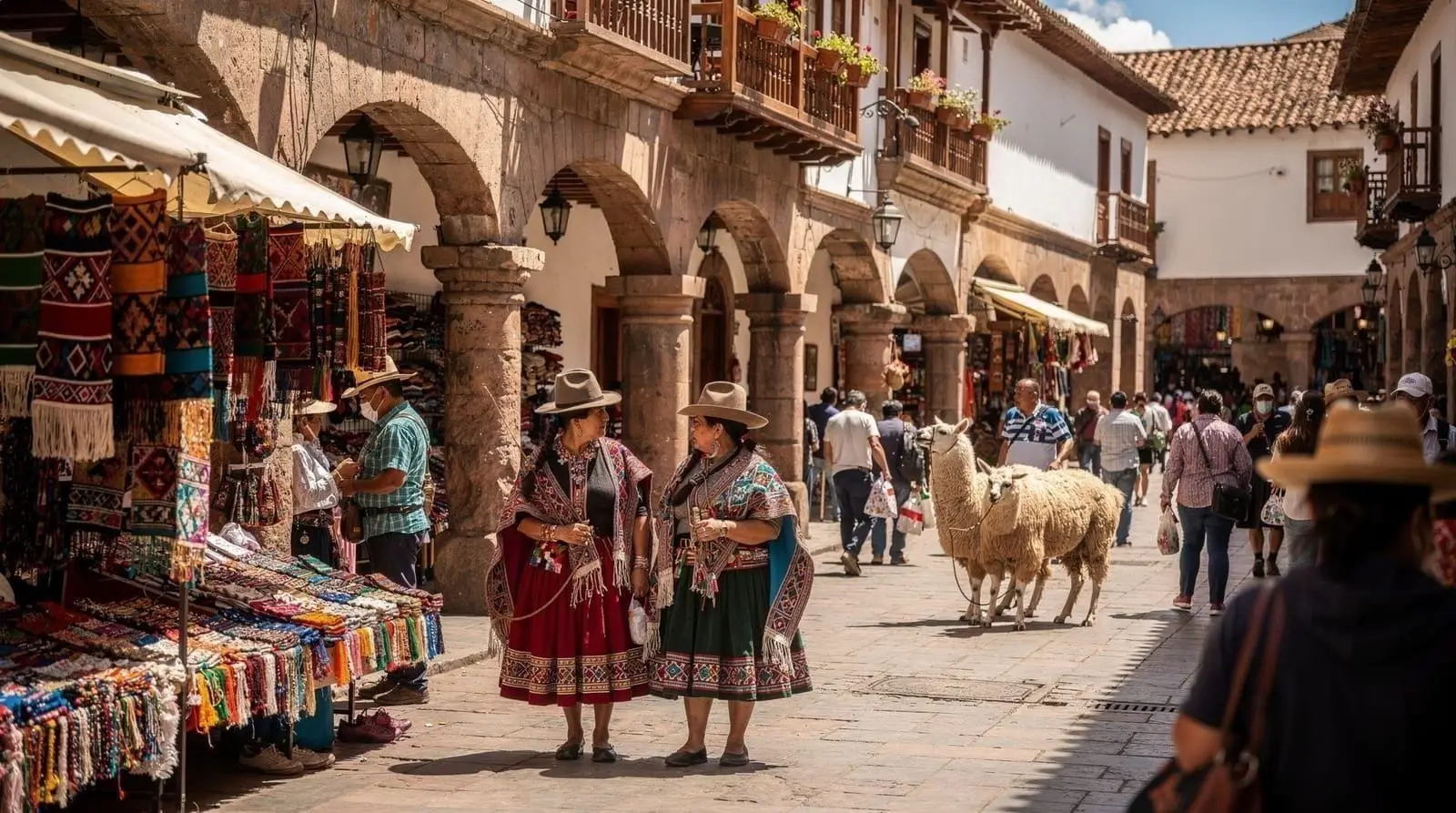
You will see them around the Plaza de Armas, the cathedral steps, and in San Blas: women in beautifully embroidered traditional dress holding baby llamas and alpacas, sometimes leading a full-grown one. They are part of the city’s texture and many of the photos are charming. They are also a business.
The trap is the ambush version: you raise your camera to shoot a “candid” street scene, and a woman who is in frame — or who steps into frame — then firmly requests payment, often following you for a block if you try to walk off. The going rate is a few soles per photo (S/2–5), which is entirely fair for a posed portrait; the problem is the surprise.
The dodge: decide in advance. If you want the photo, smile, ask, agree the tip first (“¿una foto? ¿cuánto?”), pay, and everyone is happy. If you do not want to pay, simply do not photograph them — and be aware that pointing your lens anywhere near them counts. There is no scam here, only a transaction that works far better when it is explicit.
Street agencies and too-cheap tours
The streets around the plaza — especially Calle Plateros and Procuradores — are lined with tour agencies, and touts work the pavement offering Rainbow Mountain, Sacred Valley, and Machu Picchu trips at prices that undercut everyone. Some are fine. Many are resellers who pool your booking into the cheapest available group, and a few quietly change the itinerary, merge you into an oversized bus, or cut promised inclusions (lunch, entrance fees, a real guide) on the day.
The classic version is the Rainbow Mountain bargain: a price so low it cannot cover a quality operator, ending in a 3 a.m. pickup, a packed bus, a rushed hike at 5,000 m with a guide managing forty people, and “extras” you did not expect to pay.
The dodge:
- Book with agencies that have a physical office, a real website, and recent independent reviews, not a clipboard on the street.
- Get the inclusions in writing: transport type, group size, whether lunch and entrance fees are included, pickup time, guide language.
- Be suspicious of prices well below the market — for popular day trips there is a floor below which corners are being cut.
- For the Sacred Valley and other anchor outings, the Sacred Valley and Cusco destination pages point to reputable operators rather than street resellers.
Taxi and airport fare inflation
Cusco has no widespread metered taxis, so fares are negotiated, and tourists are routinely quoted high. From the airport (CUZ) to the Plaza de Armas, drivers inside the terminal may quote S/40–60 for a ride worth S/20–30. In town, a short hop should be S/8–12 and a ride up to the ruins around S/15.
The dodge: agree the fare before getting in, every time. Use ride apps like InDriver, Cabify, or Uber, which fix the price and remove the haggling entirely — they operate well in Cusco. At the airport, walk just outside the terminal where fares drop, or pre-book a transfer through your hotel. Avoid unmarked cars late at night.
The dynamic-currency-conversion skim
When you pay by card or withdraw from an ATM, the machine or terminal often asks whether you want to be charged in your home currency or in soles. Choosing your home currency triggers “dynamic currency conversion” at a deliberately poor exchange rate — a quiet skim of several percent.
The dodge: always choose to be charged in soles (PEN). Let your own bank do the conversion at the proper rate. The same logic applies to paying tour operators in US dollars: many quote a sol-to-dollar rate around 3.55 when the real rate is closer to 3.70, so paying in dollars loses you money. Pay in soles.
The fake “Inca” massage and shop pressure
Two smaller ones worth flagging. Massage touts, mostly young women, work the plaza handing out cards for cheap massages; the legitimate spas are fine, but the street-recruited ones range from mediocre to a pressure environment, and a handful are fronts for upselling. And in the San Blas and souvenir districts, “alpaca” goods are frequently acrylic or a wool blend sold at alpaca prices — genuine baby alpaca is soft, warm, and does not squeak when rubbed, and costs accordingly.
The dodge: book a massage from your hotel’s recommendation rather than a street card, and buy textiles from cooperatives or established shops where the fibre is labelled, not from plaza stalls insisting everything is “100% baby alpaca.”
The “exclusive” Inca-site and museum upsells
A subtler trap operates around the sights themselves. At the entrances to popular sites and around the plaza, freelance “guides” offer their services, and the experience ranges from genuinely knowledgeable licensed guides to people who memorised a few dates and will deliver a thin, hurried tour for a tourist price. There is also a recurring pitch for “special access” or “exclusive” experiences at sites that are, in fact, covered by your ordinary ticket.
The dodge: licensed guides carry official accreditation and you can ask to see it. Agree the scope, language, and price before starting, and be clear whether the fee is per person or per group. If you want reliable context, a pre-booked guided tour through an established operator removes the gamble entirely — you know the guide is licensed and the price is fixed. Be sceptical of any “exclusive access” claim at a standard boleto site; almost everything at those sites is open to every ticket-holder. The Cusco tourist ticket guide explains exactly what your boleto covers, so you can recognise an upsell for what it is.
The ATM and money-changing pitfalls
Beyond the dynamic-currency-conversion skim covered above, two more money traps catch the unwary:
- Casas de cambio with bad rates near the plaza. The most touristy exchange windows post rates that look fine until you read the fine print or notice the spread. The established casas de cambio on Avenida El Sol generally offer fairer rates than the ones a step off the square aiming at fresh arrivals.
- Street money changers offering to swap dollars for soles “at a great rate.” Some are legitimate; some short-change you with sleight of hand or hand over worn or counterfeit notes. Use a bank ATM (BCP, Interbank, Scotiabank) or a reputable casa de cambio instead, and count your notes before walking away.
The dodge: withdraw soles from a bank ATM, always choose to be charged in soles, change money only at established casas de cambio, and check the rate against a currency app on your phone before committing. Keep a stash of small notes — markets, taxis, and ticket booths rarely break large bills cheerfully.
What is genuinely worth your money
This guide is not an argument that Cusco is a rip-off — it is the opposite. The point of dodging the traps is to free up your soles for the things that are honestly excellent value:
- The set lunch menú off the plaza, one of the best cheap meals in South America.
- San Pedro market juice stalls and soup counters.
- A licensed guided tour of the city or Sacred Valley booked through a real agency — context transforms the stones.
- The boleto turístico itself, which is fairly priced for what it covers (see the Cusco tourist ticket guide).
- A proper cooking class or market tour with a reputable operator.
For weaving the city’s sights into a sensible schedule that avoids the trap-heavy zones at the wrong times, see the Cusco trip planning 2026 guide, and for the broader safety picture across Peru, the Peru travel safety 2026 guide.
Machu Picchu-specific traps to know before you leave Cusco
A separate cluster of traps waits at the far end of the trip, near Aguas Calientes and the Machu Picchu ticket system, and it’s worth flagging here since most travellers plan this leg from Cusco. “Skip the line” or “exclusive access” resellers near ticket offices typically just resell the same standard entry at a markup — buy through the official portal or a reputable, established agency instead.
Unofficial “guides” at the Machu Picchu entrance offer their services at inflated prices with variable quality; a pre-booked guide through a licensed operator removes the gamble. Overpriced Aguas Calientes restaurants near the train station charge a captive-market premium similar to the Cusco plaza balconies — walk a block uphill and prices ease. None of these are dangerous, but they follow the same pattern as the Cusco-based traps: soft overcharging aimed at first-timers who haven’t done this leg before.
A quick mental checklist before any purchase in Cusco
The traps above share a common shape, and once you see the pattern you can apply it anywhere in the city, not just to the specific examples listed. Before paying for anything unplanned — a tour, a taxi, a “free” experience, a currency exchange — ask three questions: Is the price agreed before the service starts? (Taxis, tours, photo tips — always fix it first.) Is this operator licensed, reviewed, and transparent about inclusions? (Physical office, real reviews, written inclusions beat a street pitch every time.) Am I being charged in soles? (Dollars and dynamic currency conversion both cost you a hidden markup.) A “yes” to all three means you’re almost certainly fine; a “no” to any of them is the moment to pause and walk away.