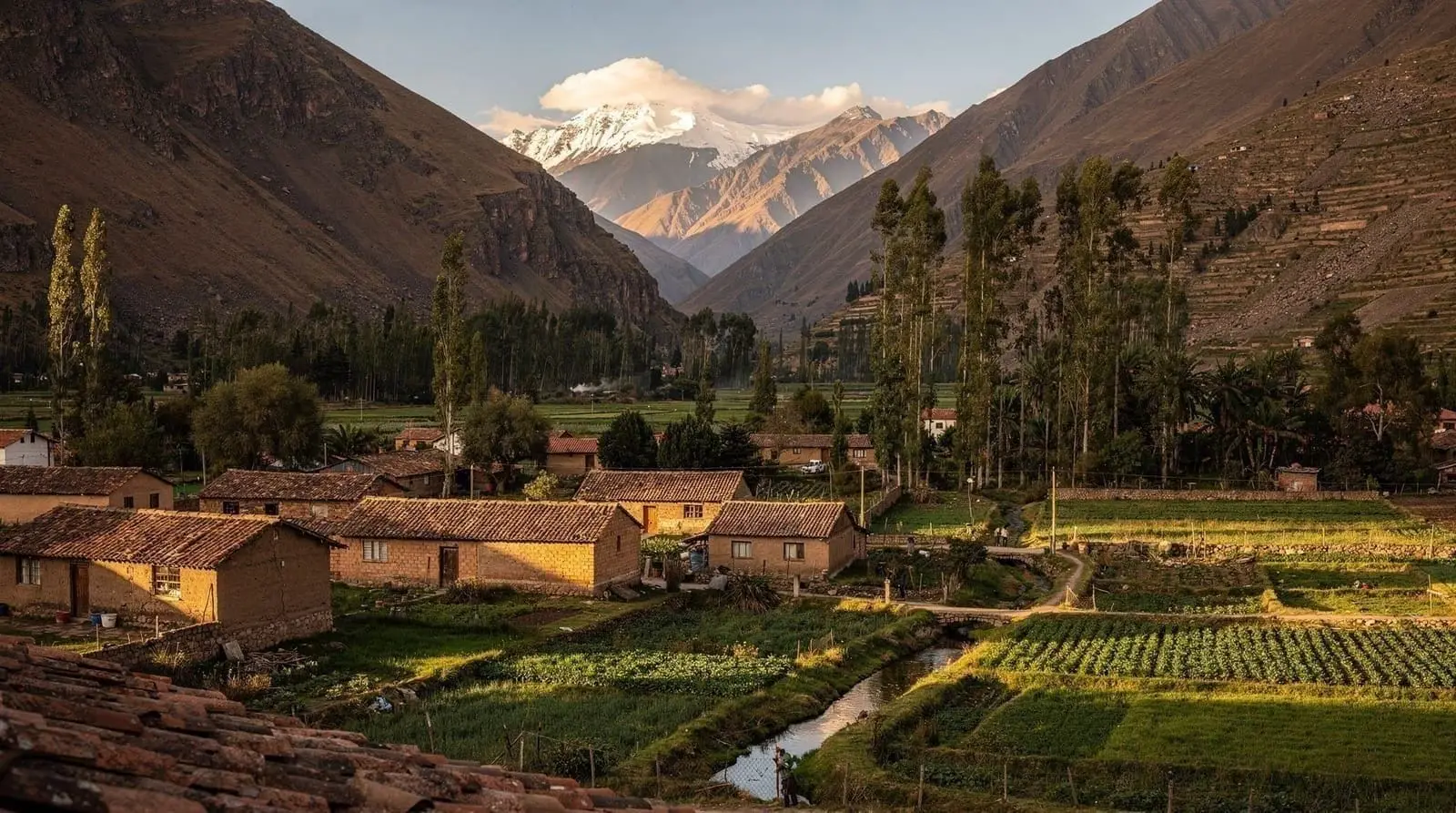
Urubamba
Urubamba honestly: the Sacred Valley's practical hub for sleeping low, services and transport — what's here, what isn't, and why base here.
From Cusco: Sacred Valley of the Incas Full-Day Tour
Quick facts
- Region
- Sacred Valley, Cusco Department
- Altitude
- 2,871 m / 9,420 ft (well below Cusco)
- Role
- Valley transport hub and main service town
- Boleto
- No boleto site here — it is your base, not a sight
- Best for
- Acclimatising, central base for valley sites, services, food
The valley’s practical heart, not its postcard
Let’s be honest up front: Urubamba is not a sightseeing destination. It has no headline Inca ruin, no famous market, no photo everyone has seen. What it has is something more useful for trip planning — it is the functional capital of the Sacred Valley, the largest town, the transport crossroads, and the place with the real services. If Pisac and Ollantaytambo are the sights, Urubamba is the base camp.
Sitting at 2,871 m (9,420 ft), it is also comfortably lower than Cusco at 3,400 m, which makes it one of the best places in the whole region to sleep while you acclimatise. Central to everything in the valley, low enough to rest well, and stocked with the pharmacies, ATMs and supermarkets that the smaller villages lack — that is the case for Urubamba.
| Where | Sacred Valley, ~1.5hrs from Cusco by road |
| Cost | No site fee — it’s a base, not a sight |
| Time needed | 1-2 nights as a valley base |
| Getting there | Colectivo (S/8-12) or taxi (S/80-120) from Cusco |
| Best time | Year-round base; May-September for drier valley days |
Why base here
The valley’s sites are scattered, and choosing where to sleep shapes your whole trip. Urubamba’s pitch:
It is central. From here, Pisac is about 30-40 minutes east, Ollantaytambo about 25-30 minutes west, and the Maras and Moray plateau and Chinchero are short hops away. Nothing in the valley is far. You can radiate out for day trips and come back to the same comfortable bed.
It has the services. This is the town with proper supermarkets (there is a Plaza Vea), a hospital and pharmacies, banks and ATMs, hardware and outdoor shops, and a real bus terminal. If you need to restock, see a doctor, or get cash before a remote stretch, Urubamba is where you do it.
It has the accommodation range. From backpacker hostels near the centre up to some of the valley’s finest hotels — Tambo del Inka (a Luxury Collection resort with its own train station for Machu Picchu), Sol y Luna, and Tierra Viva among them — plus a deep stock of mid-range guesthouses. More choice, and often better value, than the smaller villages.
It sleeps low. At under 2,900 m it is one of the gentlest places to spend your first Andean nights.
The acclimatisation case
If there is one strategic reason to put Urubamba on your itinerary, it is altitude. The standard mistake on a Peru trip is to fly into Cusco at 3,400 m and immediately try to sightsee, which is the most reliable way to bring on a pounding headache and a ruined first day.
The smarter sequence many experienced planners use: land at Cusco airport, transfer straight down to Urubamba (about 1.5 hours by road), and sleep low for your first two or three nights. Use that time for gentle valley sightseeing, plenty of water, and coca tea. Visit Machu Picchu (itself lower, around 2,430 m) from here via the Ollantaytambo train. Only then go up to Cusco, by which point your body has adjusted and the city is a pleasure rather than an ordeal.
Urubamba’s central position and low altitude make it the natural hub for exactly this plan.
What there is to do
While Urubamba itself is light on sights, it is the launchpad for everything in the valley, and a few things in and around town are worth knowing:
The Sunday market. Urubamba’s own market is a working local one rather than a tourist showpiece — good for produce, cheap eats, and a glimpse of valley life without the souvenir crush of Pisac.
Seminario Ceramics. The workshop-gallery of ceramicist Pablo Seminario, on the edge of town, is genuinely worth an hour — internationally collected work rooted in pre-Columbian techniques and motifs. Free to walk around.
A base for the big trips. Most valley tours can collect you in Urubamba or are easily joined from here. The full-day Sacred Valley tour covers the classic circuit, and the Pisac, Maras, Moray and Ollantaytambo small-group tour adds the plateau sites — both convenient from an Urubamba base.
Where to eat
This is where Urubamba quietly outshines the smaller villages. The valley’s standout restaurants cluster around here:
- Huayoccari / valley haciendas and farm-to-table spots make the most of the valley’s produce.
- El Huacatay is a long-running favourite for refined Andean-fusion cooking (mains S/45-70).
- Kampu and several mid-range places around the centre do solid Peruvian food for S/25-45.
- For the cheap option, the market and the eateries around it serve set lunches (almuerzo) for S/12-20.
- Higher-end hotel restaurants (Tambo del Inka, Sol y Luna) are open to non-guests for a splurge.
If you have been eating buffet tour lunches all day, Urubamba is the place to have one properly good dinner.
Reservations are worth making for the standout restaurants, especially El Huacatay, on weekend evenings when valley-based tour groups and weekenders from Cusco fill the small dining room. Most other mid-range places take walk-ins comfortably outside peak dinner hours (roughly 7-9 pm). If you are self-catering or want picnic supplies for a day trip to Maras or Pisac, the Plaza Vea supermarket is the most reliable stock-up point in the entire valley — smaller towns simply don’t have an equivalent.
Getting to and around Urubamba
Colectivo: Urubamba is the valley’s transport hub, so shared vans run frequently in every direction. From Cusco, vans via Chinchero take about 1.5 hours (S/8-12). From Urubamba, frequent short-hop colectivos serve Ollantaytambo, Pisac and Chinchero for a few soles each — this is exactly why basing here is convenient.
Taxi: A private taxi from Cusco is around S/80-120. Local taxis and mototaxis within the valley are cheap.
Bus terminal: Urubamba has a proper terminal, making onward connections straightforward.
Tambo del Inka station: Uniquely, the Tambo del Inka hotel has its own PeruRail station with a service toward Machu Picchu, handy if you are staying there.
Airport transfers: Most hotels and agencies offer a direct pickup from Cusco’s Alejandro Velasco Astete Airport straight to Urubamba, skipping a Cusco stopover entirely — the single most useful booking to make in advance if your acclimatisation plan depends on sleeping low from the first night.
A typical valley itinerary from an Urubamba base
To make the case concrete, here is how a three-night Urubamba stay tends to flow:
Arrival day: Transfer from Cusco airport straight down (about 1.5 hours). Do almost nothing — check in, drink water and coca tea, take a gentle stroll around the centre or the Seminario gallery, eat an early dinner, sleep. This is your body’s adjustment day, and the low altitude does the work for you.
Day two: A short, easy outing — Pisac ruins (take the road up, walk down) and the market in the morning, back to Urubamba for lunch and an afternoon at leisure. Still keeping the first full day light.
Day three: The bigger loop now that you are adjusted — Maras and Moray on the plateau, then down to Ollantaytambo for the fortress in the afternoon. If you are continuing to Machu Picchu, this is the day to move your bags to Ollantaytambo for the early train; otherwise return to Urubamba.
Onward: Either the Machu Picchu train from Ollantaytambo, or up to Cusco via Chinchero — well acclimatised, with the hardest altitude already behind you. For longer trip shapes, see /itineraries/ and the planning /guides/.
The point of basing in Urubamba is that you can run this whole sequence without repacking every night, keeping one comfortable bed at a forgiving altitude while the sights come to you.
Money, connectivity and practicalities
Cash: Urubamba has the valley’s most reliable ATMs (BCP, Interbank and others around the centre). Withdraw what you need here — the smaller villages, market vendors, the Maras salt pans, mototaxis and colectivos all run largely on cash, and machines elsewhere in the valley are scarce and sometimes empty.
SIM and Wi-Fi: Mobile coverage in the main valley towns is decent (Claro and Entel are the strongest). Hotels generally have working Wi-Fi; it thins out the moment you head up onto the plateau or into the side valleys.
Health: Urubamba has a hospital and several pharmacies — the place to buy altitude medication (sorochi pills), rehydration salts, sunscreen and anything you forgot. If altitude is hitting you hard, this is the nearest proper medical help in the valley.
Laundry and supplies: Lavanderías around the centre do same-day laundry cheaply, and the supermarket covers anything you need to restock before a trek or a remote stretch. This is, frankly, the main reason seasoned travellers route through Urubamba.
Trekking gear: A handful of outdoor shops near the centre rent or sell trekking poles, headlamps and basic cold-weather layers — useful if you are heading into the Lares side valleys or forgot a piece of kit, though selection is more limited than in Cusco’s dedicated trekking-gear district.
Day trips that work best from here
Urubamba’s central position turns the whole valley — and a bit beyond — into easy day-trip range:
Maras and Moray are the nearest plateau sights, a short drive up from town: the circular Inca terraces and the cascade of salt pans, often combined into a single half-day from an Urubamba base. Details at /destinations/maras-moray/.
Ollantaytambo is 25-30 minutes west — the fortress, the living Inca town, and the train station for Machu Picchu. Easy to do as a half-day, or the place you decamp to for a night before the train.
Pisac is 30-40 minutes east — the terraced ruins and the famous market, ideally on a market morning (Sunday, Tuesday or Thursday).
Chinchero is a short hop up toward Cusco — the weaving cooperatives, the Sunday market, and the colonial church on Inca walls. Remember it sits higher than Cusco, so save it for once you have acclimatised.
The Lares and Patacancha side valleys climb north from the main valley into more remote weaving communities and trekking country — a good off-the-beaten-track half-day or the start of the gentler Lares trek toward Machu Picchu.
Because all of these can be reached and returned from in a day, you keep one base, one bed, and one low altitude while ticking off the entire valley. For ready-made trip shapes, see /itineraries/.
Urubamba vs basing in Cusco or elsewhere in the valley
The broader question behind “should I stay in Urubamba” is really “where should I base for the Sacred Valley at all” — and the honest answer depends on your acclimatisation needs and how you like to travel. The Sacred Valley vs Cusco as a base guide lays out the full trade-off: Cusco has more nightlife, restaurants and a wider choice of budget lodging, but sits 500 m higher, which matters on your first days.
The Cusco altitude vs Sacred Valley guide goes deeper into the numbers — Urubamba’s 2,871 m against Cusco’s 3,400 m is a genuinely meaningful difference for how your body handles the first 48 hours. If altitude sickness is a specific worry, the altitude sickness in Cusco guide and the more structured Cusco acclimatisation plan both recommend exactly the low-first strategy this page describes.
Within the valley itself, Urubamba is not the only low-altitude option — Ollantaytambo sits even lower and has more atmosphere as a living Inca town, at the cost of fewer services. For the practicalities of moving between all these valley towns once you have chosen a base, see the getting around the Sacred Valley guide, which covers colectivo routes, taxi pricing and timing in more detail than fits here.
Tourist traps and honest warnings
Expecting a sight where there isn’t one. Some visitors arrive expecting an Ollantaytambo-style attraction and feel let down. Set expectations correctly: Urubamba is a base, not a sight. Its value is location, services and rest.
Booking a remote luxury lodge then wanting to walk to town. Several high-end places sit outside the centre amid gardens. Lovely, but you will need a taxi for everything. If you want to stroll to dinner and shops, stay centrally.
Overpaying for the airport transfer. Plenty of drivers will quote a premium for the Cusco-airport-to-Urubamba run. Pre-arrange through your hotel or agree the colectivo/taxi price up front (a private transfer should be in the S/100-150 range, not double).
Frequently asked questions about Urubamba
Is it worth staying in Urubamba?
Yes, as a base rather than a sight. Urubamba is the most central and best-serviced town in the Sacred Valley, with the widest accommodation range and the best dining, and at 2,871 m it is low enough to help you acclimatise. It is ideal for day-tripping to Pisac, Ollantaytambo, Maras and Moray and returning to the same bed.
Should I base in Urubamba or Ollantaytambo?
Choose Urubamba for central access to the whole valley, more services, and a wider choice of hotels and restaurants. Choose Ollantaytambo if your priority is catching an early Machu Picchu train, since the trains leave from there. Many travellers split: a couple of nights in Urubamba, then a final night in Ollantaytambo before the train.
Is Urubamba lower than Cusco?
Yes. Urubamba sits at 2,871 m, well below Cusco’s 3,400 m, which makes it one of the best places in the region to sleep while acclimatising. Transferring straight from Cusco airport down to Urubamba for your first nights is a smart way to reduce altitude sickness.
What is there to do in Urubamba itself?
Not a great deal in the way of sights — the Sunday local market and the Seminario ceramics gallery are the main in-town draws. The town’s real role is as a comfortable, well-serviced base from which to explore the surrounding valley sites and eat well in the evening.
How do I get from Urubamba to Machu Picchu?
Take a colectivo or taxi to Ollantaytambo (25-30 minutes), then the train to Aguas Calientes. If you are staying at the Tambo del Inka hotel, it has its own station with a direct service. Either way, book the train in advance during the dry season.
Where can I find ATMs and a pharmacy in the Sacred Valley?
Urubamba is the place — it has the valley’s banks, ATMs, supermarkets and pharmacies, plus a hospital. The smaller villages have very limited services, so stock up on cash, supplies and any medication in Urubamba before heading to more remote stops.
Is one night in Urubamba enough?
One night works if you are simply using it to break the journey and sleep low before Machu Picchu. Two nights is better if you want to day-trip to a couple of valley sites without rushing, and three lets you cover the whole valley from a single base while keeping your first full day deliberately gentle for altitude.
How far is Urubamba from the main Sacred Valley sites?
Everything is close, which is the appeal. Ollantaytambo is about 25-30 minutes west, Pisac roughly 30-40 minutes east, and the Maras-Moray plateau and Chinchero are short hops away. Cusco is about 1.5 hours up the road. Frequent colectivos from Urubamba’s terminal serve all of these for a few soles.
Top experiences
Bookable activities with verified prices and instant confirmation on GetYourGuide.


