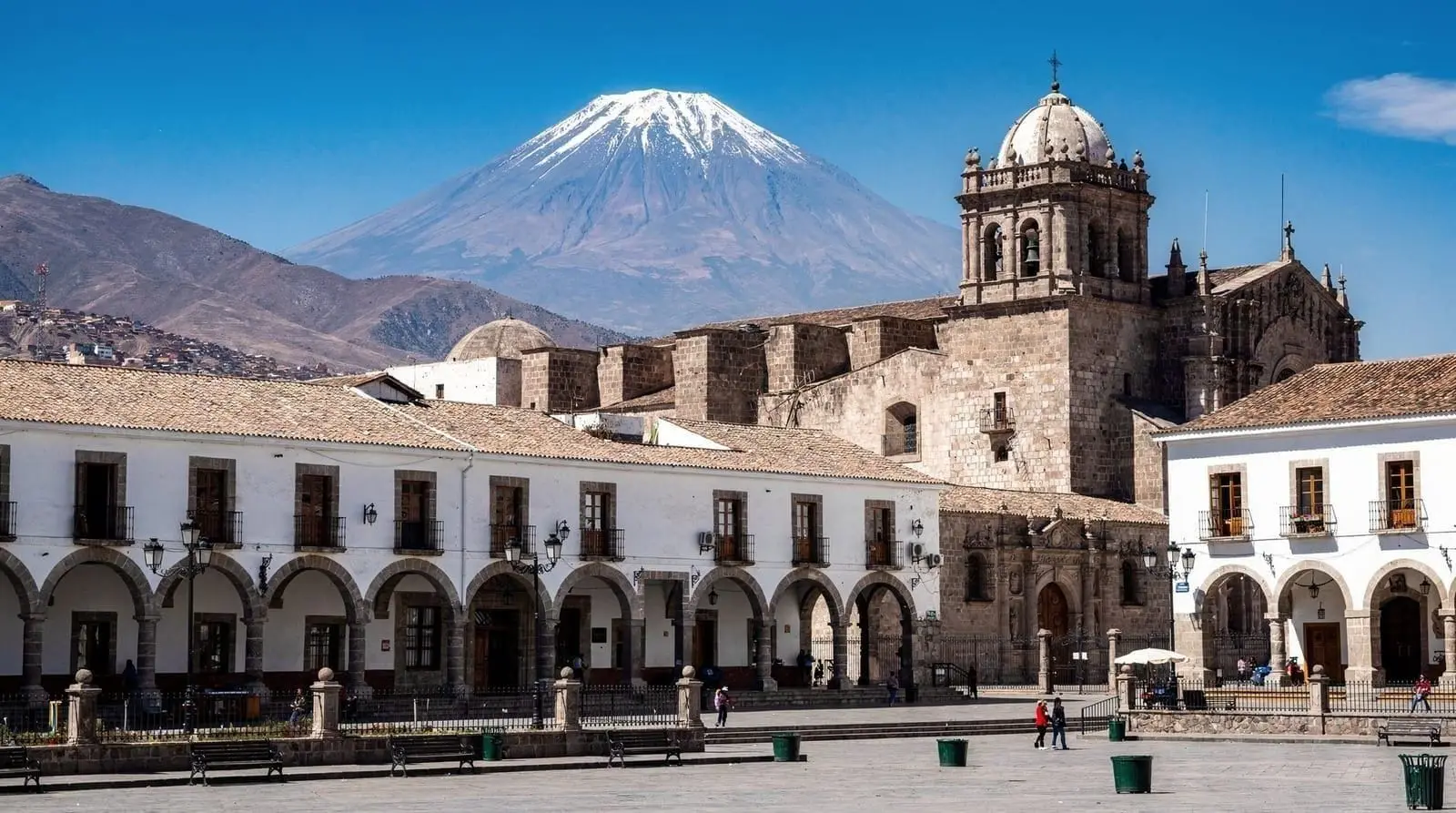
Arequipa
Plan Arequipa honestly: the Santa Catalina monastery, sillar architecture, the easy altitude, where to eat rocoto relleno, and using it as the Colca gateway.
Full-Day Colca Canyon Tour from Arequipa
Quick facts
- Country
- Peru (Arequipa region)
- Altitude
- 2,335 m / 7,660 ft — gentle, a good acclimatisation stop
- Currency
- Peruvian sol (S/) — cards widely accepted in the centre
- Best for
- Colonial architecture, the Santa Catalina monastery, gastronomy, Colca access
Why Arequipa earns more than an overnight
Arequipa is the destination that quietly wins people over. It rarely tops a Peru wish list — Machu Picchu and the Sacred Valley dominate those — yet travellers who give it two or three days consistently rate it among their favourite cities in the country. The reason is a rare combination: a genuinely beautiful colonial centre built almost entirely from white volcanic stone (sillar), a backdrop of three perfect snow-capped volcanoes, a distinctive regional cuisine, and an altitude gentle enough that you can actually enjoy all of it.
That last point matters more than it sounds. At 2,335 m / 7,660 ft, Arequipa sits well below Cusco, Puno and Lake Titicaca. It is the ideal place to begin acclimatising for the higher Andes without the headaches and breathlessness of the altiplano — which is exactly why so many sensible itineraries start the southern Andes leg here.
Plan two full days for the city itself, and a third (or a separate two-day trip) if you want to add the Colca Canyon.
| Where | Southern Peru, gateway to Colca Canyon |
| Time needed | 2–3 days for the city; add 1–2 for Colca |
| Altitude | 2,335 m — gentle, good for acclimatising |
| Getting there | Fly into AQP, or bus from Cusco/Puno/Lima |
| Best time | May–November dry; Jan–Mar green but rainier |
The White City and its sillar architecture
Arequipa is nicknamed La Ciudad Blanca — the White City — for the pale, slightly pearlescent sillar stone, a compacted volcanic ash quarried from the surrounding mountains, that built its historic core. The effect in the strong highland sun is striking: the Plaza de Armas, the cathedral, and the arcaded streets glow white against a deep blue sky.
The Basílica Catedral de Arequipa dominates the plaza — unusually, it occupies the entire north side rather than a corner. You can tour the rooftop and towers for sweeping views of the volcanoes (entry around S/15 / about $4). The plaza’s arcades shelter cafés with second-floor balconies that are the classic spot for an evening pisco sour overlooking the square.
Wander the streets around the plaza — San Lázaro, the city’s oldest neighbourhood, is a knot of narrow whitewashed lanes worth getting lost in, and the Yanahuara district across the river has a famous viewpoint (mirador) framing El Misti volcano through sillar archways.
The Santa Catalina monastery — Arequipa’s essential sight
If you do one thing in Arequipa, make it the Monasterio de Santa Catalina. Founded in 1579, it is not a single building but a walled city-within-a-city — roughly 20,000 square metres of cobbled streets, courtyards, cloisters and cells painted in vivid ochre and cobalt blue, where cloistered nuns lived (and a few still do, in a closed section). For two centuries it operated almost entirely sealed from the outside world, and walking its silent lanes feels like stepping into a different town inside the city.
Practical details:
- Entry: around S/40 / about $11.
- Hours: open daily, generally 9 am to 5 pm, with extended evening hours (until around 8 pm) on certain nights when the complex is lit by candlelight — the most atmospheric way to see it.
- Time needed: at least two hours; the complex is large and easy to lose track of time in.
- Guides: official guides wait at the entrance for a modest fee and genuinely add context — the history of the cloistered orders is hard to grasp without one.
Other worthwhile museums include the Museo Santuarios Andinos, home to Juanita, the remarkably preserved frozen mummy of an Inca girl sacrificed on a nearby volcano around 500 years ago — a sobering and unforgettable exhibit (entry around S/20 / about $5).
Arequipa as the gateway to the Colca Canyon
Arequipa is the launch point for the Colca Canyon, one of the world’s deepest canyons and the best place in Peru to see Andean condors at close range. The canyon and its gateway town Chivay sit a 3–4 hour drive north, climbing to over 3,600 m, so the trip is its own undertaking rather than a quick day out.
You have two realistic options:
- A long full-day tour — leaving Arequipa around 3 am, reaching the Cruz del Cóndor viewpoint for the mid-morning condor flights, and returning to Arequipa late the same day. It is doable but exhausting, with a punishing early start and a lot of driving. The full-day Colca Canyon tour from Arequipa covers it in one go if your schedule is tight.
- A two-day tour — overnighting in Chivay, soaking in its thermal baths, and reaching the condor viewpoint at a civilised hour on day two. This is the far more comfortable and rewarding option, and the one most travellers should choose. The two-day classic Colca Canyon tour includes the overnight and removes the brutal pre-dawn drive.
A particularly neat option if you are heading on to Lake Titicaca is the two-day Colca trek that ends in Puno rather than returning to Arequipa — it folds the canyon and the onward journey into a single trip. Full detail on the Colca Canyon and Chivay pages.
Arequipeño food — Peru’s most distinctive regional cuisine
Arequipa takes its food seriously, and locals will tell you (only half-joking) that it rivals Lima. The institution to understand is the picantería — a traditional, often lunchtime-only restaurant serving robust, spicy regional dishes. The signatures:
- Rocoto relleno — a fiery red rocoto pepper stuffed with spiced minced meat, baked with cheese. The defining Arequipa dish.
- Chupe de camarones — a rich river-shrimp chowder, best eaten as a Friday lunch.
- Adobo arequipeño — a pork stew traditionally eaten on Sunday mornings.
- Ocopa — boiled potatoes in a creamy huacatay-and-peanut sauce, served cold as a starter.
Where to eat:
- La Nueva Palomino (Yanahuara) — the most famous traditional picantería, generous portions, lively at weekend lunch; budget S/40–70 for a main.
- Zig Zag — a more upscale option in the centre known for grilled meats on volcanic-stone plates.
- Crepisimo — a long-running café inside the Alianza Francesa, good for a lighter meal or coffee.
- Mercado San Camilo — the colourful central market for cheap menús, fresh juices and a sensory crash course in Andean produce.
El Misti and getting outdoors
Arequipa’s skyline is defined by three volcanoes — El Misti (5,822 m), Chachani (6,057 m) and Pichu Pichu (5,664 m) — and a handful of visitors extend their stay specifically to climb one. El Misti is the classic: a two-day guided ascent, usually camping partway up and summiting before dawn for the sunrise view over the city and the altiplano beyond. It is a serious high-altitude climb, not a hike, and demands the same acclimatisation discipline as any Andean peak above 5,500 m — do it after, not before, your time in the city. Chachani is technically easier but still a genuine mountaineering objective; guided operators in Arequipa run both.
For a gentler outdoor half-day without the altitude commitment, the Sabandía mill and countryside just outside the city — a restored 18th-century stone flour mill surrounded by farmland and canals — makes a relaxed contrast to the monastery-and-museum pace of the historic centre, and the Yanahuara mirador at sunset frames El Misti through its sillar arches for one of the city’s best free views.
Seasons: when the volcanoes are clearest
| Season | Months | What to expect |
|---|---|---|
| Dry season | May–November | Clear skies, best volcano views, cold mornings and nights |
| Shoulder | April, early December | Transitional, generally reliable, fewer crowds |
| Wet season | January–March | Afternoon rain and cloud, but green slopes and lush countryside around Sabandía |
The dry season is the safer bet for a first visit, especially if El Misti or Colca condor-viewing is on the agenda — cloud cover during the wet months can hide both the volcanoes and the canyon views entirely.
Getting around and getting there
Within the city: the historic centre is compact and walkable. For trips to Yanahuara or the bus terminal, use app-based taxis (InDriver, Uber) — a ride across the city is typically S/8–15 / about $2–4.
By air: Rodríguez Ballón International Airport (AQP) is about 20–30 minutes from the centre, with frequent flights to Lima and Cusco.
By bus: Arequipa’s two adjacent terminals (Terminal Terrestre and Terrapuerto) connect to:
- Puno — 5–6 hours, climbing to 3,800 m
- Cusco — 9–10 hours (often overnight)
- Lima — a long 15–16 hours; flying is far more sensible
- Chivay / Colca — 3–4 hours
Use reputable lines (Cruz del Sur, Oltursa, Julsa) and travel by day where you can for the volcano scenery. For a fuller breakdown of bus versus flight options between Cusco and Arequipa, see the Cusco to Arequipa transport guide.
Practical information
Altitude: Arequipa’s 2,335 m is gentle, but if you arrive from sea-level Lima you may still notice mild effects. It is an excellent place to spend a couple of nights before climbing higher to Colca, Cusco or Puno.
Money: ATMs and card payment are widespread in the centre. Carry some cash for markets, taxis and the Colca trip.
Safety: The historic centre is among the safer urban areas for visitors in Peru; normal city precautions apply, especially around the bus terminals and at night.
Sun and dryness: The highland sun is intense and the air is dry. Sunscreen, a hat and lip balm are worth packing, and drink more water than you think you need.
Where Arequipa fits in your trip
Arequipa anchors Peru’s southern Andes circuit alongside the Colca Canyon. It pairs most naturally with Colca Canyon and Chivay on one side, and connects overland to Puno, Lake Titicaca and Cusco on the other. See the itineraries hub for full southern-loop routings and the planning tools to sequence the altitude gain sensibly.
Frequently asked questions about Arequipa
How many days do you need in Arequipa?
Two full days covers the historic centre, the Santa Catalina monastery and the food comfortably. Add a third day, or a separate two-day trip, if you want to include the Colca Canyon. Many travellers find Arequipa rewards a slightly longer, slower stay than they expected.
Is the altitude a problem in Arequipa?
Much less than in the rest of the southern Andes. At 2,335 m, Arequipa is well below Cusco, Puno and Lake Titicaca, which makes it an ideal first stop to begin acclimatising. You may feel mild effects arriving from sea level, but serious altitude sickness is uncommon here.
Is the Santa Catalina monastery worth it?
Yes — it is Arequipa’s essential sight. The 16th-century monastery is a vast, brightly painted city-within-a-city of cloistered streets and courtyards. Allow at least two hours, consider an evening candlelit visit, and hire a guide at the entrance for the history.
Can you visit the Colca Canyon from Arequipa?
Yes; Arequipa is the standard gateway. A long full-day tour starts around 3 am and returns the same night, while a two-day tour overnighting in Chivay is far more comfortable and is the option most travellers should choose. Some two-day trips end in Puno instead of returning.
What food is Arequipa known for?
Arequipa has Peru’s most distinctive regional cuisine, served in traditional picanterías. The signatures are rocoto relleno (a stuffed spicy pepper), chupe de camarones (shrimp chowder), adobo (pork stew) and ocopa. La Nueva Palomino in Yanahuara is the most famous picantería.
How do you get to Arequipa?
Fly into Rodríguez Ballón Airport (frequent connections to Lima and Cusco) or arrive by long-distance bus from Puno (5–6 hours), Cusco (9–10 hours) or Lima (15–16 hours, where flying is far better). Use reputable bus lines and travel by day for the scenery where possible.
Can you climb El Misti from Arequipa?
Yes, but treat it as a serious high-altitude climb rather than a hike. El Misti (5,822 m) is usually a two-day guided ascent with a pre-dawn summit push, and it demands genuine acclimatisation — do it after spending time in the city and, ideally, higher altitudes elsewhere, not as your first Andean exertion. Guided operators in Arequipa run both El Misti and the technically easier Chachani.
Is Arequipa better than Cusco as a base?
They serve different purposes rather than competing directly — Cusco is the gateway to Machu Picchu and the Sacred Valley, while Arequipa anchors the Colca Canyon and the gentler southern Andes. Most itineraries include both rather than choosing one; Arequipa’s lower altitude also makes it a sensible first stop before Cusco’s higher elevation.