Trujillo
Explore Chan Chan, the Huacas del Sol y Luna, Huanchaco beach, and the Marinera dance in Trujillo — northern Peru's archaeology capital.
Trujillo: Huacas de Moche, Chan Chan & Huanchaco Beach
Quick facts
- Country
- Peru
- Altitude
- 34 m (112 ft) — sea-level coastal plain
- Currency
- Peruvian sol (S/) — USD widely used
- Best for
- Pre-Columbian archaeology, colonial architecture, surf culture
Peru’s archaeology capital, hiding in plain sight
Most visitors to Peru fly straight to Cusco, ride the train to Machu Picchu, and leave feeling satisfied. Very few realise that Trujillo, a nine-hour overnight bus ride north of Lima (or a 55-minute LAN/LATAM flight), holds two of the most significant pre-Columbian sites on the continent — the Moche Huacas del Sol y Luna and the Chimú capital of Chan Chan. Entrance queues here are nothing like Machu Picchu. On a Tuesday morning you can walk the corridors of Chan Chan with a handful of other visitors, the desert wind carrying fine sand across eight centuries of carved adobe friezes.
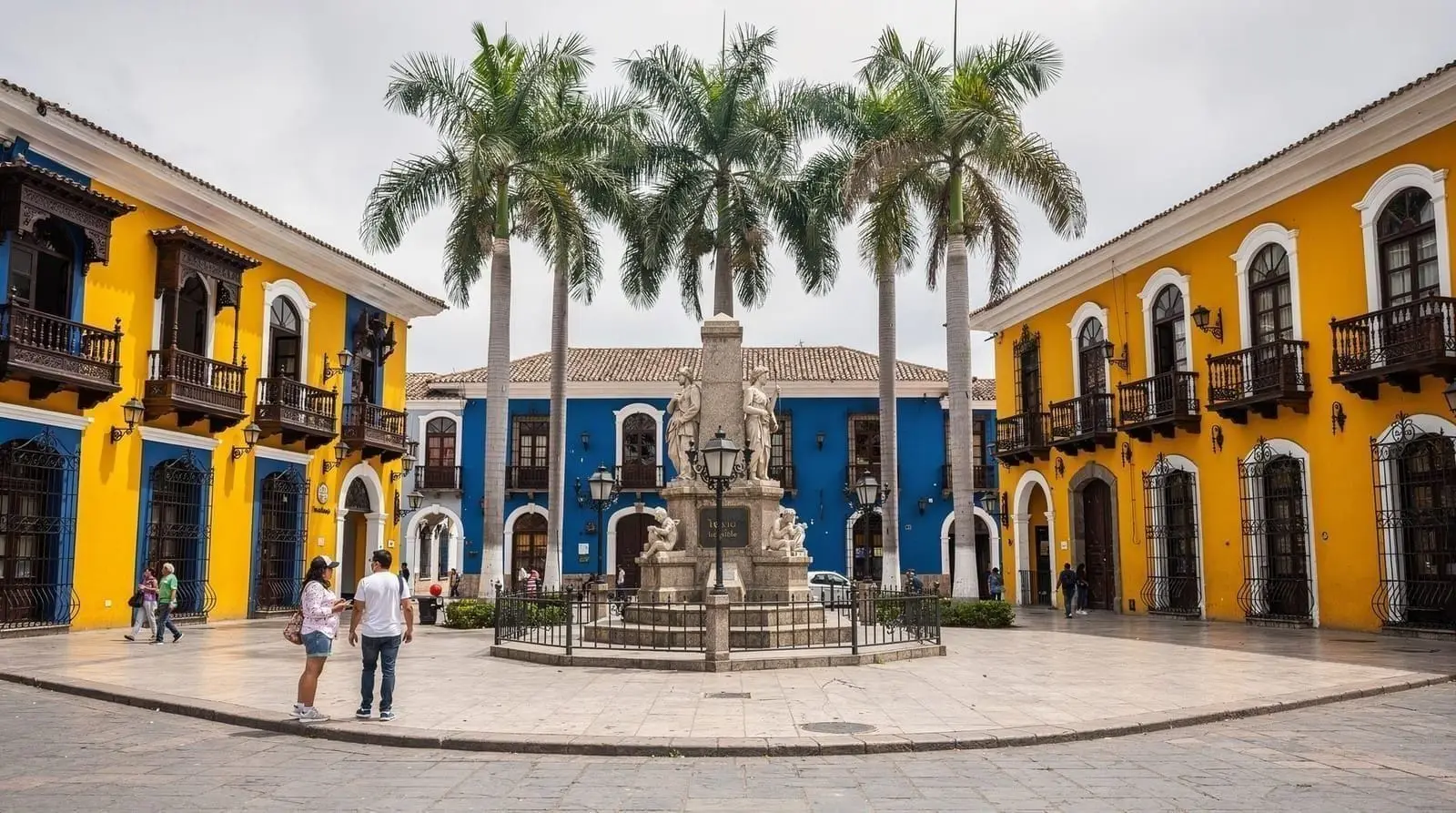
Trujillo itself is a compact, walkable colonial city — the second-largest in Peru — with a handsome main plaza ringed by yellow, ochre, and terracotta-painted facades, an active university scene, and a justified pride in two things the rest of Peru can only watch: the Marinera dance and the Peruvian Paso horse. If you land here with a single full day, you can fit more tangible history than most destinations deliver in three.
| Where | North coast, Peru, ~9hrs overnight bus or 55min flight from Lima |
| Cost | Site entry S/15 each (Chan Chan, Huacas del Sol y Luna) |
| Time needed | 1 full day; 2-3 days for the wider circuit |
| Getting there | Overnight bus (S/80-150) or flight (from ~S/150) from Lima |
| Best time | May to November (dry season, cooler coast) |
Getting to Trujillo from Lima
The overnight bus is the backpacker default. Cruz del Sur and Oltursa run semi-cama and cama services (S/80–150, roughly USD 21–40) from Lima’s Javier Prado terminals, arriving at Trujillo’s bus hub in the early morning — a practical choice if you travel light and value your hotel nights. Journey time is typically 8.5 to 10 hours depending on stops.
If time matters more than money, LATAM and Sky Airline connect Jorge Chávez International (LIM) to Capitán FAP Carlos Martínez de Pinillos Airport (TRU) in around 55 minutes, with fares starting around S/150–280 (USD 40–75) booked in advance. Taxis from the airport to the city centre cost S/20–30 (roughly USD 5–8) and take 15 minutes.
From Trujillo you can continue north to Chiclayo by bus in 3.5–4 hours, or head inland to Cajamarca on a dramatic 6-hour mountain road.
The Huacas del Sol y Luna — the Moche heartland
The Moche civilisation flourished along the north coast between roughly 100 and 800 CE, centuries before the Inca existed. Their ceremonial centre, the Huacas del Sol y Luna (Pyramids of the Sun and Moon), sits at the foot of Cerro Blanco, about 8 km south of Trujillo’s city centre. The two structures face each other across an ancient city that archaeologists estimate once held 10,000–15,000 people.
The Huaca del Sol (Temple of the Sun) is technically larger — at roughly 340 m long it is among the biggest adobe structures ever built in the Americas — but it remains closed to visitors due to ongoing stabilisation work. The star attraction is the Huaca de la Luna (Temple of the Moon), which has been under careful excavation since the 1990s. Walk the guided circuit and you encounter painted polychrome friezes depicting Ai Apaec, the Moche’s supreme deity, a fanged spider-like figure framed by wave motifs, sacrificial prisoners, and geometric borders in red, white, yellow, and black. The pigment has survived desert conditions for over a millennium.
Entrance to both huacas costs S/15 (roughly USD 4). A guided tour in English is included and lasts around 50 minutes. The site museum across the road, the Museo Huacas de Moche, adds substantial context — its reconstruction drawings help you visualise what the painted walls looked like when they were freshly plastered and ceremonially active. Allow 2–2.5 hours in total.
Trujillo: Huacas de Moche, Chan Chan & Huanchaco BeachChan Chan — the adobe empire
Nine kilometres west of Trujillo, at the edge of the Pacific coastal desert, lies Chan Chan — the largest pre-Columbian city in South America and the world’s largest adobe city. At its 15th-century peak, the Chimú capital covered roughly 20 sq km and housed an estimated 30,000 to 40,000 people organised around nine royal ciudadelas (palaces), each built for a successive Chimú king.
UNESCO inscribed Chan Chan as a World Heritage Site in 1986 and simultaneously placed it on the List of World Heritage in Danger — a status it still holds today. The threat is real: periodic El Niño rains dissolve the unbaked adobe, and even normal coastal humidity accelerates erosion. The friezes you see today are protected by modern shelters, and sections of the site are periodically closed for restoration. Visit now, because Chan Chan in fifty years will be significantly different from Chan Chan today.
The open section, the Tschudi Complex (also called the Nik An palace), is the most restored and the one covered by the standard S/15 ticket. Its entrance corridor opens into a vast ceremonial courtyard, and the deeper you walk the more intact the carved friezes become — stylised fish, sea otters, and pelican-like birds repeated in bands across every wall. The Chimú were a maritime people; their cosmology was saturated with the Pacific.
There is a small on-site museum worth the 20 minutes it takes. Hiring a licensed local guide (S/30–50 for English, S/20–30 for Spanish) adds real value because the scale of the ruins makes the layout hard to understand without explanation. Full details on timing, tickets, and the Tschudi layout are in the Chan Chan guide.
Huanchaco — the reed-boat village
Five kilometres north of Chan Chan on the coast road, the fishing village of Huanchaco is where Trujillo travellers go when they need ten minutes of ocean. The beach is long, brown-sand, and backed by modest restaurants serving fresh ceviche and the local chicha de jora (fermented maize drink). But the real reason to come is the caballitos de totora — small torpedo-shaped boats woven from bundles of totora reed, essentially unchanged from the fishing craft depicted on 2,000-year-old Moche ceramics. Local fishermen still use them at dawn to catch sea bass and corvina, riding them back to shore through the surf by straddling the stern and paddling.
You can watch them launch from the northern end of the beach in the early morning, or rent a board from one of the small surf schools for S/30–50 an hour — Huanchaco has a consistent left-hand beach break that draws Lima surfers on long weekends. The village fills up from December to April when Lima’s beaches get cold and grey. If you visit outside those months you will have the place largely to yourself.
Colectivo minivans run between central Trujillo and Huanchaco constantly (S/2–3, 20 minutes). Taxis cost S/15–20.
Colonial Trujillo: the Plaza de Armas and beyond
Trujillo’s city centre deserves an hour or two. The Plaza de Armas is one of the largest in Peru, anchored by a 1995 monument to liberty and ringed by the Cathedral (begun 1666), the Regional Government building, and painted colonial mansions with carved wooden balconies. The Casa Urquiaga on the plaza’s north side is open to visitors; Simón Bolívar reportedly stayed here in 1820 during the independence campaign, and the desk he used is still on display.
A few blocks away, the Museo de Arqueología de la Universidad Nacional de Trujillo (free for students, S/5 for visitors) has a compact but carefully curated collection of Moche ceramics, Chimú metalwork, and regional textiles. It is a good primer before visiting the sites, though the National Museum in Lima holds deeper collections.
Trujillo: City Tour and Archaeological MuseumMarinera and Peruvian Paso horses
Two cultural experiences are unique to Trujillo in ways that nothing else in Peru replicates. The Marinera is the national dance — a graceful, flirtatious courtship performance in which the male dancer pursues the female partner through a sequence of precise footwork and waving handkerchiefs. It originated on the north coast, and Trujillo holds the national Marinera competition every January, drawing couples from across Peru to compete in the Plaza de Armas in front of packed crowds. Outside January, several haciendas and cultural venues stage nightly performances for visitors.
The Peruvian Paso horse is a distinct breed developed over four centuries from Iberian stock brought by the Spanish. Its lateral ambling gait — the paso llano — is so smooth that riders claim you can carry a glass of water without spilling a drop. Haciendas around Trujillo stage regular shows combining the equestrian display with a Marinera demonstration and a pisco sour welcome. These events run for around 90 minutes and cost S/80–120 (USD 21–32) per person including transport from the city.
Both traditions are best experienced together rather than separately, since most hacienda shows pair a Paso horse exhibition with a live Marinera performance danced by the same troupes who compete in January’s national championship. Evening shows run several times a week outside the festival period, and booking ahead through your hotel or a local agency is worthwhile on weekends, when local families also attend and seats fill up.
Trujillo: Marinera Show with Peruvian Paso HorsesDay trips from Trujillo
Trujillo makes an efficient base for a wider north-coast archaeology circuit. The most undervisited site is El Brujo (45 km north), where the Lady of Cao — a female Moche ruler buried with warrior weapons around 400 CE — was discovered in 2006. The find overturned assumptions about Moche power structures. The on-site Museo Cao is one of the best-presented small archaeological museums in Peru. Tours from Trujillo take around 4 hours round-trip. The dedicated El Brujo and Lady of Cao guide covers the site’s layout and how to combine it with Trujillo in a single day.
For a longer circuit, Chiclayo is 3.5 hours north and offers complementary Moche and Chimú-era sites focused on the Lord of Sipán — another extraordinary royal tomb, contemporary with the Lady of Cao. A two-day route combining Trujillo and Chiclayo covers the full arc of north-coast pre-Columbian history and is far more coherent than rushing between them as day trips. See the northern Peru route guide for suggested pacing.
Trujillo: Sun & Moon, Chan Chan & Huanchaco with LunchHow Trujillo compares to Chiclayo
Both cities anchor Moche and Chimú archaeology, and travellers with limited time often ask which to prioritise. Trujillo has the edge on scale and variety: Chan Chan is the largest adobe city on the continent, and the Huaca de la Luna’s painted friezes are arguably the best-preserved Moche art anywhere.
Chiclayo’s strength is depth on a single spectacular find — the Lord of Sipán tomb and its museum, the Museo Tumbas Reales, are widely considered the finest archaeological museum in Peru, presenting the intact royal burial almost exactly as excavated. If you can only visit one, Trujillo gives the broader picture of Moche and Chimú civilisation across multiple sites; Chiclayo gives the single most impressive individual discovery. Doing both, as a two-day north-coast loop, is the complete version of this history.
A realistic one-day plan
If you only have a single day, sequence matters. Start at the Huacas del Sol y Luna first thing (opens around 9 am), since the painted friezes photograph best in soft morning light and the site is least crowded before the mid-morning tour buses arrive; allow around 2 hours including the site museum. From there, backtrack into the city or head directly to Chan Chan — most taxis and organised tours combine the two in one loop — and budget another 1.5-2 hours for the Tschudi Complex, ideally with a licensed guide to make sense of the scale.
Finish at Huanchaco for a late lunch of fresh ceviche by the water and, if the tide and timing align, a glimpse of the caballitos de totora coming in. This sequence — huacas, Chan Chan, Huanchaco — is also exactly what the combined full-day tours follow, so booking one is a reasonable shortcut if you would rather not manage taxis and timing yourself.
Practical information
Where to stay: The historic centre is the most convenient base. Mid-range hotels like Hotel El Brujo Colonial and Hostal Colonial cluster around the Plaza de Armas, with rooms from S/80–180 (USD 21–48). Budget options (dormitories from S/35) exist within a few blocks. Huanchaco has its own accommodation strip if you prefer to be on the water.
Food and drink: Trujillo is rightly proud of its ceviche, though it differs from Lima’s version — north-coast ceviche is typically made with corvina or sole, marinated longer, and served with cancha (toasted corn), sweet potato, and choclo. The speciality dish is shambar, a hearty bean-and-ham soup served only on Mondays according to local tradition. Budget S/15–25 for a full lunch at a local restaurant; tourist-facing places around the plaza charge S/30–50. Also look out for cabrito norteño (goat stewed in chicha de jora) and the local king kong pastry, a caramel-and-fruit-filled shortbread sandwich sold in bakeries across the city.
Getting around: Central Trujillo is walkable. For Chan Chan and Huanchaco, colectivo minibuses (S/2–3) run from the corner of Espana and Industrial, or share a taxi (S/15–20 per destination). The Huacas del Sol y Luna require a separate taxi or organised tour as public transport does not reach the site entrance.
Safety: Trujillo has a reputation among Peruvians for petty theft, particularly in the outer districts. In practice, the tourist zone — the historic centre, Huanchaco, Chan Chan, and the huacas — is well patrolled and incidents are rare. Standard precautions apply: avoid displaying phones and cameras on side streets at night, and use radio taxis called by your hotel rather than flagging vehicles on the street after dark.
Frequently asked questions about Trujillo
How long do I need in Trujillo?
One full day covers the Huacas del Sol y Luna, Chan Chan, and a quick stop in Huanchaco if you start early. Two days lets you add the city museums, a Marinera show in the evening, and a day trip to El Brujo. Three days allows a complete north-coast circuit with an overnight in Chiclayo.
Is it worth going to Trujillo if I have already visited Cusco?
Yes — these are entirely different cultures and time periods. Trujillo covers the Moche (100–800 CE) and Chimú (900–1470 CE) civilisations, which had no connection to the Inca. The scale, art style, and setting (coastal desert rather than Andean mountains) are completely different. Many experienced Peru travellers say the north coast is a more rewarding archaeological experience precisely because it is uncrowded.
Can I visit Chan Chan and the Huacas del Sol y Luna in one day?
Yes, easily. An organised full-day tour from Trujillo covers both sites plus Huanchaco and finishes by late afternoon. If you prefer to go independently, hire a taxi for the day (S/100–150 / USD 27–40) or take colectivos in sequence — Huacas first in the morning (taxi), then Chan Chan (colectivo), then Huanchaco for lunch and the beach. See Chan Chan for specific entry times.
What is the best time of year to visit Trujillo?
May to November is the coolest and driest stretch. Trujillo sits in the Sechura Desert coastal zone and almost never receives significant rain, but the garúa (coastal fog/drizzle) season between June and September can make mornings grey. The afternoon sun usually burns through by midday. December to April brings warmer temperatures (up to 28°C), more sunshine, and more visitors in Huanchaco.
How do I get from Lima to Trujillo?
Overnight bus (Cruz del Sur, Oltursa, Tepsa) takes 8.5–10 hours and costs S/80–150 (USD 21–40) depending on seat class. LATAM and Sky Airline fly the route in 55 minutes, with advance fares from S/150–280 (USD 40–75). If you are on a tight schedule, the flight saves a night of travel; if you are budget-conscious, the cama bus is comfortable enough to sleep on.
Are there tourist crowds at Chan Chan?
Not by Machu Picchu standards. Chan Chan receives perhaps 200,000–300,000 visitors a year, compared to Machu Picchu’s 1.5 million. On weekdays outside Peruvian school holidays you will often be the only group on the guided circuit. Even on busy weekends the site feels quiet relative to its size.
Is Trujillo safe for solo travellers?
The central tourist zone is generally safe during daylight. The main concerns are petty theft in crowded markets and poorly lit peripheral streets at night. The archaeological sites outside the city are supervised and peaceful. Solo female travellers report no particular issues in the historic centre and Huanchaco. Use your hotel’s recommended taxi service after dark, and keep a photocopy of your passport separate from the original.
Top experiences
Bookable activities with verified prices and instant confirmation on GetYourGuide.

