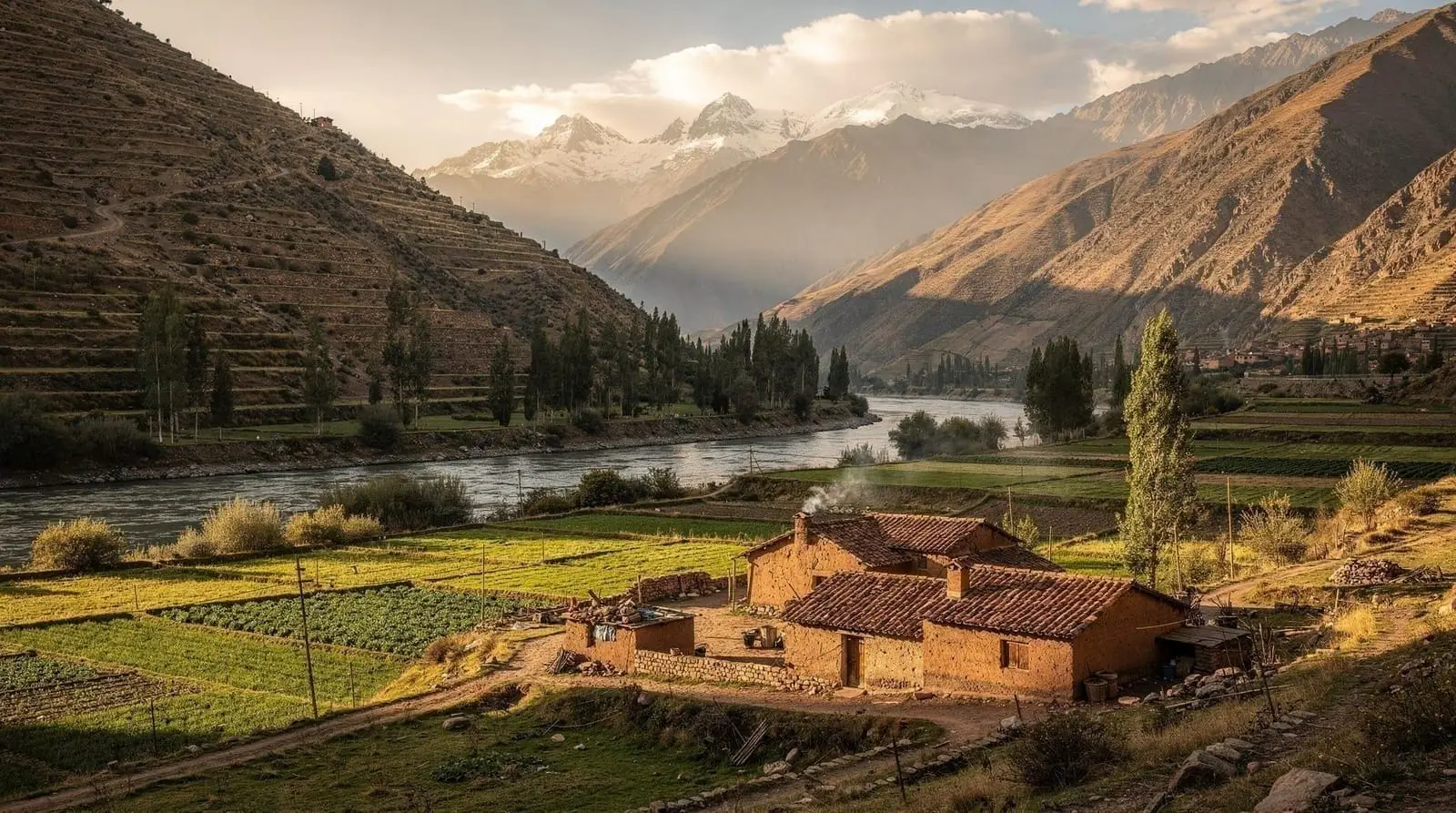
Sacred Valley
Plan the Sacred Valley honestly: ruins worth your boleto, market days, lower altitude than Cusco, and why you should sleep here before Machu Picchu.
Cusco: Pisac, Maras, Moray, Ollantaytambo Small Group Tour
Quick facts
- Region
- Valle Sagrado, Cusco Department
- Altitude
- 2,800-3,000 m / 9,200-9,800 ft (lower than Cusco)
- Currency
- Peruvian sol (S/) — bring cash for markets
- Key ticket
- Boleto Turístico covers Pisac, Ollantaytambo, Chinchero, Moray
- Best for
- Acclimatisation, Inca ruins, Andean markets, gateway to Machu Picchu
Why the valley deserves more than a rushed day trip
The Urubamba River carves a fertile corridor between Cusco and Machu Picchu, and for centuries the Inca treated it as their breadbasket and royal estate. Most visitors meet it the wrong way: as a single frantic bus loop squeezed between two nights in Cusco, hitting four ruins and a buffet lunch before dark. That itinerary exists for a reason — it is cheap and convenient — but it sells the place short, and it ignores the single most useful thing about the valley for your trip.
That thing is altitude. The valley floor sits between roughly 2,800 and 3,000 metres (9,200-9,800 ft), depending on where you stand. Cusco sits at about 3,400 metres (11,150 ft). Those few hundred metres make a measurable difference to how you sleep, how you digest, and how your head feels. Seasoned planners now flip the old order: instead of landing in Cusco and gasping for two days, they transfer straight from the airport down to the valley, sleep low for two or three nights, and only go up to Cusco afterwards. If your trip includes Machu Picchu, a Rainbow Mountain day, or a trek, the valley is the smartest acclimatisation base in the whole region.
Two days lets you see the headline sites without rushing. Three days lets you slow down, time a market properly, and treat the valley as a destination rather than a corridor. This page is the overview; each town has its own detailed guide linked below.
| Where | Valle Sagrado, between Cusco and Machu Picchu |
| Cost | Boleto General S/130 or partial Circuit III S/70 |
| Time needed | 2-3 days, or as an acclimatisation base |
| Getting there | Colectivo, taxi, or organised tour from Cusco |
| Best time | May to September (dry); April/October (quiet shoulder) |
For a single condensed version of this page, see the Sacred Valley complete guide, and for how to sequence it against a Cusco-first order, the Sacred Valley vs Cusco base comparison is worth reading before you book accommodation.
Getting your bearings
The valley runs roughly northwest from the Pisac end (closer to Cusco) down to Ollantaytambo (closer to Machu Picchu). The main towns, in the order you usually encounter them:
Pisac — about 33 km from Cusco (45-60 minutes by road). Famous for its hillside Inca ruins and its market, which is busiest and best on Sunday, Tuesday and Thursday. The eastern gateway to the valley.
Urubamba — the valley’s largest town and transport hub, roughly in the middle. Not a sightseeing destination in itself, but the practical base with the best supermarkets, clinics, and a wide spread of hotels. See /destinations/urubamba/.
Chinchero — up on a high plateau at about 3,760 m, technically above the valley floor on the road back toward Cusco. Known for its Sunday market, colonial church, and traditional weaving cooperatives. Full guide at /destinations/chinchero/.
Maras and Moray — the Maras salt pans (Salineras) and the concentric agricultural terraces of Moray, both on the plateau above Urubamba. Details at /destinations/maras-moray/.
Ollantaytambo — about 60 km from Cusco at the valley’s lower, western end. The best-preserved living Inca town in Peru and the train station where almost everyone boards for Machu Picchu. Full guide at /destinations/ollantaytambo/.
The Boleto Turístico, explained honestly
You cannot pay individually at the gate for most valley ruins. Pisac, Ollantaytambo, Chinchero, and Moray are all covered by the Boleto Turístico del Cusco (Cusco Tourist Ticket), and there is no single-site ticket for them. This trips up a lot of independent travellers.
The options that matter:
- Boleto General (full ticket): S/130 (about $35), valid 10 days, covers 16 sites across Cusco, the valley, and the South Valley.
- Boleto Parcial Circuito III (partial): S/70 (about $19), valid 2 days, covers the four Sacred Valley sites only — Pisac, Ollantaytambo, Chinchero, Moray.
If you are only doing the valley over one or two days and have already seen (or will skip) the Cusco-city ruins, the partial Circuit III ticket is the better value. If you also plan to visit Sacsayhuamán, Qorikancha’s museum, or the South Valley, buy the General. Note the salt pans of Maras are not on the boleto — Salineras charges its own separate entry of about S/18 (around $5).
Buy the ticket at the COSITUC office in Cusco (Av. El Sol 103) or at the first site you reach. Bring cash; card acceptance is unreliable. Students with an ISIC card get a discount on the General ticket.
A guided day tour bundles the entry logistics for you. The full-day Sacred Valley tour from Cusco handles transport between the scattered sites — useful because they are too far apart to link easily by public transport in a single day.
What each site is actually like
Pisac
The ruins above Pisac are, for many people, the most photogenic in the valley: a fan of agricultural terraces spilling down a mountain spur, with a ceremonial sector, an Inca cemetery riddled with looted tomb holes, and views straight down the Urubamba. The market in the town below is the most famous in the region, though it has tipped firmly toward tourist souvenirs. Go on a Sunday morning and you still catch the genuine produce trading among highland villagers in the upper square. Full detail at /destinations/pisac/.
Ollantaytambo
If you only stand on one set of terraces in the valley, make it Ollantaytambo. The fortress-temple above the town was the site of one of the few Inca military victories over the Spanish, and the unfinished Temple of the Sun shows giant pink rhyolite blocks hauled from a quarry on the opposite mountainside — a feat that still puzzles engineers. The town below it is the only place in the valley where people still live inside the original Inca street grid, with the same water channels running down the lanes. It is also where you catch the train. See /destinations/ollantaytambo/.
Moray and the Maras salt pans
Moray is a set of huge concentric circular terraces sunk into the ground — almost certainly an Inca agricultural laboratory, with temperature differences of several degrees between the top and bottom rings. A short drive away, the Salineras de Maras are more than 5,000 individual salt evaporation ponds cascading down a hillside, worked by local families since before the Inca and still harvested by hand today. They are extraordinary to photograph. Full guide at /destinations/maras-moray/.
The classic combination tour links these with Pisac and Ollantaytambo. The Pisac, Maras, Moray and Ollantaytambo small-group tour covers the spread-out highlights in one day with transport included, which is the only practical way to do all four without your own vehicle.
Chinchero
Highest and coldest of the valley sites, Chinchero is best known for its weaving cooperatives, where you can watch the full process from raw alpaca fleece to dyed, finished textile. The Sunday market and the adobe colonial church built on Inca foundations are the other draws. Details at /destinations/chinchero/.
Beyond the ruins: adventure and weaving
The valley is not only about ticking off archaeological sites. A growing number of visitors add an afternoon of adventure activity — the ziplining in the Sacred Valley guide covers the canopy courses strung across the Urubamba gorge near Ollantaytambo, a genuine adrenaline break between ruins. For a slower, more textured take on the valley, Chinchero’s weaving cooperatives demonstrate the full natural-dye process from raw fleece to finished textile, and a first-hand account in weaving with Chinchero women gives an honest sense of what a workshop visit actually involves versus the rushed souvenir-stop version some tours offer.
If you would rather build your own pace entirely, the one-day Sacred Valley itinerary is a tighter version of the suggested plans below, useful if you only have a single day to spare, and the Sacred Valley slow travel diary makes the case for the three-day version if your schedule allows it.
Suggested two- and three-day plans
Day 1 (acclimatisation-friendly): Transfer from Cusco airport straight down to the valley. Light afternoon in Pisac (ruins or market depending on the day). Sleep in Urubamba or Ollantaytambo. Keep activity gentle on arrival day — your body is adjusting.
Day 2: Maras and Moray in the morning, Ollantaytambo fortress in the afternoon, or vice versa. If you are continuing to Machu Picchu, this is the night to sleep in Ollantaytambo so you can catch a morning train.
Day 3 (optional): Chinchero on the way back up to Cusco, ideally a Sunday for the market. Arrive Cusco by mid-afternoon now better acclimatised than if you had started there.
For how the valley slots into a longer trip, see the /itineraries/ hub or the planning /guides/.
Getting around the valley
Colectivos (shared minivans): The cheapest option. From Cusco, colectivos to Pisac leave from Calle Puputi (S/5-7, about $1.50). From Pisac, onward colectivos run to Urubamba; from Urubamba you change again for Ollantaytambo or Chinchero. Doable but slow if you are chaining several sites.
Private taxi or driver: Hiring a driver for the day costs roughly S/180-280 (about $48-75) and is the most efficient independent option, letting you stop where you like. Agree the route and price before you set off.
Organised tour: The full-day loops are genuinely good value once you factor in transport between sites that public minivans do not connect well. The Sacred Valley VIP full-day group tour is the comfort-tier option with smaller groups and a slower pace, for travellers who do not want to be herded.
Renting a bike or hiring a horse: Cyclists and riders do use valley backroads between Urubamba, Ollantaytambo, and Maras, especially along the flatter valley floor sections. It is a niche option, best arranged with a local operator who knows current road conditions rather than attempted cold, but it is a memorable way to see the terraced farmland up close if you already have the fitness and experience.
Train to Machu Picchu: PeruRail and Inca Rail both run from Ollantaytambo station to Aguas Calientes (about 1 hour 45 minutes). Book ahead in dry season. There is no road to Machu Picchu — the train (or the multi-day trek) is the only way in.
Where to sleep and the lower-altitude advantage
The valley has accommodation for every budget, and sleeping here instead of Cusco is the single best altitude decision most travellers can make.
Urubamba has the widest mid-range and budget choice plus the best services — Tierra Viva and Sol y Luna are reliable; cheaper guesthouses cluster near the market.
Ollantaytambo is the romantic choice and the practical one if you are catching an early train; El Albergue sits literally on the station platform.
Pisac suits travellers who want a quieter, more bohemian village feel.
Because the valley floor is 400-600 metres lower than Cusco, you will sleep better here on your first nights in the Andes. Combine that with steady hydration, coca tea, and a gentle first day, and you significantly cut your odds of altitude sickness before tackling Rainbow Mountain or a trek.
Families in particular benefit from this order. Children often struggle more visibly with sudden altitude gain than adults realise, and a couple of easy nights in the valley before Cusco’s thinner air tends to make the whole trip noticeably smoother for younger travellers.
Best time to visit the valley
The valley has a sharp two-season climate, and the difference matters for what you will experience.
Dry season (May to September) is the classic window: clear skies, reliable sun, dramatic mountain views, and the best conditions for the salt pans and photography. It is also the busiest and priciest stretch, overlapping with the northern summer holidays, and nights on the higher plateau (Chinchero, Maras) get genuinely cold. Book trains and the better hotels well ahead.
Rainy season (November to March) brings afternoon downpours, lush green hillsides, far fewer crowds, and lower prices. Mornings are often clear, so you can still sightsee — you simply plan the energetic stuff before lunch. February is the wettest month, and it is also when the Inca Trail closes for maintenance, though the valley sites themselves stay open.
The shoulder months (April and October) are the quiet sweet spot for many: the landscape is still green from the rains, crowds have thinned, prices ease, and the weather is mostly cooperative. If you have flexibility, these are arguably the best weeks to come.
Whatever the season, pack for big daily temperature swings — warm sun by day, cold once it drops behind the mountains — and bring serious sun protection, because the altitude makes the UV fierce regardless of temperature.
For a deeper seasonal breakdown month by month, including how Inti Raymi in June and the February Inca Trail closure ripple into valley crowds and prices, the best time to visit Cusco guide covers the wider regional picture that the valley shares, and it is worth reading before you lock in travel dates.
Tourist traps and honest warnings
The “everything in one day” tours that skip the ruins you came for. Some budget loops spend more time at a buffet lunch and a roadside alpaca-textile sales stop than at the actual sites. Read the itinerary and check how long you get inside Ollantaytambo and Pisac, not just how many stops are listed.
Maras salt pans are not on the boleto. Tour sellers occasionally imply your tourist ticket covers everything. It does not cover Salineras — that is a separate S/18 cash entry, and the pans are not always included in the cheapest tours.
The “Inca massage” and gemstone touts. Around Pisac market in particular, expect persistent vendors. Prices on textiles are negotiable; the first quote is rarely the real one.
Photographing people in traditional dress. The women and children with llamas at the viewpoints expect a tip (S/2-5) for photos. That is fair — they are working — but agree before you shoot to avoid an argument.
Underestimating drive times between sites. The valley looks compact on a map, but Pisac to Chinchero to Maras to Ollantaytambo involves genuine mountain roads with switchbacks. Budget more transit time than a straight-line distance suggests, especially if you are self-driving rather than using a guide who knows the shortcuts.
Altitude complacency. The valley is lower than Cusco, but Chinchero at 3,760 m is higher than Cusco. Do not assume “the valley” means low everywhere.
Frequently asked questions about the Sacred Valley
Should I visit the Sacred Valley before or after Cusco?
Before, if you can. Landing in Cusco at 3,400 m and trying to sightsee immediately is the most common cause of altitude sickness on a Peru trip. Transferring straight down to the valley (2,800-3,000 m) for your first two or three nights lets you acclimatise more gently, then move up to Cusco afterwards. The one exception is if you have a fixed Machu Picchu date that forces a different order.
How many days do I need in the Sacred Valley?
Two days covers the main ruins and one market without rushing. Three days lets you slow down, time a market day properly, and treat the valley as a base rather than a corridor. If you are using it purely to acclimatise before Machu Picchu, even a single relaxed night and a half-day of light sightseeing is worthwhile.
Which tourist ticket do I need for the Sacred Valley?
The Boleto Turístico. For the valley alone, the partial Circuit III ticket (S/70, valid 2 days) covers Pisac, Ollantaytambo, Chinchero and Moray. If you also want Cusco-city sites, buy the full Boleto General (S/130, valid 10 days). The Maras salt pans are a separate S/18 cash entry, not on either ticket.
Is the Sacred Valley worth it, or should I just go to Machu Picchu?
It is worth it for two reasons beyond the ruins. First, it is the best place to acclimatise. Second, Ollantaytambo and Pisac are remarkable Inca sites in their own right, and the train to Machu Picchu leaves from the valley anyway. Skipping it to rush Machu Picchu means a harder altitude experience and missing some of the best-preserved Inca architecture in Peru.
When are the Sacred Valley markets?
Pisac’s market runs daily but is biggest on Sunday, Tuesday and Thursday, with Sunday the most authentic for produce trading. Chinchero’s main market day is Sunday. If you want a market as part of your trip, plan your valley days around a Sunday.
Can I do the Sacred Valley as a day trip from Cusco?
Yes, and most people do — full-day tours loop the highlights and return to Cusco by evening. But it is a long day with limited time at each site, and you miss the acclimatisation benefit of sleeping low. If your schedule allows, at least one night in the valley improves the trip considerably.
What else is there to do besides ruins?
Ziplining across the Urubamba gorge, weaving demonstrations at Chinchero’s cooperatives, horseback riding, and mountain biking are all established add-ons alongside the archaeology. They suit travellers who want a break from ruins-and-history days, or families looking for something more active to break up the sightseeing. Most operators offering these activities are based in or near Urubamba and Ollantaytambo, so it is easiest to arrange them once you have already settled on where you are staying in the valley.
Top experiences
Bookable activities with verified prices and instant confirmation on GetYourGuide.

