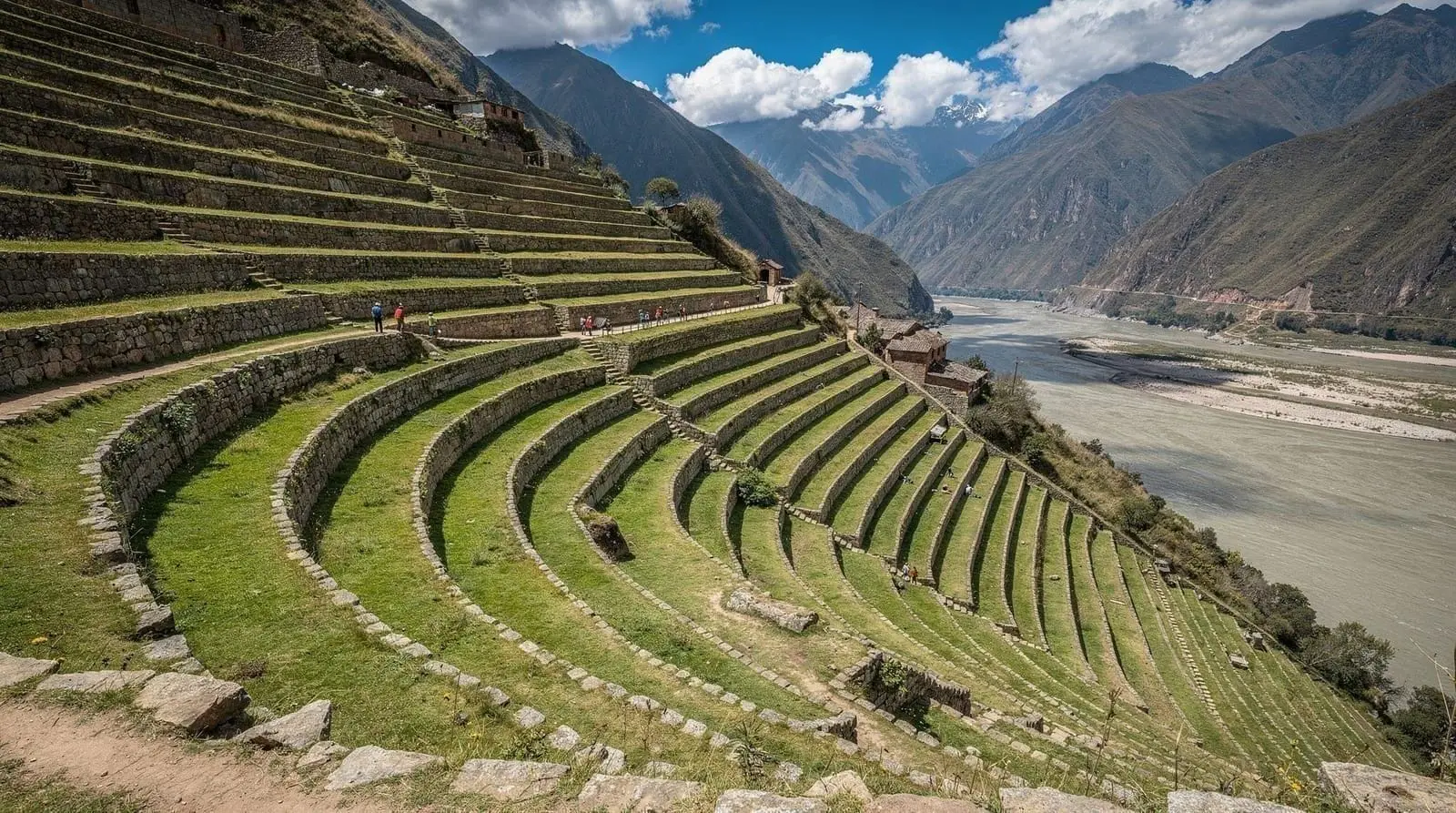
Písac
Písac done right: hillside Inca ruins, the real market days, boleto turístico tips, lower altitude than Cusco, and the tourist traps to dodge.
From Cusco: Sacred Valley Tour with Pisac and Ollantaytambo
Quick facts
- Region
- Sacred Valley, Cusco Department
- Altitude (town)
- 2,970 m / 9,750 ft (lower than Cusco)
- Altitude (ruins)
- Up to ~3,450 m / 11,300 ft on the upper terraces
- Entry
- Boleto Turístico (Circuit III S/70 or General S/130)
- Best for
- Inca terraces, Andean market shopping, valley day trips
A market town with a fortress hanging above it
Písac is two places stacked on top of each other. Down on the valley floor sits the colonial town, built around a plaza that fills with one of the most famous markets in the Andes. High on the mountain spur above, reached by a switchback road or a stiff walk, sprawls one of the largest and most photogenic Inca complexes in the Sacred Valley — a cascade of agricultural terraces, a ceremonial sector of finely cut stone, and a cliff face honeycombed with looted tombs.
| Where | Sacred Valley, ~45–60 min from Cusco |
| Cost | Boleto Circuit III S/70 or General S/130; taxi up ~S/30–40 |
| Time needed | Half day for ruins or market; a full day for both |
| Getting there | Colectivo from Calle Puputi, Cusco, or taxi/tour |
| Best time | Sunday morning for the market, early for the ruins |
Most people meet Písac as the first stop on a Sacred Valley day loop from Cusco, arriving mid-morning with a hundred other buses. That works, but if you can, come early and on your own schedule. The ruins before 9 am are quiet and the light on the terraces is far better. The town sits at about 2,970 m (9,750 ft), comfortably lower than Cusco’s 3,400 m, which makes it a gentle place to spend your first day in the Andes.
The ruins above town
The archaeological park crowns the ridge between the Quitamayo and Chongo gorges, and it is genuinely large — allow two to three hours if you want to walk the full circuit. The standout sectors:
Intihuatana — the ceremonial heart, with the finest Inca masonry on the site, including a carved ritual stone and curved temple walls of the imperial-quality stonework usually reserved for the most important sites.
The agricultural terraces — broad curving andenes that follow the contour of the spur. They were not just decorative; the microclimates they created let the Inca grow crops at altitudes that would otherwise fail.
The cliff cemetery — across the gorge, a steep face is pocked with hundreds of holes. These were tombs, one of the largest Inca cemeteries known, almost all looted long ago. You see them best from the upper terraces.
Two ways to do it. By road: a taxi from town up to the upper entrance costs about S/30-40 (around $8-11) round trip, letting you walk down through the ruins, which is the easier direction. On foot: a steep trail climbs from the town in about 1.5-2 hours — rewarding but a real workout at altitude. Bring water and sun protection either way; there is no shade on the terraces.
Entry is by Boleto Turístico — there is no gate ticket for Písac alone. The Circuit III partial ticket (S/70, about $19, valid 2 days) covers Písac plus Ollantaytambo, Chinchero and Moray; the full General ticket (S/130) adds the Cusco-city sites. Buy it in Cusco or at the site entrance, in cash.
A guided loop saves you the transport headache between the valley’s scattered sites. The Sacred Valley tour with Písac and Ollantaytambo pairs the two best ruin complexes in a single day with transport and a guide who explains the masonry you would otherwise just photograph.
The market — and what it really is
Písac’s market is the most famous in the region and, honestly, the most touristed. The plaza and surrounding streets are packed with stalls selling alpaca textiles, jewellery, ceramics, and the inevitable mass-produced souvenirs. Much of it is aimed squarely at the buses.
That said, it is still worth your time if you know what to look for and when to come:
- Market days: Stalls operate daily, but the market is biggest and most lively on Sunday, Tuesday and Thursday. Sunday is the most traditional — highland villagers from surrounding communities come down to trade produce in the upper part of the square, and there is a colourful Quechua mass and a small procession in the morning.
- The genuine goods: Look for the weaving cooperatives and the stalls where you can see who made the item. Hand-woven textiles cost more than the machine-made ones for a reason — feel the difference in the alpaca.
- Haggling: Expected and normal. The first price is rarely the real one; a polite counter of 50-60% is a reasonable starting point on souvenirs. Be fair on genuine handwork.
Skip the market entirely if you have limited time and the ruins are your priority — the terraces are the unmissable part, the market is replicable elsewhere in the valley.
Písac vs Chinchero vs Ollantaytambo markets
| Písac | Chinchero | Ollantaytambo | |
|---|---|---|---|
| Character | Famous, touristed, biggest range | Smaller, weaving cooperatives | Small daily market, most local |
| Best days | Sunday, Tuesday, Thursday | Sunday, less touristed | Any day, low-key |
| What to buy | Textiles, ceramics, alpaca | Hand-woven textiles, dyeing demos | Everyday produce, less souvenir-focused |
| Ruins nearby | Yes, major complex above town | Yes, smaller Inca terraces | Yes, the fortress-temple |
If your time is tight and you want the fullest market experience, Písac wins on scale; for a genuine weaving demonstration, the Chinchero weaving guide is worth reading before you go, since Chinchero’s cooperatives show the whole hand-spinning and natural-dye process rather than just selling the finished cloth.
Eating and the famous empanadas
Písac has a small but good food scene. The town is locally famous for its wood-fired oven empanadas — several bakeries near the plaza sell them hot from clay ovens for S/3-5 (under $1.50). Horno Colonial San Francisco is a long-standing favourite.
For a sit-down meal, Ulrike’s Café on the plaza is a reliable traveller standby (mains S/25-40), and the town has a cluster of vegetarian and health-food cafés reflecting its bohemian expat community. Budget S/15-25 for a market-stall almuerzo (set lunch) if you want the cheap local option.
Walking the ruins: a practical circuit
If you take the road up to the upper entrance (the easier and recommended approach for most), here is roughly how the descent unfolds so you know what you are walking into:
From the upper car park, a path leads first to the Q’allaqasa sector — a cluster of buildings on a rocky outcrop that functioned as a citadel guarding the valley, with some of the most vertiginous views on the site. From there the trail traverses toward the Intihuatana ceremonial sector, the architectural heart, where the masonry suddenly jumps in quality to the fine fitted stonework reserved for the most sacred Inca buildings. Take your time here; this is the highlight.
The path then drops through the P’isaqa terraces — the great curving andenes that give Pisac its postcard silhouette — and continues down toward the town. Across the gorge you will see the cliff cemetery the whole way down. The full descent on foot takes a leisurely 1.5-2 hours with stops, and it is genuinely downhill, which is why taking the taxi up is the kind option for your lungs.
A couple of practical notes: there are no facilities, water or shade once you are on the terraces, so carry what you need and start with sun protection on. The stone steps can be uneven and slippery after rain — proper shoes matter. And keep your boleto on you; rangers check it at more than one point on the circuit.
Using Písac to acclimatise
Písac is one of the smartest first stops in the Andes precisely because it is lower than Cusco. If you land at Cusco airport and transfer straight down to the Sacred Valley, spending your first night around Písac or nearby Urubamba means sleeping at roughly 2,800-3,000 m instead of 3,400 m. That difference helps you sleep and digest while your body adjusts.
A word of caution, though: the upper terraces of the ruins reach about 3,450 m, higher than Cusco itself. On your very first day, take the road up rather than the steep climbing trail, and walk gently. Save the strenuous hike for once you have a night or two of acclimatisation behind you.
A bit of history and the cliff cemetery
Pisac was almost certainly built by the Inca Pachacuti in the mid-15th century, the same expansionist ruler credited with Machu Picchu and much of imperial Cusco. The site guarded the eastern entrance to the Sacred Valley and the route toward the Antisuyu — the Amazon-facing quarter of the empire — which explains its citadel character as much as its ceremonial and agricultural ones. The quality of the masonry in the Intihuatana sector signals how important it was: that grade of fitted stonework was reserved for places that mattered.
The pocked cliff face across the Quitamayo gorge is one of the largest known Inca cemeteries. The dead were placed in tombs cut into the rock, the more important ones higher up. Spanish-era and later looting emptied almost all of them — the holes you see are the scars of that plunder, not the original openings. It is a sobering counterpoint to the polished terraces: a reminder that much of what the Inca built was systematically stripped after the conquest.
Knowing this changes how the site reads. The terraces were not decoration but a working agricultural engine; the temple was a genuine ceremonial centre aligned to the sun; and the town below, with its market, sits where Andean trade has happened for centuries. A good guide brings these layers out, which is why a tour or a hired local guide at the gate (around S/40-60 for a small group) is money well spent if the history interests you.
Pisac as part of a one-day Sacred Valley loop
Because Písac sits at the eastern entrance to the valley, it is the natural first stop on any Cusco-based day loop, typically followed by Ollantaytambo or Maras and Moray later in the day. The one-day Sacred Valley itinerary guide sets out a realistic sequence if you only have a single day for the whole valley, and the getting around Sacred Valley guide covers the colectivo and taxi logistics for stringing several sites together independently rather than on a fixed tour.
Getting to and from Písac
Colectivo (shared minivan): From Cusco, vans to Písac leave when full from Calle Puputi, near the city centre. The ride is 45-60 minutes and costs S/5-7 (about $1.50). From Písac you can pick up onward colectivos to Urubamba for the rest of the valley.
Taxi: A private taxi from Cusco runs about S/60-80 (around $16-21) one way; hiring a driver for a full valley day is S/180-280.
Organised tour: The valley loops include Písac as the standard first stop. The Písac, Maras, Moray and Ollantaytambo small-group tour is the most complete day option, linking Písac with the salt pans, the circular terraces of Moray, and Ollantaytambo — sites that are awkward to connect on public transport.
Ziplining and other add-ons near Pisac
Beyond the ruins and market, the hills around Pisac and the wider valley host a small adventure-tourism industry, including ziplines strung across the valley with views back toward the terraces. These are a genuine change of pace if you have already spent a day or two on ruins and markets and want something more active, though they add a half-day and a separate cost on top of the standard sightseeing. The ziplining Sacred Valley guide covers operators and what to expect if this appeals; it’s an easy add-on to combine with a Pisac day if you are staying in the valley rather than day-tripping from Cusco.
Pisac as a base, and the New Age scene
Pisac town has, over the past two decades, become the bohemian heart of the Sacred Valley. Alongside the Quechua farming community, the village hosts a substantial international expat and wellness scene — yoga studios, meditation retreats, vegetarian and raw-food cafés, and a fair amount of New Age commerce. For some travellers this is a draw; for others it is the thing they came to the Andes to escape. Either way, it gives Pisac a different texture from the more workaday Urubamba or the historic feel of Ollantaytambo.
A frank word of caution attaches to this scene: Pisac has become a hub for ayahuasca and San Pedro “ceremonies” marketed to tourists. These are powerful psychoactive substances, the retreats are largely unregulated, the qualifications of self-styled “shamans” are impossible to verify, and there have been serious incidents involving foreigners across the Cusco region. This is not a casual tourist activity. If it is something you are determined to pursue, research the operator exhaustively rather than booking on a market-stall flyer — and understand that you are taking a real risk.
As a place to sleep, Pisac suits travellers who want a small, walkable, slightly alternative village base with good cafés and easy access to the eastern end of the valley. It is less central than Urubamba and further from the Machu Picchu train than Ollantaytambo, so weigh it against your wider plan.
Tourist traps and honest warnings
The “10-minute photo stop” tours. Some budget loops give you barely 30-40 minutes at Písac, split between the market and a quick look at part of the ruins from a single viewpoint. If the terraces matter to you, check the itinerary for how long you actually get inside the archaeological park.
Buying gemstones and “ancient artefacts.” Vendors around the market sometimes offer “Inca” pottery or stones. Genuine antiquities cannot be legally exported from Peru, and the items on offer are reproductions regardless. Buy them as souvenirs if you like the look, not as investments.
The photo-with-a-llama tip. Costumed locals with llamas at the ruins viewpoints expect S/2-5 for a photo. Agree before you point the camera.
Assuming the boleto covers the market or the empanadas. It does not — the boleto is only for the archaeological park. The market and food are separate cash costs.
Frequently asked questions about Písac
What is the best day to visit Písac market?
Sunday is the most traditional and lively, with highland villagers trading produce, a Quechua mass, and a small procession in the morning. Tuesday and Thursday are also major market days with full stall coverage. The market runs daily, but other days are quieter and more souvenir-focused.
Do I need the Boleto Turístico for the Písac ruins?
Yes. There is no individual gate ticket for the Písac archaeological park — it is only accessible with the Boleto Turístico. The partial Circuit III ticket (S/70, valid 2 days) covers Písac plus three other valley sites; the General ticket (S/130) adds the Cusco-city sites. Buy it in cash in Cusco or at the entrance.
Is Písac a good place to acclimatise?
The town, at 2,970 m, is a good place to spend an early Andean night because it is lower than Cusco. But the upper ruins climb to about 3,450 m, higher than Cusco, so on your first day take the road up rather than hiking the steep trail, and move gently.
How long do I need at Písac?
Half a day covers either the ruins or the market comfortably. A full day lets you do both without rushing, ideally arriving early for the quiet ruins before the buses, then dropping into the market afterwards. Allow two to three hours for the ruins alone if you walk the full circuit.
How do I get from Cusco to Písac independently?
Take a colectivo (shared minivan) from Calle Puputi in Cusco — they leave when full, take 45-60 minutes, and cost S/5-7. A private taxi is about S/60-80 one way. From Písac you can continue by colectivo to Urubamba and the rest of the valley.
Should I walk up to the ruins or take a taxi?
If it is early in your trip or you are not acclimatised, take a taxi to the upper entrance (S/30-40 round trip) and walk down through the ruins — easier and you still see everything. The climbing trail from town takes 1.5-2 hours and is a serious effort at altitude; save it for later in your trip.
Top experiences
Bookable activities with verified prices and instant confirmation on GetYourGuide.


