Peru domestic flights guide: airlines, routes and airports
Which airlines fly domestic routes in Peru?
Three main carriers run Peru's domestic network: LATAM (the full-service incumbent), and the low-cost airlines Sky Airline and JetSMART. LATAM has the widest network and most reliable schedules; Sky and JetSMART undercut it on price but charge separately for bags and seats.
Why flying is part of almost every Peru trip
Peru is large and mountainous, and its road network reflects that. The distance from Lima to Cusco is around 1,100 km by road over the Andes — a 20-plus-hour bus journey — versus a 1 hour 20 minute flight. Anyone trying to fit Lima, Cusco, the Sacred Valley, Arequipa and Lake Titicaca into a two-week trip ends up flying at least one leg, and usually two or three. The country’s domestic aviation market is competitive enough that fares, booked sensibly, are reasonable. Booked carelessly, they are not.
This guide covers the three airlines you will actually use, the routes worth flying, real 2026 fares, the baggage traps on the budget carriers, and the airport-specific quirks — chiefly Cusco’s weather-driven morning bias and Lima’s role as the connecting hub for almost everything. Fares are given in US dollars because that is how most travellers compare them; expect to pay in soles at roughly S/3.70 to the dollar when booking locally.
| Where | Lima hub to Cusco, Arequipa, Iquitos, Juliaca, north coast |
| Cost | Around US$40–130 one way, booked 3–6 weeks ahead |
| Time needed | 1 hr 15 min–1 hr 50 min per leg |
| Getting there | Book directly on airline sites; compare LATAM, Sky, JetSMART |
| Best time | Morning departures to Cusco most reliable |
The three airlines, compared honestly
LATAM
LATAM is the full-service incumbent and the airline most travellers default to. It flies the widest domestic network, including thinner routes that the budget carriers ignore, and its schedules are the most robust when weather disrupts the day. Fares are higher, but the standard fare usually includes a checked bag and seat selection is cheaper, which narrows the real-world gap with the low-cost airlines once you add their fees. If reliability and a single connecting itinerary through Lima matter to you, LATAM is the safe pick.
Sky Airline
Sky is a Chilean low-cost carrier with a solid Peruvian network on the main trunk routes — Lima to Cusco, Arequipa, Iquitos, Tarapoto, Piura and others. Base fares undercut LATAM, but the cheapest fare class is hand-baggage only, and a checked bag, a chosen seat and any change cost extra. Add it all up and Sky is genuinely cheaper if you travel light and book ahead; it is not cheaper if you need a checked bag and pick the fare carelessly.
JetSMART
JetSMART is the other low-cost carrier, also Chilean-owned, competing head to head with Sky on the busiest routes. The model is the same: very low base fares, everything-is-extra pricing, hand-baggage-only on the cheapest tickets. JetSMART often has the lowest headline fare on Lima–Cusco, which makes it worth checking, but read the baggage and change rules carefully before you celebrate the price.
The practical takeaway: check all three for any route you are flying. On a popular trunk route the cheapest LCC base fare can be a third of LATAM’s, but once you need a 23 kg bag and a guaranteed seat together, the gap often shrinks to where LATAM’s reliability is worth it.
Lima–Cusco is by far the busiest route and worth its own note: it runs so frequently that fare-watching over a few days genuinely pays off, and the dedicated Lima to Cusco flights guide tracks typical price swings and the best departure windows for that specific leg in more detail than there is room for here.
The routes worth flying
Not every leg should be flown. Here are the domestic routes that genuinely earn their place, with typical air times and sensible-booking fares.
- Lima to Cusco — 1 h 20 min, US$45–110 booked ahead. The most-flown route in Peru; the alternative is a 20-plus-hour bus. Almost everyone flies this.
- Lima to Arequipa — 1 h 35 min, US$50–110. Saves a 15–16 hour bus from Lima to Arequipa.
- Lima to Juliaca (for Puno and Lake Titicaca) — 1 h 45 min, US$60–120. Juliaca airport serves Puno, about 45 minutes away by road.
- Lima to Iquitos — 1 h 50 min, US$60–130. Iquitos has no road access at all, so flying (or a multi-day riverboat) is the only practical way in.
- Lima to Tarapoto — 1 h 20 min, US$45–100. The gateway to the central jungle and Tarapoto waterfalls.
- Lima to Trujillo / Chiclayo / Piura — about 1 h 15–35 min, US$40–100. Useful for the north coast archaeology circuit and Mancora.
- Cusco to Arequipa / Juliaca — short hops that let you avoid backtracking to Lima, though frequency is lower and fares can be higher per kilometre.
Note that almost all domestic flying routes through Lima. Direct flights between, say, Cusco and the north coast are limited, so a typical multi-region trip pivots on Lima’s hub.
Real fares and how booking timing changes them
The single most important fare fact for Peru: low-cost-carrier prices roughly double in the final two weeks before departure, and peak-season Cusco flights can sell out entirely. A Lima–Cusco fare that is US$50 six weeks out is routinely US$120–200 if you wait until the week of travel. LATAM’s fares are steadier but also climb closer to departure.
Practical booking rules:
- Book trunk routes three to six weeks ahead, earlier for the June–August dry-season peak to Cusco.
- Book directly on the airline website where possible; third-party sites sometimes hide the baggage fees that make a “cheap” fare not so cheap.
- Compare the all-in price, not the base fare — add a checked bag and seat to the LCC fare before declaring it the winner.
- Morning flights to Cusco are not just better priced sometimes; they are more reliable (see below).
For how flight costs slot into a full trip budget, see the Peru trip cost guide.
Baggage: the trap on the budget carriers
This is where travellers get caught. On Sky and JetSMART, the cheapest fare class typically includes only a small personal item or one cabin bag, and a checked bag is a paid extra that is far cheaper added at booking than at the airport. Buying a checked-bag allowance at the check-in desk can cost two or three times the online price. LATAM’s standard domestic fares are more generous and usually include a checked bag, which is part of why the real-world price gap is smaller than the headline.
If you are carrying a large backpack or doing a multi-region trip with trekking gear, factor the checked-bag fee into every LCC fare you compare. If you travel light enough to go cabin-only, the low-cost carriers become genuinely cheap.
Airports you will pass through
Jorge Chávez International (LIM), Lima
Lima’s airport in Callao is the hub for the entire country and handles both international and domestic flights. It is 45–60 minutes from Miraflores in normal traffic. Allow generous connection time if you are arriving internationally and connecting domestically, as you collect and re-check baggage. For getting between the airport and the city, see the dedicated Lima airport to city guide.
Alejandro Velasco Astete (CUZ), Cusco
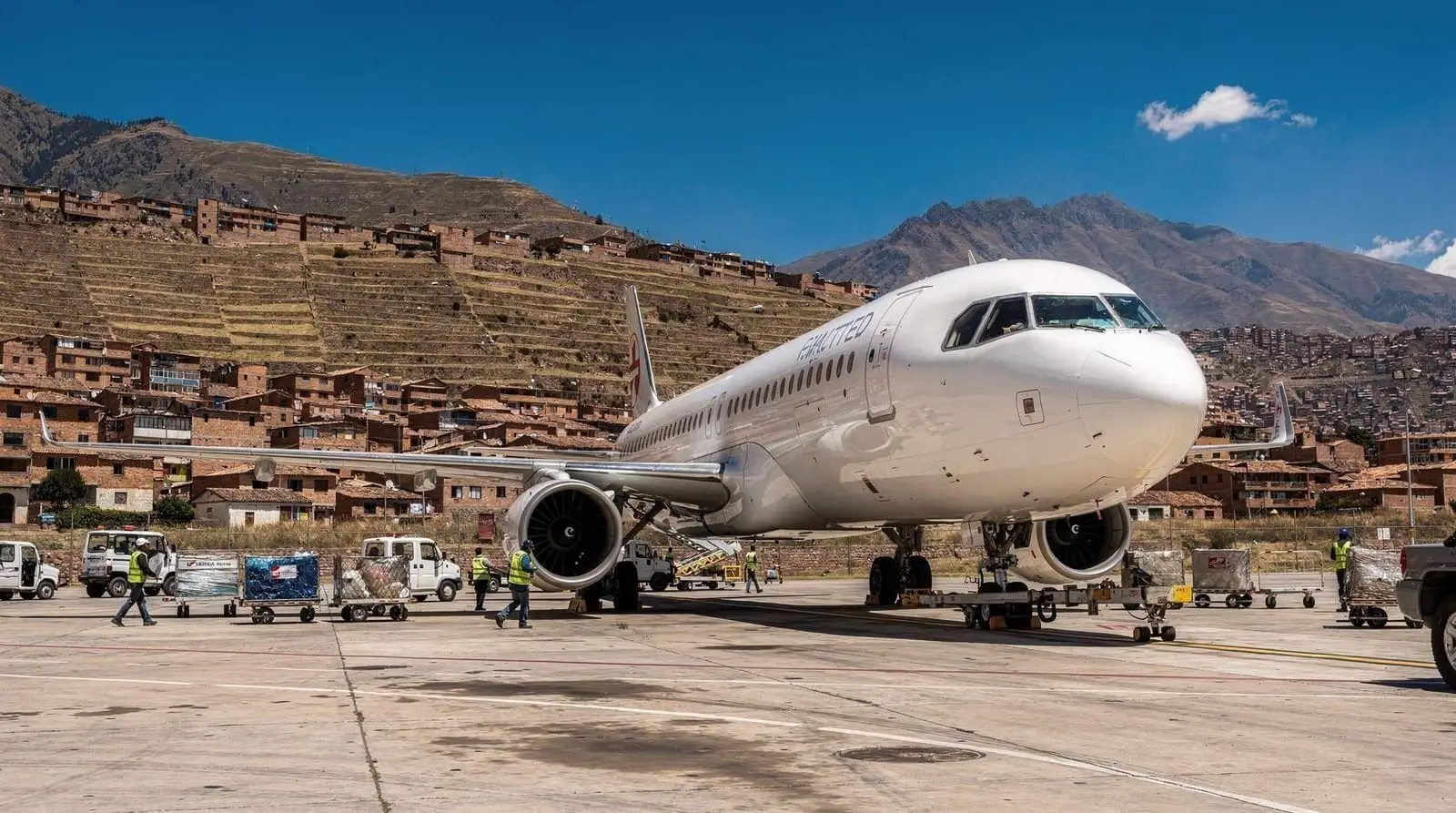
Cusco’s airport sits inside the city at 3,310 m, ringed by mountains, which is why morning flights are far more reliable than afternoon ones. Mountain weather builds through the day and afternoon flights are frequently delayed, diverted to nearby airports, or cancelled. Book the earliest departure you reasonably can, and if you have a same-day international connection out of Lima, leave a wide buffer. The dedicated Cusco airport guide covers the terminal layout, transfers into the city, and what to do if your flight is delayed.
Landing straight into 3,310 m from sea level also means you arrive with zero acclimatisation, so treat your first Cusco day gently regardless of how the flight went — the Cusco acclimatization plan lays out a sensible first 48 hours.
Other domestic airports
Juliaca (JUL) for Puno, Rodríguez Ballón (AQP) for Arequipa, Francisco Secada Vignetta (IQT) for Iquitos, and the north-coast airports at Trujillo and Chiclayo are all straightforward, smaller airports. Juliaca is high (3,800 m) and basic; arrange your onward transfer to Puno in advance.
Tips that save money and stress
- Fly the earliest Cusco departure to dodge afternoon weather disruption.
- Build a buffer day in Lima before an international departure if your domestic leg comes from Cusco, in case of weather delays.
- Check all three airlines and compare all-in, baggage-included prices.
- Pre-pay checked bags online on Sky and JetSMART; never at the airport.
- Arrive two hours before domestic departures at busy times — security lines at Lima and Cusco can be long in peak season.
- Keep altitude in mind: if you fly straight from sea-level Lima to Cusco, your body has no acclimatisation buffer. Take the first day in Cusco gently. The Huaraz acclimatization guide explains the physiology, and the safety guide treats altitude as the real risk it is.
When flying does not make sense — scenic legs, short hops, or to save a hotel night — the bus travel guide covers the premium overnight services. For help deciding which legs to fly on a full route, see the two-week itinerary guide or browse /itineraries/. Packing for a same-day jump from sea-level Lima to a cold Andean evening in Cusco also catches people out — the what to pack for Cusco guide covers the layering this requires.