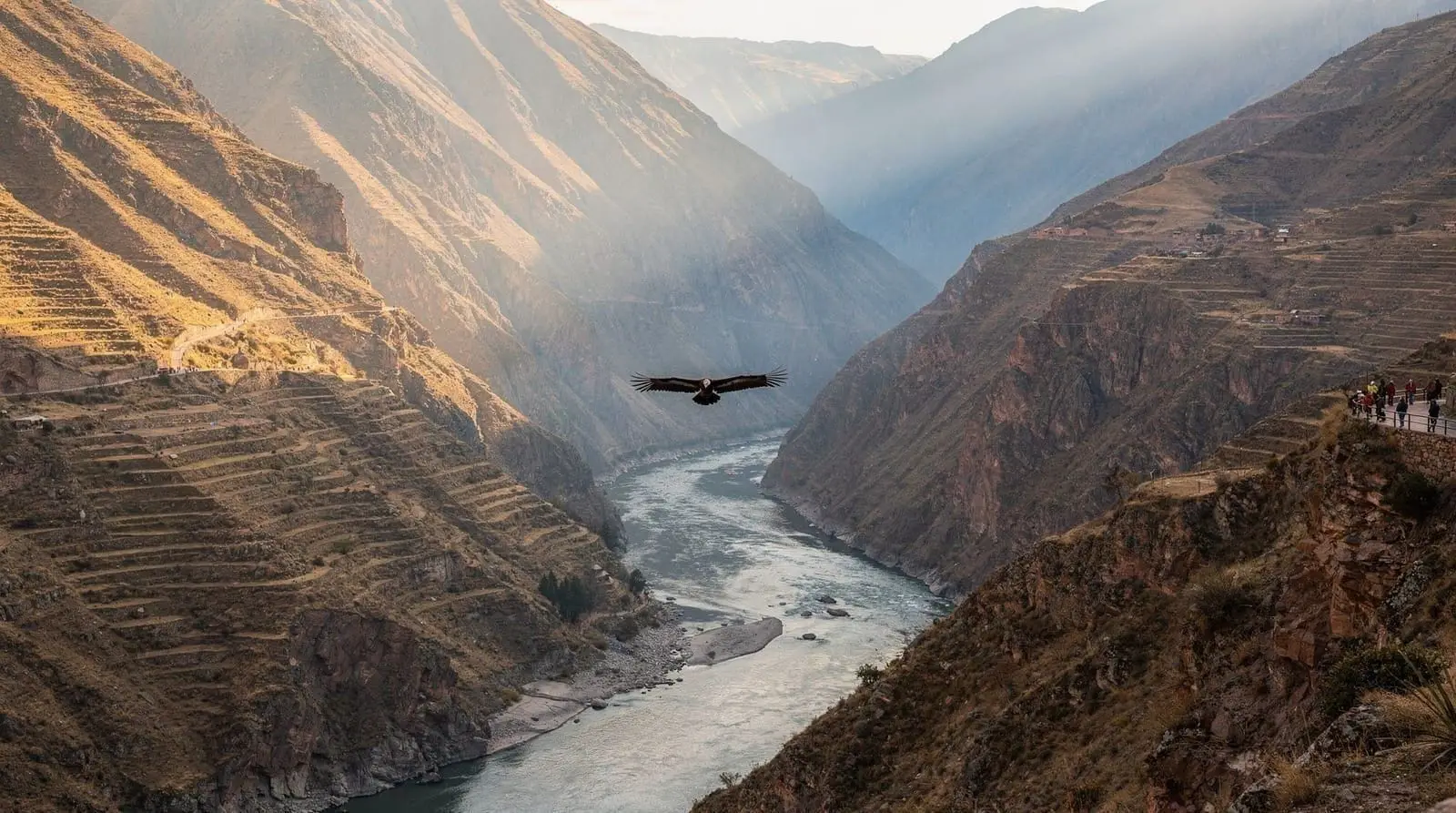
Colca Canyon
Colca Canyon explained honestly: the Cruz del Cóndor flights, full-day vs 2-day tours, altitude and mountain sickness, costs and how to actually see condors.
Arequipa: 2-Day Classic Colca Canyon Tour
Quick facts
- Depth
- ~3,270 m / 10,730 ft — among the deepest canyons on Earth
- Condor viewpoint
- Cruz del Cóndor, ~3,287 m, best mid-morning
- Gateway towns
- Chivay (the hub) and Cabanaconde (near the viewpoint)
- Best for
- Andean condors, trekking, terraced valleys, thermal baths
What the Colca Canyon really offers
The Colca Canyon is, by some measures, one of the deepest canyons on Earth — around 3,270 m / 10,730 ft from rim to river, considerably deeper than the Grand Canyon, though shaped differently and far less sheer. But depth statistics are not why most people come. They come for two things: the Andean condor, one of the largest flying birds in the world, which rides the morning thermals at close range over a viewpoint called the Cruz del Cóndor; and a dramatic valley of pre-Inca agricultural terraces still farmed by Collagua and Cabana communities.
| Where | 3–4h drive north of Arequipa, southern Peru |
| Time needed | 2 days recommended (full-day possible but exhausting) |
| Cost | Around S/120–250 for a 2-day tour + S/70 regional ticket |
| Getting there | Tour or bus from Arequipa via Patapampa pass (4,910 m) |
| Best time | May–November (dry season, best condor sightings) |
The honest framing is that Colca is a journey, not a quick excursion. It sits a 3–4 hour drive north of Arequipa, climbing through a high pass before dropping into the canyon, and the condor viewing happens at a fixed time of morning. That geography drives every planning decision below.
The condors — how to actually see them
The condors are the main event, and seeing them is partly down to timing and partly down to luck. The key facts:
- Where: the Cruz del Cóndor viewpoint (Mirador Cruz del Cóndor), on the road between Chivay and Cabanaconde, perched on the canyon rim at around 3,287 m.
- When: the birds use rising morning thermals to gain height out of the canyon, so the prime window is roughly 8 am to 10 am. By late morning the chances drop sharply. This is the single reason tours leave so brutally early.
- What you see: on a good morning, several condors (sometimes a dozen or more) circling and rising on the air currents, often passing close overhead. On a poor morning, you may see only one or two distant birds, or none. Sightings are best in the dry season (May–November) and are never guaranteed — any operator promising a sure thing is overselling.
- The crowds: the viewpoint gets busy at peak time. Arrive early, claim a spot on the railing, and bring patience and a zoom lens.
The condors are wild birds, not a fed attraction, which is exactly what makes the encounter worthwhile when it works.
Beyond the Cruz del Cóndor, condors are occasionally spotted at other points along the canyon rim, and Colca is also home to Andean geese, vizcachas (a rabbit-like rodent that suns itself on the rocks), and the giant hummingbird. Bring binoculars if you have them — the condors often circle at a distance before drifting close, and casual phone photos rarely do the birds justice compared with a longer lens or a good pair of binoculars.
Full-day vs two-day tours — choose carefully
This is the most important planning decision for Colca, and the answer matters for your comfort.
The full-day tour from Arequipa leaves around 3 am, drives 3–4 hours in the dark, reaches the Cruz del Cóndor for the morning flights, makes a few stops (a viewpoint, a village, sometimes Chivay’s thermal baths), and returns to Arequipa late the same evening — a 16–18 hour day, much of it on the road. It is genuinely exhausting, and the early start at altitude leaves some travellers feeling rough. Choose it only if you are tight on schedule. The full-day Colca Canyon tour from Arequipa packages this single-day version.
The two-day tour is the option most travellers should take. Day one drives up at a humane hour, explores the valley villages and terraces, and overnights in Chivay, where you can soak in the thermal baths and acclimatise. Day two reaches the Cruz del Cóndor at the right time without the pre-dawn agony, then returns. It is far more relaxed, gives you a better shot at the condors, and lets your body adjust to the altitude. The two-day classic Colca Canyon tour includes the overnight in Chivay.
The two-day tour ending in Puno is the smart routing if Lake Titicaca is next on your itinerary. Instead of backtracking to Arequipa, you finish in Puno, saving a full travel day. The two-day Colca Canyon trek ending in Puno combines the canyon with the onward leg toward Lake Titicaca.
| Format | Start time | Duration | Overnight | Condor viewing |
|---|---|---|---|---|
| Full-day from Arequipa | ~3 am | 16–18 hours | None | Rushed, tiring by the time you arrive |
| Two-day, back to Arequipa | Sensible morning | 2 days / 1 night | Chivay | Relaxed, better odds |
| Two-day, ending in Puno | Sensible morning | 2 days / 1 night | Chivay | Relaxed, plus saves a travel day |
For most travellers without a very tight schedule, one of the two-day formats is worth the extra cost over the full-day marathon.
Altitude and mountain sickness — read this before you go
Colca is high, and the route in is higher still. This is not a sea-level day trip, and underestimating the altitude is the most common Colca mistake.
- The drive from Arequipa crosses the Patapampa pass at around 4,910 m / 16,110 ft — higher than Everest Base Camp on the Nepal side. Tours usually stop here for photos of the volcano panorama, and some travellers feel light-headed even in the brief halt.
- The canyon-rim towns and viewpoints sit between roughly 3,300 and 3,650 m.
- Mountain sickness (soroche) is common: headache, nausea, breathlessness and disturbed sleep.
How to manage it:
- Acclimatise first. Spend a night or two in Arequipa (2,335 m) before the trip, and ideally avoid coming straight from sea level.
- The two-day tour helps by spreading the altitude gain over two days with an overnight in Chivay.
- Stay hydrated, eat lightly, and avoid alcohol on the first day at altitude.
- Coca tea is offered everywhere and many find it eases mild symptoms; acetazolamide (Diamox) is the standard preventative — ask a doctor before your trip.
- If you have heart or lung conditions, the Patapampa pass altitude is genuinely high; consult a doctor before booking.
Trekking in the canyon
Beyond the condor viewpoint, the Colca is a serious trekking destination. The classic route descends from Cabanaconde to the canyon floor and the Sangalle oasis (also called the Oasis), a green pocket of palm trees and small pools at the bottom, then climbs back out — a demanding two- or three-day trek with a long, steep ascent at the end. It is rewarding but not casual: the descent is hard on the knees and the climb out is genuinely tough at altitude. Go with a guide or a well-marked operator, carry plenty of water, and do not attempt it without acclimatising first.
Most trekkers overnight at Sangalle, where basic lodges with small swimming pools sit among the palms — a genuinely surreal contrast to the arid canyon walls above. The climb back out to Cabanaconde the next morning is the hard part: budget three to four hours of steady, steep uphill walking, ideally starting before sunrise to beat the heat. Mules can carry your pack for a fee if the ascent worries you.
Costs and practical details
- Boleto Turístico (tourist ticket): a regional entry fee of around S/70 / about $19 for foreign visitors is collected on the way into the Colca valley. Confirm whether your tour price includes it — it often does not.
- Full-day tour: roughly S/80–150 / about $22–40 plus the entry ticket.
- Two-day tour: roughly S/120–250 / about $32–67 including the Chivay overnight and most meals; confirm inclusions.
- Thermal baths in Chivay: around S/15–20 / about $4–5 if not bundled.
Bring layers (it is cold before dawn and warm by midday), sun protection, water, small soles for the entry ticket and tips, and a zoom lens if you have one.
Where Colca fits in your trip
The Colca Canyon pairs with Arequipa as its gateway and Chivay as its hub. The most efficient routing folds it into the southern Andes loop, often continuing to Puno, Lake Titicaca and Cusco. See the itineraries hub for full routings and the planning tools to sequence the altitude legs.
Frequently asked questions about the Colca Canyon
When is the best time to see condors at the Colca Canyon?
The prime window is roughly 8 am to 10 am at the Cruz del Cóndor viewpoint, when the birds ride the morning thermals out of the canyon. Sightings are best in the dry season (May to November) and are never guaranteed — be wary of any operator promising a certain sighting.
Should I do a full-day or two-day Colca Canyon tour?
The two-day tour is the better choice for most travellers: it avoids the brutal 3 am start, overnights in Chivay, and reaches the condor viewpoint at a sensible hour while helping you acclimatise. The full-day tour is a 16–18 hour marathon and only worth it if your schedule is very tight.
How high is the Colca Canyon and will I get altitude sickness?
The canyon-rim viewpoints sit at 3,300–3,650 m, and the drive crosses the Patapampa pass at around 4,910 m. Mountain sickness is common. Acclimatise in Arequipa first, choose the two-day tour, stay hydrated, avoid alcohol on the first day, and consider altitude medication.
Is the Colca Canyon worth visiting?
Yes, for the chance to see wild Andean condors in flight at close range and for the dramatic terraced valley — but go with realistic expectations. It is a long journey from Arequipa, the early starts are demanding, and condor sightings depend on luck and timing. The two-day version makes it far more enjoyable.
How much does a Colca Canyon tour cost?
A full-day tour runs roughly S/80–150 and a two-day tour roughly S/120–250 including the overnight, plus a regional tourist ticket (boleto turístico) of about S/70 that is often not included. Always confirm whether the ticket, meals and thermal baths are bundled.
Can you trek in the Colca Canyon?
Yes. The classic trek descends from Cabanaconde to the Sangalle (Oasis) on the canyon floor and climbs back out over two or three days. It is demanding — steep, long and at altitude — so go with a guide, carry plenty of water, and acclimatise before attempting it.
Top experiences
Bookable activities with verified prices and instant confirmation on GetYourGuide.

