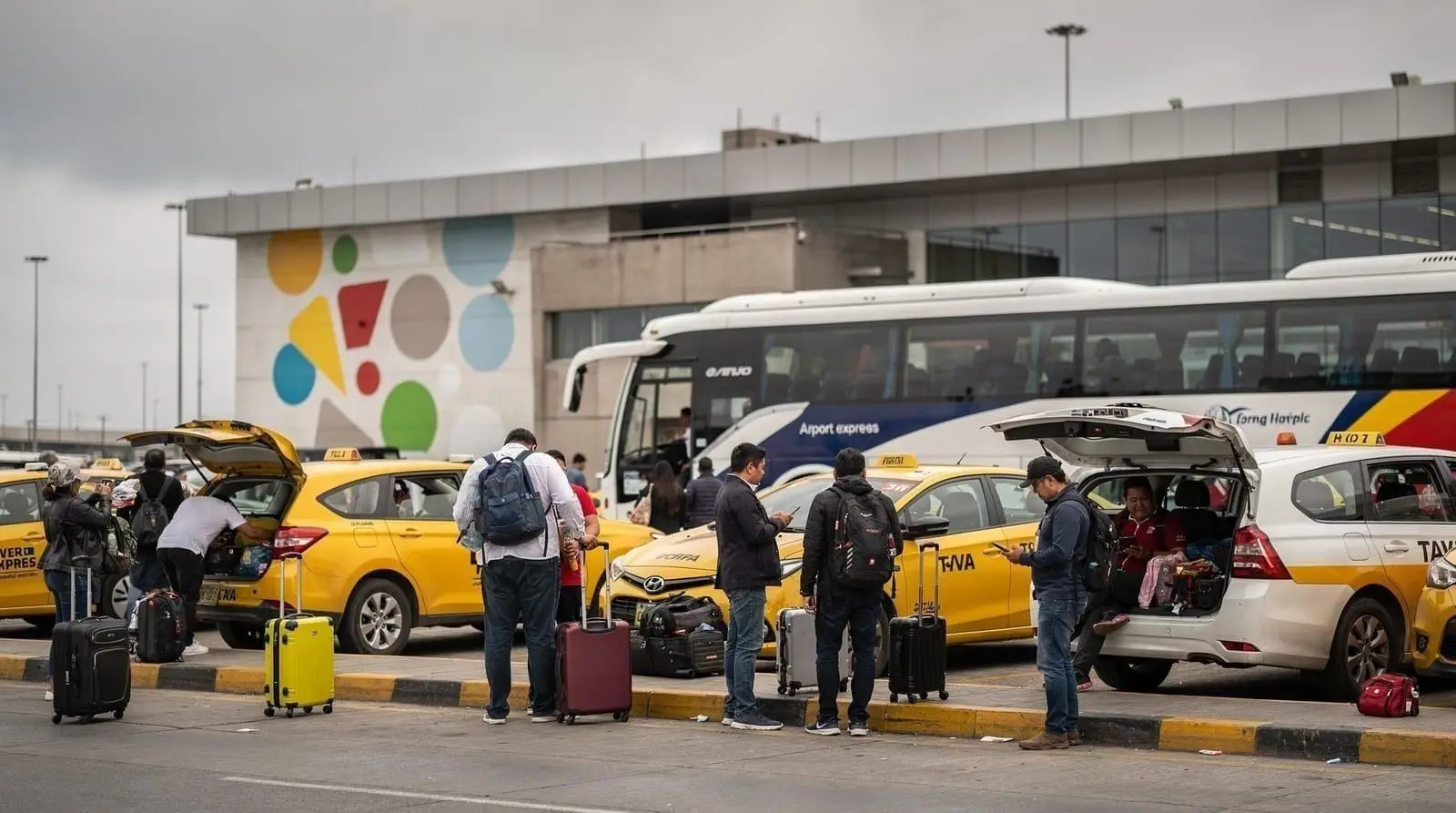
Lima airport to city: every transfer option compared
How do I get from Lima airport to Miraflores?
Official airport taxis or pre-booked transfers cost S/70-110 (about $19-30) and take 45-75 minutes. App taxis (Cabify, Uber) from the designated pickup area are cheaper at S/45-70. The Airport Express bus to Miraflores is the budget option at around S/30.
What you are dealing with on arrival
Lima’s Jorge Chavez International Airport (LIM) sits in Callao, about 17 km northwest of the tourist neighbourhoods of Miraflores and Barranco. On a map that looks close; in practice the drive crosses a dense, traffic-heavy city, so plan for 45-60 minutes in normal conditions and 75-90 minutes at rush hour. The airport completed a major expansion with a new terminal, so signage and the location of taxi counters and app pickup zones may differ from older guidebooks — follow the current in-terminal signage rather than memorised directions.
The single most important rule applies the moment you clear customs: do not accept a ride from anyone who approaches you inside or just outside the arrivals hall. Touts offering “taxi, taxi, amigo” are the source of nearly every overcharging and short-change story you will read about Lima. Every safe option below means walking past them to an official counter, a designated pickup area, or a driver holding a sign with your name. With that one habit, getting from the airport to your hotel is straightforward.
| Where | Jorge Chávez (LIM), Callao, ~17 km from Miraflores |
| Cheapest | Airport Express bus, around S/30 |
| Cheapest door-to-door | App taxi from the designated pickup zone, S/45-70 |
| Easiest for first-timers | Official terminal taxi counter, S/70-110 |
| Best for night arrivals/families | Pre-booked transfer, S/90-140 |
| Time | 45-60 min normal traffic, 75-90 min rush hour |
The options, compared
Official airport taxis (counters inside the terminal)
Inside the arrivals area you will find authorised taxi company desks (such as Taxi Green and similar licensed operators). You pay a fixed fare at the counter — typically S/70-110 (about $19-30) to Miraflores — and are walked to a marked vehicle. The fare is set in advance, so there is no meter argument and no surprise at the end.
This is the simplest safe choice for first-time visitors who do not want to deal with apps after a long flight. It costs more than a ride-hail app but buys certainty: a regulated company, a fixed price, and a desk to complain to if anything goes wrong.
Pre-booked private transfer
Booking a transfer in advance means a driver waits in arrivals holding a sign with your name, helps with luggage, and drives you door-to-door. Prices are broadly in the S/90-140 (about $24-38) range depending on vehicle size and the operator, and many include flight tracking so a delayed arrival is not a problem.
This is the option to choose for late-night arrivals, families, groups with lots of luggage, or anyone who simply wants zero friction after a long-haul flight. Your hotel can often arrange it, or you can book an established transfer company online before you travel. It is the most expensive door-to-door option but the lowest-stress.
App taxis: Cabify, Uber, InDriver
Ride-hail apps work well at Jorge Chavez and are usually the cheapest door-to-door option at around S/45-70 (about $12-19) to Miraflores. The important detail: you cannot be picked up at the arrivals curb. The airport has a designated app pickup area — follow the signs (often a short walk or a level change from arrivals) and meet your driver there.
Cabify is widely regarded as the most reliable and transparent in Lima; Uber and InDriver also operate. Whichever you use, confirm the licence plate and the driver’s name before getting in, and prefer paying through the app rather than cash. A local SIM (Claro or Entel, around S/20-30 with data) bought at the airport or beforehand makes this seamless; without data, the official counter is the better choice.
Airport Express Lima bus (budget pick)
The Airport Express Lima is a dedicated tourist bus running directly between the airport and Miraflores for around S/30 (about $8). It has air conditioning, Wi-Fi, luggage storage, and an onboard guard, and it stops at a series of points along the Miraflores hotel corridor. It is the best-value genuinely safe option for solo or budget travellers.
The trade-offs: it runs on a schedule rather than on demand, it only serves the Miraflores corridor (not Barranco, San Isidro, or the historic centre directly), and you may have a short walk or onward taxi from the drop point to your exact hotel. For a backpacker heading to a Miraflores hostel, it is hard to beat.
Public city buses and the Metropolitano (not recommended with luggage)
For completeness: ordinary city buses and combis serve Callao, and the Metropolitano express-bus corridor runs through central Lima and Miraflores. But the Metropolitano does not connect directly to the airport, and reaching it involves a local bus or taxi first. With luggage, jet lag, and Lima’s crowded buses, this is not a sensible arrival route. Use it for getting around the city later, not for the airport run.
Getting to districts other than Miraflores
Most arrival advice assumes you are heading to Miraflores, but you may be staying elsewhere. Here is how the options change:
- Barranco: Add roughly 15-20 minutes and S/10-20 to any Miraflores fare; it sits just south. Taxis and apps go door-to-door. The Airport Express bus does not serve Barranco directly, so bus travellers face an onward taxi from the Miraflores corridor.
- San Isidro: Broadly the same distance and price as Miraflores, sometimes marginally cheaper as it is slightly closer. All taxi and transfer options work normally.
- Historic centre / Centro: Closer to the airport than Miraflores (it is on the same side of the city), so app and counter taxis run S/40-70 and 30-45 minutes. The Airport Express does not serve the centre.
- Callao Monumental: The revitalised arts district is genuinely close to the airport (both are in Callao), a short S/25-40 taxi. Worth noting if you have a long layover and want to see the murals rather than sit in the terminal.
In short: taxis and transfers reach every district; the budget Airport Express bus is Miraflores-corridor only. If you are staying outside Miraflores and want to save money, take the bus to Miraflores and an app taxi onward, or simply use an app taxi door-to-door.
Cost and time summary
- App taxi (Cabify/Uber/InDriver): S/45-70 · 45-75 min · cheapest door-to-door, needs mobile data and the pickup-zone walk
- Airport Express bus: ~S/30 · 45-75 min · best budget option, Miraflores corridor only
- Official airport taxi (counter): S/70-110 · 45-75 min · fixed price, easiest for first-timers
- Pre-booked transfer: S/90-140 · 45-75 min · driver waits in arrivals, best for night flights and groups
All times assume light to normal traffic. Add 20-40 minutes during the 7-9 am and 5-8 pm peaks.
Practical arrival tips
- Get cash and a SIM at the airport carefully. Use a bank-branded ATM (BCP, Interbank, Scotiabank) inside the terminal rather than Banco de la Nacion, which carries higher fees. Withdraw soles; decline “dynamic currency conversion” that offers to charge in your home currency at a poor rate.
- Have your hotel address written down in Spanish, including the district (Miraflores, Barranco, San Isidro). Drivers know districts better than hotel names.
- Carry small soles for the bus or tips. Counters and apps handle larger amounts, but small change is useful.
- For the return to the airport, allow generous buffer time — Lima traffic is unpredictable, and the airport security and check-in queues can be long. Aim to leave Miraflores at least three hours before an international departure, more at rush hour.
- Continuing to Cusco? If you have a connecting domestic flight to Cusco and altitude ahead, consider an overnight in Lima rather than a same-day connection — it gives you a rest buffer before you face 3,400 m. See the /guides/peru-domestic-flights-guide/ for connection planning.
Connecting straight to Cusco or another domestic flight
A large share of travellers land at Lima only to connect onward to Cusco, Arequipa, or the jungle. Two honest points are worth making.
First, on the logistics: domestic and international flights at Jorge Chávez use the same airport, so a connection does not require leaving and re-entering — but you do clear customs and immigration on an international arrival, collect and re-check bags if your tickets are not on a single booking, and pass security again. Allow a comfortable buffer; a connection under two hours on separate tickets is risky given immigration queues.
Second, on your health: if your onward flight is to Cusco (3,400 m) or another high-altitude destination, think hard before connecting on the same day. Arriving jet-lagged and then ascending straight to altitude reliably makes acclimatisation worse. Many experienced travellers deliberately overnight in Lima — at sea level — to rest and hydrate before facing the Andes. It costs a night but pays off in how you feel for the first days of the trip. The /guides/peru-domestic-flights-guide/ covers connection timing in detail.
Arriving with a family or heavy luggage
If you are travelling with children, car seats, or a lot of luggage, the calculus shifts toward the pre-booked private transfer. A named driver waiting in arrivals who helps load bags and knows your destination removes a real source of stress at the end of a long flight, and a larger vehicle (van or SUV) avoids the squeeze of fitting a family plus suitcases into a small taxi.
Confirm car-seat availability in advance if you need one, as it is not standard. App taxis can also order larger vehicle categories, but you still face the walk to the pickup zone and the luggage handling yourself. For solo travellers and couples with normal luggage, the cost premium of a private transfer is harder to justify, and an app taxi or the Airport Express bus does the job well.
Avoiding the common airport scams
Lima’s airport is safe, but a handful of well-worn scams target tired arriving travellers, and knowing them in advance defuses all of them.
The friendly fake “official” taxi. Touts in or just outside arrivals often wear lanyards or carry clipboards to look official and quote a reasonable-sounding price, then either inflate it en route, take a long way round, or drive an unregistered car. The defence is simple: ignore anyone who approaches you, and only deal with the company desks inside the terminal, your pre-booked driver holding your name, or an app driver at the designated zone.
The “the address doesn’t exist / hotel is closed” detour. An unlicensed driver claims your hotel is full, closed, or in a bad area and offers to take you to a “better” one (where they earn a commission). A legitimate driver takes you where you booked. Insist on your destination; if a driver argues, get out at a safe, public spot.
The currency and change shuffle. Paying cash in dollars invites a poor exchange rate and “no change” claims. Pay app taxis through the app, pay counter taxis the fixed posted fare, and carry small soles so you are never dependent on a driver’s change.
The SIM and ATM upsell. Use bank-branded ATMs inside the terminal and official telecom counters (Claro, Entel) rather than informal stalls offering to “help.” Decline dynamic currency conversion at any ATM that offers to charge in your home currency.
None of this should make you nervous — millions arrive at Jorge Chávez every year without trouble. The single habit that prevents almost every problem is refusing rides from anyone who approaches you and walking to an official option instead.
Terminal layout and what changed with the new building
Jorge Chávez finished a major terminal expansion in stages through the mid-2020s, and the physical layout has shifted more than once as a result — a real source of confusion for anyone relying on an older guidebook or a friend’s memory of the airport from a few years back. Arrivals now funnel through a longer corridor before reaching the taxi counters and the app pickup signage, and the walk from the gate to ground transport can take longer than at the old terminal.
The fix is simple: ignore memorised directions and follow the current overhead signage, which is repainted each time the layout changes and is more reliable than secondhand advice. Airport staff in yellow vests are stationed at the main junctions and will point you the right way if you ask; this is a normal, safe interaction, unlike accepting a ride from someone in the same uniform-adjacent clothing who offers a “taxi.”
Exchanging money and getting a SIM before you leave the terminal
Two small tasks at the airport make the rest of your trip smoother, and both are worth doing before you queue for a taxi. For cash, use one of the bank-branded ATMs (BCP, Interbank, Scotiabank) inside the arrivals hall rather than the informal currency-exchange booths, which post worse rates than the interbank one, or Banco de la Nación machines, which carry higher withdrawal fees.
Withdraw soles directly and decline any prompt for “dynamic currency conversion” that offers to charge your home currency instead — it is always a worse deal dressed up as a convenience. For connectivity, the Claro and Entel counters near arrivals sell tourist SIMs with a data bundle for roughly S/20-30, activated on the spot with your passport; having data live before you leave the terminal makes the ride-hail apps, offline maps, and translation tools work properly for the taxi ride itself, not just once you reach your hotel.
Which option should you pick?
- First-time visitor, daytime arrival, want zero hassle: official airport taxi counter.
- Late night, family, lots of luggage, or nervous traveller: pre-booked private transfer.
- Cost-conscious but want comfort and a known price: app taxi from the designated pickup zone.
- Backpacker heading to Miraflores on a budget: Airport Express bus.
Once you are settled, the rest of getting around Lima is covered in the /destinations/lima/ overview, and the /guides/lima-in-2-days/ itinerary shows how the districts connect. If you are still weighing whether to spend time in the city at all, see /guides/is-lima-worth-visiting/.