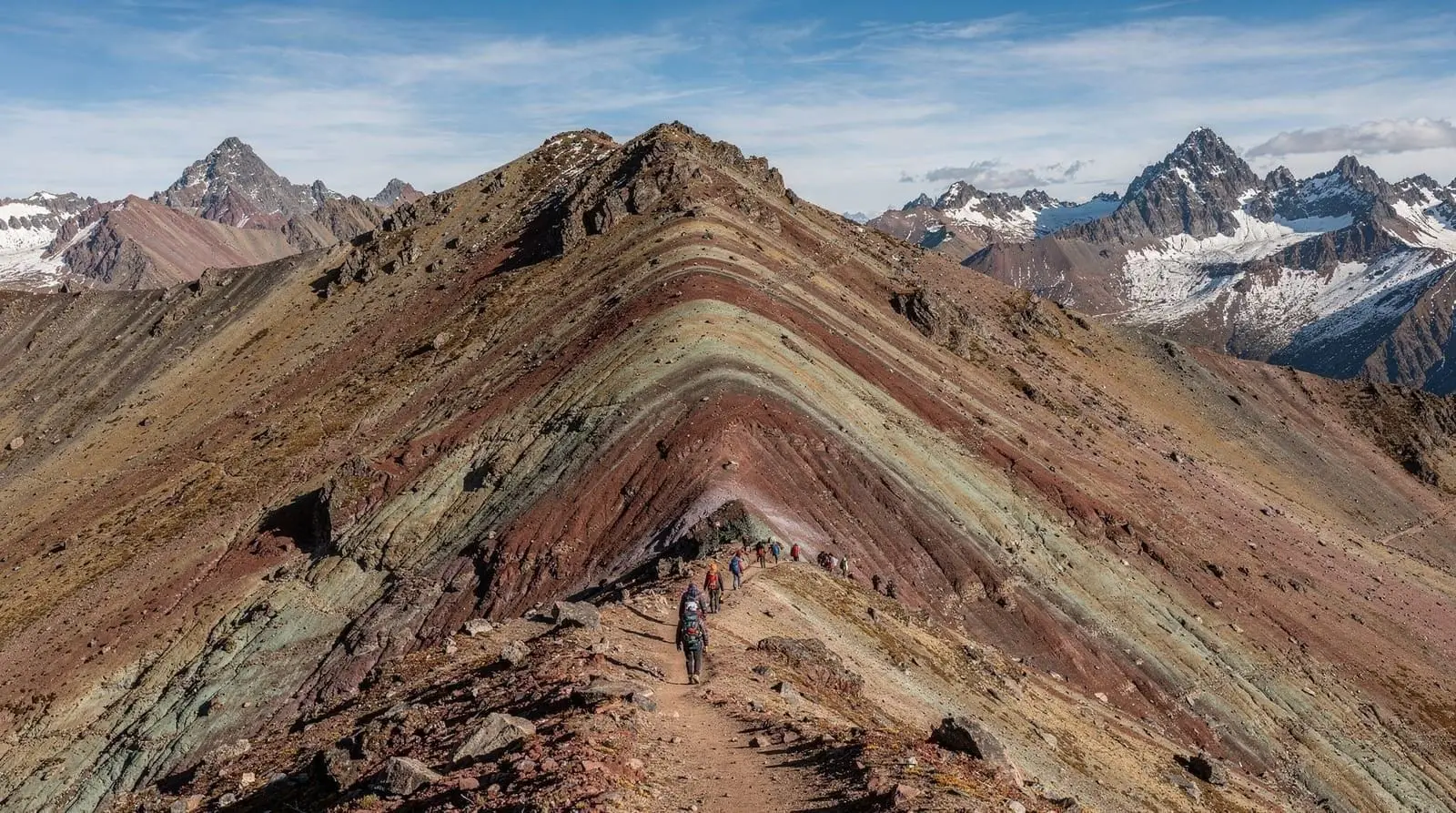
Rainbow Mountain (Vinicunca)
What Rainbow Mountain (Vinicunca) is really like: the 5,200 m altitude, the 3 am start, the crowds, the horses, and how to do it without suffering.
Vinicunca Rainbow Mountain Day Trip from Cusco
Quick facts
- Summit altitude
- 5,036-5,200 m / 16,520-17,060 ft
- Pickup time
- Typically 3:00-4:30 am from Cusco
- Round-trip time
- 14-16 hours including transport
- Hike
- 5-7 km round trip, 1.5-2 hours up
- Entry fee
- S/25 community ticket (not always included)
Should you actually do Rainbow Mountain?
This is the single most important question on this page, so let’s answer it before anything else. Vinicunca tops out somewhere between 5,036 and 5,200 metres depending on which photo spot you walk to. That is higher than Everest Base Camp on the Nepal side, and it is reached on a day trip from Cusco — which itself sits at 3,400 m. If you arrive in Cusco one evening and attempt Rainbow Mountain the next morning, there is a real chance you will spend the hike with a pounding headache, nausea, and a heart rate that will not settle. Some people are fine. Many are not, and a small number end up needing oxygen at the trailhead.
So the honest answer is: yes, it is worth it, but only if you have spent at least two full days acclimatising in Cusco, the Sacred Valley, or Ollantaytambo first. The striped hillside is genuinely striking when the light is right and the snow has melted off. But it is also crowded, cold, dusty, and physically demanding in a way the Instagram photos never show.
If you are short on acclimatisation time or want a gentler day, read the section on Palccoyo further down — it is the smarter choice for a lot of travellers. The is Rainbow Mountain worth it guide goes deeper on this exact question if you are still undecided.
| Where | Cordillera Vilcanota, ~3 hrs southeast of Cusco |
| Cost | Around $25-45 USD guided day trip; +S/25 community entry |
| Time needed | Full day, 14-16 hours door to door |
| Getting there | Guided minivan pickup from Cusco (no public transport option) |
| Best time | April to October (dry season, clearest colours) |
What Vinicunca really is
Vinicunca, also spelled Winikunka and marketed everywhere as “Montaña de Siete Colores” (Seven-Colour Mountain), is a ridge in the Cordillera Vilcanota whose flanks are banded in red, gold, green, and turquoise. The colours come from mineral sediments — iron oxides for the reds and pinks, chlorite for the greens, sulphur compounds for the yellows — that were tilted and exposed by tectonic uplift and only fully revealed in the last decade or so as the glacier and snow cover retreated. That retreat is the uncomfortable backstory: Rainbow Mountain became visible, and then a global attraction, largely because the climate warmed.
The site sits within land belonging to the communities of Pitumarca and Cusipata, roughly three hours’ drive southeast of Cusco. There was effectively no tourism here before around 2015. Today, on a peak-season morning, well over a thousand people walk the trail. Understanding that history matters because it shapes everything about the visit: the infrastructure is community-built and improvised, the trail is dusty and eroded, and the experience is far more commercial than the pristine-wilderness imagery suggests.
The day, hour by hour
A standard Rainbow Mountain day trip is long and front-loaded with driving. Here is the realistic timeline so you can decide whether you have the stamina:
- 3:00-4:30 am — hotel pickup in Cusco. Yes, that early. The aim is to reach the summit before the worst of the crowds and the afternoon clouds.
- 5:30-6:00 am — breakfast stop in a roadside community (usually Cusipata or Pitumarca). Basic but warm.
- 8:00-8:30 am — arrive at the trailhead at around 4,600 m.
- 8:30-10:00 am — hike up. The walk is only 5-7 km round trip, but the final ascent to the viewpoint at 5,036+ m is where altitude bites hardest.
- 10:00-10:45 am — time at the top for photos.
- 11:00 am-1:00 pm — descend and drive to a lunch stop.
- 5:00-7:00 pm — back in Cusco.
That is 14 to 16 hours door to door for roughly 45 minutes at the actual viewpoint. Go in knowing the ratio.
For most travellers the simplest way to do it is a guided group day trip such as the Vinicunca Rainbow Mountain day trip from Cusco, which bundles the pre-dawn transport, breakfast, a guide, and the long drive home — logistics that are genuinely awkward to arrange independently because there is no public transport to the trailhead.
The hike itself
The walking distance is short, which lulls people into underestimating it. The problem is never the kilometres; it is the air. At 4,800-5,000 m there is roughly half the oxygen available at sea level. A flight of stairs feels like a sprint. The trail climbs steadily on a wide dirt path, gaining around 350-400 m of elevation over 2.5-3.5 km depending on where you start.
Walk slowly and deliberately — what Andean guides call “paso de llama,” a llama’s pace. Take three steps, breathe, repeat if you need to. There is no prize for arriving first, and pushing hard at this altitude is exactly how you trigger acute mountain sickness. Most reasonably fit, acclimatised people make the top in 90 minutes to two hours. The descent is faster, around an hour, but loose gravel makes trekking poles worthwhile.
The horse question. At the trailhead, local wranglers offer horses (caballos) for the ascent, typically S/80-120 / about $22-32 one way, negotiable. This is a legitimate option if altitude is overwhelming you — there is no shame in it, and the income supports the communities. Note that horses cannot go the entire way: there is a final steep stretch of 10-15 minutes you must walk regardless. Decide honestly at the bottom rather than collapsing halfway up.
Altitude: the part nobody should skip
If you read one section on this page, make it this one.
Acclimatise first. Spend a minimum of two full days at Cusco altitude or in the Sacred Valley before attempting Vinicunca. Three is better. Do not fly into Cusco and book Rainbow Mountain for the following morning, no matter how tight your schedule is.
Know the symptoms. A mild headache, breathlessness, and fatigue are normal at this elevation. Vomiting, confusion, an inability to walk in a straight line, or a wet cough are not — they are warning signs of serious altitude illness, and the correct response is to descend immediately. A good guide carries an oxygen bottle and watches for these signs.
Practical defences. Drink far more water than feels natural. Avoid alcohol the night before. Eat lightly. Many travellers chew coca leaves or drink coca tea (mate de coca), which is the traditional Andean remedy and genuinely helps some people; it is legal and freely available in Peru. Some travellers take acetazolamide (Diamox) starting a day or two before — discuss this with a doctor before your trip, not at the trailhead.
Dress for winter, even in summer. The trailhead can be sunny and 15 °C while the summit is in freezing wind and sleet 45 minutes later. Bring layers, a windproof jacket, gloves, a hat, and strong sunscreen — UV at 5,000 m is brutal even through cloud.
Crowds, conditions, and the parts brochures omit
Rainbow Mountain is busy. On a typical dry-season morning you will share the viewpoint with hundreds of other people, queuing for the same photo angle. If you want the colours without the crush, the only reliable lever is timing: the earliest tours that reach the top by 9 am beat the worst of it, and weekdays are quieter than weekends.
Group size varies by operator, and this is worth asking about when you book. Budget agencies often combine several minivans of travellers at the trailhead, so a “small group” tour on paper can still merge into a much larger crowd on the trail itself. Paying slightly more for an operator that genuinely caps numbers and does not merge groups tends to produce a noticeably calmer morning, particularly for photography.
The trail is dusty in the dry season and a mud bath after rain. There are basic toilets at the trailhead (a small fee, bring change) and almost nothing on the trail itself. Snacks and water are sold by community vendors along the way at marked-up but fair prices. The community entry ticket is around S/25 / about $7 and is sometimes — but not always — included in tour prices; confirm before you book so you are not caught out with cash at the gate.
One genuine alternative worth knowing: the Rainbow Mountain and Red Valley ATV tour swaps part of the slog for quad bikes and adds the nearby Red Valley (Valle Rojo), a deep-red eroded valley that most day-trippers never see and that is, for many people, more memorable than Vinicunca itself. The Red Valley Cusco guide covers this add-on in more depth, and a first-hand Rainbow Mountain reality check is worth reading if you want an unfiltered account before you commit to the 3 am alarm.
What to pack
Getting this wrong is one of the most common regrets travellers report. Layer for both a mild trailhead and a genuinely cold, windy summit: a base layer, a warm mid-layer, and a windproof/waterproof outer shell. Add gloves, a warm hat, and sunglasses — snow glare at 5,000 m is real even on a clear day. Broken-in walking shoes or boots with grip matter more than technical mountaineering gear. Bring more water than feels necessary, high-energy snacks, cash in small soles for the entry fee, optional horse hire, and toilets, and sunscreen rated for high-altitude UV. A walking pole helps on the loose gravel descent. See the general what to pack for Cusco guide for the rest of your bag.
Rainbow Mountain vs Palccoyo vs Ausangate
Three different experiences get marketed under the “rainbow” banner, and choosing the right one saves a lot of regret.
- Vinicunca (this page): the famous one. Highest, busiest, most photographed, hardest hike. Best for acclimatised travellers who specifically want the iconic striped ridge.
- Palccoyo: the gentle alternative. Lower (around 4,900 m), a near-flat 30-45 minute walk, three rainbow ridges instead of one, and a fraction of the crowds. The honest pick for anyone short on acclimatisation or wary of the altitude.
- Ausangate: the serious one. A multi-day trek (or a long day to the seven lagoons) around Peru’s holiest mountain, far less travelled, for hikers who want wilderness rather than a photo stop.
If Vinicunca is on your list mainly because it is famous, take a hard look at Palccoyo before you commit to the 3 am alarm.
How it fits a longer trip
Rainbow Mountain pairs naturally with the rest of the Cusco region. Most travellers slot it after they have already seen Machu Picchu and the Sacred Valley, using it as a final high-altitude day before flying out — by which point they are well acclimatised. Combining it earlier, before Machu Picchu, works too, as long as those Cusco acclimatisation days come first.
A realistic sequence for a first-time Cusco trip: arrive and spend two nights acclimatising in the city or the Sacred Valley, do Machu Picchu, then finish with Rainbow Mountain as the last big day before flying home tired but satisfied. Scheduling it on day one or two of any Peru trip is the single most common mistake independent planners make, usually driven by flight schedules rather than physiology — resist the temptation if you can shift even one day.
Some longer packages fold Rainbow Mountain into a single Cusco itinerary; the 5-day Machu Picchu, Rainbow Mountain and Sacred Valley tour is one such option that handles the sequencing and altitude pacing for you, which removes the temptation to attempt Vinicunca too soon. For building your own route, see /itineraries/ or the planning /guides/, and use the /tools/ page to check seasonal conditions.
Frequently asked questions about Rainbow Mountain
How hard is the Rainbow Mountain hike?
The distance is short — 5 to 7 km round trip — but the altitude makes it genuinely demanding. The viewpoint sits above 5,000 m, where oxygen is roughly half of sea-level. Reasonably fit and acclimatised people manage it in 90 minutes to two hours of slow walking. The difficulty is almost entirely about the thin air, not the terrain, which is a wide dirt path.
Do I need to acclimatise before Rainbow Mountain?
Yes, and this is not optional advice. Spend at least two full days at Cusco altitude or in the Sacred Valley before attempting Vinicunca. Arriving in Cusco and doing Rainbow Mountain the next day risks serious altitude sickness. If your schedule cannot accommodate the acclimatisation, choose Palccoyo, which is lower and gentler.
What time does the Rainbow Mountain tour start?
Pickups in Cusco are typically between 3:00 and 4:30 am. The early start lets you reach the summit before the heaviest crowds and the afternoon clouds. The full round trip is 14 to 16 hours, so it is a complete day with very little flexibility.
Can I take a horse up Rainbow Mountain?
Yes. Local wranglers rent horses at the trailhead for roughly S/80-120 one way, negotiable. It is a reasonable choice if altitude is overwhelming you, and the income supports the host communities. Horses cannot reach the final viewpoint, however — there is a steep last stretch of 10-15 minutes you must walk on foot.
When is the best time to visit Rainbow Mountain?
April to October, the Andean dry season, gives the most reliable colours and the firmest trail. The January-to-March rainy season often blankets the ridge in snow or cloud, hiding the very colours you came to see, and turns the path to mud. Early-morning arrivals in the dry season see the best light and the fewest people.
Is Rainbow Mountain too crowded to enjoy?
It can be very busy — hundreds of people at the viewpoint on a peak morning. The crowds are real and the trail is commercial. If that matters to you, the earliest tours beat the worst of it, weekdays are quieter, and Palccoyo offers the same rainbow-ridge experience with a fraction of the people.
Should I do Vinicunca or Palccoyo?
If you specifically want the famous striped ridge and you are well acclimatised, do Vinicunca. If you are short on acclimatisation, nervous about extreme altitude, travelling with children, or simply want a calmer day, Palccoyo is the better choice — lower, flatter, less crowded, and home to three rainbow ridges rather than one.
What should I pack for Rainbow Mountain?
Warm layers for a sub-zero summit even if the trailhead is mild, gloves, a hat, sunglasses for snow glare, sturdy walking shoes, a windproof shell, sunscreen, snacks, and more water than feels necessary. Cash in small soles covers the community entry fee, toilets, and optional horse hire. A trekking pole helps on the loose gravel descent.
Top experiences
Bookable activities with verified prices and instant confirmation on GetYourGuide.
