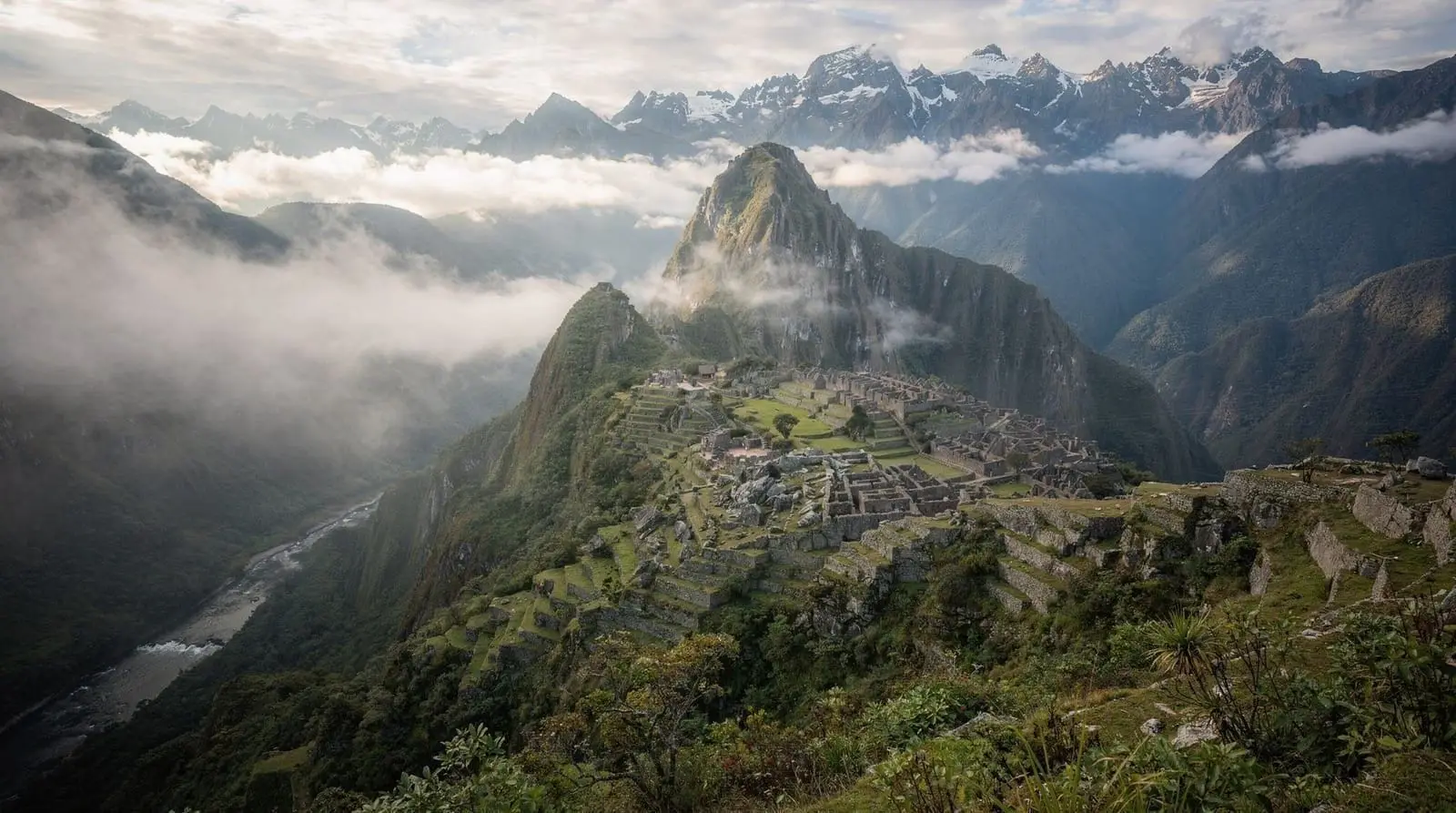
Peru in 2 weeks: a realistic 14-day itinerary
Lima: City Tour, Larco Museum and Huaca Pucllana
What is the best 2-week itinerary for Peru?
The classic 14-day southern circuit runs Lima (2 nights) → Cusco and the Sacred Valley (5 nights, including Machu Picchu) → Lake Titicaca (2 nights) → Arequipa and Colca Canyon (3 nights), ending with a flight back to Lima. It balances the headline sights with enough acclimatisation time and avoids backtracking.
The logic behind this route
Two weeks is the length most experienced Peru travellers point first-timers toward, and the route below is the reason. It is the southern circuit — Lima, Cusco, Machu Picchu, Lake Titicaca, Arequipa, and the Colca Canyon — strung together in the order that acclimatises you gradually, avoids doubling back, and folds the unavoidable travel days into scenery rather than dead time.
If you are still deciding whether a fortnight is the right length, read how many days you need in Peru first. If you have more time, the three-week itinerary adds the Amazon or the south coast. This plan deliberately leaves both out: trying to cram a jungle lodge into fourteen days is where two-week trips fall apart.
| Where | Lima, Cusco/Sacred Valley, Machu Picchu, Lake Titicaca, Arequipa/Colca |
| Cost | $1,200-4,000+ per person, excluding international flights |
| Time needed | 14 days |
| Getting there | International flight into Lima, 2-3 domestic flights |
| Best time | May-September (dry season) for the clearest mountain views |
Three principles shape the order:
- Altitude rises gradually. Sea-level Lima → 2,800–3,400 m Cusco region → 3,800 m Lake Titicaca → 2,335 m Arequipa. You never make a big jump on an arrival day.
- Travel days are productive. The Cusco–Puno leg becomes a sightseeing bus; the Puno–Arequipa leg is overnight or daytime scenic; the final hop is a flight.
- Machu Picchu sits mid-trip, not on day two. By the time you reach the citadel you are acclimatised and over your jet lag.
Days 1–2: Lima
Day 1 — Arrival. Most long-haul flights land in Lima in the evening or overnight. Do not schedule anything. Get to Miraflores or Barranco, sleep, hydrate.
Day 2 — Lima proper. Use your one full day on the things Lima does best: the colonial historic centre in the morning, the Larco Museum and the Huaca Pucllana pyramid in the afternoon, and a ceviche lunch (it is a midday dish in Lima, not an evening one). The Lima city tour combining Larco Museum and Huaca Pucllana covers the three anchor sights in one guided sweep, which is the efficient choice when you only have a day.
Where to stay: Miraflores for convenience, Barranco for atmosphere.
Cost note: A solid ceviche lunch runs S/35–60 (about $9–16); the airport taxi to Miraflores is S/60–90 ($16–24). See the full breakdown in our trip cost guide.
Days 3–7: Cusco, the Sacred Valley and Machu Picchu
This is the heart of the trip — five nights that need careful sequencing because of altitude.
Day 3 — Fly to Cusco, descend to the valley. Take a morning Lima–Cusco flight (about 1h25). Counter-intuitively, do not sleep in Cusco (3,400 m) on your first night. Transfer straight down to the lower Sacred Valley around Urubamba or Ollantaytambo at 2,800 m, where the thinner air is noticeably gentler. Spend the afternoon doing nothing strenuous.
Day 4 — Sacred Valley. The big sights: the agricultural terraces and ruins of Pisac, the fortress town of Ollantaytambo, and the salt pans of Maras and the circular terraces of Moray. The Sacred Valley small-group tour covering Pisac, Maras, Moray and Ollantaytambo hits all of these in a day with transport sorted, which matters because the sites are spread across the valley.
Day 5 — To Machu Picchu. Take the train from Ollantaytambo to Aguas Calientes (about 1h40 on the scenic line along the Urubamba river). Overnight in Aguas Calientes so you can catch an early bus up the next morning.
Day 6 — Machu Picchu, then Cusco. Early bus up to Machu Picchu for your timed entry slot. Take a guide on the site — the layout makes far more sense with one. Train back down in the afternoon and transfer up to Cusco for the night. If you want the logistics handled end to end, the 2-day, 1-night Sacred Valley and Machu Picchu tour by train bundles the train, bus, ticket, and guide so you are not juggling four separate reservations.
Day 7 — Cusco city. Now that you are acclimatised, explore Cusco itself: Qorikancha, the San Blas artisan quarter, San Pedro Market, and the Inca-walled fortress of Sacsayhuamán above the city. This is also the day to add a high-altitude trip if you want one — Rainbow Mountain or Humantay Lake — but only because your body has had four days to adjust.
Acclimatisation note: If anyone in your group struggles with altitude, this Cusco block is where it shows. Coca tea, slow walking, and avoiding alcohol for the first two days are the standard local remedies.
Days 8–9: Lake Titicaca
Day 8 — Cusco to Puno, the scenic way. The transfer from Cusco to Puno is the classic “travel day that is actually a sightseeing day.” The Route of the Sun bus from Cusco to Puno takes 6–7 hours but stops at the Sistine-Chapel-of-the-Andes church at Andahuaylillas, the Wari–Inca site of Raqchi, and the 4,335 m La Raya pass. Far better than the alternative of a Cusco–Juliaca flight that strands you 45 minutes from the lake.
Day 9 — Lake Titicaca. The world’s highest navigable lake at 3,812 m. A full-day boat trip visits the floating Uros reed islands and the weaving community of Taquile. The full-day Lake Titicaca tour of Uros and Taquile is the standard version; with a spare night you can do the two-day Amantaní homestay instead for a far more memorable, less touristy experience.
Altitude warning: Puno (3,800 m) is higher than Cusco. Some travellers who breezed through Cusco feel the lake’s altitude. Take it easy on the first afternoon.
Days 10–14: Arequipa and the Colca Canyon
Day 10 — Puno to Arequipa. A 5–6 hour bus across the altiplano brings you down to Arequipa at 2,335 m — a relief for your lungs after a week up high. Cruz del Sur and similar operators run comfortable daytime services. Settle in; the lower altitude means you sleep better tonight.
Day 11 — Arequipa city. Peru’s second city is built from white volcanic sillar stone and frames three volcanoes. The Santa Catalina Monastery (a walled city-within-a-city of nuns) and the mummy Juanita at the Museo Santuarios Andinos are the standouts. Spend the evening on the Plaza de Armas, one of the finest in Peru.
Day 12 — To the Colca Canyon. Transfer to Chivay on the rim of the Colca Canyon, one of the deepest canyons on earth at over 3,400 m from rim to river. The drive crosses a 4,910 m pass with vicuña on the high plain. Overnight in Chivay or the canyon villages; soak in the Calera hot springs.
Day 13 — Cruz del Cóndor and back to Arequipa. Early start for the Cruz del Cóndor viewpoint, where Andean condors ride the morning thermals out of the canyon — Peru’s most reliable big-bird sighting. Return to Arequipa in the afternoon.
Day 14 — Fly home. Morning Arequipa–Lima flight (about 1h35) to connect with your international departure. Critically: do not book a same-day international connection on a tight margin — domestic delays are routine. If your flight home leaves at night, the schedule works; if it leaves in the afternoon, add a Lima buffer night.
Cost snapshot for 14 days
Rough per-person estimates, excluding international flights to and from Lima:
| Travel style | 14-day total | Daily average |
|---|---|---|
| Budget (hostels, public buses, set menus) | $1,200–1,800 | $85–130 |
| Mid-range (3-star hotels, tourist buses, guided tours) | $2,000–3,500 | $145–250 |
| Comfortable (4-star, private transfers, premium train) | $4,000+ | $285+ |
The biggest fixed costs are the Machu Picchu logistics (train, bus, and ticket together run roughly $150–220 depending on train class) and the two or three domestic flights. Everything else scales with your choices. Our full Peru trip cost guide breaks down food, transport, and entry fees in detail.
How to adapt this itinerary
Tighter on time (10 days): Cut the Arequipa/Colca block and end after Lake Titicaca, or cut Titicaca and keep Arequipa — do not try to keep both in ten days.
More adventurous: Swap the standard Machu Picchu train for a trek. The Salkantay route and Machu Picchu 4-day trek reaches the citadel via a high pass and cloud forest and is bookable without the months-ahead Inca Trail permit. Note that a multi-day trek replaces Days 5–6 and tightens the rest of the schedule — read the gringo trail guide for how the trekking options compare.
Add the Amazon: You cannot fit a proper jungle stay in fourteen days without dropping a region. If the Amazon matters to you, move up to the three-week plan.
Prefer less altitude: If high elevation is a concern, weight the trip toward Lima, the Sacred Valley (lower than Cusco), and Arequipa, and keep the Lake Titicaca leg short. See our best time and altitude notes.
For more ready-made plans and to mix and match destinations, browse the itineraries hub, compare guided options on the tours hub, and map your own route with the planning tools.
What this itinerary deliberately leaves out, and why
Every 14-day plan is a series of trade-offs, and being upfront about what this one skips helps you decide if it is right for you. It leaves out the Amazon entirely — a proper jungle lodge stay needs its own 3-to-4-night block that this schedule has no slack for, and trying to bolt it on turns two other legs into rushed half-measures. It also skips northern Peru (Chachapoyas, Kuélap, Trujillo) and the south coast (Paracas, Nazca, Huacachina) — both genuinely worthwhile, both requiring their own dedicated days that a first two-week trip cannot absorb without cutting the southern circuit’s core.
The logic is deliberate: for a first Peru trip, depth on the proven southern circuit beats breadth across the whole country. Travellers who try to squeeze in a jungle lodge or the south coast on top of this schedule routinely report exhausting, rushed final days that undercut Machu Picchu and Titicaca rather than adding real value. If any of those regions matter enough to you that skipping them would be a disappointment, the three-week itinerary is the honest answer, not squeezing a compromise into fourteen days.
Booking timeline: what to lock in and when
Machu Picchu logistics are the piece of this itinerary most likely to unravel if left too late. Book the entrance ticket and train tickets as soon as your dates are fixed — ideally three to six months ahead for June-to-August travel, when both sell out. If you are considering the Salkantay trek instead of the standard train, that can usually be booked with a few weeks’ notice, but the classic Inca Trail permit needs five to six months’ lead time and is a different itinerary shape entirely.
Domestic flights (Lima-Cusco and Arequipa-Lima) are the next priority: book these once your overall dates are set, since fares roughly double in the final month before departure during high season. Everything else on this itinerary — the Sacred Valley tour, the Titicaca boat, the Colca Canyon trip — can reasonably be booked a few days ahead once you are in Peru, giving you flexibility to adjust the pace if altitude or fatigue slows you down.