Huaca Pucllana
Honest guide to Huaca Pucllana, Lima's adobe pyramid in Miraflores: entry prices, hours, the night visit, the restaurant, and how long you need.
Lima: Huaca Pucllana Site Museum Private Tour with Tickets
Quick facts
- Location
- General Borgoño block 8, Miraflores, Lima
- Age
- Built ~400-700 CE by the Lima Culture
- Entry
- ~S/15 / about $4 (guided visit included)
- Closed
- Tuesdays
- Best for
- Pre-Columbian archaeology, an easy in-city culture stop
A 1,500-year-old pyramid in the middle of Miraflores
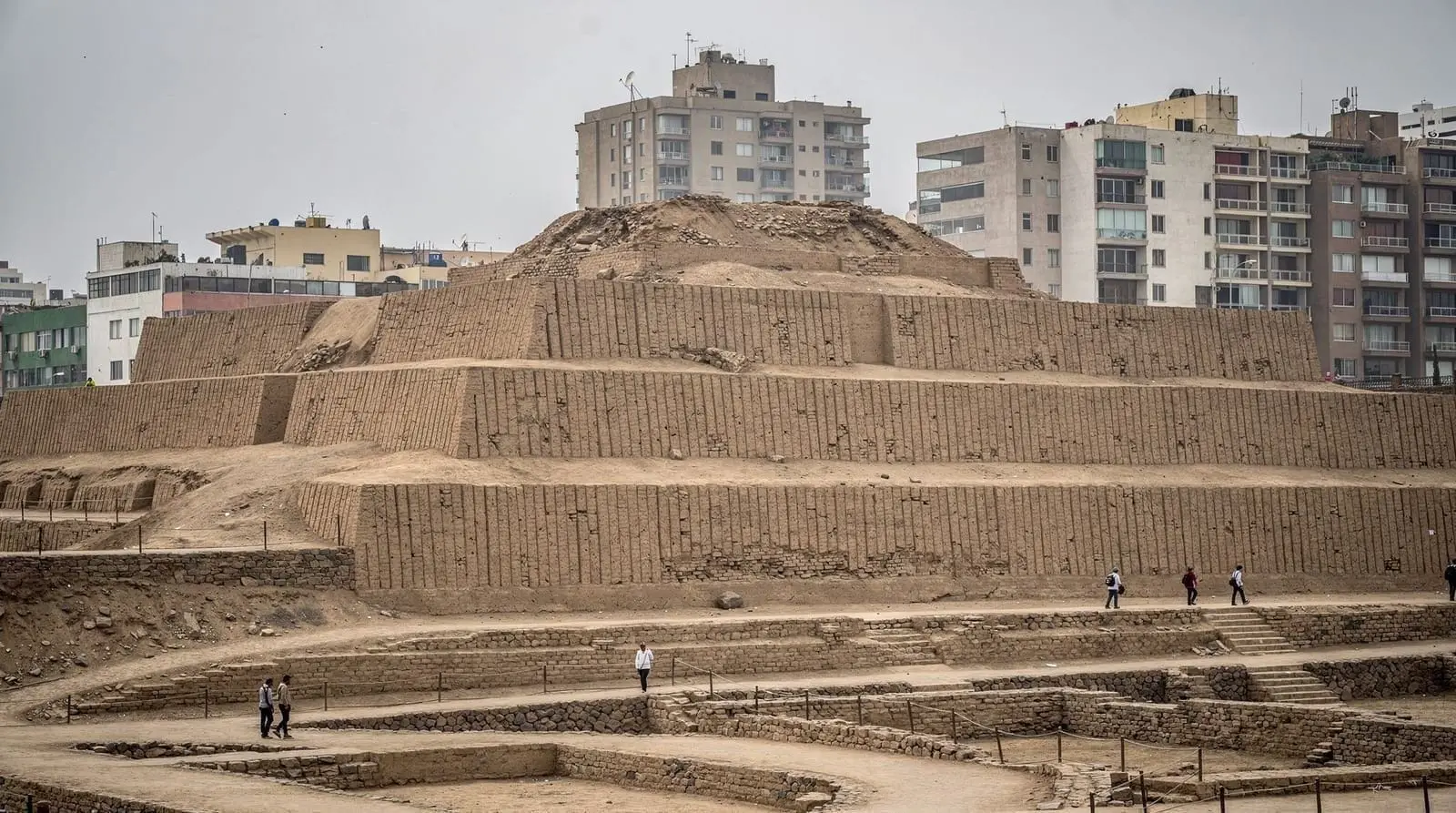
There are few sights in Lima as quietly surreal as Huaca Pucllana. In the middle of Miraflores, surrounded on all sides by apartment blocks, a supermarket, and a busy avenue, rises a stepped pyramid of hand-shaped adobe bricks roughly 25 metres high and spread over several hectares. It was built between about 400 and 700 CE by the Lima Culture, a coastal society that flourished here a thousand years before the Inca arrived, and it served as a ceremonial and administrative centre — a place of temples, plazas, and ritual offerings.
The word huaca means a sacred place in Quechua, and the Lima coast is dotted with dozens of these adobe mounds, most of them flattened or built over as the modern city expanded. Pucllana survived because it was excavated and protected starting in the 1980s. Today it is one of the most accessible archaeological sites in Peru: you can be standing on a pre-Columbian pyramid fifteen minutes after finishing a ceviche lunch.
| Where | General Borgoño block 8, Miraflores, Lima |
| Cost | Around S/15 / about $4 daytime; S/17 / about $4.50 evening |
| Time needed | Around 1.5–2 hours, guide included |
| Getting there | 10–15 min walk from Parque Kennedy; app-taxi from Barranco or the Historic Center |
| Best time | Any day except Tuesday (closed); torch-lit evening visit is most atmospheric |
Quick answer: is Huaca Pucllana worth visiting?
Yes — it is the easiest meaningful archaeology in Lima, requires no day trip, and the guided walk takes only about an hour. It is genuinely impressive in scale and the bricks-on-edge construction is unusual and well explained. Manage expectations on the artefacts: this is a structure to walk through, not a treasure-filled museum. For the gold and ceramics, you go to the Larco Museum; for sheer scale and atmosphere, especially at night, you come here.
What you see on the visit
Entry to Huaca Pucllana is only via a guided walk — you cannot wander it alone — and the guided format is included in the ticket. Groups leave roughly every 30 minutes in Spanish, with English-language departures at set times through the day. The standard circuit lasts about 45–60 minutes and covers:
- The great pyramid itself, built from millions of small adobe bricks set vertically, on edge, with gaps between them — a deliberate technique that gave the structure flexibility to survive the region’s frequent earthquakes. Your guide will point out how the layers were sealed and rebuilt over centuries.
- The ceremonial plazas at the base, where the Lima Culture held rituals that included offerings of fish, shells, and — as excavations revealed — human sacrifices, particularly of young women.
- A reconstructed area showing how the structures and ramps would have looked in use.
- A small site museum displaying ceramics, textiles, and tools recovered on site, plus a section on the later Wari occupation layer.
- A modest garden of native crops and animals — including a few llamas and Peruvian hairless dogs — that recreates the agricultural setting.
The path is uneven adobe and packed earth with some inclines and steps; wear closed shoes and bring water, as there is little shade. The whole visit is short enough to slot into a half-day in Miraflores alongside the cliff walk.
The bricks, and why they stand on edge
The detail visitors remember most is the construction. Look closely and you will see millions of small mud bricks set vertically, on edge, with deliberate gaps between them — a pattern archaeologists nicknamed the “bookshelf” technique. The standard explanation is seismic: the spaces and the upright orientation let the structure flex and absorb the shaking of the Lima coast’s frequent earthquakes rather than crack and collapse. Fifteen centuries and dozens of major tremors later, the pyramid is still standing, which is a reasonable argument that the builders knew exactly what they were doing. It is a striking thing to stand beside once you know what you are looking at, and the single best reason the on-site guide is worth following closely.
Who built it: the Lima Culture and the Wari
Huaca Pucllana predates the Inca by roughly a thousand years. It was raised by the Lima Culture, a society that occupied the central Peruvian coast from around 200 to 700 CE, living off the rich Pacific fisheries and irrigated valley agriculture. They left no writing, so almost everything we know comes from sites like this one. Pucllana was their major ceremonial and administrative centre — a place of feasts, offerings, and the rituals that bound the community and legitimised its leaders.
Excavations have revealed offerings of sardines and anchovies, Spondylus shell traded from warm Ecuadorian waters, and ceramic vessels deliberately smashed as part of ceremonies. More soberingly, they have also uncovered the remains of sacrificed individuals, predominantly young women, buried at key points in the structure — a reminder that the pyramid’s serene appearance today belies its original function.
After the Lima Culture declined, the site was reused around 700–900 CE by people associated with the Wari (or Huari) empire, the highland power that expanded across much of Peru in this period. The Wari turned part of Pucllana into a cemetery and buried high-status mummy bundles here; one of the most significant finds, a richly wrapped Wari dignitary nicknamed “the Lord of the masks,” came from this layer. A good guide will point out where the Lima-era ceremonial use ends and the Wari burial layer begins, which is the kind of stratigraphic detail the standard audio commentary glosses over.
Pucllana in context: Lima’s other huacas
Pucllana is the most visited of Lima’s adobe mounds, but it is not the only one. Huaca Huallamarca, a smaller stepped pyramid in nearby San Isidro, is restored to a smooth, almost geometric profile and has a tidy little museum; it is quieter than Pucllana and makes a good quick add-on if you are staying in that district. Out at the much larger Pachacámac complex south of the city, you can see an entire ancient city — temples, plazas, and pyramids spanning the Lima, Wari, and Inca periods — which is the natural next step for anyone whose appetite Pucllana whets.
Seeing two or three of these in sequence is genuinely illuminating, because together they sketch the long pre-Inca history of the coast that the Cusco-and-Machu-Picchu circuit otherwise skips entirely. Pucllana is the easiest possible entry point to that story.
For visitors who want depth beyond the standard group walk, a private guided visit lets a trained archaeologist take you through the stratigraphy and the sacrificial finds at your own pace. The private Huaca Pucllana tour with entry tickets handles the tickets and the timing and gives you the kind of detail the rotating group guides cannot, which is worthwhile if pre-Columbian history is a real interest of yours.
Getting there
The site is at General Borgoño block 8, in the heart of residential Miraflores, about a ten-to-fifteen-minute walk from Parque Kennedy and the main Miraflores hotel cluster. If you are already staying in the district, walking is the simplest option; the streets are pleasant and safe by day. From Barranco it is a short S/12–18 / about $3–5 app-taxi ride, and from the Historic Center roughly S/25–35.
There is no need to pre-book a regular daytime visit — simply turn up and join the next available group — but arrive at least an hour before closing to be sure of catching a tour. If you want an English-language guide specifically, ask at the ticket office what time the next English departure leaves, as these run less frequently than the Spanish ones.
The night visit — the best way to see it
Huaca Pucllana stays open in the evenings, and the torch-lit night visit is the standout experience. From around 7 pm (typically Wednesday to Sunday), the pyramid is lit with warm lamps and the guided walk takes on a far more atmospheric quality — the adobe glows, the modern city recedes into darkness around you, and the scale of the structure reads more dramatically than it does under flat daytime light.
The night circuit costs slightly more than the daytime visit (around S/17 / about $4.50) and is well worth the small premium. Bring a light layer: Lima evenings on the coast are cool and damp, especially during the garúa-fog months from May to October.
The restaurant beside the ruin
One of Pucllana’s quirks is its restaurant, set on the edge of the site with tables overlooking the floodlit pyramid. Restaurante Huaca Pucllana is a genuinely good upmarket Peruvian kitchen — not a tourist-trap cafeteria — and the dinner view of the illuminated structure is the main reason to book. Expect S/120–180 / about $32–48 per person for a full dinner with drinks, which is high for Lima but in line with the setting and the cooking. Lunch is somewhat cheaper.
Booking is essential for a table on the view side, especially at weekends. An honest note: you do not need to dine here to enjoy the site, and the food, while good, is not at the level of Lima’s top restaurants — you are partly paying for the view. If your budget is tight, do the night visit and eat your serious meal elsewhere in Miraflores.
A practical tip if you do want both the site and the meal: the restaurant and the archaeological visit are run separately, so dining does not include a tour of the pyramid, and a tour does not get you a table. Book each on its own. The most atmospheric combination is an early-evening guided night visit followed by a late dinner on the terrace, when the structure is fully floodlit and the temperature has dropped.
Combining it with the rest of Lima
Huaca Pucllana sits a few minutes’ walk from Parque Kennedy and the heart of Miraflores, so it pairs effortlessly with a day in the district. A natural half-day is the pyramid in the late afternoon, the Malecón cliff walk at sunset, and dinner along Avenida La Mar. If your interest in pre-Columbian Lima runs deeper, combine Pucllana with the Museo Larco in Pueblo Libre, whose ceramic and gold collection gives the archaeological context the site itself lacks.
Several city tours bundle the two with the colonial centre into a single guided day, which is efficient if you would rather not arrange separate visits. The Lima city tour combining Larco Museum and Huaca Pucllana joins the pyramid, the museum, and the Historic Center in one circuit, removing the taxi logistics between districts.
For more pre-Columbian sites, the much larger Pachacámac complex south of the city is the logical next step — a full ancient city rather than a single pyramid, and an easy half-day trip from Lima.
A sample half-day in Miraflores around the pyramid
If you want a ready-made plan, here is how a Pucllana-anchored afternoon and evening tends to work well. Have a proper ceviche lunch around 1 pm at one of the cevicherías along Avenida La Mar — remember that Lima ceviche is a lunch dish and the best places wind down by mid-afternoon. From about 3:30 pm, walk the Malecón cliff-top promenade, taking in the Parque del Amor with its mosaic wall and, on clear November-to-April days, the paragliders launching off the cliffs.
As dusk approaches, make your way to Huaca Pucllana for the 7 pm torch-lit night visit. Afterwards, either dine on the restaurant terrace beside the floodlit pyramid or head back toward Parque Kennedy for a more budget-friendly dinner. That single sequence captures the food, the coastline, and the archaeology of Miraflores in one relaxed half-day, with very little taxi time involved.
This is also a sensible plan for your first or last night in Lima if you are bracketing a Cusco trip — it is low-altitude, low-effort, and asks nothing strenuous of jet-lagged legs.
Practical tips
- Closed Tuesdays. Plan around it; this is the most common mistake visitors make.
- Hours run roughly 9 am to 5 pm for daytime visits and from about 7 pm for the night circuit (Wednesday–Sunday). Confirm the same week, as the schedule shifts on holidays.
- Tickets are bought at the gate (around S/15 daytime / S/17 evening). The site is small enough that pre-booking is only needed for the private tour or a restaurant table.
- Time needed: budget about 1.5 hours including the guided walk and the small museum; 2 hours if you linger or dine.
- Accessibility: the adobe paths and steps make it difficult for wheelchairs and challenging for anyone with limited mobility.
- Children: the visit works well for curious kids — the scale is impressive, the garden has llamas and Peruvian hairless dogs, and the guided walk is short enough to hold attention. Bring water and a hat for the daytime version.
- Photography: allowed throughout, with no flash needed even at night thanks to the warm lighting. The classic shot is from the upper terraces looking back across the pyramid with the apartment blocks behind — the juxtaposition of ancient adobe and modern Miraflores is the whole point.
Is it worth paying for a guide over the included group walk?
The standard ticket already includes a guided group walk, so for most visitors the bundled guide is enough — you are never left to wander alone, and the basic narration covers the essentials. The case for upgrading to a private tour is specific: you get an archaeologist rather than a rotating staff guide, you set the pace, you can linger over the Wari burial layer or the construction technique, and you can ask real questions. If pre-Columbian Peru is a genuine interest, or if you are visiting before Pachacámac and want the foundational context, the private option earns its premium. If you simply want to see the pyramid and tick it off, the included walk does the job.
For the full Lima picture and where the pyramid fits among the city’s other sights, see the Lima destination guide and the neighbourhood guide to Miraflores. Browse the guides hub for deeper planning, the itineraries for sample routes, the tours hub to compare guided options, and the tools section for budget and timing help.
Frequently asked questions about Huaca Pucllana
How much does it cost and what are the hours?
Daytime entry is around S/15 / about $4, and the evening night visit around S/17 / about $4.50, with the guided walk included in both. Daytime hours run roughly 9 am to 5 pm, and the night circuit from about 7 pm, typically Wednesday to Sunday. The site is closed on Tuesdays. Confirm the current schedule the same week, as holidays alter it.
Can I visit Huaca Pucllana on my own?
No — access is only via the included guided walk, which leaves roughly every 30 minutes. Spanish departures are frequent and English ones run at set times through the day. The guided format keeps visitors off the fragile adobe and provides the context that makes the site make sense. For more depth at your own pace, book a private guided tour.
Is the night visit worth it over the daytime one?
For most people, yes. The torch-lit evening circuit is more atmospheric — the pyramid glows against the dark city and the scale reads more dramatically than under flat daytime light. It costs only marginally more. Bring a light layer, as Lima evenings on the coast are cool and damp, especially in the foggy months from May to October.
How long do you need at Huaca Pucllana?
About 1.5 hours covers the guided walk and the small site museum comfortably. Allow two hours if you linger over the exhibits or stay to dine at the on-site restaurant. It is a short, easy stop rather than a half-day commitment, which is part of its appeal — you can fit it around a meal or the cliff walk in Miraflores.
Is the on-site restaurant worth it?
The view of the floodlit pyramid is the real draw, and the upmarket Peruvian cooking is genuinely good, though not at the level of Lima’s very top restaurants — you are partly paying for the setting. Expect S/120–180 / about $32–48 per person at dinner, and book ahead for a view-side table. If your budget is tight, do the night visit and eat your serious meal elsewhere in Miraflores.
How does it compare to Pachacámac?
Huaca Pucllana is a single pyramid in the middle of the city, visited in about 90 minutes with no day trip required. Pachacámac, south of Lima, is a vast ancient city spanning multiple cultures over a thousand years and needs a half-day excursion. Pucllana is the convenient introduction to coastal archaeology; Pachacámac is the deeper experience if you have the time and the interest.
Do I need closed shoes and water?
Yes. The visit is on uneven adobe and packed-earth paths with some steps and inclines, and there is little shade, so closed comfortable shoes and water are sensible, particularly for the daytime circuit. The site is difficult for wheelchairs and for anyone with limited mobility because of the terrain and steps.
Top experiences
Bookable activities with verified prices and instant confirmation on GetYourGuide.
