Maras and Moray
Maras and Moray done right: the Inca circular terraces, 5,000 salt ponds, the separate Salineras fee, altitude, ATV options and tourist traps.
Cusco: Pisac, Maras, Moray, Ollantaytambo Small Group Tour
Quick facts
- Region
- Sacred Valley plateau, Cusco Department
- Altitude (Moray)
- ~3,500 m / 11,500 ft
- Altitude (Salineras)
- ~3,380 m / 11,090 ft
- Moray entry
- Boleto Turístico (Circuit III S/70 or General S/130)
- Salt pans entry
- Separate S/18 (~$5) — NOT on the boleto
- Best for
- Inca agronomy, salt-pan photography, plateau scenery, ATV trips
Two of the strangest sights in the Andes, side by side
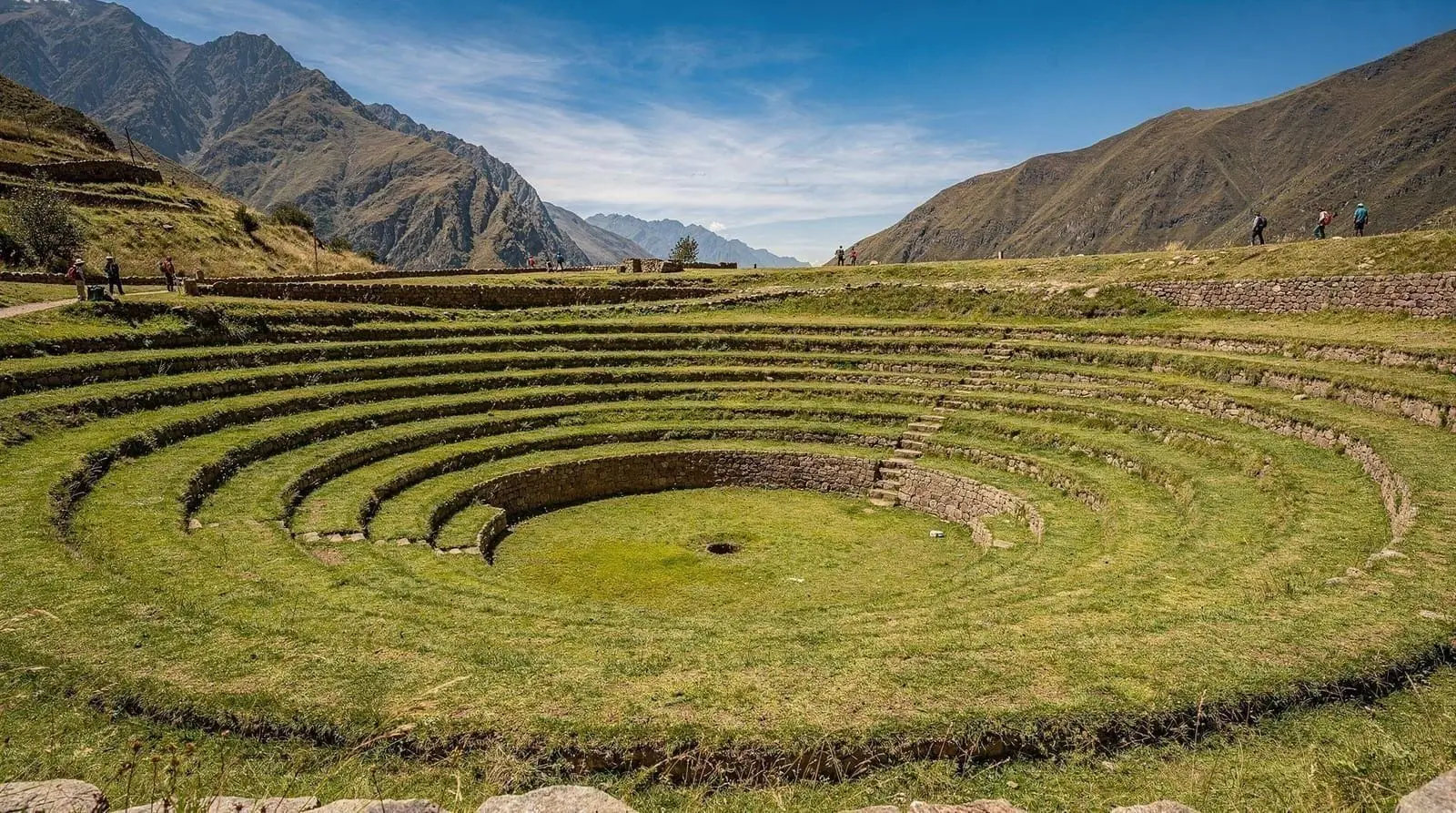
Up on the plateau above Urubamba sit two Inca-era sites that look like nothing else in Peru. Moray is a set of vast concentric circular terraces sunk into the earth, like a green amphitheatre carved by an enormous compass. The Salineras de Maras are more than 5,000 individual salt-evaporation ponds spilling down a ravine in a cascade of white, ochre and pink, worked by hand for over a thousand years. They are usually visited together as a half-day, because they sit only a few kilometres apart on the same high tableland between Cusco and the Sacred Valley floor.
The crucial planning fact, and the one that catches independent travellers out: the two sites have different tickets. Moray is on the Boleto Turístico; the salt pans are not, and charge their own separate cash fee.
| Where | Sacred Valley plateau, between Cusco and Urubamba |
| Cost | Moray: Boleto Turístico (S/70 Circuit III or S/130 General); Salineras: separate S/18 cash |
| Time needed | Half day (usually paired with the valley loop) |
| Getting there | Tour, hired taxi, or colectivo plus local taxi from the Maras turnoff |
| Best time | May to September (dry season) for the whitest salt pans; mornings for best light |
Moray — the Inca agricultural laboratory
Moray is three (with smaller ones, more) sets of concentric circular terraces, the largest dropping about 30 metres from the top ring to the floor. They are not just pretty: the prevailing theory, supported by measurement, is that the Inca built them as an agricultural research station. The depth and orientation create distinct microclimates, with a temperature difference of as much as 15°C (27°F) between the top and bottom terraces. That spread lets a single site mimic many altitudes and growing conditions — useful for an empire trying to adapt crops like maize, quinoa and potato to terrain from coast to high Andes.
Whether or not every detail of that theory holds, standing on the rim is striking. You can no longer walk all the way down into the central terraces (access was restricted to protect the structure), but the view from the upper edge is the point. Allow 45-60 minutes. Moray sits at about 3,500 m — higher than Cusco — so move gently if you are early in your trip.
Entry is by Boleto Turístico. The Circuit III partial (S/70, valid 2 days) covers Moray plus Písac, Ollantaytambo and Chinchero; the General (S/130) adds the Cusco-city sites. Cash only.
The Salineras de Maras — salt the way the Inca made it
A short drive away, the Salineras are pre-Inca in origin and still worked today. A natural underground spring brings up water so saturated with salt that locals channel it into thousands of shallow clay pans terraced down a steep ravine. The sun evaporates the water, leaving salt that families rake out by hand. The ownership is communal and hereditary — each pond belongs to a local family — and the colours shift from blinding white to rust and rose depending on the stage of evaporation. In the dry season the whole cascade is at its whitest and most dramatic.
You walk along paths between the pans (do not step into the ponds themselves — they are someone’s livelihood). Vendors at the entrance sell the famous pink Maras salt and salt-based products; it makes a genuinely good, light souvenir, and buying directly supports the families. Allow 45 minutes.
The fee everyone forgets: Salineras charges its own entry of about S/18 (around $5), in cash, and it is NOT covered by the Boleto Turístico. Some budget tours quietly leave the salt pans out, or stop only at a roadside viewpoint rather than entering. Check before booking if the cascade is what you came for.
A combined tour links both sites with the rest of the valley. The Písac, Maras, Moray and Ollantaytambo small-group tour covers the salt pans, the circular terraces and the two big ruin towns in one day, with transport between the scattered stops included — the only efficient way to do all four without your own vehicle.
Doing it by ATV or on foot
Because the plateau is open and scenic, Maras and Moray are a popular ATV (quad bike) destination. Operators run half-day quad trips across the tableland linking the two sites, which is more fun than a minibus if you like a bit of adventure — though it is dusty and the high-altitude wind is cold. Book through a reputable Cusco operator and confirm helmets and basic instruction are included.
There is also a lovely downhill walk from Moray (or the village of Maras) to the salt pans and on down to the valley floor near Urubamba — roughly 2-3 hours, mostly descending, with big views. Pleasant once you are acclimatised; tough if you are not, given the altitude.
For the comfort-tier experience, the Sacred Valley VIP full-day group tour covers the circuit with smaller groups and a slower pace.
How the salt actually works
It is worth understanding what you are looking at, because the Salineras are a genuinely clever piece of pre-Inca engineering still running on its original logic. A subterranean stream emerges from the hillside already heavily saturated with salt, dissolved out of ancient marine deposits left when this part of the Andes was under the sea. The community channels that brine through a network of small canals, and each family opens a gate to flood its own shallow clay-lined pans.
Then the work is just sun and patience. Over several days the water evaporates in the dry mountain air, and a crust of salt forms on the surface and bottom of each pan. A family rakes off the top layer — the whitest, finest “flower of salt” prized for the table — and the coarser salt below is collected for cooking and livestock. The pans are then re-flooded and the cycle begins again. The varied colours you photograph are simply the different stages: freshly flooded pans are darker, near-dry ones blinding white.
The ponds have been worked this way for well over a thousand years, predating the Inca, and ownership passes down through families and the community rather than being bought and sold on an open market. When you buy a bag of pink Maras salt at the entrance, you are buying directly into a living system that has barely changed in a millennium — which is a better souvenir story than most.
Eating
Neither site has much in the way of food beyond drink and snack vendors at the entrances. The village of Maras itself has a handful of simple eateries, and there are a few roadside restaurants on the plateau. Most tours build in a buffet lunch down in Urubamba or Ollantaytambo, which is the practical place to eat properly. Carry water and a snack; the plateau is exposed and there is nowhere to shelter.
Combining them with the rest of the valley
Maras and Moray sit on the plateau rather than the valley floor, which shapes how they fit into a day. The two most common patterns:
The half-day plateau loop. From a base in Urubamba or even Cusco, do Moray and the salt pans together in a morning, optionally finishing with the downhill walk toward the valley. Pair the afternoon with Chinchero, which is on the same plateau road back toward Cusco. This is a relaxed, manageable day.
The full valley loop. The classic big day links Maras and Moray with the two headline ruin towns — Pisac at the eastern end and Ollantaytambo at the western. It is a lot to pack in, and the sites are far apart, so it is the day most worth doing with a driver or on a tour rather than fighting public transport. Be wary of versions that cram in so much that each stop becomes a photo dash.
A sensible compromise, if you have two valley days, is to give Maras-Moray-Chinchero one half-day and Pisac-Ollantaytambo a separate one, rather than chaining all five into a single exhausting marathon. For how this slots into a longer route, see /itineraries/ and the planning /guides/.
Altitude and weather
Both sites are on a high, exposed plateau at around 3,400-3,500 m — higher than Cusco, not lower. The Sacred Valley floor is gentler on the lungs, but Maras and Moray are not on it. Implications: bring sun protection (the altitude sun is fierce and there is no shade), a windproof layer (it is cold and breezy even in sun), and do not tackle the long downhill walk or an energetic ATV trip on your very first day in the Andes. Morning light is best for both photography and avoiding the afternoon cloud build-up of the rainy months.
Getting to and from Maras and Moray
Colectivo plus walk/taxi: Take a colectivo on the Cusco-Urubamba road and get off at the Maras turnoff, then arrange a local taxi or mototaxi from the village to the sites (the sites are several kilometres off the main road). Workable but fiddly.
Taxi: A driver from Urubamba to cover both sites is around S/80-120 for the trip; from Cusco, a full plateau-and-valley day is S/200-280.
Tour: This is the easiest option, since the two sites are off the main road and awkward to reach independently. The Sacred Valley tour with Písac, Ollantaytambo and Chinchero plus lunch packages the day with transport, entries and a meal handled.
Tourist traps and honest warnings
The hidden salt-pan fee — and tours that skip it. Salineras charges S/18 in cash, separate from the boleto. Cheaper tours sometimes stop only at a distant viewpoint or omit the salt pans entirely. Confirm you actually enter the cascade.
Stepping into or touching the salt ponds. Each pond is a family’s livelihood. Stay on the paths; do not lean on or step into the pans for a photo.
ATV operators cutting corners. Cheap quad trips can mean poor bikes and minimal safety briefing. Use an established operator and check helmets and instruction are included.
Underestimating sun and cold. The plateau is exposed at 3,500 m. People get sunburnt and chilled on the same trip because the sun is fierce but the wind is cold. Bring both sunscreen and a layer.
Frequently asked questions about Maras and Moray
Is the Boleto Turístico enough for both Maras and Moray?
No. Moray is covered by the Boleto Turístico (Circuit III S/70 or General S/130), but the Maras salt pans (Salineras) charge a separate entry of about S/18 in cash that is not on any version of the boleto. Budget for both and bring cash.
What is Moray and why is it circular?
Moray is a set of concentric circular Inca terraces sunk into the ground, widely believed to have been an agricultural research station. The depth creates microclimates with a temperature spread of up to 15°C between the top and bottom rings, letting the Inca test crops under conditions mimicking many different altitudes.
Can you walk down into the salt pans?
You walk along paths between the ponds at the Salineras, but you must not step into the pans themselves — each belongs to a local family and is a working salt source. You can buy pink Maras salt directly from vendors at the entrance, which supports the community.
How do Maras and Moray fit into a Sacred Valley day?
They sit on the plateau between Cusco and the valley floor and are usually combined into a half-day, or added to a full valley loop with Písac, Ollantaytambo and sometimes Chinchero. Because both sites are off the main road, a tour or hired driver is far easier than public transport.
Are Maras and Moray higher than Cusco?
Yes. Both sit around 3,400-3,500 m, slightly higher than Cusco’s 3,400 m and well above the valley floor. Despite the Sacred Valley’s reputation for lower altitude, these plateau sites are not low, so acclimatise before any energetic ATV trip or downhill hike.
When is the best time to see the salt pans?
The dry season (May to September) makes the ponds whitest and most photogenic, and morning light is best. In the rainy months the pans hold more water and the colours are muddier, and afternoon clouds build up over the plateau.
Can I buy salt directly at Maras?
Yes, and you should — vendors at the Salineras entrance sell the famous pink Maras salt, salt-flake “flower of salt” for the table, and salt-based products like chocolate and soaps. Buying here supports the families who work the pans, and it is a light, durable souvenir. Prices are low and largely fixed; this is one place where heavy haggling is not really the done thing.
How long do Maras and Moray take together?
Budget about half a day. Allow 45-60 minutes at Moray and around 45 minutes at the Salineras, plus the driving time between them and from your base. Combined with a couple of other valley stops, the two sites slot neatly into a full-day loop.
Is the downhill walk from Moray to Maras worth it?
If you are acclimatised and enjoy hiking, yes — it is a roughly 2-3 hour, mostly downhill route across open plateau with big views, ending at the salt pans or down toward Urubamba. Skip it on your first day in the Andes, when the altitude makes even gentle walking harder than it looks, and carry water and sun protection as there is no shade.
Top experiences
Bookable activities with verified prices and instant confirmation on GetYourGuide.

