Barranco
Lima's bohemian clifftop district offers street murals, 19th-century mansions, craft cocktail bars, and ceviche in a single compact half-day or evening.
Lima: Barranco Art and Culture Tour
Quick facts
- Country
- Peru
- Altitude
- 85 m / 279 ft (coastal cliff)
- Currency
- Peruvian sol (S/) — USD widely used
- Best for
- Street art, independent galleries, bars, boutique hotels, republican architecture
Why Barranco is Lima’s most liveable neighbourhood
Barranco is where Lima gets interesting. If Miraflores is the upscale district that most visitors base themselves in — practical, walkable, reassuringly prosperous — Barranco is the place they wish they had stayed instead. The neighbourhood sits on the same Pacific coastal cliff, fifteen minutes south of Miraflores by taxi, but the architecture is older, the streets narrower, the gallery density higher, and the bar scene genuinely excellent.
A half-day from mid-afternoon into evening is enough to cover the essentials. A full day lets you add a proper lunch, gallery visits, and a late-evening bar crawl. Several boutique hotels in Barranco have become among Lima’s best-reviewed places to stay.
| Where | Coastal cliff district, 15 min south of Miraflores |
| Time needed | Half day (afternoon into evening); full day for galleries + bars |
| Cost | S/150–220 / $40–60 for a full evening (dinner + drinks) |
| Getting there | S/15–20 taxi from Miraflores, 15–20 min |
| Best for | Street art, republican architecture, bars, boutique hotels |
The Puente de los Suspiros
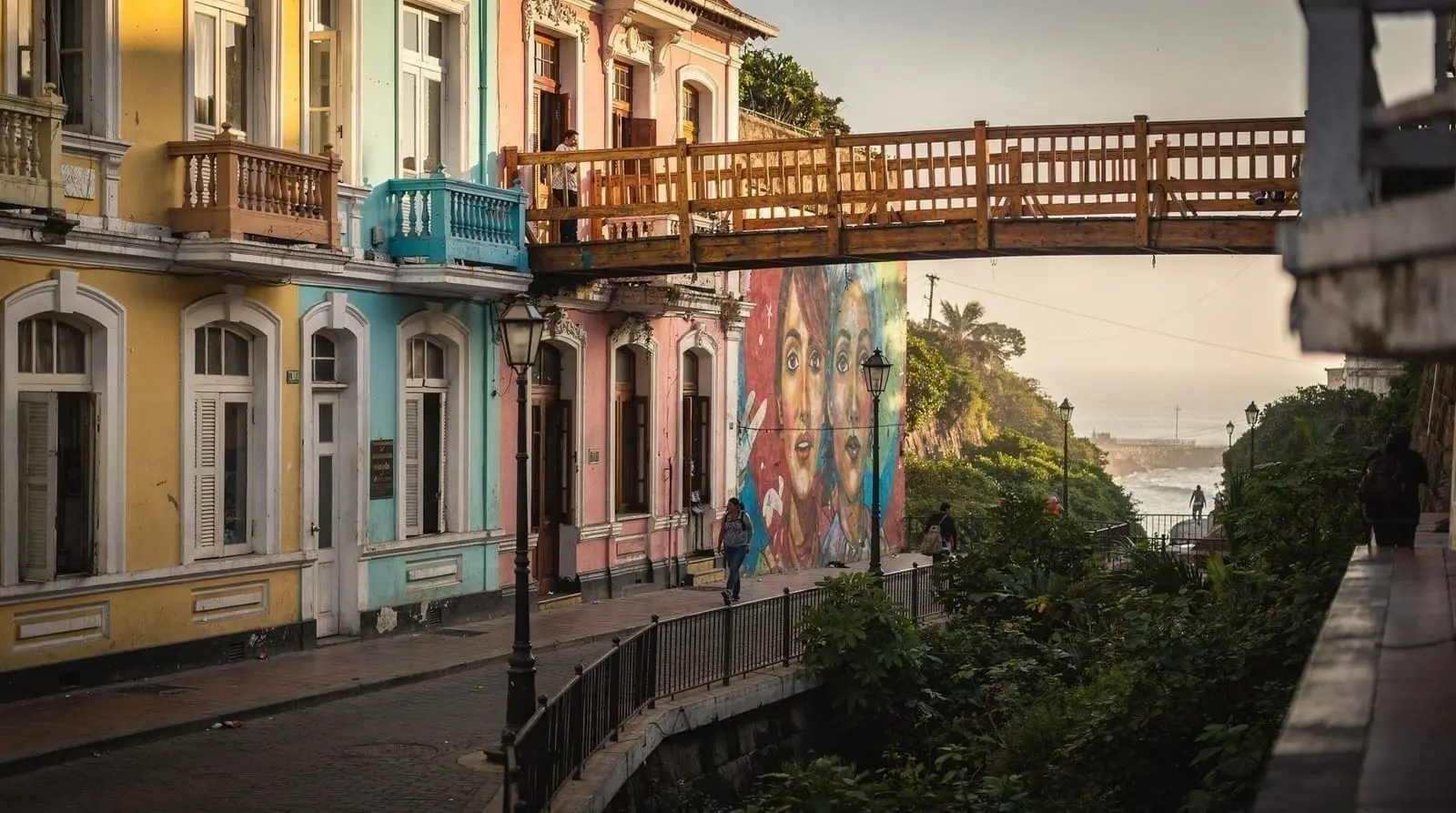
The Bridge of Sighs (Puente de los Suspiros) is Barranco’s single most photographed spot. The original wooden footbridge crosses a ravine of tumbling bougainvillea and moss-covered walls; below it, a narrow path called the Bajada de los Baños drops through dense greenery toward the base of the cliff and the old beach access steps. The view looking south from the bridge at sunset — when the ravine catches the last low light — is genuinely beautiful and worth arriving in time for.
The legend attached to the bridge is characteristically Peruvian: if you cross holding your breath and make a wish, it will come true. The queue of tourists attempting this at any given moment is a reliable source of entertainment.
Walk down the Bajada de los Baños to the beachside path at the base. The beach here is not swimmable — Pacific currents are dangerous and the water is cold year-round — but the cliff base walk and the old lampposts and stone steps give you the best view back up to the Barranco clifftop.
Republican architecture and the walking circuit
Barranco was Lima’s aristocratic summer retreat in the late 19th and early 20th centuries. The old railway from Lima centre deposited families from their downtown townhouses to their oceanside villas each summer weekend, and what they built is still visible on the streets between Plaza Barranco and Av. Pedro de Osma: two-storey republican mansions with carved wooden balconies, ornate street gates, and interior courtyards planted with jasmine and roses.
A compact walking circuit covers the main streets:
- Plaza Municipal de Barranco — the central plaza with the church and the old 19th-century municipality building. Morning or evening light is best for photography.
- Calle Domeyer — residential street with some of the best-preserved mansions; also home to the MAC Lima (Museo de Arte Contemporáneo de Lima).
- Avenida Pedro de Osma — the main gallery and museum strip; the Museo de Arte Contemporáneo and several private galleries are walkable from each other.
- Bajada Berlin — a cobbled alley decorated with large-format street murals, connecting the main plaza to the cliff-edge.
- Back to Puente de los Suspiros via Calle Ayacucho.
This full circuit takes about 90 minutes at a relaxed pace without going inside any galleries.
Street art in Barranco
Barranco has the highest concentration of quality street murals in Peru. Unlike Callao’s Monumental district — which is purpose-built as a muralism tourist destination — Barranco’s art emerged organically over two decades of local and international artists working with building owners. The result feels more integrated with the neighbourhood and less like an outdoor gallery.
The best murals cluster around Bajada Berlin, Calle Colina, and the alleys running between Av. Grau and the cliff edge. Styles range from hyperrealistic portrait work to abstract geometric pieces and politically engaged commentary.
The Barranco art and culture tour runs two to three hours and covers the murals alongside the republican architecture, the Puente de los Suspiros, and at least one gallery interior — useful if you want context for the murals rather than just photographs of them. Alternatively, the bike tour through Miraflores, Malecón, and Barranco street art covers both neighbourhoods in a single session and is popular with visitors who want to combine the coastal cliff with the art circuit.
Galleries and museums
MAC Lima (Museo de Arte Contemporáneo) — Calle Grau 1511, free admission on Tuesdays, S/15 / about $4 other days. The collection focuses on Latin American contemporary art from the 1950s to the present. The permanent collection is well-curated; temporary exhibitions are generally excellent and often feature emerging Peruvian artists.
Museo Pedro de Osma (Av. Pedro de Osma 421) — a grand colonial-era mansion housing a private collection of colonial religious art: paintings, silver, furniture, and textiles from the 16th to 19th centuries. Entry S/30 / about $8. Less visited than the MAC but exceptional for anyone with an interest in viceregal period aesthetics.
Galería Lucía de la Puente (Calle Colina 180) — one of Lima’s most respected commercial galleries representing contemporary Peruvian and Latin American artists. Open to walk-in visitors; no admission charge.
Food and drink in Barranco
Lunch: Barranco has a handful of outstanding restaurants pitched between casual and mid-range. Isolina (Av. San Martín 101) is frequently cited as the best traditional Peruvian comfort cooking in Lima — think thick meat stews, chicharrón sandwiches, and ceviche served with restrained grandeur. Budget S/45–75 per person for a full lunch; book ahead for weekends.
El Cortes (on the main plaza) serves reliable ceviche and anticuchos at S/30–50 for a full plate — lower key than Isolina and better if you want to eat quickly before an afternoon walk.
Evening drinks: The La Noche de Barranco and Ayahuasca Bar (Calle Prolongación San Martín 130 — a converted republican mansion) are Barranco’s most atmospheric bars. Ayahuasca is the more theatrical — three floors of a restored house filled with religious art, taxidermied animals, and pre-Columbian ceramics, all serving pisco cocktails. Budget S/30–50 for two cocktails.
The gourmet food tour by night through Miraflores and Barranco is a good option if you are spending only one night in Lima and want to cover both neighbourhoods with food and drink stops rather than walking them independently.
Barranco vs Miraflores: which to stay in?
Stay in Miraflores if: you want maximum convenience, easy taxi access to the airport and historic centre, a larger selection of restaurants at all price points, and proximity to Huaca Pucllana. Best for first-time Lima visitors and travellers with early-morning onward flights.
Stay in Barranco if: you want more character, are staying more than two nights, or are specifically interested in Lima’s art and music scene. Boutique hotels here (such as the Hotel B or The Barranco’s House) are among Lima’s best. Slightly further from the centre but a more memorable experience day to day.
The distance between the two districts is only 15–20 minutes by taxi (S/15–20) so staying in either does not meaningfully cut off the other. Most visitors who stay in Miraflores spend at least one evening in Barranco, and vice versa.
A sample half-day, hour by hour
| Time | What to do |
|---|---|
| 3:00 pm | Arrive, start the walking circuit at Plaza Municipal de Barranco |
| 3:30 pm | Bajada Berlin murals, then Av. Pedro de Osma gallery strip |
| 5:00 pm | Puente de los Suspiros and the Bajada de los Baños at golden hour |
| 6:30 pm | Dinner at Isolina or El Cortes |
| 8:30 pm | Drinks at Ayahuasca Bar or La Noche de Barranco |
This rhythm times the bridge for sunset, which is when the ravine light is best, and leaves the bars for after dark when Barranco’s evening character actually shows up. Shift the whole sequence later in garúa season (May–October), when the fog softens daylight anyway and there’s less reason to chase golden hour precisely.
Nightlife beyond the two flagship bars
Ayahuasca Bar and La Noche de Barranco get most of the attention, fairly, but the neighbourhood’s bar scene runs deeper. Barra Barranco and a cluster of smaller craft-cocktail spots along Calle Sáenz Peña serve inventive pisco-based drinks in a quieter, less touristed setting than the two big names — useful if you want the Barranco bar experience without the crowds.
For live Afro-Peruvian and Creole music beyond La Noche, ask your hotel about peñas (traditional music houses) running informally most weekends; they rarely advertise online but are easy to find by asking locally. If you’d rather have someone else handle the logistics of a full night out, the gourmet food tour by night covers dinner and drinks stops without you needing to plan the route yourself — see the food and drink section above.
Getting to Barranco
From Miraflores: S/15–20 by app-based taxi (Taxi Beat, InDriver, Cabify), 15–20 minutes.
From the colonial centre: S/25–35 by taxi, 25–35 minutes.
From the airport: S/60–80 by taxi, 50–70 minutes. Barranco is slightly further from the airport than Miraflores.
There is no direct bus connection between the airport and Barranco. The Metropolitano runs along the main coastal corridor but requires a transfer and does not serve deep Barranco; taxis are the practical option for evening arrivals.
For the full Lima context — including the historic centre, Larco Museum, and multi-day planning — see /destinations/lima/. For the neighbouring coastal district, see /destinations/miraflores/. For the Pachacámac ruins south of Lima, see /destinations/pachacamac/.
For the wider south coast, see /destinations/paracas/ and /destinations/huacachina/. To plan the full trip, browse /itineraries/ or start at /tools/. For Lima food recommendations in depth, see /guides/best-ceviche-in-lima/ and the full /guides/lima-complete-guide/.
Frequently asked questions about Barranco
Is Barranco safe for tourists?
Barranco is one of Lima’s safer districts for visitors. The main tourist zone around the plaza, Puente de los Suspiros, and the Pedro de Osma gallery strip is well-lit and active in the evenings. Standard urban caution applies — keep your phone out of sight on the street, use app-based taxis rather than flagging cabs — but Barranco does not have the same pickpocket risk as the colonial centre.
Can you visit Barranco in the garúa season?
Yes, and in some ways it is better. The garúa (coastal fog, May–October) softens the light and keeps temperatures mild around 15 °C. The Puente de los Suspiros view is less dramatic without sun, but the restaurants and bars are the same and the queues are shorter. If you want photographs of the cliff and bridge in strong light, November through April is preferable.
How long does Barranco take to visit?
A focused afternoon and evening — arriving around 3 pm, walking the main circuit, visiting one gallery, having drinks and dinner, and leaving around 10 pm — covers the essential Barranco experience in about six to seven hours. If you want to add a proper gallery visit and a long lunch, a full eight-hour day is comfortable.
What is the best thing to do in Barranco?
Walk down the Bajada de los Baños below the Puente de los Suspiros at sunset, then have dinner at Isolina, then drinks at Ayahuasca Bar. That three-part evening is uniquely Lima and cannot be replicated anywhere else in Peru. The whole sequence costs S/150–220 / about $40–60 per person including food and drinks.
Is Barranco good for families with children?
Daytime Barranco — the plaza, the Bridge of Sighs, the cliff walk, the MAC Lima on Tuesdays when it is free — is entirely family-appropriate. The evening bar scene is adult-oriented but not hostile to children; most restaurants welcome all ages. The Bajada de los Baños steps are uneven and require care with young children.
Are there any tours that combine Barranco and Miraflores?
Yes — the Miraflores, Barranco, and San Isidro small group tour covers all three upscale districts in a single half-day session and is a good orientation on arrival in Lima before you explore independently.
Where should I eat lunch in Barranco?
Isolina (Av. San Martín 101) is the landmark: it specialises in traditional Peruvian home cooking rather than fusion or fine dining, and the portions are generous. A full lunch — causa, ceviche, and a main stew or fried fish — runs S/55–80 per person. For something lighter and less expensive, the market stalls on the Plaza Municipal de Barranco serve set lunches (menú del día) for S/15–22: soup, main, and a drink. The menú option gives you an honest local lunch in a setting that most tourists walk past.
What is the music scene like in Barranco?
Barranco has been Lima’s live music neighbourhood for decades. The bars around Plaza Barranco host everything from Afro-Peruvian cajón percussion nights to cumbia and salsa. La Noche de Barranco (Calle Bolognesi 307) schedules live acts most Friday and Saturday evenings from around 10 pm; check their social media for the current programme. Cover charges are usually S/20–40 depending on the act. Jazz also has a quiet presence in the neighbourhood — a few independent venues run midweek sets that rarely appear on tourist maps but are easy to find by asking at your hotel.
Should I stay in Barranco instead of Miraflores?
If you’re spending more than two nights in Lima and value atmosphere over convenience, yes — Barranco’s boutique hotels are among the city’s best-reviewed. First-time visitors with an early departure flight or who want maximum convenience are still better served staying in Miraflores and treating Barranco as an evening excursion, since the two districts are only 15–20 minutes apart by taxi either way.
Is one evening enough to see Barranco properly?
Yes, for the essentials — the walking circuit, the Puente de los Suspiros at sunset, and dinner and drinks afterwards comfortably fills six to seven hours. If you want a proper gallery visit or the Museo Pedro de Osma in depth, add a second, quieter afternoon before the evening rhythm starts.
Top experiences
Bookable activities with verified prices and instant confirmation on GetYourGuide.

