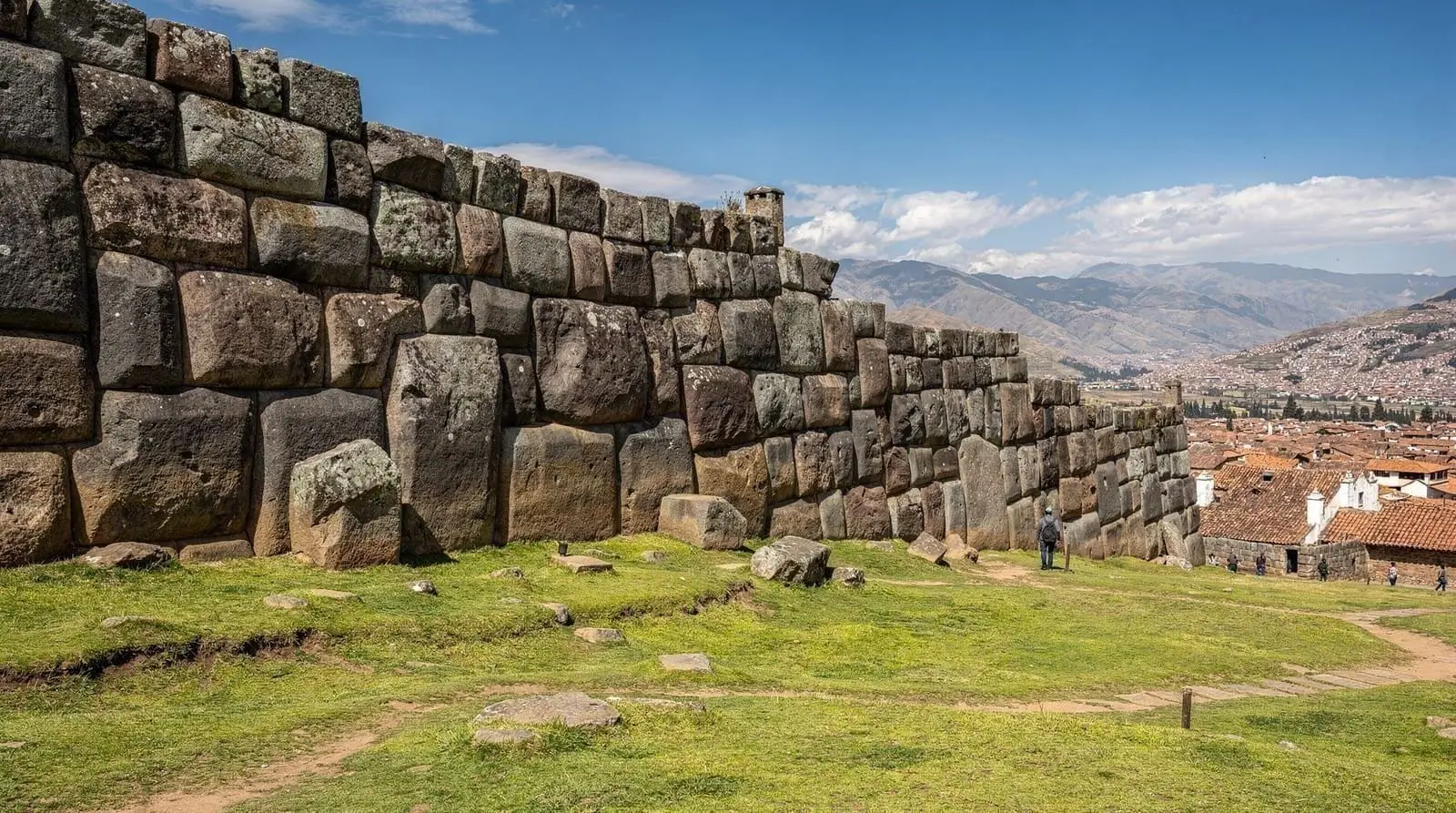
Sacsayhuamán
The giant Inca fortress above Cusco explained: the megalithic walls, boleto turístico entry, how to get up at altitude, opening hours, and Inti Raymi.
Cusco: Half-Day City Tour with Sacsayhuaman and Q’enco
Quick facts
- Location
- ~2 km uphill north of central Cusco
- Altitude
- ~3,700 m / 12,140 ft
- Entry
- Boleto turístico (full S/130 or partial Circuit I S/70)
- Best for
- Megalithic Inca masonry, city views, Inti Raymi festival
The walls that made the Spanish doubt their eyes
Sacsayhuamán is the colossal Inca complex on the hill immediately above Cusco, and it contains the single most astonishing piece of stonework in the Andes: three tiers of zigzagging walls built from limestone blocks so large — the biggest weighs an estimated 120 tonnes and stands taller than a person — that early Spanish chroniclers concluded no human power could have raised them. The blocks are cut into irregular polygons and fitted together without mortar so tightly that, in the worn local phrase, you cannot slide a sheet of paper into the joints. Earthquakes that have flattened colonial Cusco repeatedly leave these walls standing.
The name is a tongue-twister in English — locals smile at the “sexy woman” mnemonic tourists use — and is properly pronounced roughly sak-sai-wa-MAN. What it actually was remains debated: part fortress (it was the site of a brutal 1536 siege during the Inca rebellion), part ceremonial temple complex, part royal estate. What is certain is that what survives is a fraction of the original. The Spanish quarried the smaller stones for decades to build the churches and mansions of the colonial city below, which is why the famous walls are essentially the foundations: too big to move, they were left where they stood.
| Location | ~2 km uphill north of central Cusco |
| Cost | Boleto turístico — full S/130 or partial Circuit I S/70 |
| Time needed | Half a day (2 hrs alone, half-day with Circuit I) |
| Getting there | 30-45 min walk, taxi S/15-20, or guided tour |
| Best time | Early morning; late June for Inti Raymi |
For a wider tour of Cusco’s paid archaeological sites, see Cusco archaeological sites, and if you are still deciding which circuit ticket to buy, Cusco tourist ticket guide breaks down every option.
What you actually see today
The site spreads across a broad hillside, and there is more to it than the headline walls. Allow two to three hours to do it justice.
- The three terraced walls (the zigzag ramparts) — the reason everyone comes. The angular layout is often read as the teeth of a puma, the animal whose body the Inca city of Cusco was laid out to represent, with Sacsayhuamán as the head. Walking the base of the largest tier brings the scale home in a way photos never manage.
- The Suchuna (“slide”) rock formations — natural outcrops worn smooth, including a polished chute that children (and adults) slide down. Casual, fun, and free of crowds.
- The throne of the Inca (K’usilluchayoq area) and carved channels — worked bedrock, ceremonial seats, and water channels scattered across the upper field.
- The great esplanade — the open plain below the walls where the Inti Raymi festival is staged each June.
- Wide views over Cusco — the whole red-tiled city laid out below, with the cathedral and Plaza de Armas visible.
A guide turns a pile of impressive rocks into a coherent story. The half-day Cusco city tour with Sacsayhuamán and Qenqo includes the transport up, the boleto-covered entries, and a guide explaining the masonry and the siege, which is the efficient way to see it without arranging a taxi and timing the light yourself. For a version that pairs the fortress with the Qorikancha temple downhill, the Qorikancha and Sacsayhuamán city tour covers both anchors in one route.
Independent visitors sometimes underestimate how much a guide adds specifically at this site. Without context, Sacsayhuamán can read as an impressive but unexplained pile of stone; with a guide pointing out the puma-head layout, the throne carvings, and the siege history, the same walk becomes the highlight of a Cusco stay for many travellers. If budget rules out a private guide, the bundled half-day tours above are the efficient middle ground.
Getting there — and why altitude matters here
Sacsayhuamán sits at roughly 3,700 m, around 300 m higher than central Cusco, and the site itself involves walking on uneven, sloping ground. This is emphatically not a first-day outing. Do it on day two or three, after you have acclimatised, or you will spend the visit gasping rather than admiring.
Three ways up:
- On foot — a steep 30–45 minute climb from the Plaza de Armas, usually via San Blas and the Cuesta del Almirante or the path behind the San Cristóbal church. Scenic but hard on unacclimatised lungs.
- By taxi — S/15–20 from the centre, the sensible choice if you would rather save your energy for the site. You can walk back down afterwards, which is easy.
- On a tour — transport included, which removes the climb and the parking question entirely.
The boleto turístico (your only way in)
Sacsayhuamán has no individual ticket. The only way to enter is with the boleto turístico del Cusco, which catches a lot of first-timers off guard at the gate.
Your options:
- Full boleto (BTG) — S/130 (about $35), valid 10 days, covers Sacsayhuamán plus 15 other sites including the nearby Tambomachay, Qenqo and Puka Pukara and the major Sacred Valley ruins.
- Partial boleto, Circuit I — S/70 (about $19), valid 1–2 days, covers exactly the four ruins immediately above Cusco: Sacsayhuamán, Qenqo, Puka Pukara, and Tambomachay.
If you are only doing the four upper ruins, Circuit I is the economical pick. If you also plan to see the Sacred Valley, the full pass quickly pays off. Buy it at the gate or at the COSITUC office on Avenida El Sol — bring cash in soles, as card facilities are unreliable. There is a student discount with a valid ISIC card.
The four upper ruins string along the same road above the city, so most visitors combine all of Circuit I in one half-day, finishing at Tambomachay at the top and working back down. Standard opening hours are roughly 7 am to 5:30 pm daily.
Inti Raymi — the festival on the esplanade
Once a year, on 24 June, Sacsayhuamán’s great esplanade hosts Inti Raymi, the Festival of the Sun — a large-scale reenactment of the Inca winter-solstice ceremony, with hundreds of costumed performers, the symbolic role of the Sapa Inca, and a procession that begins at Qorikancha and the Plaza de Armas before culminating at the fortress. It is the biggest event in the Cusco calendar.
The honest planning notes: the central esplanade requires a paid ticket (sold separately, well in advance, and not cheap), while the surrounding hillsides offer free but distant views that fill up hours ahead. The whole city is at its busiest and priciest in the days around 24 June, so book accommodation early or plan around it. If you are not specifically chasing the festival, the days before and after are best avoided for a normal site visit, as setup and crowds disrupt access.
The full Inti Raymi festival guide covers ticket tiers, viewing spots, and how the procession from Qorikancha unfolds, and a first-hand Inti Raymi festival diary gives an honest account of what the day actually feels like from the crowd. If your dates do not line up with 24 June, the Cusco festivals calendar lists the other events worth timing a trip around.
The 1536 siege — the history under your feet
The esplanade and walls you walk are not just an architectural curiosity; they were the scene of one of the decisive battles of the Spanish conquest. In 1536, the Inca Manco Inca Yupanqui — installed as a puppet ruler and then in open revolt — laid siege to Spanish-held Cusco with a large army, and Sacsayhuamán, looming over the city, became the key strongpoint.
The Spanish, led by Juan Pizarro (who was killed in the fighting), mounted a desperate assault to retake the heights. The battle for the towers and terraces was ferocious, and Andean accounts remember the warrior Cahuide, who is said to have thrown himself from a tower rather than surrender. The Spanish eventually took the complex; the rebellion failed, and Manco Inca withdrew to Vilcabamba.
The aftermath shaped what survives. With the Inca state broken, Sacsayhuamán’s dressed stone became a free quarry, and for generations the colonists hauled its smaller blocks downhill to build the cathedral, the churches, and the mansions of the city below. That is why the site reads as foundations: the megalithic tiers were simply too massive to move, so they were abandoned in place while everything portable was carted away. Standing at the base of the largest block, it is worth remembering you are looking at what was left precisely because no one could take it.
Combining the four upper ruins
Sacsayhuamán is the first and largest of the four sites strung along the road climbing north out of Cusco, all covered by the same boleto. Doing them as a sequence is the standard, efficient way to spend the morning:
- Sacsayhuamán (~3,700 m) — the megalithic fortress, your main stop, around two hours.
- Qenqo — a short distance up the road, a carved limestone outcrop with a zigzag channel (qenqo means “zigzag”) and an underground ceremonial chamber, thought to have been used for rituals possibly involving libations or mummies. 20–30 minutes.
- Puka Pukara (“red fort”) — further up, a small reddish complex of walls and terraces, likely a checkpoint or waystation controlling the road into Cusco. 20 minutes.
- Tambomachay — the highest, a refined arrangement of terraces, niches, and still-flowing water channels often called the “Inca baths,” widely read as a site of water worship. 20–30 minutes.
The full breakdown of the upper three is on the Tambomachay, Qenqo and Puka Pukara page. A taxi can drop you at Tambomachay at the top so you walk gently downhill back toward Sacsayhuamán and the city, which is the kindest order on the lungs.
Independent travellers sometimes skip Puka Pukara and Tambomachay because they look modest on a map next to Sacsayhuamán’s scale. That is a mistake: Tambomachay’s still-functioning Inca water channels are a genuinely different kind of engineering achievement, and both sites take only 20 minutes each, so there is little cost to including them once you have already bought the ticket that covers all four.
Practical tips
Timing: go early. Morning light is better for the walls and views, the site is quietest before the tour buses arrive mid-morning, and you avoid the near-daily afternoon rain of the wet season (November–March).
Photography: the largest blocks photograph best in low, raking morning or late-afternoon light, which brings out the texture of the stonework far better than the flat light of midday. Wide-angle lenses help capture the zigzag ramparts’ scale, but a genuinely striking shot often comes from getting close to a single joint and letting the size of one block tell the story. Drones require a permit and are generally not permitted without prior arrangement — ask your guide rather than assuming.
What to bring: water, sun protection (the high-altitude sun is fierce even when the air is cool), a layer for wind on the exposed esplanade, and shoes with grip for the uneven ground. A trekking pole is unnecessary here but useful if you are continuing on to the uneven ground at Qenqo.
Time needed: around two hours for Sacsayhuamán alone, or a half-day if you continue along Circuit I to Qenqo, Puka Pukara, and Tambomachay.
Toilets and food: basic facilities near the entrance; vendors sell drinks and snacks, but bring your own water to be safe. There is no major café on site — plan to eat back in San Blas or the historic centre after you descend.
The puma, the astronomy, and what we can and cannot know
Two ideas come up constantly at Sacsayhuamán, and both deserve a clear-eyed look. The first is the puma: Inca Cusco is often described as having been laid out in the shape of a crouching puma, with the Tullumayo and Saphi rivers forming its flanks and Sacsayhuamán’s zigzag walls representing the head and bared teeth. It is a compelling image and there is genuine chronicle support for the puma symbolism in Inca thought. How literally the city plan was designed as a puma — versus how much is later interpretation read back onto it — is debated among scholars. Treat it as a meaningful Inca idea, not a proven blueprint.
The second is astronomy. The Inca were careful sky-watchers, and solstice and solar observation mattered enormously to a state whose chief deity was the sun, Inti — which is exactly why Inti Raymi is staged here. Some alignments at the site do appear deliberate. But you will also hear sweeping claims about precise astronomical calculations encoded in every wall; these run well ahead of the evidence. The honest position is that Sacsayhuamán was a major ceremonial and political centre with real solar significance, built by a sophisticated culture, without needing the embellishments that tend to accompany the souvenir-stand version of its story.
What is not in doubt is the sheer organisation behind it. Chroniclers recorded that tens of thousands of labourers worked on the complex over decades under the Inca system of rotational labour tax (mit’a). The achievement is human and administrative as much as it is engineering — a reminder of the scale of the state that ran the Andes from the city below.
How Sacsayhuamán fits your Cusco days
Sacsayhuamán is the natural centrepiece of your “ruins above town” day, best done after acclimatising on the flatter historic centre and San Blas. Pair it with Qorikancha downhill and the rest of Circuit I — Tambomachay, Qenqo and Puka Pukara. For the full acclimatisation strategy, the boleto in detail, and onward trips to the Sacred Valley and Machu Picchu, see the main Cusco guide, browse /itineraries/, or use the planning tools at /tools/.
Frequently asked questions about Sacsayhuamán
How do I pronounce Sacsayhuamán?
Roughly sak-sai-wa-MAN, with the stress on the last syllable. The common “sexy woman” mnemonic that guides joke about is close enough to be remembered but is not how locals say it. The name comes from Quechua and is sometimes spelled Saqsaywaman.
Do I need the boleto turístico for Sacsayhuamán?
Yes — there is no individual ticket. You must enter with either the full boleto turístico (S/130, 10 days, 16 sites) or the partial Circuit I (S/70, 1–2 days, covering Sacsayhuamán, Qenqo, Puka Pukara, and Tambomachay). Bring cash in soles, as card payment at the gate is unreliable.
Is Sacsayhuamán hard to reach at altitude?
It sits at about 3,700 m, higher than central Cusco, and the site itself is uneven and sloping, so it is not a first-day outing. Acclimatise for a day or two first. The easiest approach is a S/15–20 taxi up, then an easy walk back down; the climb on foot from the plaza is steep and tiring while you adjust.
How long should I spend at Sacsayhuamán?
About two hours for the fortress itself. If you continue along Circuit I to nearby Qenqo, Puka Pukara, and Tambomachay — all on the same road above the city and covered by the same ticket — budget a half-day in total. Go early to beat the mid-morning tour buses and afternoon rain.
What is Inti Raymi and can I see it at Sacsayhuamán?
Inti Raymi is the Festival of the Sun, staged on Sacsayhuamán’s esplanade every 24 June with hundreds of costumed performers reenacting the Inca solstice ceremony. The central viewing area needs a paid ticket bought well in advance; the surrounding hillsides give free but distant views. Cusco is at its busiest and most expensive around that date.
Was Sacsayhuamán a fortress or a temple?
Scholars still debate it. The site saw heavy fighting during the 1536 Inca siege of Cusco, giving it a military reputation, but the carved ceremonial features and its alignment with the city suggest a major religious and ceremonial role too. It was likely all of these at once. Much of the original was dismantled by the Spanish for building stone, leaving the immovable megalithic walls.
Can I visit Sacsayhuamán for Inti Raymi?
Yes. Sacsayhuamán’s esplanade is the main stage for the 24 June Inti Raymi festival. The central viewing area requires a separate paid ticket bought well in advance, while free but distant views are available from the surrounding hillsides, which fill up hours before the ceremony starts. Book accommodation early, as the whole city is at its busiest and priciest around that date.
Can I combine Sacsayhuamán with a guide who explains the astronomy debate honestly?
Look for guides or the Cusco archaeological sites guide, which present the puma-shape and solstice-alignment ideas as debated interpretations rather than settled fact. A guide who distinguishes documented Inca solar reverence from unverified “lost technology” claims will generally give you a more trustworthy and ultimately more interesting version of the site’s history.
Top experiences
Bookable activities with verified prices and instant confirmation on GetYourGuide.

