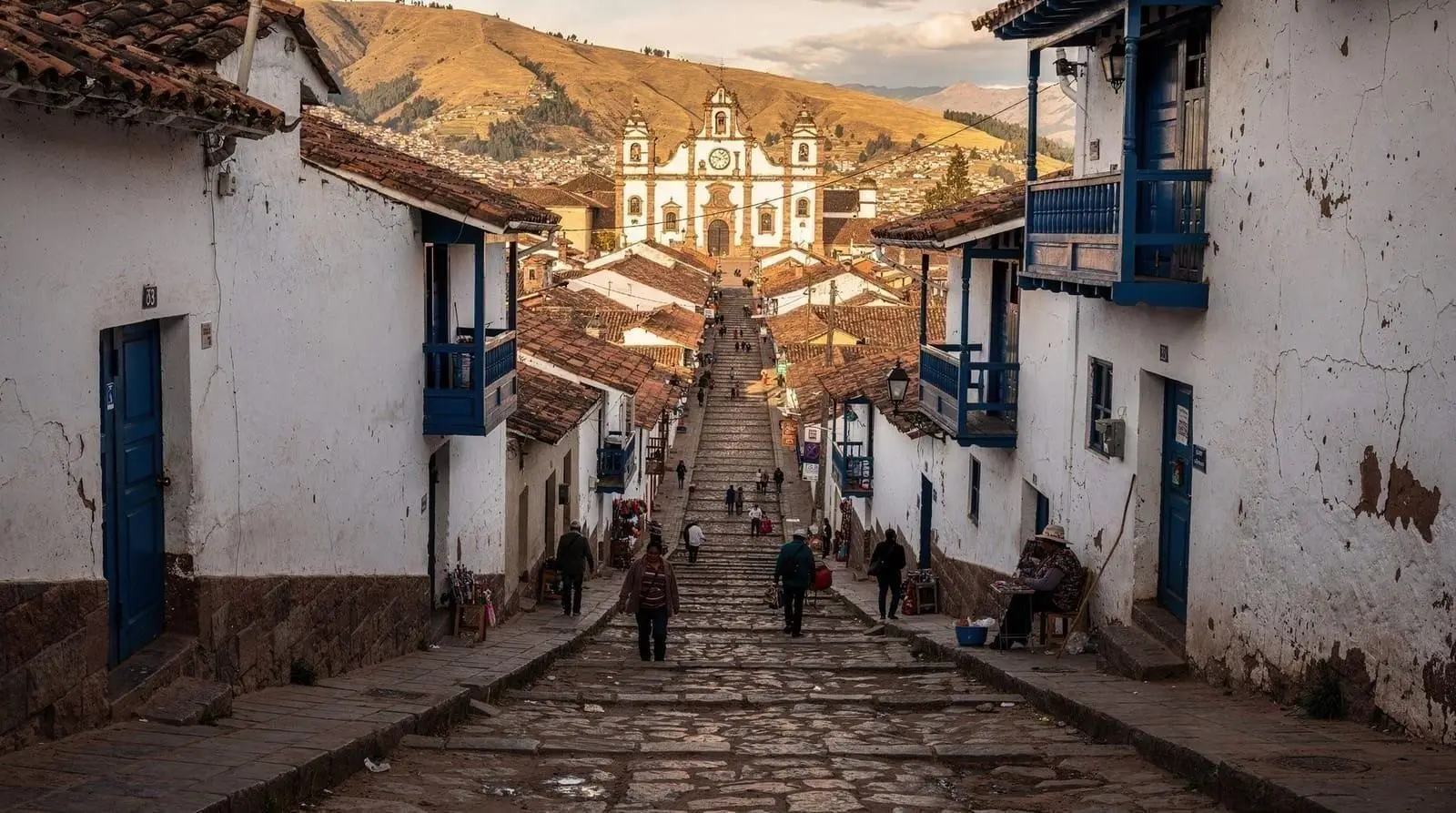
San Blas
Cusco's artisan quarter explained: the steep climb, the San Blas viewpoint, real workshops vs tourist tat, café prices, and where to eat without the markup.
Cusco: City Center and San Blas Walking Tour
Quick facts
- Location
- Uphill east of the Plaza de Armas, Cusco
- Altitude
- ~3,450 m / 11,300 ft (above the centre)
- Known for
- Artisan workshops, cobbled lanes, viewpoints, cafés
- Best for
- Crafts, photography, slow wandering, sunset views over Cusco
The quarter that rewards a slow climb
San Blas is the hillside artisan neighbourhood that fans out uphill to the east of Cusco’s Plaza de Armas. It is the city’s most photographed barrio — a tight grid of steep cobbled lanes, whitewashed walls with blue balconies, craft workshops, small cafés, and a string of viewpoints that frame Cusco’s red-tiled roofs against the surrounding hills. The Incas knew the area as T’oqokachi (“salt cave”), and it has been a craftspeople’s quarter for centuries, home to woodcarvers, weavers, and saint-makers since the colonial period.
The honest caveat is in the gradient. San Blas climbs hard, and at roughly 3,450 m the stairs that look like a quick scramble on the map will leave you breathing heavily on your first day or two in Cusco. Treat it as a slow afternoon, not a brisk errand. Done at the right pace, with a coffee stop or two and an unhurried browse of the real workshops, it is one of the most pleasant half-days in the city.
| Location | Uphill east of the Plaza de Armas, Cusco |
| Cost | Free to wander; workshops and cafés priced per item |
| Time needed | Half a day |
| Getting there | 10-15 min walk from the plaza, or taxi to the top (S/8-12) |
| Best time | Late morning into evening; Saturday for the artisan market |
Getting up there (and saving your legs)
San Blas sits directly above the centre. The classic approach is on foot from the plaza up Calle Hatun Rumiyoc — past the twelve-angled stone — and then up the steep Cuesta de San Blas to the little Plazoleta de San Blas. It is a 10–15 minute walk on flat ground, but the final stretch is a sharp climb.
If altitude has you flagging, two cheats help. A taxi can drop you at the top of San Blas for around S/8–12, letting you walk downhill through the quarter afterwards — far kinder on the lungs. Alternatively, join a guided walk that paces the ascent and adds context. The Cusco city centre and San Blas walking tour links the plaza, the Inca walls, and San Blas in one route, while the private San Blas neighbourhood walking tour goes deeper into the artisan workshops at a pace you set, which suits travellers still acclimatising.
The Iglesia de San Blas and the pulpit
At the heart of the quarter, the small Iglesia de San Blas is the oldest parish church in Cusco, an unassuming adobe building that hides one of the great works of colonial Andean woodcarving: an intricately carved cedar pulpit, attributed (with the usual local legends) to an Indigenous carver, dense with figures, foliage, and a carved skull at its base. It is a genuine highlight and easy to miss given the modest exterior. Entry is via the religious circuit ticket; the church keeps limited hours, so check before you climb.
The Plazoleta de San Blas in front of it has a fountain, a cluster of cafés, and on Saturdays a small artisan market where local makers sell directly — a better bet for authentic, fair-priced crafts than the tourist stalls down by the plaza.
Real workshops vs tourist tat
San Blas’s reputation rests on its craftspeople, and the quarter still holds working studios — but they sit alongside shops selling the same mass-produced “Andean” goods you will find in every Peruvian airport. Knowing the difference saves both money and disappointment.
The historic artisan families are the names to look for. The Mendívil workshop is known for its distinctive long-necked saints and religious figures; the Mérida family for expressive ceramic sculptures of Andean people. Both have been working in San Blas for generations and welcome visitors. Independent weavers and silversmiths keep small studios along Cuesta de San Blas and the lanes off the plazoleta — look for a workshop with tools and half-finished pieces, not just shelves of identical stock.
Honest pricing notes:
- Genuine handwoven alpaca and quality silver cost real money; a price that seems too good usually means acrylic posing as alpaca or alpaca posing as vicuña.
- Haggling is expected in markets but less so in established workshops, where prices reflect labour.
- The “baby alpaca / vicuña” labels are routinely misapplied; if it is cheap, it is neither.
A market-and-kitchen half-day is a good alternative way to engage with local craft if textiles are not your thing — the three-hour Peruvian cooking class teaches the dishes you will keep meeting on Cusco menus, a hands-on counterpoint to an afternoon of browsing.
If textiles do interest you, read the Andean textiles guide before you shop. It explains how to tell genuine alpaca and vicuña from acrylic by touch and smell, why prices vary so widely between shops that look identical, and what natural-dye techniques to look for — knowledge that turns a San Blas browse from guesswork into an informed purchase.
A short history of the artisan barrio
San Blas did not become a craftspeople’s quarter by accident. In Inca times the slope was T’oqokachi, a populated area on the edge of the ceremonial core below. After the conquest, the Spanish parcelled the city into parishes for the Indigenous population, and San Blas became one of them — a barrio of native Andean residents kept slightly apart from the Spanish centre around the plaza. The craft traditions grew out of that: workshops producing the carved saints, retablos, and religious images the new colonial churches demanded, made by Indigenous and mestizo artisans who folded their own iconography into imposed Catholic forms.
That continuity is why the quarter still feels different from the polished centre. The lanes were never widened for carriages or cars, the houses stayed small, and the families who carve and weave here trace their trades back generations. Understanding that backstory changes how you read the place — the steep, awkward streets are not quaint by design but simply un-modernised, and the workshops are the surviving end of a 450-year-old economy, not a tourist invention. A guide who knows the families and the parish history brings this out; wandering alone, it is easy to mistake San Blas for a pretty shopping district rather than a living craft neighbourhood.
The viewpoints
San Blas’s height is its other draw. Several spots reward the climb with panoramas over Cusco:
- Mirador de San Blas — just above the plazoleta, the classic postcard view down over the red roofs to the Plaza de Armas and the hills beyond. Best in late afternoon light.
- Café terraces — a handful of cafés along the upper lanes have rooftop or balcony seating with the same view for the price of a coffee (S/8–14).
- The lanes climbing toward Sacsayhuamán open onto progressively wider vistas; if you are walking up to the fortress, the upper edge of San Blas is the natural staging point.
Sunset is the prize, but it also brings the most people. For a quieter version, come mid-morning when the light is still soft and the steps are nearly empty.
How the masonry was made — and why the joints are perfect
Visitors photographing the Inca walls on the climb up to San Blas often ask the obvious question: how were polygonal blocks fitted so precisely without mortar, metal tools, or the wheel? There is no single tidy answer, and the honest version is more interesting than the “lost technology” myths sold by touts.
The Inca worked stone primarily with harder hammerstones — rounded cobbles of a tougher rock used to peck, bruise, and gradually grind a block into shape. The fine fit came not from cutting each face flat but from repeatedly offering a block up against its neighbour, marking the high points, and dressing them down, again and again, until the surfaces seated together. Soft, irregular polygonal joints actually help: by interlocking many angles rather than stacking neat rectangles, the wall flexes slightly and resettles during the earthquakes that level mortared colonial work above.
The slight inward lean (batter) of the best walls adds further stability. It was a process measured in labour and time — vast quantities of organised, taxed labour — rather than a secret tool. Knowing this lets you look at the famous Hatun Rumiyoc wall on your way up and see craft and organisation, not magic, which is also a useful filter for the more fanciful claims you will hear in the souvenir shops.
Eating and drinking in San Blas
San Blas has Cusco’s densest concentration of cafés and small restaurants, skewing toward the city’s traveller crowd. Quality is high and prices sit a notch above the local average but well below the plaza balconies.
- Coffee: the quarter is the centre of Cusco’s specialty-coffee scene. Several roasters and cafés around the plazoleta serve properly made flat whites for S/9–14, a relief if hostel instant coffee has worn thin.
- Casual meals: lunch menús and à la carte mains run S/20–40 in the neighbourhood’s small kitchens — more than a market stall, less than a tourist restaurant on the square.
- Pacha Papa on the Plazoleta de San Blas is the local favourite for traditional Cusqueño cooking, including clay-oven cuy ordered ahead, served in a pleasant courtyard.
Avoid the touts handing out flyers near the plazoleta for “free” pisco or chocolate sessions, which tend to be sales funnels; the legitimate workshops do not need to chase you up the hill. For a wider view of where to eat across the city beyond San Blas itself, the best restaurants in Cusco guide rounds up options at every budget level.
Practicalities
Pace and altitude: the single most useful tip is to come down through San Blas rather than up. Taxi to the top, then wander downhill toward the plaza. Carry water and do not rush the stairs on your first days at altitude.
Tickets: the streets, plazoleta, and viewpoints are free. The Iglesia de San Blas requires the religious circuit ticket. None of San Blas is on the boleto turístico.
Staying here: San Blas is a popular base for travellers who want character over convenience — boutique guesthouses and small hotels in restored colonial houses, quieter than the bar-strip blocks near the plaza, with the trade-off that everything involves a climb home.
Safety: the quarter is generally safe and walkable, including in the evening when the cafés are busy. Normal caution applies on dim, steep side lanes late at night; stick to the lit main routes.
Money: small artisan workshops and independent cafés rarely accept cards, so carry soles in small denominations. See the Cusco taxi and money tips guide for where to change money and which ATMs are reliable in the city centre nearby.
San Blas after dark
The quarter changes character after sunset. The cafés that serve flat whites by day switch to a low-key bar-and-bistro crowd by evening, and the steep lanes — busy with photographers by afternoon — empty out considerably. It is a good time for a quiet dinner away from the tourist-menu restaurants directly on the plaza, but it is also when the “free pisco tasting” touts are most persistent, so keep the same scepticism after dark that you would apply during the day. If you are staying in San Blas, the walk home after dinner is genuinely steep; a taxi for the final stretch is a reasonable choice rather than a failure of adventurousness.
Budget considerations
San Blas skews pricier than the market-and-street-food end of Cusco, but it does not have to break a budget. A coffee and pastry can be had for under S/15, and the Saturday artisan market offers fixed, fair prices without the haggling culture of the bigger tourist markets. Compare this against the wider city in the Cusco on a budget guide, which breaks down typical daily costs across accommodation tiers, food, and activities — useful context before you decide how much of your Cusco days to spend browsing San Blas’s cafés versus eating more cheaply elsewhere.
A practical wandering route
San Blas works best as an unhurried loop rather than a checklist. A route that keeps the climbing gentle and the light working in your favour:
- Start at the top. Take a taxi (S/8–12) to the upper edge of the quarter, near the lanes that climb toward Sacsayhuamán, late morning or early afternoon.
- Drift down to the Mirador de San Blas for the panorama while the light is still soft, before the sunset crowd.
- Visit the Iglesia de San Blas on the plazoleta for the carved pulpit, and browse the Saturday market if your timing lands on a weekend.
- Work down the Cuesta de San Blas, dipping into the Mendívil and Mérida workshops and any independent studio whose door is open.
- Stop for coffee at one of the terrace cafés, timed so you catch the late-afternoon glow over the roofs.
- Finish at the twelve-angled stone on Calle Hatun Rumiyoc as you descend back toward the Plaza de Armas, arriving in time for dinner in the centre.
Done this way, the only real climbing is the optional detour to the upper viewpoints, and you spend the rest of the afternoon walking downhill — exactly what your lungs want in the first days at altitude. Pack a light layer for the descent — the temperature drop once the sun dips behind the hills is more noticeable at this elevation than it looks from the plaza below.
Honest expectations: charm and its limits
San Blas earns its reputation, but it is worth setting expectations. The quarter is firmly on the tourist trail: the cafés are priced for travellers, the “artisan” shops nearest the plazoleta increasingly sell the same factory goods as the rest of Cusco, and on a sunny afternoon the famous viewpoint can be shoulder-to-shoulder with phones held aloft. The genuine workshops, the quiet early-morning lanes, and the real craft are all still here, but you have to look slightly past the postcard version to find them.
That is not a reason to skip it — it remains one of the most rewarding corners of the city — but it is a reason to come with the right frame of mind. Treat San Blas as a place to slow down, talk to a maker, and watch the light change over the roofs, rather than a box to tick. The travellers who leave underwhelmed are usually the ones who marched up the hill, photographed the mirador, and marched back down without ever stepping into a studio or sitting still for half an hour.
A first-hand account in Cusco off the beaten path makes a similar case for slowing down across the wider city, not just San Blas, if the standard highlight-reel itinerary is starting to feel rushed.
How San Blas fits your Cusco days
San Blas pairs naturally with the historic centre — climb up through Hatun Rumiyoc in the afternoon — and sits on the route up to Sacsayhuamán for those tackling the fortress on foot. Combine it with Qorikancha downhill and a lunch at San Pedro market for a full, walkable city day. For acclimatisation strategy, the boleto, and onward trips to the Sacred Valley and Machu Picchu, see the main Cusco guide, browse /itineraries/, or use the planning tools at /tools/.
However you build the day, leave San Blas for the second half of the afternoon rather than the morning. The workshops open later than the ruins, the light for photography is better after about 3 pm, and arriving tired from an earlier sightseeing day suits the quarter’s slower pace far better than trying to fit it in before breakfast.
Frequently asked questions about San Blas
Is San Blas a steep walk?
Yes. San Blas climbs hard up cobbled lanes and staircases east of the Plaza de Armas, and at around 3,450 m the ascent is genuinely tiring on your first days in Cusco. The easy fix is to take a taxi to the top (S/8–12) and walk downhill through the quarter instead.
What can I actually buy in San Blas?
Genuine Andean crafts from working studios — the Mendívil and Mérida family workshops for religious figures and ceramics, plus independent weavers and silversmiths. Look for studios with tools and half-finished pieces rather than shelves of identical stock. The Saturday market on the plazoleta is good for buying direct from makers.
Is the San Blas viewpoint worth it?
The Mirador de San Blas gives the classic panorama over Cusco’s red roofs to the Plaza de Armas and the hills, best in late-afternoon light. It is free and a short climb above the plazoleta. Several café terraces offer the same view for the price of a coffee if you would rather sit down for it.
Is the Iglesia de San Blas included in the boleto turístico?
No. The little church — worth visiting for its remarkable carved cedar pulpit — is on the separate religious circuit ticket, not the boleto turístico. None of San Blas’s streets or viewpoints require any ticket; only the church interior does, and it keeps limited hours.
How long should I spend in San Blas?
Half a day is ideal — an afternoon to wander the lanes, browse a workshop or two, see the church, and catch the viewpoint at sunset, with a café stop along the way. It pairs well with a morning in the historic centre, making a full and almost entirely walkable Cusco day.
Is San Blas a good place to stay in Cusco?
It suits travellers who value character and quiet over convenience. The guesthouses and small hotels occupy restored colonial houses and sit away from the noisy bar strip near the plaza. The trade-off is the climb: every return home means walking up the hill, which is tiring while you acclimatise.
How do I know if a workshop is genuine?
Look for tools, half-finished pieces, and a working studio feel rather than shelves of identical, shrink-wrapped stock. The Mendívil and Mérida family workshops are established names worth seeking out by name. Genuine handwoven alpaca and quality silver cost real money — a suspiciously low price is the clearest single warning sign, and the Andean textiles guide has more detail on spotting the difference.
Top experiences
Bookable activities with verified prices and instant confirmation on GetYourGuide.

