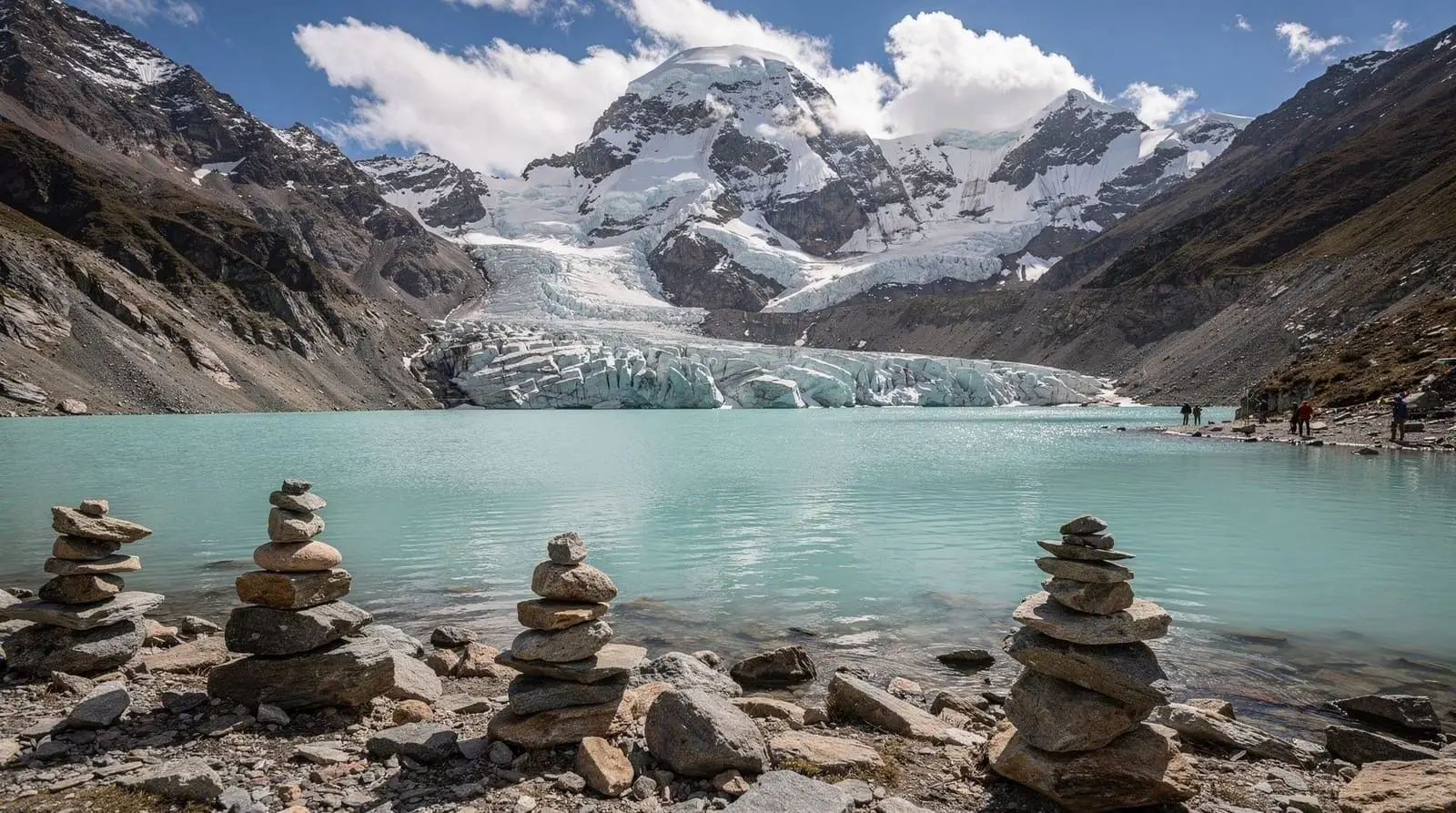
Humantay Lake
Humantay Lake is a turquoise glacial lagoon below Salkantay: a short but steep 4,200 m hike. Here is the altitude reality, the timing, and what to expect.
Humantay Lake Tour from Cusco
Quick facts
- Lake altitude
- 4,200 m / 13,780 ft
- Pickup time
- Typically 4:00-5:00 am from Cusco
- Round-trip time
- 12-14 hours including transport
- Hike
- 5-6 km round trip, 600 m climb, 1.5-2 hrs up
- Trailhead
- Soraypampa, ~3,900 m
Is Humantay Lake worth the early start?
Yes — and of the big day trips out of Cusco, it is the one that most reliably lives up to the photos. Humantay (Humantay or Wamantay) is a glacial lake whose water glows an almost unreal turquoise, fed by meltwater from the Humantay glacier above and ringed by snow peaks. Unlike Rainbow Mountain, whose colours depend heavily on light and season, Humantay’s blue-green water shows up in nearly all conditions, which makes it a more dependable payoff for the 4 am wake-up.
The catch, as always in the high Andes, is the climb. The lake sits at 4,200 m, reached by a short but genuinely steep 600-metre ascent from the trailhead at Soraypampa. It is not a long walk — 5 to 6 km round trip — but it is relentless uphill in thin air, and people who have not acclimatised find it brutal. If you have spent two or three days at Cusco or Sacred Valley altitude first, it is a hard but very achievable half-day on the mountain. If you have just arrived, it will hurt.
| Where | Soraypampa trailhead, ~4 hrs west of Cusco |
| Cost | Around $30–50 for a guided day tour, transport and lunch included |
| Time needed | 12–14 hours door to door; 1.5–2 hrs hiking up |
| Getting there | Organised day tour from Cusco (independent transport is impractical) |
| Best time | April to October (dry season) for clear water and skies |
What Humantay Lake actually is
Humantay Lake lies in the Vilcabamba range, beneath the towering twin peaks of Salkantay (6,271 m) and Humantay (5,917 m), about four hours’ drive west of Cusco. The lake is glacial: its colour comes from “rock flour,” the fine glacial sediment suspended in the meltwater that scatters light toward the turquoise end of the spectrum. The same glaciers that feed and colour it are retreating, which is the quiet environmental subtext to a lot of Andean lake tourism.
The trailhead, Soraypampa, sits at around 3,900 m and is also the first camp on the multi-day Salkantay trek to Machu Picchu. Day-trippers to Humantay are, in effect, walking the opening section of that famous route. For many people the day trip is a way to sample the Salkantay landscape without committing to four or five days of trekking.
The day, hour by hour
A Humantay Lake day trip is long, but the structure is straightforward:
- 4:00-5:00 am — hotel pickup in Cusco.
- 6:30-7:00 am — breakfast stop in Mollepata.
- 8:30-9:00 am — arrive at Soraypampa trailhead (~3,900 m).
- 9:00-11:00 am — hike up to the lake, with photo time at the top.
- 11:30 am-1:00 pm — descend.
- 1:30-3:00 pm — lunch in Mollepata.
- 6:00-7:00 pm — back in Cusco.
That is 12 to 14 hours door to door for a couple of hours at the lake — a better ratio than Rainbow Mountain, and a more rewarding view at the end of it. The cleanest way to do it is a guided group tour like the Humantay Lake tour from Cusco, which handles the four-hour transfer, breakfast, lunch, the entry fee, and a guide. If you want a version with a stronger focus on the walk itself and more time at altitude, the Humantay Lake tour and hike is the same destination with a more hiking-led pace.
The hike: short, steep, unforgiving
Do not let the modest distance fool you. The trail from Soraypampa to the lake climbs around 600 vertical metres in roughly 2.5-3 km. That is a steep gradient at any altitude; at 4,000+ m it is genuinely tough. Most acclimatised, reasonably fit people reach the lake in 1.5 to 2 hours of slow, breath-managed walking. The first 45 minutes are the hardest — a sustained pull up switchbacks — after which it eases slightly toward the lake basin.
Pace is everything. Adopt the slow, steady “paso de llama” rhythm and stop to breathe whenever you need to. The descent takes about an hour and is hard on the knees; trekking poles help on the loose sections.
Horses are available at Soraypampa for the ascent, typically S/80-100 / about $22-27, negotiable, and ridden by many people who underestimate the climb. As at Rainbow Mountain, there is no shame in it and the income stays local — but the very last stretch to the lakeshore must be done on foot.
Altitude: read this before you go
Humantay’s altitude profile is serious enough to warrant the same caution as anywhere in the high Andes.
- Acclimatise first. Two to three days at Cusco or Sacred Valley altitude before attempting the hike. Do not do it the day after flying into Cusco.
- Hydrate hard and go slow. Drink far more water than usual, eat lightly, and avoid alcohol the night before.
- Know the warning signs. A mild headache and breathlessness are normal; vomiting, confusion, or an inability to walk straight are not — descend immediately if they appear.
- Coca tea and leaves are the traditional remedy and freely available; some travellers take acetazolamide after consulting a doctor before the trip.
- Dress for cold. The lake basin is windy and can be near freezing even when the trailhead is sunny. Layers, a windproof jacket, gloves, a hat, and strong sunscreen are essential — the UV at this elevation is intense.
A note on the water: it is tempting to wade in, but the lake is glacial-cold and the communities increasingly ask visitors not to enter it for cultural and conservation reasons. Photograph it, do not swim in it.
Humantay vs the other Cusco day hikes
Humantay sits in a sweet spot among the big day trips:
- vs Rainbow Mountain: Humantay is lower (4,200 vs 5,200 m), the payoff is more reliable, but the climb is steeper per metre. Rainbow Mountain is more famous and more crowded.
- vs Palccoyo: Palccoyo is far easier (a flat walk) but lacks Humantay’s dramatic glacial-lake setting. Choose Palccoyo for comfort, Humantay for the view.
- vs the Salkantay trek: Humantay is the day-trip taster of the Salkantay route. If you love it, the full trek to Machu Picchu is the natural next step.
If you can only do one big high-altitude day and you want the most dependable reward for the effort, Humantay is the pick.
How Humantay fits a Cusco itinerary
Because it shares its trailhead with the Salkantay route, Humantay slots neatly into a Cusco region plan alongside Machu Picchu, the Sacred Valley, Ollantaytambo, and Pisac. Many travellers do it as a final acclimatised day after Machu Picchu rather than as their first outing. Longer packages sometimes combine it with the Maras and Moray sites; the 7-day Cusco, Machu Picchu, Maras salt mines and Humantay Lake tour bundles several of these into one altitude-paced trip.
To build your own route and time the hike for good weather, see the /itineraries/, the planning /guides/, and the seasonal /tools/ page.
Frequently asked questions about Humantay Lake
How difficult is the Humantay Lake hike?
It is short but steep. The trail climbs about 600 vertical metres over 2.5-3 km from the Soraypampa trailhead, reaching the lake at 4,200 m. Acclimatised, reasonably fit people make it in 1.5 to 2 hours of slow walking. The difficulty is the combination of a steep gradient and thin air, not the distance — the first 45 minutes are the hardest.
Do I need to acclimatise before Humantay Lake?
Yes. The lake sits at 4,200 m and the trailhead at 3,900 m, both high enough to cause altitude sickness in unacclimatised visitors. Spend at least two to three days at Cusco or Sacred Valley altitude before the hike, hydrate well, and skip alcohol the night before. Doing it the day after arriving in Cusco is a common mistake.
Can I swim in Humantay Lake?
No. The water is glacial and dangerously cold, and the host communities ask visitors not to enter the lake for cultural and conservation reasons. Enjoy it from the shore and the surrounding viewpoints instead.
What time does the Humantay Lake tour start?
Pickups in Cusco are usually between 4:00 and 5:00 am because the drive to the Soraypampa trailhead takes around four hours. The full day runs 12 to 14 hours door to door, including the breakfast and lunch stops in Mollepata.
Is Humantay Lake better than Rainbow Mountain?
For a more reliable reward, many travellers think so. Humantay’s turquoise water shows up in almost all conditions, while Rainbow Mountain’s colours depend heavily on season and light. Humantay is also lower at 4,200 m, though its climb is steeper per metre. Rainbow Mountain wins on fame and the iconic striped ridge; Humantay wins on dependability.
Can I take a horse up to Humantay Lake?
Yes. Horses are available at the Soraypampa trailhead for roughly S/80-100 one way, negotiable, and are widely used by people who find the steep climb too hard. The income supports local families. The final approach to the lakeshore, however, must be walked on foot.
Top experiences
Bookable activities with verified prices and instant confirmation on GetYourGuide.

