Qorikancha
Honest guide to Qorikancha, Cusco's Inca Temple of the Sun: entry tickets, the Santo Domingo overlay, hours, what to skip, and how long you need.
City Tour in Cusco: Qorikancha and Sacsayhuaman
Quick facts
- Location
- Plazoleta Santo Domingo, Avenida El Sol, Cusco
- Altitude
- 3,400 m / 11,150 ft
- Entry
- S/15 / about $4 (separate ticket, NOT on the boleto turístico)
- Hours
- Mon-Sat ~8:30 am-5:30 pm; Sun shorter hours
- Best for
- Inca masonry, colonial-Inca contrast, art history
The Inca temple a cathedral was built on top of
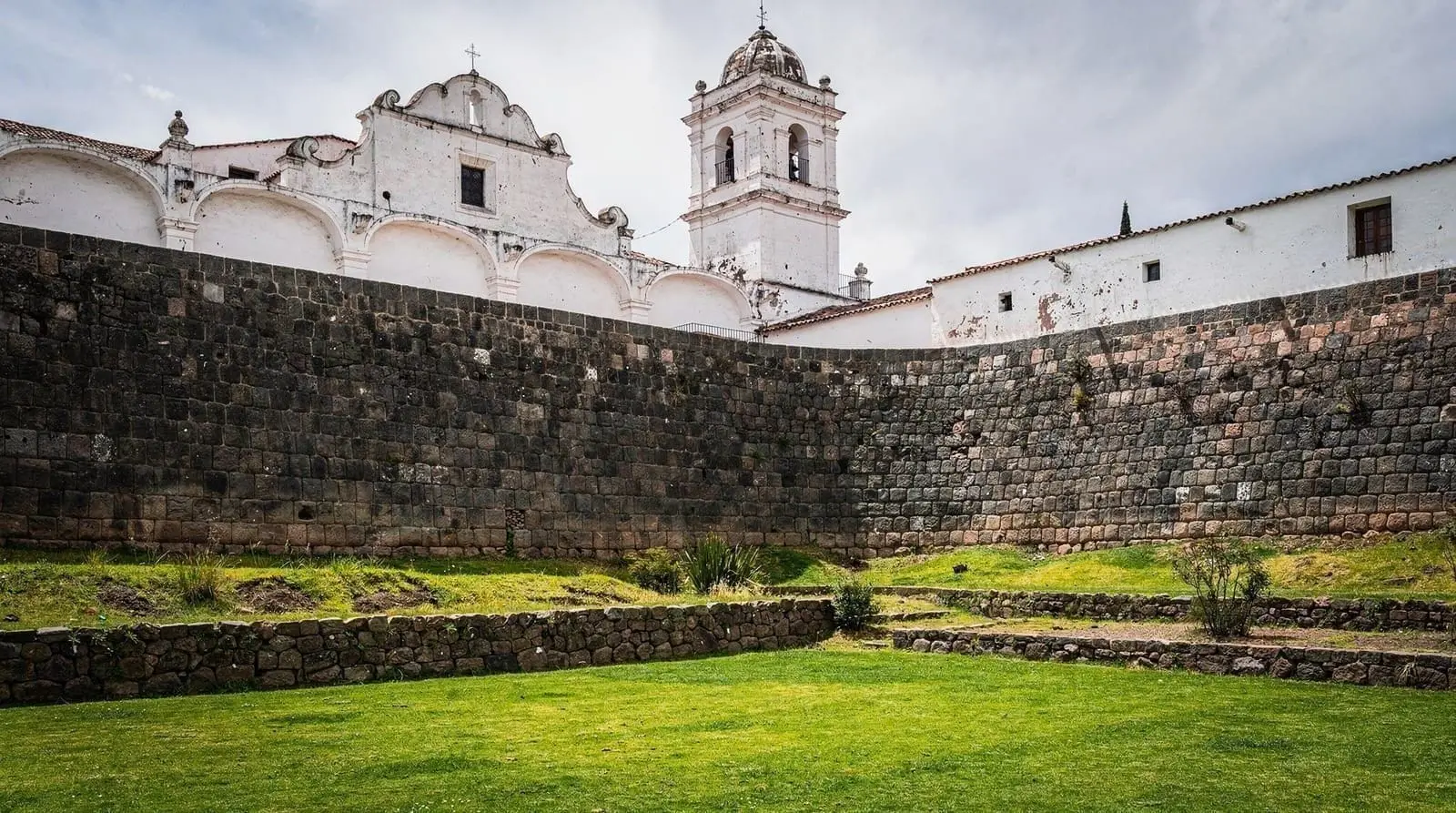
Qorikancha is the clearest single lesson in Peruvian history you can absorb in two hours. Walk in off Avenida El Sol and you step straight into the collision that defines this country: the most sacred temple of the Inca Empire, its walls of darkly polished andesite fitted without mortar, with a baroque Spanish convent and church planted directly on top of it.
The Quechua name means roughly “golden enclosure” (quri gold, kancha enclosure), and in Inca times the complex was reportedly sheathed in sheets of hammered gold, with a garden of life-size gold and silver llamas, maize, and figures in the courtyard. The Spanish stripped it within months of arriving in 1533 and handed the site to the Dominican order, who raised the Convento de Santo Domingo over the surviving foundations.
What makes Qorikancha worth your time is not what was lost but what survived. The lower Inca walls were too perfectly built to demolish — the Spanish simply used them as foundations — so today you can stand in a colonial cloister and run your hand along curved Inca masonry that has outlasted every earthquake the colonial structures above it could not. The great 1650 and 1950 earthquakes badly damaged the church; the Inca walls barely moved. It is the most honest object lesson in Andean engineering anywhere in Cusco.
Is Qorikancha worth visiting?
Yes — and it is one of the few sites in Cusco I would call genuinely essential rather than merely pleasant. It is compact, central, and you can absorb it without altitude exhaustion. If you only have a half-day in the city and have to pick one paid site, this is the one. The combination of intact Inca temple chambers and the colonial church built over them exists nowhere else in such concentration, and the on-site curation is better than at most Cusco attractions.
The caveat: Qorikancha is small. Allow 1.5 to 2 hours and no more. People who expect a sprawling ruin like Sacsayhuamán sometimes leave underwhelmed because they were looking for scale rather than precision. Come for the craftsmanship, the curved wall, and the layering of two empires, and you will not be disappointed.
| Location | Plazoleta Santo Domingo, Avenida El Sol, Cusco |
| Cost | Around S/15 / $4, separate from the boleto turístico |
| Time needed | 1.5 to 2 hours |
| Getting there | 10-minute downhill walk from the Plaza de Armas |
| Best time | Opening (~8:30 am) or after 3 pm, to avoid the mid-morning tour buses |
A crucial ticketing note: this is NOT on the boleto turístico
This trips up more visitors than any other Cusco logistics issue, so read it carefully. Cusco’s boleto turístico (the bundled tourist ticket that covers Sacsayhuamán, Qenqo, Puka Pukara, Tambomachay, Pisac, Ollantaytambo, and several city museums) does not include Qorikancha.
Qorikancha charges its own separate entry of around S/15 (about $4) for adults, with a reduced rate for students holding an ISIC card and for Andean Community nationals. Pay it at the door on the Plazoleta Santo Domingo side. There is no advantage to buying it in advance; lines move quickly except mid-morning.
To muddy matters slightly: there is also a separate, free-to-the-public Site Museum of Qorikancha in the gardens below the temple on Avenida El Sol, which is covered by the boleto turístico. It is a small underground archaeology museum and is entirely different from the temple-and-convent complex above it. Most visitors mean the temple when they say “Qorikancha,” and that is the paid S/15 ticket. Do not assume your boleto covers the main site — it does not.
For a fuller breakdown of which ticket covers what, see the boleto turístico explained guide and the Cusco destination page.
| Site | Ticket needed | Typical cost |
|---|---|---|
| Qorikancha (main temple) | Separate entry only | S/15 / ~$4 |
| Qorikancha Site Museum (gardens) | Boleto turístico | Included in boleto |
| Sacsayhuamán | Boleto turístico (or Circuit I) | S/70-130 |
| Sacred Valley ruins (Pisac, Ollantaytambo, Chinchero, Moray) | Boleto turístico | Included in full/partial boleto |
Knowing which column your destination falls into before you arrive avoids the single most common ticketing mix-up in Cusco. The where to buy tickets in Cusco guide has the full list of counters and online options.
What you actually see inside
The Inca chambers
Past the entrance you reach a sequence of trapezoidal-doorway chambers built from the dark, fine-grained andesite the Inca reserved for their most important structures. These are thought to have been temples to the Sun (Inti), the Moon (Killa), Venus, thunder, and the rainbow. The stonework here is the imperial “polished” style — blocks ground to mirror-flat faces and fitted so tightly a credit card will not slide between them. Notice the slight inward lean of the walls and the trapezoidal niches, both earthquake-resistant features the Inca used deliberately.
The curved wall
The single most photographed feature is the curved exterior wall on the Avenida El Sol side — a smooth, gently bowed sweep of perfectly coursed masonry that has survived intact for roughly five centuries. It is best photographed from the garden below, in morning light, before the tour groups assemble. Standing beneath it gives you the clearest sense of why the Spanish chose to build on rather than tear down.
The colonial overlay
Upstairs and through the cloisters, the Dominican convent layers in baroque arches, a sequence of colonial paintings (including the Cusco School style that blended European technique with Andean iconography), and the church proper. The deliberate contrast — Inca trapezoid beside Spanish arch — is the whole point of the visit, and the site presents it well.
Why the Spanish left the walls standing
The looting of Qorikancha in 1533 is one of the best-documented episodes of the conquest: chroniclers describe conquistadors stripping gold cladding, ceremonial objects, and the famous garden of metal plants and llamas within weeks of entering Cusco, melting most of it into ingots for shipment to Spain. What they did not do — could not do — was dismantle the lower walls. The andesite blocks were cut and fitted with a precision that made demolition impractical with the tools of the time, so the Dominicans built directly on top rather than clearing the site.
That decision, made for purely practical reasons, is the only reason the finest surviving example of imperial Inca stonework in Cusco still stands complete rather than scattered into colonial rubble, as happened to so much of Sacsayhuamán’s smaller stonework. For the broader arc of that conquest and what it meant for Inca society, the Inca Empire for travelers guide gives useful context before you visit any of Cusco’s ruins.
Getting there and combining it
Qorikancha sits on Avenida El Sol, an easy ten-minute downhill walk from the Plaza de Armas. Coming back up is the only effort, and at 3,400 m even a gentle climb will leave you breathing harder than you expect — pace yourself.
Most visitors fold Qorikancha into a wider Cusco day. A practical sequence is the temple first thing in the morning, then a walk up through the San Blas artisan quarter, then the afternoon city-and-ruins circuit to Sacsayhuamán and the outlying ruins of Tambomachay, Qenqo and Puka Pukara.
If you would rather have the history explained in context, the Cusco city tour combining Qorikancha and Sacsayhuamán covers both anchor sites with a licensed guide in a single afternoon — useful because the Inca-versus-colonial story at Qorikancha is far richer with someone unpacking it than with a self-guided wander. The standard half-day Cusco city tour with Sacsayhuamán and Qenqo is the cheaper bundled option if you want the whole ruins circuit in one go.
Honest watch-outs
Don’t confuse the two “Qorikanchas.” As above: the paid temple-and-convent is the main attraction. The free boleto-covered site museum below it is a minor extra, not a substitute.
Mid-morning crush. Between roughly 10 am and noon, organised tour buses arrive in waves and the compact chambers get genuinely crowded. Arrive at opening (~8:30 am) or after 3 pm for breathing room.
The “gold temple” framing oversells it. Marketing copy leans hard on the lost gold. There is no gold left to see — it was melted down in 1533. Come for the masonry and the history, not for treasure, and you will leave satisfied.
Photography of the curved wall. The best shot is from the lawned garden on the El Sol side, not from inside. You do not need a ticket to photograph the exterior wall.
Altitude. If you have just arrived in Cusco, do not make Qorikancha your sprint up Avenida El Sol on day one. Give yourself a day to acclimatise first; the altitude guidance covers this in detail.
Practical information
Hours: Roughly Monday to Saturday 8:30 am to 5:30 pm, with shorter Sunday hours. Hours shift with the season and on religious holidays the convent may close to tourists — check locally the day before.
Entry: About S/15 (around $4) for adults, paid at the door, separate from the boleto turístico. Reduced rates for ISIC students and Andean Community nationals.
Time needed: 1.5 to 2 hours is ample.
Accessibility: The site has steps and uneven Inca thresholds; it is not fully step-free.
Nearby food: Avenida El Sol and the streets back toward the Plaza de Armas have plenty of cafés. For something more local, the San Pedro Market is a ten-minute walk and serves cheap, fresh lunches.
Frequently asked questions about Qorikancha
Is Qorikancha included in the Cusco tourist ticket?
No. The main Qorikancha temple-and-convent complex is not covered by the boleto turístico and charges its own separate entry of about S/15 (around $4) at the door. Confusingly, a small separate site museum in the gardens below is covered by the boleto — but that is a minor underground archaeology room, not the main temple. Budget for the standalone ticket.
How much time do you need at Qorikancha?
Between 1.5 and 2 hours is plenty. The complex is compact, and unlike sprawling outdoor ruins you can see everything at a comfortable pace without altitude exhaustion. Visitors expecting a large ruin sometimes feel it is small — it is, and that is fine; the value is in the precision masonry and the colonial overlay, not in scale.
What is the difference between Qorikancha and Coricancha?
They are the same place — just two spellings of the same Quechua name (quri kancha, “golden enclosure”). “Qorikancha” follows modern standardised Quechua spelling; “Coricancha” is the older Spanish-influenced version. Signage, maps, and tour listings use both interchangeably.
Is there any gold left to see at Qorikancha?
No. The Inca temple was reportedly sheathed in gold panels with a gold-and-silver garden in Inca times, but the Spanish stripped and melted it all in 1533. Marketing that promises a “golden temple” oversells it — what survives is the extraordinary stonework, not treasure. Come for the masonry and the history.
Can you visit Qorikancha and Sacsayhuamán in one day?
Easily. Qorikancha sits in the city centre and Sacsayhuamán is a short drive or a steep 30-minute walk uphill above town. A common plan is Qorikancha in the morning and the outlying ruins circuit — Sacsayhuamán, Qenqo, Puka Pukara, Tambomachay — in the afternoon. Guided city tours bundle both, and a half-day tour covers the core sights efficiently.
Is Qorikancha safe and easy to reach?
Yes. It is a ten-minute walk down Avenida El Sol from the Plaza de Armas in a well-trafficked part of central Cusco. The only effort is the uphill return at 3,400 m, which feels harder than it looks until you have acclimatised. Standard urban caution applies; keep valuables out of sight as you would anywhere busy.
Do I need a guide at Qorikancha?
Not strictly, but it helps more here than at most sites. The value of Qorikancha is in understanding what you are looking at — which chambers served which deities, how the Inca stonework techniques differ from the colonial arches above them — and a guide or the Cusco archaeological sites guide read beforehand makes the visit noticeably richer than wandering with no context at all.
Top experiences
Bookable activities with verified prices and instant confirmation on GetYourGuide.

