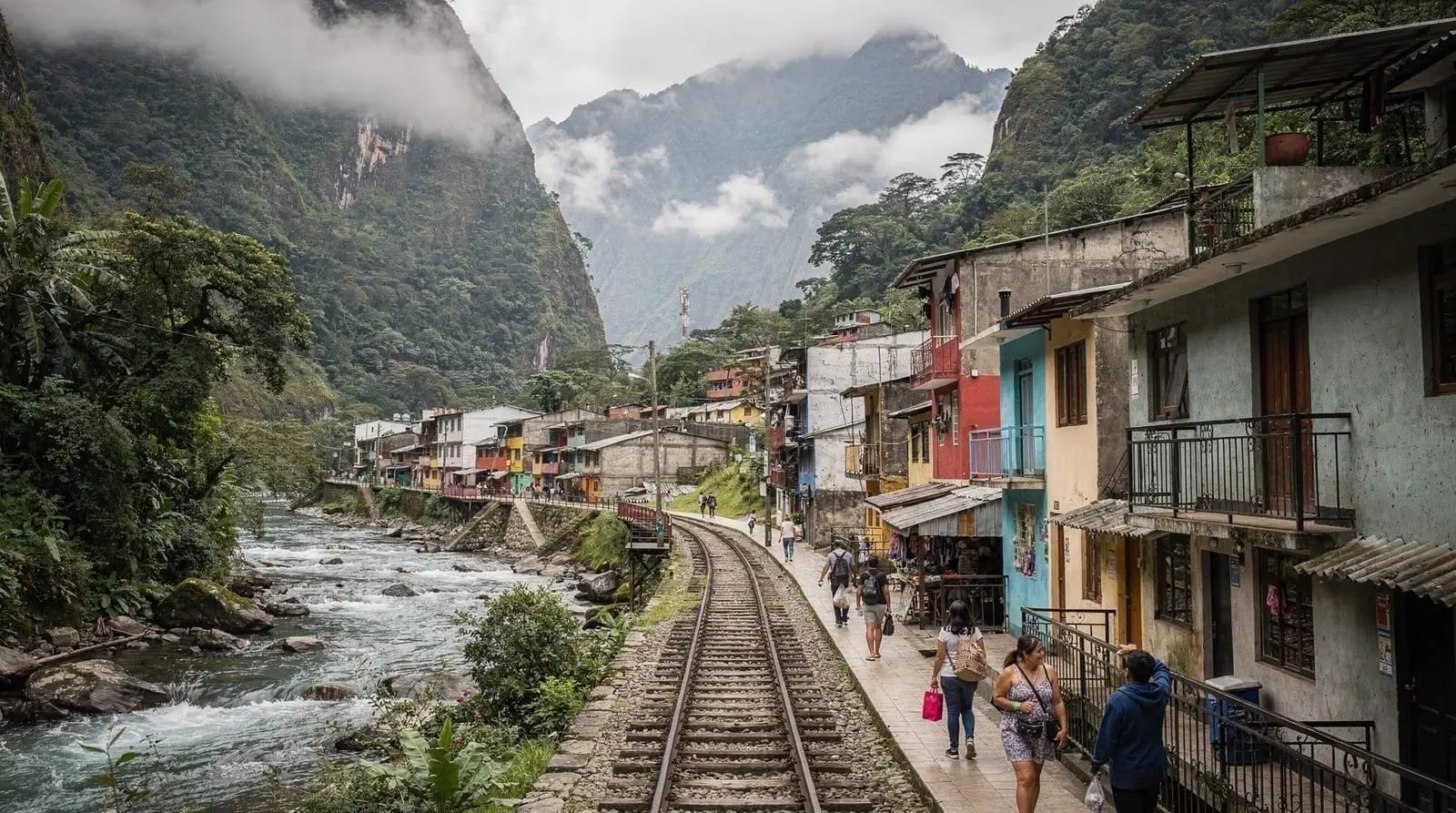
Aguas Calientes (Machu Picchu Pueblo)
An honest look at Aguas Calientes, the town below Machu Picchu: where to sleep, where to eat without overpaying, the hot springs, and the early bus queue.
Sacred Valley & Machu Picchu by Train: 2-Day, 1-Night Tour
Quick facts
- Altitude
- 2,040 m / 6,690 ft (lower than Cusco)
- Also called
- Machu Picchu Pueblo
- Access
- Train only — no road in
- Best for
- A base before an early Machu Picchu entry
Should you stay overnight in Aguas Calientes?
For most people, yes — even though the town gives you few reasons to love it. Aguas Calientes, officially renamed Machu Picchu Pueblo, exists for one purpose: it is the train terminus and bus departure point at the foot of Machu Picchu. There is no road in; you arrive by rail or on foot off the trekking routes. The town is wedged into a steep river gorge, packed with hotels and restaurants stacked up the hillsides, and almost everything costs more than it would in Cusco because everything has to come in by train.
The case for staying a night is purely logistical and it is a strong one. Sleeping here lets you catch the first Consettur buses at 5:30 am and reach the citadel before the day-trip crowds arrive from Cusco on the mid-morning trains. If you try to do it all in one day, your entry slot is at the mercy of the train schedule and you lose the quiet early gate. One night here buys you the best two hours of light on the mountain.
| Where | Train terminus below Machu Picchu, in the Urubamba gorge |
| Stay | 1 night, arriving the afternoon before your citadel visit |
| Cost | Dorm from around S/40; mid-range S/300–550; splurge $1,000+ |
| Getting there | PeruRail or IncaRail from Ollantaytambo (~1h40) or Cusco |
| Best time | Dry season (May–September) for clear morning views up top |
A two-day package such as the Sacred Valley and Machu Picchu 2-day train tour includes the overnight and removes the booking juggling. If you are setting out from the valley, the 2-day Machu Picchu tour from Ollantaytambo does the same starting from the train platform.
Getting there and getting oriented
Trains from Ollantaytambo and (less often) Cusco run by PeruRail and IncaRail terminate at the station in the middle of town. From the platform you walk through the artisan market — there is no way to avoid it; the exit funnels everyone past the stalls — and out into the town centre along the Río Vilcanota.
The town is tiny and entirely walkable. Three things matter for your visit:
The bus stop and ticket booth sit on Avenida Hermanos Ayar by the river, where the Consettur shuttles up to the citadel depart. The pre-dawn queue forms here.
The main plaza (Plaza Manco Cápac) has the church, a few sit-down restaurants, and the steps up to the higher hotels.
Avenida Pachacútec climbs from the plaza toward the thermal baths and is lined with restaurants and tour offices.
Everything is within a 10-minute walk. There are no cars to speak of — the town runs on foot.
Where to stay
Accommodation spans hostel dorms to genuine luxury, and price does not always track quality, so book on reviews rather than star ratings.
Budget: Hostels near the station and up the side streets run S/40–90 / about $11–24 for a dorm bed or basic private. Supertramp Hostel and Ecopackers-style places are functional; expect thin walls and early-rising neighbours.
Mid-range: Solid hotels like Tierra Viva Machu Picchu and Casa del Sol sit around S/300–550 / $80–150 a night with breakfast and reliable hot water — not guaranteed at the cheaper end.
Luxury: The Inkaterra Machu Picchu Pueblo Hotel, set in cloud-forest gardens at the edge of town, and the Sumaq are the standout high-end choices, running $300–600+.
The one splurge worth knowing about: the Belmond Sanctuary Lodge is the only hotel directly beside the citadel gate, letting you walk in at opening without the bus. It costs accordingly ($1,000+), but it removes the queue entirely.
Whatever the tier, book ahead in dry season — the town’s bed stock is finite and the trekking groups finishing the Salkantay and short Inca Trail routes fill rooms.
Where to eat without overpaying
Aguas Calientes is the classic tourist-trap dining trap: hawkers on Avenida Pachacútec wave laminated menus and “free pisco sour” offers at every door. The food behind those pitches is usually mediocre and overpriced. A few honest pointers:
- Avoid the restaurants with a person actively pulling you off the street; the good places do not need to.
- A plain trout or lomo saltado will run S/35–55 / $9–15 — fair for the town’s logistics. If a “tourist menu” is dramatically cheaper, the portions and quality drop accordingly.
- Mapacho (on the riverside) and Indio Feliz (a long-running French-Peruvian spot up Calle Lloque Yupanqui) are the two most consistently recommended sit-down options.
- For breakfast before the early bus, ask your hotel for a packed or early breakfast — most will arrange one if you ask the night before, which matters when you are leaving at 5 am.
Buy water and snacks here before heading up; nothing is sold inside the citadel and prices at the gate kiosks are steep.
The hot springs
The town is named for its thermal baths — “aguas calientes” means hot waters. The springs are a 10–15 minute uphill walk from the plaza at the top of Avenida Pachacútec.
Honest assessment: they are a row of modest concrete pools of varying temperature, not a polished spa. Entry is about S/20 / $5. After a long trek or a steep citadel day they are a pleasant soak, and the setting in the gorge is atmospheric in the evening. They are busiest late afternoon when trekkers come off the trail. Bring a towel and flip-flops or rent them at the entrance; the changing facilities are basic. Do not make a special trip for them, but they are a reasonable way to spend a tired evening.
Fitting Aguas Calientes into your trip
The standard rhythm is: travel down from the Sacred Valley or Cusco by train in the afternoon, sleep in Aguas Calientes, take the first bus up to Machu Picchu at dawn, then catch an early-afternoon train back. If you are adding the Huayna Picchu climb, staying overnight is close to essential — the early entry slots for the peak pair best with the first buses.
Trekkers on the Salkantay and short Inca Trail routes typically arrive in Aguas Calientes on foot or by the last stretch of rail, spend the night, and visit the citadel the next morning. For how the whole sequence fits a longer route, see /itineraries/ or the planning hub at /guides/.
Staying overnight vs. a same-day round trip
Not everyone has a spare night to give Aguas Calientes, so it is worth weighing the trade-off honestly rather than assuming the overnight is mandatory.
| Overnight in Aguas Calientes | Same-day round trip from Cusco/Sacred Valley | |
|---|---|---|
| Entry timing | First bus at 5:30 am, quiet early light | Mid-morning entry, tied to the train schedule |
| Crowds at the citadel | Ahead of the day-trip wave | Arriving alongside the busiest trains |
| Cost | Extra hotel night, S/40–600+ | No extra lodging, but pricier same-day train fares |
| Fatigue | One relaxed overnight, easier pace | Very long single day (train, bus, hike, train) |
| Best for | Anyone adding Huayna Picchu or wanting first light | Tight schedules, one-day Cusco stopovers |
If your itinerary genuinely has no room for an extra night, a same-day trip from the Sacred Valley is workable — you simply accept a later entry slot and a longer day. The Machu Picchu day trip guide walks through the train timings that make it possible, and the 2-day budget itinerary shows how the overnight version fits together for those who can spare it.
Practical information
Cash. There are a couple of ATMs near the plaza but they run dry and charge high fees; the queue at peak times is long. Bring soles from Cusco. Many restaurants and the bus booth take USD but at a poor rate.
Altitude. At 2,040 m the town is lower and easier on the lungs than Cusco — a comfortable place to sleep before the climb.
Luggage. If you are doing a quick in-and-out, most hotels and a few storefronts near the station offer left-luggage so you do not haul a big pack up the mountain. The citadel itself does not allow large backpacks inside.
Weather. The gorge is humid and rain is possible any month; pack a light rain layer even in dry season.
Timing the last train. Returning trains in the early afternoon sell out first because they suit a same-day-to-Cusco plan. Book the return when you book the outbound.
Frequently asked questions about Aguas Calientes
Is it worth staying overnight in Aguas Calientes?
For most visitors, yes — purely for logistics. Sleeping in town lets you take the first Consettur buses at 5:30 am and reach Machu Picchu before the day-trip crowds arrive on mid-morning trains. The town itself is unlovely and overpriced, but one night buys you the quiet early gate and the best morning light on the citadel.
How do you get to Aguas Calientes?
By train only. PeruRail and IncaRail run from Ollantaytambo (about 1 hour 40 minutes) and less frequently from Cusco. There is no road into the town. Trekkers on the Salkantay and short Inca Trail routes also arrive partly on foot.
Where should I eat in Aguas Calientes?
Avoid any restaurant with someone actively pulling you in off the street with a “free pisco sour” pitch. Long-running spots like Indio Feliz and Mapacho are the safer bets. Expect S/35–55 for a main given the town’s transport costs; dramatically cheaper tourist menus usually mean smaller portions and lower quality.
Are the hot springs worth visiting?
They are modest concrete thermal pools, not a spa, about a 15-minute uphill walk from the plaza, with entry around S/20. After a long trek or citadel day they make a pleasant soak, especially in the evening, but they are not a reason in themselves to come. Bring a towel and flip-flops.
How much does accommodation cost?
Dorms and basic privates run S/40–90 / about $11–24; mid-range hotels with reliable hot water around S/300–550; luxury lodges $300–600+. The Belmond Sanctuary Lodge beside the citadel gate costs $1,000+ but removes the bus queue. Book ahead in dry season, when trekking groups fill the limited rooms.
Can I store luggage while I climb to Machu Picchu?
Yes. Most hotels and several storefronts near the station offer left-luggage, which is sensible because the citadel does not allow large backpacks inside — there is also a paid left-luggage office at the gate itself. Carry only a small daypack with water, a rain layer, and your passport.
Do I need to book the Consettur bus in advance?
You cannot pre-book a specific bus time — tickets are sold at the booth in town the day before or the same morning, and you simply queue for the next departure. What you can and should book ahead is your Machu Picchu entrance ticket and time slot, since those sell out days or weeks ahead in high season; the bus itself is rarely the bottleneck.
Is one night in Aguas Calientes ever not enough?
For most visitors it is enough, but if you are also climbing Huayna Picchu on a separate later slot, doing the full citadel circuit, and want time to actually enjoy the hot springs afterwards without rushing for a train, some travellers add a second night. It is optional, not essential, for a standard one-day Machu Picchu visit.
Top experiences
Bookable activities with verified prices and instant confirmation on GetYourGuide.

