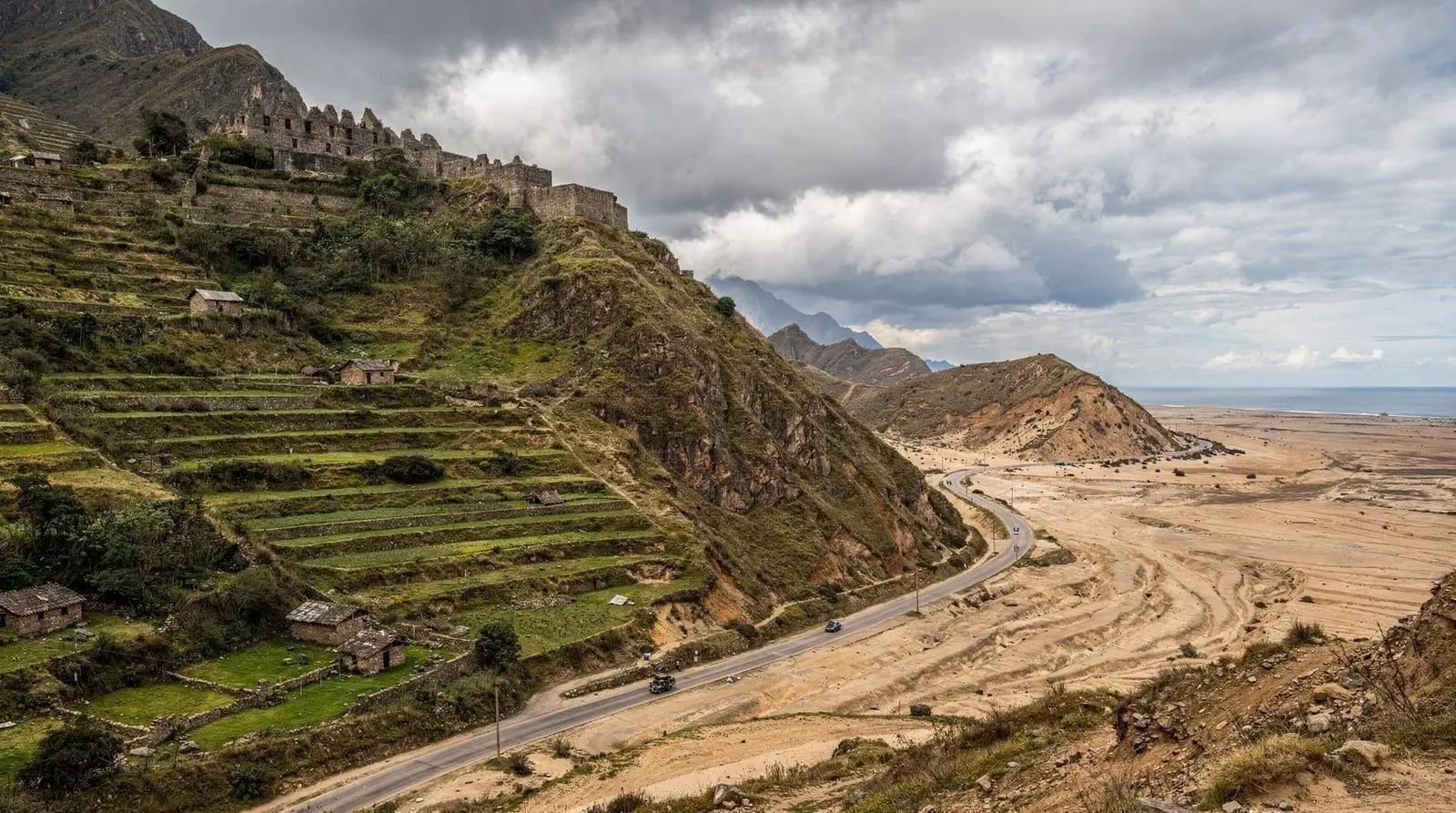
North vs south Peru: which should you visit?
Cusco: Machu Picchu + Tourist Train + Entrance Ticket
Should I visit northern or southern Peru?
For a first trip, southern Peru wins: it holds Cusco, Machu Picchu, Lake Titicaca, Arequipa, and the south coast, all linked by easy transport. Northern Peru — Chachapoyas, Kuélap, Gocta, and the Moche pyramids — is for return visitors or travellers who prize uncrowded ruins over convenience and accept slower roads.
Two very different Perus
Most travellers never realise there is a choice to make. The default Peru trip — the one in every brochure and the gringo trail — lives entirely in the south: Cusco, Machu Picchu, Lake Titicaca, Arequipa. It is famous, spectacular, and busy.
But Peru has a quieter, older second half. The north — Chachapoyas, the Kuélap fortress, Gocta waterfall, the Moche and Chimú coast around Trujillo and Chiclayo — holds ruins as significant as anything in the south, with a fraction of the visitors. The catch is slower roads, fewer flights, and a need for more time.
This guide compares the two honestly so you can decide which suits your trip. The short version: first-timers should go south; the north is the connoisseur’s choice or a return-trip reward. But the nuance matters, and for some travellers the north is the better call even on a first visit. If you want to do both, our three-week itinerary shows how.
| First trip? | Go south — it holds the headline sights |
| Returning / value solitude? | Go north — uncrowded ruins, slower roads |
| Time available | 7-14 days = south only; 3+ weeks = both |
| Altitude concerns | North is lower and gentler on the body |
| Combining with Bolivia | South connects easily at Lake Titicaca |
| Booking pressure | South needs Machu Picchu booked early; north needs little advance planning |
Head to head: the quick comparison
| Factor | Southern Peru | Northern Peru |
|---|---|---|
| Headline sights | Machu Picchu, Cusco, Titicaca, Arequipa | Kuélap, Gocta, Chan Chan, Sipán |
| Crowds | High, peaks in June–August | Low all year |
| Logistics | Easy: frequent flights, tours, buses | Slower: long mountain roads, fewer flights |
| Best for | First trips, headline sights | Return visits, uncrowded ruins |
| Minimum time | 7 days (Cusco core) | 5–7 days (dedicated loop) |
| Altitude | High (Cusco 3,400 m, Puno 3,800 m) | Moderate (Chachapoyas ~2,300 m, coast at sea level) |
| Cost on the ground | Higher (tourist pricing) | Lower (fewer tourists) but flight-heavy |
The case for southern Peru
It has the sights everyone comes for
There is no honest way around it: the south holds the icons. Machu Picchu is the most-visited site in South America for good reason, and the Sacred Valley, Rainbow Mountain, and Lake Titicaca are right there alongside it. If you are flying halfway around the world and may only do Peru once, the south is where the once-in-a-lifetime sights live.
The logistics are effortless
Decades of tourism have built dense, reliable infrastructure. Lima–Cusco flights run all day; the Cusco–Puno–Arequipa circuit is served by comfortable buses; tours for every sight depart constantly. You can assemble a southern trip with minimal forward planning beyond the one thing that must be booked early — Machu Picchu itself. The Machu Picchu day trip with tourist train and entrance ticket handles the trickiest logistics in a single booking.
It packs into less time
A focused Cusco core works in seven days; the full southern circuit fits a comfortable two weeks. For time-pressed travellers, the south delivers more iconic sights per day than anywhere else in the country.
The honest downside
Crowds. In high season the marquee sights feel saturated, and tourist pricing runs higher than the rest of Peru. You are sharing the experience with a lot of people. Shoulder-season timing helps — see the best time to visit — but the south is, by design, where everyone goes.
The case for northern Peru
Ruins without the crowds
The north’s headline act is Kuélap — a vast stone citadel of the “cloud people” perched on a ridge above the Chachapoyas cloud forest, older than much of what you’ll see in the south and reached by cable car. On many days you can wander it nearly alone. Add the Huacas de Moche pyramids and Chan Chan — the largest adobe city in the Americas — near Trujillo, and the Royal Tombs of Sipán museum at Chiclayo, and you have a region of world-class archaeology that almost no one visits.
Spectacular, varied landscapes
Gocta waterfall, one of the tallest in the world, drops out of cloud forest on a forest hike from Cocachimba. The northern highlands are greener and more dramatic than the stark southern altiplano, and the coast adds the surf town of Máncora and the Tumbes mangroves. For a single region, the variety is remarkable.
Lower altitude, gentler on the body
Chachapoyas sits around 2,300 m and the coast is at sea level — far easier than the south’s week above 3,000 m. Travellers who struggle with altitude often have a better time in the north.
The honest downside
Time and roads. The sights are spread between the coast and the highlands, and the connecting roads are slow, winding, and weather-dependent. There are fewer flights, so getting around eats into your days. The north is uncrowded precisely because it is harder to reach — that is the trade-off in a sentence. Our northern Peru route guide and the Chachapoyas complete guide cover the logistics in detail.
Which should you choose?
Choose southern Peru if:
- It’s your first trip and Machu Picchu is the goal.
- You have two weeks or less.
- You want easy logistics and don’t mind crowds.
- You’re combining Peru with Bolivia (the south connects at the Titicaca border).
Choose northern Peru if:
- You’ve already done the south, or icons matter less to you than solitude.
- You value uncrowded ruins and dramatic cloud-forest scenery.
- Altitude is a concern (the north is lower).
- You have at least a dedicated week and patience for slow roads.
Do both if: you have three weeks or more. The standard approach is the southern circuit first, then a flight north for a dedicated 5–7 day loop — exactly the structure in our three-week itinerary. Do not try to combine the two in a fortnight; the regions are far apart and the north’s roads will eat your schedule.
A note on the rest of Peru
North and south are not the only axes. Peru’s third dimension is the Amazon — accessible from the south via Puerto Maldonado and Tambopata, or from the north via Iquitos and the Pacaya-Samiria reserve.
The Tambopata 4-day Amazon rainforest tour is the easiest jungle add-on from the southern circuit, while the northern Amazon out of Iquitos is wilder and more remote. And the Cordillera Blanca around Huaraz — turquoise glacial lakes like Laguna 69 — sits between the two, world-class for hiking and skipped by almost everyone on the standard route.
If your priority is the headline circuit, go south. If it is solitude and discovery, go north. If you have the time, the most rewarding Peru trip touches both, plus a slice of the Amazon. Compare full routes on the itineraries hub and plan your own with the tools.
Weather and timing for each region
Timing matters differently in each half of the country. Southern Peru’s dry season, roughly May to September, is also its busiest and most expensive — clear skies for Machu Picchu and the Sacred Valley, but the biggest crowds and highest prices of the year. The wet season (December-March) thins crowds but can close the classic Inca Trail in February for trail maintenance.
Northern Peru’s climate is gentler on the calendar: the Chachapoyas highlands see rain most of the year but rarely enough to derail a trip, and the coast around Trujillo and Chiclayo is dry almost year-round, so the north is far more forgiving if your travel dates are fixed regardless of season. See the best time to visit Peru for the month-by-month detail.
Getting between the two regions
If you do decide to combine north and south, know the logistics before you commit: there is no quick overland link between Cusco and Chachapoyas, and most travellers fly Cusco-Lima-Chiclayo or Cusco-Lima-Trujillo, effectively routing back through the capital. Budget a full travel day for the transition, and use it as a natural rest point between two very different paces of travel — the well-oiled southern circuit and the slower, more improvised northern loop. The northern Peru route guide lays out the internal north-south connections once you land.