Kuélap
Kuélap is the Chachapoya cloud-forest fortress at 3,000 m — older than Machu Picchu, massive in scale, and genuinely quiet. Here's how to visit in a day.
From Chachapoyas: Kuélap Fortress and Cable Car Tour
Quick facts
- Country
- Peru
- Altitude
- 3,000 m (9,843 ft)
- Currency
- Peruvian sol (S/) — USD widely used
- Best for
- Pre-Inca archaeology, cloud-forest scenery, off-the-beaten-path history
The fortress the Incas struggled to conquer
When Inca armies pushed north in the 1470s, they encountered the Chachapoya people — a highland culture spread across the cloud-forest ridges of the upper Amazon basin — and they found them difficult to subdue. The Chachapoya were mountain fighters on home terrain, and their principal settlement was one of the most formidable stone enclosures in pre-Columbian America. Kuélap took the Incas years of sustained effort to overcome, and even after the conquest the region remained restive enough that the Incas deported large numbers of Chachapoya people to prevent further resistance.
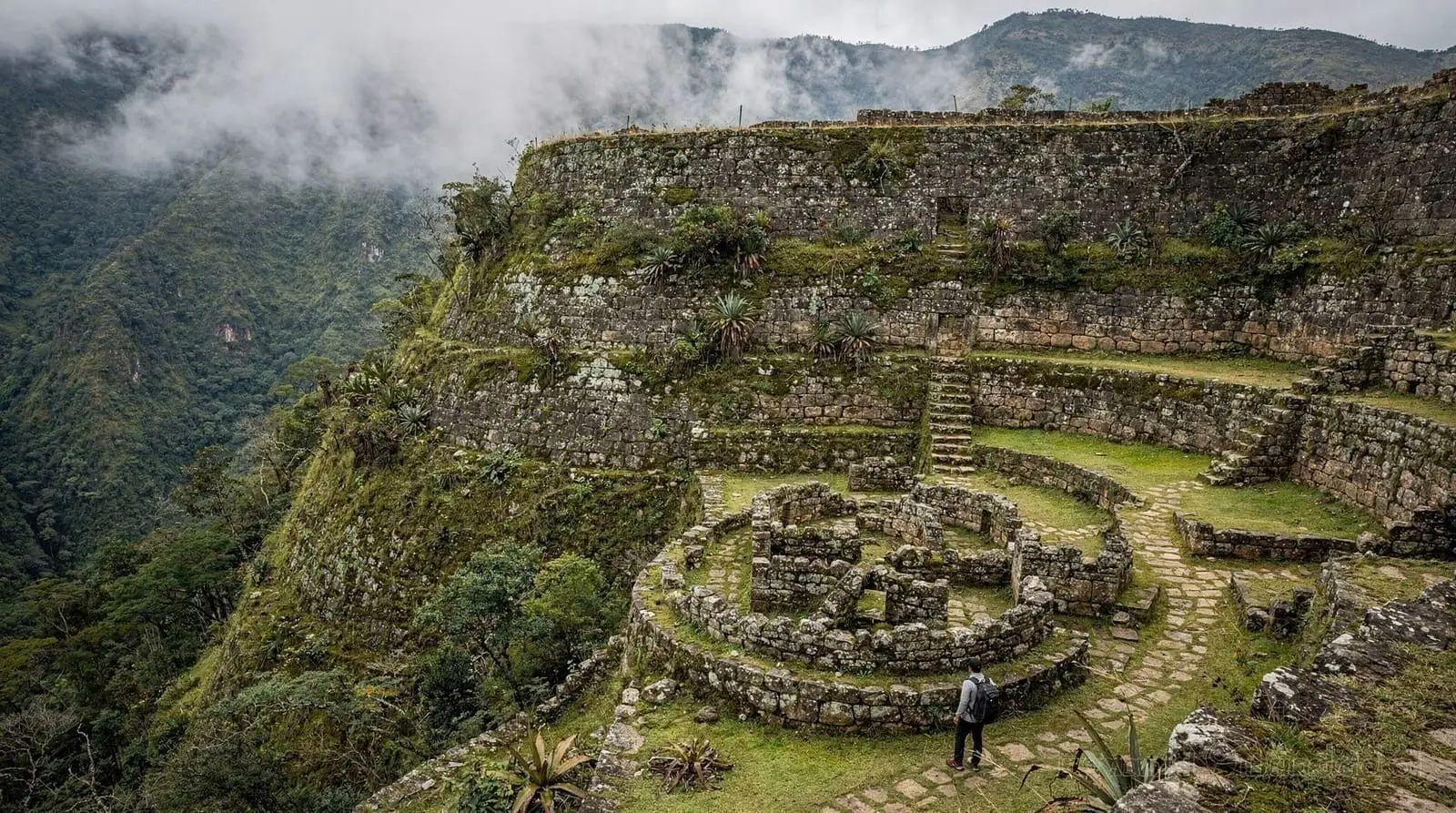
Standing inside Kuélap today, it’s easy to understand why. The site sits on a narrow ridge at around 3,000 m, with the Utcubamba valley plunging away on both sides. The outer walls — built from roughly hewn limestone blocks, mortared with clay — stand up to 20 m high in places and enclose a platform roughly 600 m long and 110 m wide. Inside, the remains of more than 400 circular stone dwellings cover the interior, along with ritual enclosures, water channels, and a single inverted-cone entrance passage so narrow that only one person can pass at a time. The defensive intent is unmistakable.
The fortress was constructed starting around 500 CE and was occupied for roughly a thousand years before the Inca conquest. It is not “the Machu Picchu of the north” in any meaningful architectural or functional sense — the comparison is a tourism shorthand that flattens the genuine differences between the two sites — but it is absolutely worth the journey.
| Where | Utcubamba valley, ~50 km south of Chachapoyas, northern highlands |
| Cost | Around S/15 entry + S/40–70 for a guide; day tours from Chachapoyas from around S/80–120 |
| Time needed | Full day from Chachapoyas (2–3 hours on site) |
| Getting there | Cable car (20 min, when running) or road plus a steep 45-minute walk |
| Best time | May to September, drier with clearer valley views |
Kuélap versus Machu Picchu: an honest comparison
The comparison comes up constantly, so let’s address it directly. Kuélap and Machu Picchu are both remarkable pre-Columbian stone complexes in the Peruvian Andes, and that’s roughly where the similarity ends.
Machu Picchu is visually spectacular in a way Kuélap is not — the drama of the mountain setting, the terraces, the iconic gate view. It also has polished tourist infrastructure, dense on-site interpretation, a UNESCO World Heritage designation backed by serious funding, and visitor numbers in the thousands per day. The tradeoff is that experiencing it requires navigating crowds, timed-entry systems, mandatory guides in some areas, and costs that add up quickly.
Kuélap has none of that infrastructure and none of those crowds. On a typical day you may share the site with a few dozen people rather than a few thousand. The on-site signage is limited and a guide who knows Chachapoya history adds enormously to the experience. The scale — that 600 m stone platform, those 20 m walls — takes time to absorb because there’s no single viewpoint that captures it the way the Inti Punku frames Machu Picchu. The site rewards slow exploration over two or three hours.
What Kuélap unambiguously has over Machu Picchu is solitude, authenticity, and the feeling that you’re standing in a place most travellers have never heard of. For the detailed comparison, see Kuélap vs Machu Picchu.
The cable car: dramatic, when it runs
The Kuélap cable car (teleférico) opened in 2017 and was immediately one of the most visually dramatic approaches to any archaeological site in South America. The cabins cross about 4 km from the valley floor station at Nuevo Tingo to the fortress plateau, rising 1,200 m with views across the cloud forest and the Utcubamba valley. The crossing takes about 20 minutes.
The cable car has experienced technical and operational interruptions since its opening, including an extended closure for maintenance in 2023-2024. Before planning your visit around it, verify its current status through your tour operator or the Ministerio de Cultura. The road approach — which involves driving to the car park below the walls and walking up — is always available as an alternative and adds about 45 minutes of walking each way on a steep path.
Kuélap Fortress and cable car tour from ChachapoyasWhen the cable car is running, it is worth taking. The view from the cabins as you rise above the cloud forest — with the fortress walls emerging from the mist — is the kind of arrival that stays with you.
Inside the fortress: what you’re actually seeing
The main entrance passage — the famous inverted-cone tunnel — funnels visitors into the fortress interior one by one. It was deliberately narrow, presumably for defensive reasons, though archaeologists continue to debate its exact function. Step through and the scale of the interior reveals itself gradually.
The circular dwellings (kullpi) were the standard Chachapoya domestic unit. Most have their walls surviving to chest height; a few have been partially restored. Decorative friezes — geometric zigzag and rhombus patterns in carved stone — ornament the lower exterior walls of some structures, and several serpent-head reliefs remain visible on the main outer wall. The Chachapoya aesthetic is distinct from both the Inca and the coastal Moche/Chimú traditions; spending time looking at the individual stonework makes this clear.
The site has two main elevated enclosures: El Tintero, a large platform with a circular altar in the interior, and El Castillo, the highest point of the site, which may have served a religious function. Views from El Castillo on a clear day extend across the valley to the cloud-forest ridges.
Allow at least two to three hours inside the fortress. A knowledgeable guide doubles the value of the visit by contextualising the architecture, the Chachapoya culture, and the site’s history through to the Spanish colonial period.
The archaeology in detail: what to look for
A skilled guide transforms Kuélap from a maze of knee-high walls into a legible city. These are the specific features worth understanding.
The entrance passages: The main entrance tunnel narrows to less than a metre at its base, forming the inverted-cone shape. Entering one by one, even in small groups, creates a deliberately choreographed arrival — you emerge into the interior already slightly disoriented by the constriction. Archaeologists believe this design controlled population flow during major gatherings and gave defenders an extreme advantage if the fortress were breached. There are two secondary entrances at either end of the platform, each with the same funnel shape.
The frieze decorations: Not every building has surviving surface decoration, but those that do are worth examining closely. The zigzag and rhombus patterns that ornament the lower exterior courses of some dwellings are the Chachapoya signature motif, appearing at sites across the region from Kuélap to the painted cliff mausoleums at Revash. The serpent heads (cabezas de serpiente) visible at several points on the main outer wall are distinct from the interior frieze work and may have a separate religious significance.
Torreón: This circular tower near the centre of the platform is the most intact standing structure at the site. Its walls reach roughly 6 m, far higher than the surrounding dwellings, and the interior held a small rectangular room. Its exact function — watchtower, priestly residence, astronomical observatory — is debated. Climb to the viewing platform behind it for the best overview of the site’s scale.
El Tintero and El Castillo: El Tintero (“the inkwell”) is a large round enclosure on the eastern end of the platform, its shape distinct from all the surrounding structures. El Castillo, at the highest point of the site, offers the widest views and is believed to have been a ceremonial or administrative centre. Standing there, you can see how the ridge-top location made the site simultaneously defensible and visually commanding.
The Chachapoya skeletal remains: An ossuary near the El Tintero enclosure holds disarticulated human bones uncovered during excavations. The Chachapoya burial practices combined cliff-side mausoleums (as at Karajía and Revash) with in-site interment; the bones at Kuélap are believed to be from the later occupation period.
The Chachapoya culture: context beyond the fortress
Kuélap is the best-known Chachapoya site, but it represents only one expression of a culture spread across hundreds of kilometres of cloud-forest ridges. The Chachapoya left ruins on ridge tops throughout the upper Marañón and Utcubamba valleys — circular-walled settlements, cliff mausoleums, roads, and water channels — many of which have never been formally excavated.
What we know of them comes from Inca accounts (which portrayed them as fierce warriors), Spanish colonial records, and the archaeological record. Their art is geometric rather than figurative. Their architectural unit — the cylindrical stone dwelling — appears consistently across hundreds of sites. Their burial practice of placing sarcophagi in inaccessible cliff faces suggests a belief system in which ancestors were kept visible and present in the community rather than interred underground.
The Incas conquered Chachapoya territory under Tupac Yupanqui, probably in the 1470s. They imposed their administrative systems, constructed roads and tambos (way stations), and deported thousands of Chachapoya people to other parts of the empire as a security measure. Despite this, Chachapoya communities maintained aspects of their distinct culture through the colonial period.
For visitors coming from Cusco or the Sacred Valley, where the Inca narrative is all-encompassing, Kuélap and the broader Chachapoya region offer a genuinely different lens on Andean pre-history — older, less well-documented, and consequently more open to the imagination. The Kuélap fortress guide goes deeper on the historical and cultural context.
Combining Kuélap with other northern highlands sites
Kuélap is the anchor of a northern highlands itinerary, but it works best in combination with the other Chachapoya sites accessible from Chachapoyas. The sequence that most visitors find most satisfying runs: Kuélap on day one (full day including cable car), Gocta waterfall on day two (hiking through cloud forest), and the Karajía sarcophagi combined with Quiocta Caves on day three. The fourth day, for those who have it, fits the Revash mausoleums and the Leymebamba museum.
Each of these sites requires its own day and its own physical engagement. Trying to combine Kuélap and Gocta in a single day is technically possible but leaves both experiences feeling rushed. Give the fortress the full day it deserves.
Practical information for visiting Kuélap
Getting there: Kuélap is approximately 50 km from Chachapoyas by road, following the Utcubamba valley south before a switchback road climbs to the site. Tour agencies in Chachapoyas run daily departures, typically leaving by 8 am and returning by 4–5 pm. Private transport can be arranged for S/80–120 per vehicle each way. Shared combis to Nuevo Tingo leave from the Chachapoyas bus terminal, but coordinating the timing for the return journey independently is tricky.
Admission: S/15 per foreign adult (as of 2025). Students with valid ID may receive a discount. The cable car, when operating, may carry a separate ticket charge — confirm with the site or your operator.
Opening hours: The site opens at 8 am and closes at 5 pm. The last cable car departure from the valley is typically around 3:30 pm.
On-site facilities: A small café operates near the cable car upper station, selling snacks and drinks. Bring water, sunscreen, and a light waterproof layer — the cloud forest means the weather can change quickly, and the temperature at 3,000 m is cooler than the valley.
Guides: On-site guides can be hired at the entrance for S/40–70 per group. Guides hired through Chachapoyas agencies are generally better-prepared; ask to confirm their knowledge of Chachapoya (not just Inca) history before booking.
How Kuélap fits into a northern Peru itinerary
Kuélap is the primary reason most travellers make the effort to reach Chachapoyas, but it works best as part of a multi-day exploration of the region rather than a lone excursion. After Kuélap, the obvious additions are Gocta waterfall (a full-day hike through cloud forest), the Karajía sarcophagi (cliff-face funerary figures), and the Leymebamba museum (200+ preserved mummies). Each deserves its own day.
If you’re approaching from the north coast, a circuit running Trujillo → Chachapoyas → Kuélap → Gocta → Cajamarca makes geographic sense. See the itineraries section for structured route options, and the Kuélap fortress guide for the full archaeological and historical deep-dive.
Frequently asked questions about Kuélap
How long does it take to visit Kuélap from Chachapoyas?
A full day trip from Chachapoyas to Kuélap takes approximately 8–9 hours including transport (1.5 hours each way by road), the cable car crossing (20 minutes each way when operating), and 2–3 hours on site. Most organised tours return to Chachapoyas by 4–5 pm.
Is the Kuélap cable car running?
The cable car has experienced operational interruptions. Always verify its current status before your visit — check with your tour operator, your hotel in Chachapoyas, or the Ministerio de Cultura Peru website. Road access to the site is always available as an alternative.
Is Kuélap accessible without a guide?
The site can be explored independently, but the lack of on-site interpretation makes a guide strongly worthwhile. Without context, the circular dwellings and enclosures can feel like a maze of waist-high walls. A good guide explains the Chachapoya culture, the construction sequence, and the significance of specific features — including the entrance passage and the El Tintero platform.
What altitude is Kuélap and will I feel altitude effects?
Kuélap is at approximately 3,000 m. If you’ve already spent several days in Chachapoyas (2,335 m), you should be reasonably acclimatised. Visitors arriving from sea level who go straight to Kuélap may feel mild breathlessness and fatigue, particularly on the uphill walk from the car park. Take it slowly, hydrate well, and rest if you feel lightheaded.
Is Kuélap suitable for children?
The site is suitable for children old enough to manage a moderate hike (the walk from car park to entrance involves an uneven stone path). The cable car makes access much easier with younger children. There are no guardrails on some elevated sections of the site, so supervision is needed. The experience is unusual enough — the tunnel entrance, the giant walls — that children often find it more memorable than the more polished Inca sites.
Top experiences
Bookable activities with verified prices and instant confirmation on GetYourGuide.
