Tambopata National Reserve
Tambopata is Peru's accessible southern Amazon reserve — famous for macaw clay licks, Lake Sandoval's giant otters, and lodges reached from Puerto Maldonado.
Tambopata: Multi-Day Amazon Rainforest Tour with Local Guide
Quick facts
- Country
- Peru (Madre de Dios region)
- Protected area
- Tambopata National Reserve — 274,690 hectares
- Access
- By boat from Puerto Maldonado (30 min to 4+ hours upriver)
- Best for
- Macaw clay licks, Lake Sandoval, giant otters, birdlife
One of the most biodiverse places on Earth
Tambopata is the protected heart of Peru’s southern Amazon — a reserve and surrounding buffer forest in the Madre de Dios region that consistently turns up among the most species-rich places ever surveyed by biologists. The numbers are almost unhelpfully large: well over 600 bird species, more than 1,200 butterflies, hundreds of trees, and a long list of mammals from giant otters to jaguars. What this means in practice is that a single morning’s walk with a sharp guide can produce more life than a week in most ecosystems, even if the headline animals stay hidden.
The Tambopata National Reserve proper covers about 274,690 hectares, bordered by the much larger Bahuaja-Sonene National Park to the south. Together they protect a stretch of lowland rainforest running up toward the Bolivian border. Crucially for visitors, the reserve is reached from Puerto Maldonado, a 35-minute flight from Cusco, which makes it the most accessible serious Amazon in Peru. You can stand on the Tambopata River, deep in the reserve, less than a day after leaving the Andes.
This page is about the reserve and its wildlife — the clay licks, Lake Sandoval, what you can realistically expect to see, and how to plan a meaningful visit. For the practical gateway logistics — flights, transfers, town, and how lodge packages are sold — see the Puerto Maldonado page.
| Where | Madre de Dios region, reached via Puerto Maldonado |
| Cost | Around $250-600 for a 3-day/2-night lodge package |
| Time needed | 3 to 5 days |
| Getting there | Flight to Puerto Maldonado, then boat upriver |
| Best time | May to September (dry, active clay licks) |
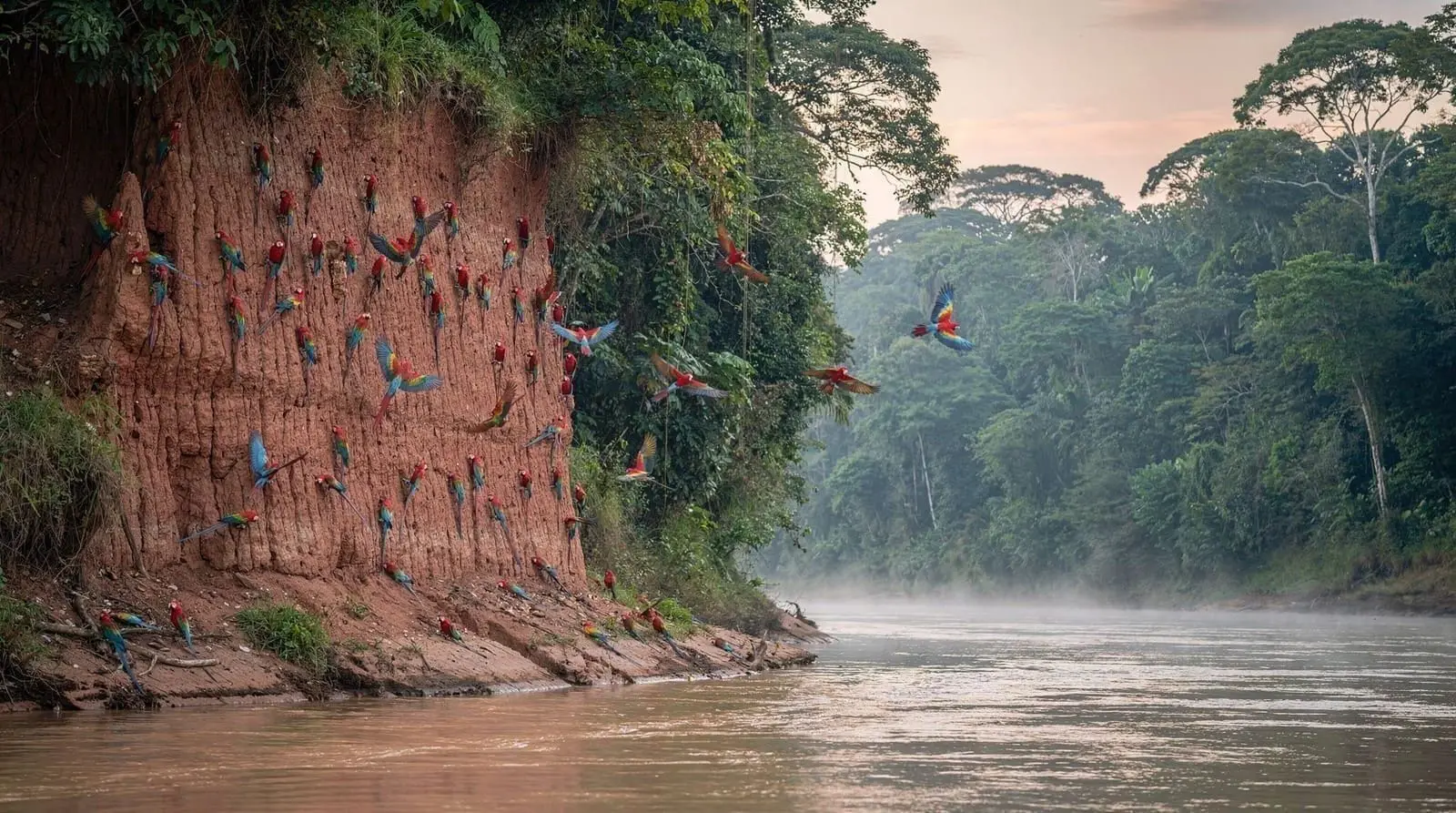
The clay licks: Tambopata’s signature spectacle
The reason many serious wildlife travellers choose Tambopata over other Peruvian Amazon destinations is the collpas, or clay licks — exposed riverbank clay where parrots, parakeets, and macaws gather in the early morning to eat the mineral-rich soil. The behaviour is thought to help neutralise toxins in the seeds and fruit the birds eat, and on a good morning the result is extraordinary: dozens or hundreds of birds wheeling and settling against a red clay bank in a riot of green, blue, red, and gold.
The largest and most famous is the Colorado clay lick (Collpa Colorado), deep in the reserve and reached only from the interior lodges, principally Rainforest Expeditions’ Tambopata Research Center. It is among the biggest known macaw licks in the world and the reason the deepest, most expensive lodges exist. Closer to Puerto Maldonado, smaller licks such as Chuncho and various parrot licks are accessible from mid-range lodges and even some day trips.
A clear-eyed note on expectations: clay-lick activity is weather-dependent and seasonal. The big macaw shows are most reliable in the dry season, broadly May to September; rain or an overcast dawn can keep the birds away entirely. Even in good conditions, no operator can guarantee a spectacular day. The deeper you go and the more mornings you allow, the better your odds — which is the central argument for the longer, pricier programmes.
Tambopata: multi-day Amazon rainforest tour with a local guideLake Sandoval and the giant otters
If the clay licks are Tambopata’s signature, Lake Sandoval is its most beloved single excursion. This oxbow lake, formed where the Madre de Dios River long ago changed course, sits within the reserve about an hour or so downriver from Puerto Maldonado, reached by a short boat ride and then a walk through palm forest (often muddy — rubber boots earn their keep here).
The lake’s celebrities are its resident family of giant river otters, an endangered species that can reach nearly two metres and hunts fish in noisy, social groups. Sightings are likely but never guaranteed; patience and an early or late visit improve the odds. The lake also holds black caiman, several monkey species in the surrounding trees, hoatzins clattering in the lakeside vegetation, and an enormous variety of birds. A dawn or dusk paddle across the still water, with the forest reflected and the otters surfacing, is for many visitors the high point of the whole trip.
Because Sandoval is relatively close to town, it can be done as part of shorter programmes or even a long day trip, which makes it the realistic Amazon highlight for travellers short on time.
Tambopata Peruvian Amazon jungle: 3 days / 2 nightsHow deep should you go?
The single biggest planning decision in Tambopata is how far up the Tambopata River to base yourself, because it directly determines what you can see.
Closer lodges (30 minutes to about 2 hours upriver) are cheaper, easier, and ideal for shorter stays. They give you forest walks, night excursions, canopy towers, and access to Lake Sandoval and smaller parrot licks. The forest is good and the wildlife real, though these areas see more visitors and the animals are somewhat more used to people.
Deep-reserve lodges (3 to 5+ hours upriver), principally the Tambopata Research Center, sit in far wilder forest with direct access to the great Colorado macaw lick. This is where the odds of rarer mammals — and the full clay-lick spectacle — are highest. The cost is significant and the journey is long, so these programmes need four to five days minimum to be worthwhile.
Puerto Maldonado: 3-day Amazon jungle tour with lodging in TambopataAs a rough guide: a three-day, two-night programme at a closer lodge suits travellers folding the Amazon into a busy Peru itinerary; a four- or five-day programme reaching the deeper reserve and the Colorado lick suits travellers for whom the rainforest, and birds especially, are a primary reason for the trip.
Honest expectations on wildlife
It is worth saying plainly what Tambopata is and is not. It is one of the richest ecosystems on the planet, and with a good guide you will see a remarkable quantity of life. It is not a place where charismatic mammals parade past on cue.
Highly likely: abundant birds (parrots, macaws, toucans, hoatzins, raptors), caiman on night trips, several monkey species, and — at Lake Sandoval — giant otters. Active clay licks, in season and with luck on the weather.
Possible with time and luck: capybara, peccary herds, sloths, and a long list of frogs, snakes, and insects that the smaller-scale naturalist will get genuinely excited about.
Rare: jaguar, tapir, giant anteater, and the big cats generally. These exist here, and a lucky few see them, but planning your trip around them is a recipe for disappointment.
The travellers who come away happiest are those who tune into the smaller scale — the leafcutter ant columns, the poison frogs, the bird diversity, the night sounds — rather than waiting for a jaguar that almost never comes. A good guide is what unlocks all of it; this matters more than the lodge’s comfort level, and it is the one thing worth asking hard questions about before you book.
When to visit Tambopata
The reserve follows the broader Madre de Dios pattern. The dry season (roughly April to October) offers walkable trails, moderate river levels, easier wildlife access, and the most reliable clay-lick activity from May to September — this is the recommended window. Expect occasional friaje cold snaps, brief southern wind events that drop temperatures for a day or two, so pack one warm layer even in the heat.
The wet season (November to March) brings heavy rain, high rivers, lush forest, and quieter, cheaper lodges, but some trails flood and clay-lick activity is less predictable. It is a fine time for those who prioritise the dramatic, alive forest over guaranteed trail access.
On health: yellow fever vaccination is recommended for the Amazon lowlands (get it at least 10 days ahead and carry the certificate), malaria risk exists and antimalarial prophylaxis is a decision for a travel-health doctor, and dengue is present — so high-DEET repellent, long sleeves at dawn and dusk, and permethrin-treated clothing all matter. For the fuller practical rundown, see the Puerto Maldonado gateway page.
How Tambopata fits a Peru trip
Because of its short flight from Cusco, Tambopata is the Amazon that slots most easily into the classic southern circuit. A common shape is Cusco and the Sacred Valley, then Machu Picchu, then a short flight down to the lowlands for three to five days in Tambopata before flying home. Travellers wanting a wilder, harder-to-reach Amazon sometimes weigh it against Manu National Park to the north — wilder and more pristine, but far more committing — or against the river-cruise world of Iquitos in northern Peru.
For suggested routes that combine the highlands with the jungle, see the itineraries section, and for flight search and planning resources, the tools page. A dedicated Cusco-to-Amazon 7-day itinerary shows how a Tambopata add-on slots after the Sacred Valley and Machu Picchu, and the broader 7-day Peru Amazon itinerary is useful if the jungle is the main event rather than an add-on.
What a typical day looks like
Lodge programmes are built around the animals’ clock, not yours. A representative day: pre-dawn wake-up for a boat ride to a clay lick or Lake Sandoval while the light and bird activity are best; a mid-morning rest during the hottest, quietest hours (a good time to nap, journal, or read on the lodge’s deck); an afternoon forest walk with the naturalist guide pointing out insects, frogs, and canopy movement that a casual visitor would walk straight past; and a night excursion by boat or on foot with a spotlight, hunting for caiman eyes reflecting red and the occasional tarantula or owl.
The pace is more structured than a beach holiday and less strenuous than a trek — comfortable walking shoes and a willingness to get up before dawn are the main physical requirements.
Choosing a lodge and guide
Because the guide, not the lodge’s comfort level, determines what you actually see and understand, it is worth asking pointed questions before booking: How many guests per guide? Is the guide a certified naturalist or a general tour leader? Does the itinerary reach Lake Sandoval, a clay lick, or both? For the deep-reserve programmes, does the price include the full boat transfer time, or is that billed separately?
Community-linked and research-affiliated lodges (several operate alongside conservation projects) often have the strongest guiding, since their staff work the same trails year-round and know individual animals and nest sites. The comprehensive Peru Amazon guide and the best time for the Amazon guide cover season-by-season planning in more depth than fits on this page.
What to pack for Tambopata
Lightweight, quick-dry long sleeves and trousers (for sun and insects, not cold), a hat, high-DEET repellent, a dry bag or dry sack for cameras and electronics on the boat, a headlamp for night walks and lodges with limited electricity, and binoculars if birds interest you at all — lodges rarely have spares to lend. Rubber boots are usually provided by the lodge for muddy trail sections, but check when booking. The full packing breakdown, including what differs between the dry and wet seasons, is in the what to pack for the Amazon guide.
Frequently asked questions about Tambopata
What is a clay lick and when is the best time to see one?
A clay lick (collpa) is an exposed riverbank where parrots and macaws gather in the early morning to eat mineral-rich clay, probably to neutralise toxins in their diet. On a good morning, dozens to hundreds of colourful birds gather against the clay bank. Activity is most reliable in the dry season, broadly May to September, and depends on clear weather — rain or an overcast dawn can keep the birds away, and no sighting is ever guaranteed.
How do I get to Tambopata?
Tambopata is reached from Puerto Maldonado, which is a 35-minute flight from Cusco. From town you travel by boat up the Tambopata River to your lodge — anywhere from 30 minutes for the closest lodges to four or more hours for the deep-reserve lodges near the great Colorado macaw lick. Lodge packages include the airport pickup and the river transfer.
Will I see giant otters at Lake Sandoval?
Lake Sandoval has a resident family of endangered giant river otters, and sightings are likely but never guaranteed. Visiting at dawn or dusk and being patient improve your chances. The lake also reliably offers black caiman, monkeys, hoatzins, and abundant birdlife, so the excursion is worthwhile even on the rare day the otters stay hidden.
How many days do I need in Tambopata?
Three days and two nights at a closer lodge gives a real taste of the rainforest, including Lake Sandoval and forest walks. To reach the deep reserve and the Colorado macaw clay lick, allow four to five days, as the journey upriver is long. More mornings also mean better odds at the weather-dependent clay licks, so longer stays genuinely improve the experience.
Is Tambopata better than Manu or Iquitos?
They are different. Tambopata is the most accessible (a short flight from Cusco) and excellent for clay licks, Lake Sandoval, and birds. Manu is wilder and more pristine but far harder and slower to reach. Iquitos, in northern Peru, is the base for Amazon River cruises and Pacaya-Samiria. Choose Tambopata for an efficient, high-quality Amazon add-on to a Cusco trip; choose Manu or Iquitos for a more committing wilderness or river experience.
Will I see a jaguar in Tambopata?
Almost certainly not, though it is not impossible. Jaguars, tapirs, and giant anteaters live in the reserve, but they are rare sightings that the great majority of visitors never get. The reliable rewards are birds, caiman, monkeys, giant otters at Sandoval, and the extraordinary diversity of smaller life. Travellers who set expectations toward those, rather than the big cats, leave happiest.
Do I need vaccinations for Tambopata?
A yellow fever vaccination is recommended for Peru’s Amazon lowlands; get it at least 10 days before travel and carry the certificate. Malaria risk exists in Madre de Dios, and whether to take antimalarial prophylaxis is a decision to make with a travel-health doctor. Dengue is also present, so use high-DEET repellent, wear long sleeves at dawn and dusk, and consider permethrin-treated clothing.
Top experiences
Bookable activities with verified prices and instant confirmation on GetYourGuide.

