Northern Peru route guide
Chiclayo: Sipán Museum, Huaca Rajada & Royal Tombs
What is the northern Peru route?
It is the overland circuit through Peru's underrated north — the coast from Trujillo and Chiclayo up to the beaches of Máncora and the Tumbes mangroves, with an optional highland loop inland to Cajamarca and the cloud-forest ruins of Chachapoyas. Allow 7–14 days; it is far quieter than the Cusco south.
The Peru most visitors never see
Almost everyone who comes to Peru flies to Cusco, rides the train to Machu Picchu, and goes home. It is a superb week — but it leaves the entire north of the country, an area larger than many European nations, almost untouched by tourism. The northern Peru route is the circuit through that overlooked half: a coast strung with pre-Inca cities and warm-water beaches, and a highland interior of cloud forest, fortress ruins and mountain towns where you can spend a day at a major archaeological site and share it with a handful of other people.
This is not a hidden secret because it is bad. It is overlooked because it is far from the famous south, the distances are big, and it takes more time and self-reliance than the packaged Cusco loop. The reward is a Peru that feels genuinely undiscovered: the Moche and Chimú civilisations that predate the Inca by centuries, the cliff-side sarcophagi and the vast fortress of Kuélap, the surf and whales of the far north, and prices and crowds a fraction of the south’s. This guide lays out the route, the realistic timings, the distances and bus times, what to prioritise, and the honest pitfalls. If you are still deciding between the two halves of the country, read north vs south Peru first.
| Where | Trujillo → Chiclayo → Máncora → Tumbes (coast); Cajamarca → Chachapoyas (highlands) |
| Time needed | 5-7 days coast only; 10-14 days with the highland loop |
| Getting there | Fly or bus into Trujillo from Lima; fly out of Tumbes or Piura |
| Cost | Backpacker S/90-150/day, mid-range S/250-450/day, cheaper than the south |
| Best time | May-September dry season for the highlands; year-round on the coast |
The two halves of the route
The northern route splits naturally into two parts, which you can do separately or join into one long loop:
- The coast — Trujillo, Chiclayo, the beaches of Máncora and the Tumbes mangroves. Flat, warm, fast roads, the classic backpacker overland run up to the surf.
- The highlands — the inland loop from the coast up to Cajamarca and across to Chachapoyas and Kuélap. Slow, winding mountain roads, cloud forest, dramatic archaeology, far fewer travellers.
Most people with limited time do the coast only. Those with two weeks or more add the highland loop, which is where the route’s most spectacular and least-visited sites are. The two connect at several points — Trujillo and Chiclayo both have road links up into the highlands — so the circuit can be run in either direction.
The coastal route, south to north
This is the spine of any northern trip.
Trujillo is the natural starting point, an 8–9 hour bus or 1h 20min flight from Lima. It is the gateway to the Chan Chan adobe city, the largest pre-Columbian city in the Americas, and the Moche temples of the Sun and Moon. The fishing-and-surf village of Huanchaco, with its reed caballito boats, is 20 minutes away and makes a relaxed base. Allow 2 days.
Chiclayo, 3–3.5 hours north of Trujillo by bus (S/20–40), is the access point for the astonishing royal Moche tombs — the Lord of Sipán and the museums at Lambayeque. The city itself is workaday, but the archaeology is world-class and uncrowded. See the Chiclayo destination page. Allow 1–2 days.
Chiclayo Lord of Sipán and Royal Tombs tour
Máncora, 3.5–4 hours north of Chiclayo (S/30–50), is the warm-water reward: surf, July–October whale watching, and turtle snorkelling at El Ñuro. The full picture is in the Máncora complete guide, with dedicated surfing, whale watching and turtle guides. Allow 2–4 days.
A guided full-day tour is the simplest way to see Chan Chan and the Moche temples around Trujillo without arranging separate taxis for each site.
Full-day Trujillo, Chan Chan and Huacas de Moche tour
Tumbes and the mangroves, about an hour north of Máncora, hold Peru’s only tropical mangrove forest at Puerto Pizarro — a calm half-day of boats and birds, and the last stop before Ecuador. See the Tumbes mangroves guide. Allow a half-day to a day. Most travellers treat Tumbes as a closing stop rather than a destination in itself — either flying home from Tumbes airport or continuing overland into Ecuador via the Aguas Verdes border crossing, which is straightforward by day but best avoided after dark.
Coast-only timing: 5–7 days Trujillo to Tumbes, finishing with a flight home from Tumbes or Piura.
The highland loop
This is where the north earns its reputation among those who know it.
Cajamarca, reached by overnight bus from the coast (roughly 6–7 hours from Trujillo or Chiclayo, S/40–70), is a handsome colonial highland city at 2,750 m — the place where the Inca emperor Atahualpa was captured by Pizarro. The Ransom Room, the Cumbemayo aqueduct and the surrounding dairy country (Cajamarca is famous for its cheese) fill 2 days. See the Cajamarca destination page.
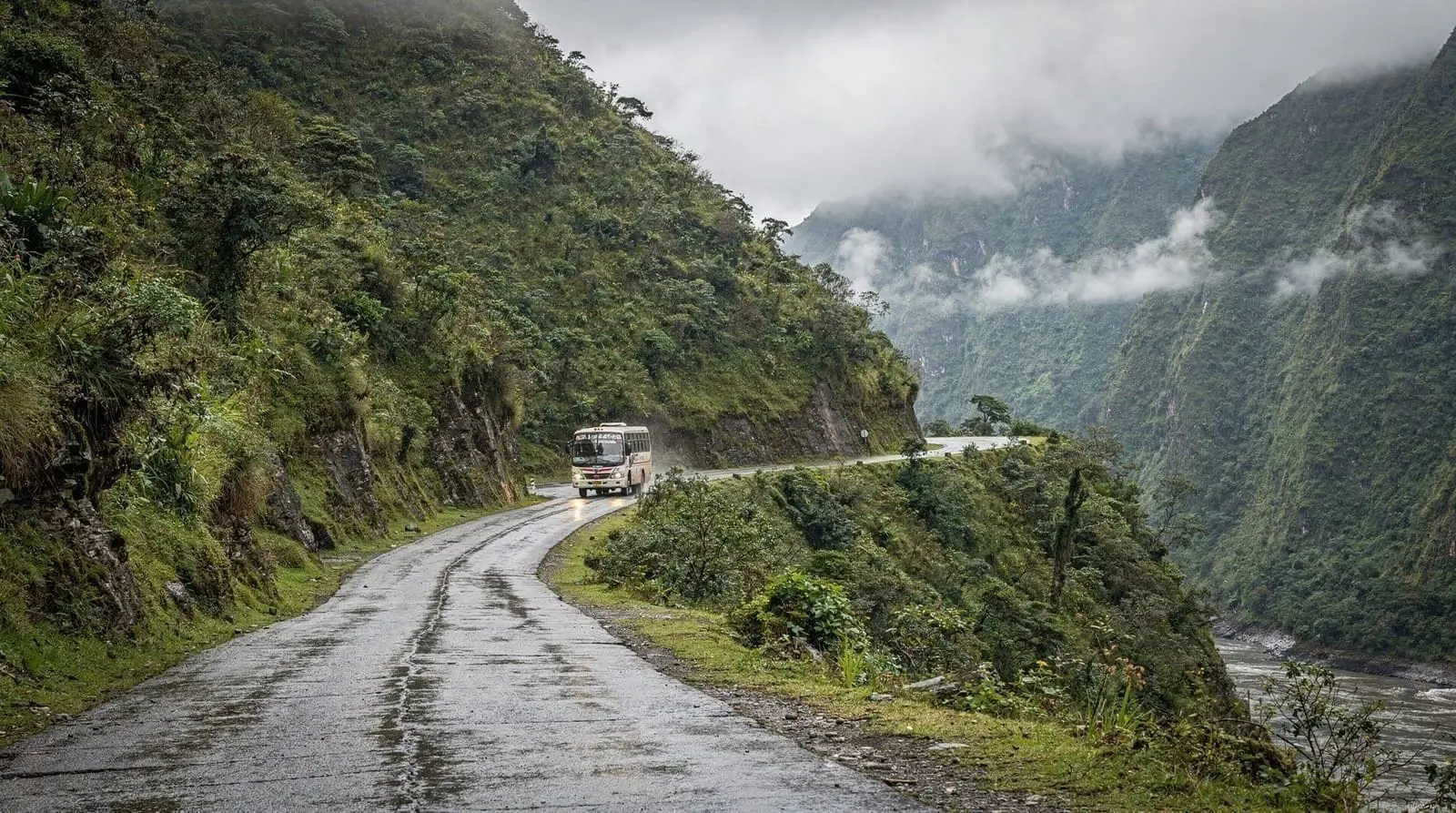
Chachapoyas and Kuélap are the highland headline. Chachapoyas is the base town for the cloud-forest realm of the Chachapoya, the “warriors of the clouds.” The vast stone fortress of Kuélap — often called the Machu Picchu of the north, larger in footprint than its famous southern cousin — sits high above the Utcubamba valley, along with the cliff-side sarcophagi of Karajía and the Gocta waterfall, one of the tallest in the world. See the Chachapoyas destination page. Allow 3–4 days; the roads in are slow and winding.
The journey between Cajamarca and Chachapoyas is long (a full day on mountain roads) and is the most demanding leg of the whole route. Many travellers approach Chachapoyas instead from Chiclayo via Jaén/Bagua, a more direct if still lengthy run.
Highland-loop timing: 5–7 days added to the coastal route, for a total 10–14 days.
Distances and travel times at a glance
- Lima → Trujillo: 560 km, 8–9 hrs bus / 1h 20min flight
- Trujillo → Chiclayo: 210 km, 3–3.5 hrs bus
- Chiclayo → Máncora: 285 km, 3.5–4 hrs bus
- Máncora → Tumbes: 110 km, ~1.5 hrs bus / colectivo
- Trujillo/Chiclayo → Cajamarca: 6–7 hrs bus (mountain road)
- Cajamarca → Chachapoyas: full day on winding highland roads
- Chiclayo → Chachapoyas (via Jaén): ~9–10 hrs bus
These are real, not optimistic, times. Highland roads in particular are slow and prone to delay; never plan a tight connection across them. The Peru bus travel guide covers operators, seat classes and overnight safety in detail.
Choosing how to travel
Bus. The default and best-value option on the coast. Cruz del Sur, Oltursa and Movil Tours run comfortable cama and semi-cama services between the coastal cities; overnight legs save accommodation. Highland routes use smaller operators and slower vehicles.
Fly to save time. Flights from Lima to Trujillo, Chiclayo, Cajamarca, Piura and Tumbes let you skip the longest hauls and bookend the route. A common efficient pattern is to fly into Trujillo and out of Tumbes or Piura (or into Cajamarca and out of the coast), avoiding backtracking.
Shared taxis (colectivos). The workhorse of the last legs — Chiclayo–Máncora, Máncora–El Ñuro, Tumbes–Puerto Pizarro. Cheap, frequent and fast, if cramped.
Self-drive. Possible and rewarding on the coast, where roads are good and distances clear. The highland loop is demanding — narrow, winding, sometimes unpaved roads — and best left to experienced drivers comfortable with mountain conditions. Most travellers find buses and the odd flight simpler than a hire car for the full circuit.
When to go
The north’s two halves want different seasons, which is the central planning tension:
- The coast is warm year-round. December–April is best for beach weather; July–October is the Máncora whale-watching window. The two do not overlap.
- The highlands (Cajamarca, Chachapoyas) are best in the May–September dry season, when the mountain roads are most reliable and the ruins least likely to be rained out. The wet season (roughly December–March) brings landslide risk and cloud.
If you are combining coast and highlands, the May–September dry season is the safest overall compromise — it keeps the highland roads open and still offers good (if cooler) coast conditions and, from July, the whales. Cross-check against the national picture in the best time to visit Peru guide.
The archaeology of the north
It is worth dwelling on what makes the north special to anyone interested in Peru’s deeper history, because this is its singular advantage over the south. Long before the Inca, the northern coast was home to a succession of sophisticated civilisations. The Moche (roughly 100–800 AD) built the adobe Huacas del Sol y de la Luna near Trujillo and produced some of the finest ceramics and metalwork in the ancient Americas — the royal tombs of the Lord of Sipán, near Chiclayo, rival Tutankhamun’s for richness and are displayed in the superb Lambayeque museums.
The Chimú who followed built Chan Chan, the largest adobe city ever constructed and the biggest pre-Columbian city in the Americas, a sprawl of decorated citadels on the edge of modern Trujillo. Inland and later, the Chachapoya raised the cloud-forest fortress of Kuélap and entombed their dead in cliff-side sarcophagi. None of these sites draws Machu Picchu’s crowds, which means you can often explore them in near-solitude. For travellers whose interest in Peru runs to its ancient past as much as its Inca chapter, the north is unmatched — the Inca were latecomers who absorbed these older cultures, and seeing the originals reframes the whole story.
Highland vs coast: which half to prioritise
If you cannot do the full loop, the choice between the coast and the highlands comes down to what you want:
- Choose the coast if you want beaches, surf, whales and turtles alongside the Moche and Chimú archaeology, on fast, easy roads. It is the lower-effort, warmer-weather half, and it links cleanly to a border crossing into Ecuador.
- Choose the highlands if your priority is the cloud-forest archaeology of Kuélap and Chachapoyas, dramatic mountain scenery, and the deepest sense of getting off the trail. It is slower, more demanding and weather-dependent, but its rewards are the route’s most spectacular.
Many travellers do a compressed version of both — Trujillo and Chiclayo on the coast for the archaeology, then up to Chachapoyas for the cloud forest, skipping either the far-north beaches or Cajamarca to save time. There is no wrong answer; there is only the time you have. The broader regional trade-off is covered in north vs south Peru.
Budgeting the northern route
The north is generally cheaper than the south, with transport the main expense given the distances. Rough per-person daily figures, excluding inter-city transport:
- Backpacker: dorms and menú del día meals, S/90–150 (USD 24–40) a day.
- Mid-range: private rooms and restaurant meals, S/250–450 (USD 67–120) a day.
Inter-city transport adds up: budget S/20–70 per coastal bus leg, more for the long highland runs, and S/150–300 per domestic flight if you fly to save time. Tours (Kuélap, Sipán museums, Máncora boat trips) are individually modest — typically S/30–150 each. A two-week northern loop is comfortably cheaper than the equivalent in the Cusco region, where demand keeps prices high. Carry cash in soles, since ATMs are scarce outside the main cities.
What guided tours cover versus going independent
Independent travel works well on the north coast, where roads are good, distances are clear, and bus and colectivo networks are frequent. A guided day tour still earns its cost at the major sites, though, for a simple reason: Chan Chan, the Huacas de Moche and the Sipán tombs reward context far more than a self-guided wander, and a knowledgeable local guide turns adobe walls into a readable story about the Moche and Chimú.
In the highlands, the calculation shifts further toward guided or at least locally-arranged transport, since the Cajamarca-Chachapoyas roads are genuinely demanding and English-speaking independent infrastructure is thin. A sensible middle path many travellers use: independent buses and accommodation for the overall route, paired with day tours or a hired local guide at each headline site.
Honest pitfalls
- Underestimating distances. This is the number-one mistake. The north is huge and the highland roads are slow; a route that looks tidy on a map can swallow days in transit. Build in buffer time.
- Trying to bolt it onto a Cusco week. It does not fit. The north needs its own dedicated 7–14 days, not a tacked-on weekend.
- Wrong-season highland travel. Cajamarca–Chachapoyas roads in the wet season can be slow, foggy or blocked. Favour the dry months for the mountains.
- Thin tourist infrastructure. Outside the main cities, English is rare, ATMs are scarce and tours run less frequently. Carry cash in soles, some Spanish, and patience.
- Beach theft and long-bus fatigue. The usual coastal precautions apply. See the Peru travel safety guide for the practicalities.
None of these is a reason to skip the north — only to plan it properly. The travellers who give it the time it needs almost always rate it among the most rewarding parts of Peru, precisely because so few people make the effort.
Sample routes
One week, coast only: Fly Lima→Trujillo (2 days, Chan Chan + Huanchaco) → bus Chiclayo (1 day, Sipán) → bus Máncora (3 days, beach + tour) → fly home from Tumbes/Piura.
Two weeks, coast plus highlands: Fly Lima→Trujillo (2 days) → Chiclayo (1 day) → overnight bus Cajamarca (2 days) → highland leg to Chachapoyas (3–4 days, Kuélap + Gocta) → back to the coast and up to Máncora (3 days) → Tumbes mangroves (half-day) → fly home from Tumbes.
Archaeology focus: Trujillo (Chan Chan, Moche temples) → Chiclayo (Sipán, Lambayeque museums) → Cajamarca → Chachapoyas (Kuélap, Karajía) — skipping the beaches entirely for a pre-Inca and Chachapoya circuit. For the full classic-south alternative, see the Peru two-week itinerary.