Chan Chan
Explore Chan Chan, the Chimú capital and world's largest adobe city, 9 km from Trujillo. UNESCO World Heritage Site on Peru's north coast.
Trujillo: Discovering Chan Chan
Quick facts
- Country
- Peru
- Altitude
- 29 m (95 ft) — coastal desert, near Pacific Ocean
- Currency
- Peruvian sol (S/) — USD widely used
- Best for
- Pre-Columbian adobe architecture, Chimú civilisation, photography
The largest adobe city in the Americas
Nine kilometres west of Trujillo, at the point where the coastal desert meets the Pacific, lies a city that once housed more people than London did in the 13th century. Chan Chan was the capital of the Chimú Empire — the largest pre-Columbian state in South America before the Inca arrived and absorbed it in 1470 CE. At its peak, around 1400 CE, the city stretched across approximately 20 square kilometres and contained an estimated 30,000 to 40,000 inhabitants. It was built entirely from adobe — sun-dried mud bricks — in a desert where rainfall is measured in millimetres per year.
| Where | 9 km west of Trujillo, north coast desert |
| Time needed | Half day (1.5–2 hours on site) |
| Cost | S/15 entry (also covers Huacas del Sol y Luna same day) |
| Getting there | Colectivo S/2–3, or taxi S/15–20 from Trujillo |
| Best time | May–November (drier, less erosion risk) |
UNESCO inscribed Chan Chan as a World Heritage Site in 1986. In the same session, it placed the site on the List of World Heritage in Danger. That dual designation has never been removed, and it accurately describes the current situation: Chan Chan is simultaneously one of the most important archaeological sites in the Western Hemisphere and one of the most threatened.
The very material that allowed it to survive for 1,000 years — adobe, which preserves remarkably well in near-total aridity — becomes vulnerable the moment moisture enters the equation. El Niño rain events, rising coastal humidity, and groundwater intrusion are all accelerating the deterioration of structures that survived intact through ten centuries of dry desert conditions.
The Chimú Empire and the architecture of kingship
The Chimú were a sophisticated state that controlled roughly 1,000 km of the Pacific coast between approximately 900 and 1470 CE. Their capital Chan Chan was not built all at once: it grew through the successive reigns of ten or more Chimú kings, each of whom constructed a new royal ciudadela (palace compound) that served as their administrative centre in life and their tomb after death. When a king died, his palace was sealed and maintained as a royal funerary estate by a custodial lineage. His heir built a new ciudadela from scratch.
This cycle of construction produced the city’s distinctive structure: nine large rectangular compounds, each enclosed by adobe walls up to 9 m high, arranged across the desert floor and connected by roads and lower-status residential zones. Each ciudadela was a self-contained administrative, ceremonial, and storage complex — aerial photographs show the regular geometric layout clearly, though at ground level the walls block any overview.
The Chimú were also gifted artisans in metal. Their goldsmiths were so highly regarded that after the Inca conquest, Chimú craftsmen were forcibly relocated to Cusco to work for the Inca court. The metalwork itself was largely melted down by the Spanish, which is why Chan Chan’s legacy survives principally in its architecture rather than its portable artefacts.
What visitors see today: the Tschudi Complex
Of the nine royal ciudadelas, only one is fully open to visitors: the Tschudi Complex (officially named Nik An, the Chimú term meaning “large house”). It is the best preserved and most heavily restored of the palaces and covers an area of roughly 220,000 square metres — comparable to 30 football pitches. Entry costs S/15 (approximately USD 4) and includes access to the small on-site museum. The same ticket also covers the Huacas del Sol y Luna (if used on the same day), though this is rarely publicised at the entrance.
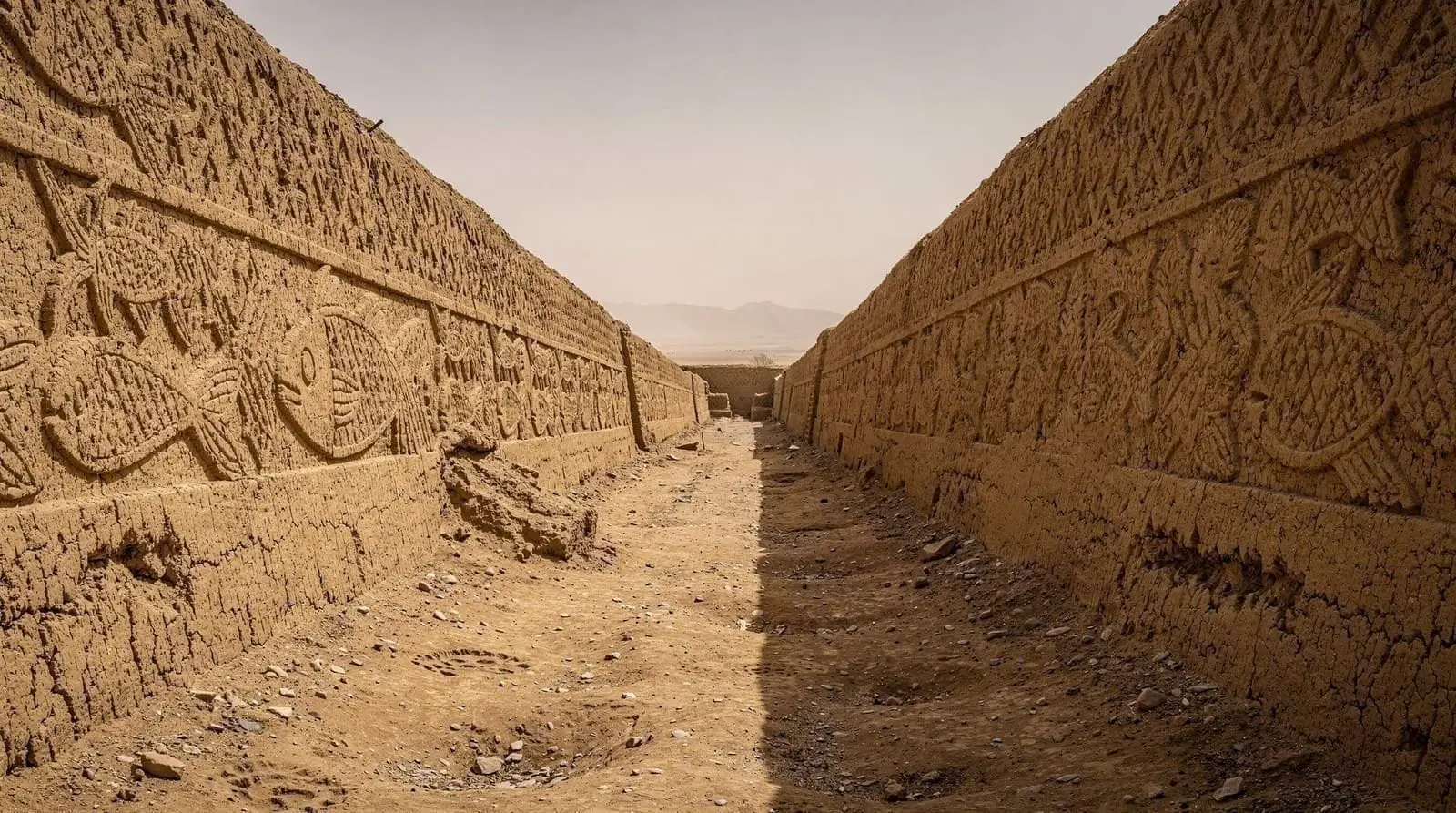
The walking circuit through Tschudi takes about 45 minutes at a comfortable pace. You enter through a massive gateway into a broad ceremonial courtyard — possibly used for audiences with the king — then move through a series of smaller corridors and rooms whose walls are covered in carved friezes. The friezes are Chan Chan’s great visual achievement: repeated bands of geometric and figurative motifs stamped into the wet adobe plaster using wooden moulds. Sea otters, pelicans, fish, and wave patterns dominate, reflecting the Chimú’s deep relationship with the Pacific. Moon images also recur — the Chimú worshipped the moon (Si) rather than the sun, which they associated with heat and drought.
The later sections of the circuit open into a large burial platform (tschudi platform) and a set of storerooms (audiencias) — large U-shaped structures thought to have functioned as administrative offices for receiving tribute. The scale only becomes apparent when you stand in one of these corridors and realise the walls rising on both sides are original 15th-century construction, not modern reproductions.
Trujillo: Discovering Chan ChanThe erosion problem — what you need to know before you visit
Some sections of the Tschudi Complex are covered by modern shade shelters — open-sided corrugated metal roofs on concrete pillars — which protect the most fragile frieze panels from direct rain and sun. These structures are not pretty, and they change the visual experience of the site compared with older photographs you may have seen. They are, however, necessary: unprotected adobe friezes exposed to the occasional El Niño rains that hit this coast every few years deteriorate visibly within a season.
Parts of the complex are periodically closed for conservation work. There is no reliable published schedule for which sections are open on any given date — the best strategy is to ask your guide or the ticket office on arrival. In practice, the core of the Tschudi circuit remains open most of the time.
The eight closed ciudadelas are visible from roads around the site and can be seen from a distance, but they are not accessible to the public. Some of them are in an advanced state of erosion — one or two are little more than eroded mounds. This erosion process will continue regardless of conservation efforts; the honest assessment is that Chan Chan in 2050 will be significantly less intact than it is today.
Getting to Chan Chan from Trujillo
Chan Chan is 9 km west of central Trujillo, a 20-minute drive or 30-minute colectivo ride. Colectivo minibuses (route 01 or 02, marked “Chan Chan” or “Huanchaco”) run constantly from the corner of Avenida España and Industria in central Trujillo for S/2–3 per person. Ask the driver to drop you at the Chan Chan entrance rather than continuing to Huanchaco.
Taxis from central Trujillo cost S/15–20 (USD 4–5) one-way. If you are combining Chan Chan with the Huacas del Sol y Luna and Huanchaco in a single day — the standard Trujillo circuit — hiring a private taxi for the full day (S/100–150 / USD 27–40) is the most practical approach. Organised tours that include all three sites are available from Trujillo agencies and hotels for S/80–150 (USD 21–40) per person including a licensed English-speaking guide.
Trujillo: Chan Chan and Huanchaco Beach TourVisiting with a guide versus independently
Chan Chan is navigable without a guide — the circuit is signposted in Spanish and English, and the on-site museum provides context. However, hiring a licensed guide at the ticket office or bringing one from Trujillo adds substantial value. The guides explain the Chimú administrative system (why the audiencias are U-shaped, what the storerooms held), identify specific frieze panels that are easy to overlook, and can answer questions about the conservation dilemma that dry summaries cannot address.
English-speaking guides at the ticket office charge S/40–60 for a 60-minute circuit. Spanish-speaking guides start at S/25–30. Guides from Trujillo agencies who accompany you from the city typically cost more (S/80–120 for a half-day) but can also cover Huanchaco and the huacas in the same excursion.
Beyond Tschudi: what you don’t get to see
It’s worth understanding what lies outside the visitable circuit, because it shapes expectations. Of Chan Chan’s nine royal ciudadelas, only Tschudi is open — the other eight are scattered across the surrounding desert, in varying states of preservation, and are closed to protect them from further erosion and looting. Some remain substantial; others have degraded to little more than eroded mounds visible from access roads.
This is not a case of bureaucratic overcaution: unrestricted foot traffic across fragile, unbaked adobe walls would accelerate the damage that rain and humidity are already causing. If your interest runs deeper than Tschudi alone, the Chan Chan guide covers the layout and history of the other ciudadelas and the ongoing conservation programme in more depth than a single visit can convey.
Self-guided vs. guided: a quick cost comparison
| Self-guided | With a guide | |
|---|---|---|
| Entry | S/15 | S/15 (same) |
| Guide fee | — | S/25–60 (Spanish/English at the entrance) |
| What you get | Signposted circuit, on-site museum | Frieze detail, administrative context, Chimú history explained |
| Best for | Budget travellers, repeat visitors | First-timers who want the site to make sense |
For a S/40–60 upgrade over a self-guided visit, most first-time visitors find the guide pays for itself in comprehension alone — Chan Chan’s significance is much more in what you understand than what you photograph.
Chan Chan in the context of Trujillo’s archaeology circuit
Chan Chan works best as part of a full day that also takes in the Huacas del Sol y Luna and Huanchaco village. The logical order depends on your priorities: archaeologists suggest starting with the Huacas del Sol y Luna (earliest civilisation in the region, Moche, 100–800 CE) and ending with Chan Chan (the later Chimú capital, 900–1470 CE) to follow chronological sequence. Huanchaco village is naturally placed between or after the two sites as a lunch stop and coastal walk.
All three sites are covered in the broader Trujillo destination guide. If Chimú civilisation and adobe architecture are your primary interest, the Chan Chan guide covers the site in greater depth including the layout of all nine ciudadelas and the ongoing UNESCO conservation programme.
Trujillo: Huacas de Moche, Chan Chan & Huanchaco BeachPractical information
Opening hours: Daily 9am–5pm. Last entry at 4pm. Closed on some public holidays — check locally.
Tickets: S/15 per person. The combined ticket also covers Huacas del Sol y Luna if used on the same day. Children under 12 with a Peruvian school ID may enter free; foreign children pay the standard rate.
Photography: Permitted throughout. Flash photography inside the frieze corridors is not recommended (the guards will usually remind you). Drone photography requires advance permission from the Ministry of Culture and is rarely granted.
What to bring: Sun protection and water are essential — there is almost no shade in the open courtyards between the corrugated shelter structures. The site has a small drinks kiosk at the entrance but nothing inside. Morning is cooler than afternoon; the June–October garúa (coastal fog) can make mornings grey but keeps temperatures comfortable.
Accessibility: The main circuit is largely flat with compacted sand paths. Some doorway thresholds require stepping up (10–20 cm) and a few passages are narrow. Not fully wheelchair-accessible but manageable with assistance for much of the route.
Frequently asked questions about Chan Chan
How long does a visit to Chan Chan take?
Allow 1.5–2 hours for the full Tschudi Complex circuit including the on-site museum. If you hire a guide, the circuit itself takes around 60 minutes with commentary. The museum adds 20–30 minutes. Combined with travel from central Trujillo, a Chan Chan half-day is realistically 3–3.5 hours including a taxi or colectivo each way.
Can I visit Chan Chan without a guide?
Yes. The site is well signposted and the walking circuit through Tschudi is easy to follow independently. That said, the carved friezes and administrative structures are significantly more comprehensible with a guide who can explain what you are looking at and why the ciudadela layout worked the way it did. For a S/40–60 upgrade, a local guide is good value.
Is Chan Chan included in any multi-site ticket with the Huacas del Sol y Luna?
Yes — the S/15 ticket covers both Chan Chan and the Huacas del Sol y Luna on the same day. The ticket is sold at either site. If you visit Chan Chan in the morning and the Huacas in the afternoon (or vice versa), keep your ticket for re-entry.
Why is Chan Chan on the UNESCO Danger List?
Adobe construction survives only in conditions of near-total aridity. Chan Chan built its thousand-year legacy on the assumption that almost no rain would ever fall on the Peruvian north coast. That assumption held for most of its post-occupancy history. El Niño events — which bring heavy rain to this desert coast every few years to decades — dissolve the unbaked mud rapidly. Rising coastal humidity from climate change is a longer-term concern. UNESCO’s designation reflects the reality that no amount of conservation investment can fully offset the vulnerability of the material itself.
How does Chan Chan compare to other UNESCO sites in Peru?
Chan Chan is different in character from Machu Picchu and the Sacred Valley. It is lower altitude, hotter, and in a desert rather than mountains. The architecture is horizontal rather than vertical — low corridors and broad courtyards rather than terraced stone buildings on hillsides. It appeals particularly to visitors interested in urbanism, administrative systems, and non-Inca civilisations. It is not scenic in the conventional sense but becomes more compelling the more context you bring to it.
Is there anything else to see near Chan Chan?
Huanchaco village is 2 km north of the site and worth a 30-minute stop for the caballitos de totora reed boats and lunch on the beach. Trujillo city centre (9 km east) has a walkable colonial zone. For a full day’s circuit add the Huacas del Sol y Luna (8 km south of central Trujillo, so roughly 17 km from Chan Chan). See things to do in northern Peru for the broader region.
Why can I only visit one of Chan Chan’s nine palaces?
Only the Tschudi Complex has been fully restored and secured for public access. The other eight ciudadelas are closed to protect their fragile, unbaked adobe walls from further erosion and looting; some remain substantial, others have degraded significantly. This is a genuine conservation trade-off, not simple bureaucracy — unrestricted access would accelerate the damage.
Should I visit Chan Chan or focus on Chiclayo’s Moche sites instead?
They complement rather than compete — Chan Chan represents the later Chimú civilisation (900–1470 CE), while Chiclayo’s sites like Sipán cover the earlier Moche period. If your itinerary allows both northern coast stops, seeing them in chronological order (Chiclayo/Moche, then Trujillo/Chan Chan) gives the clearest sense of how the region’s civilisations evolved.
Top experiences
Bookable activities with verified prices and instant confirmation on GetYourGuide.
