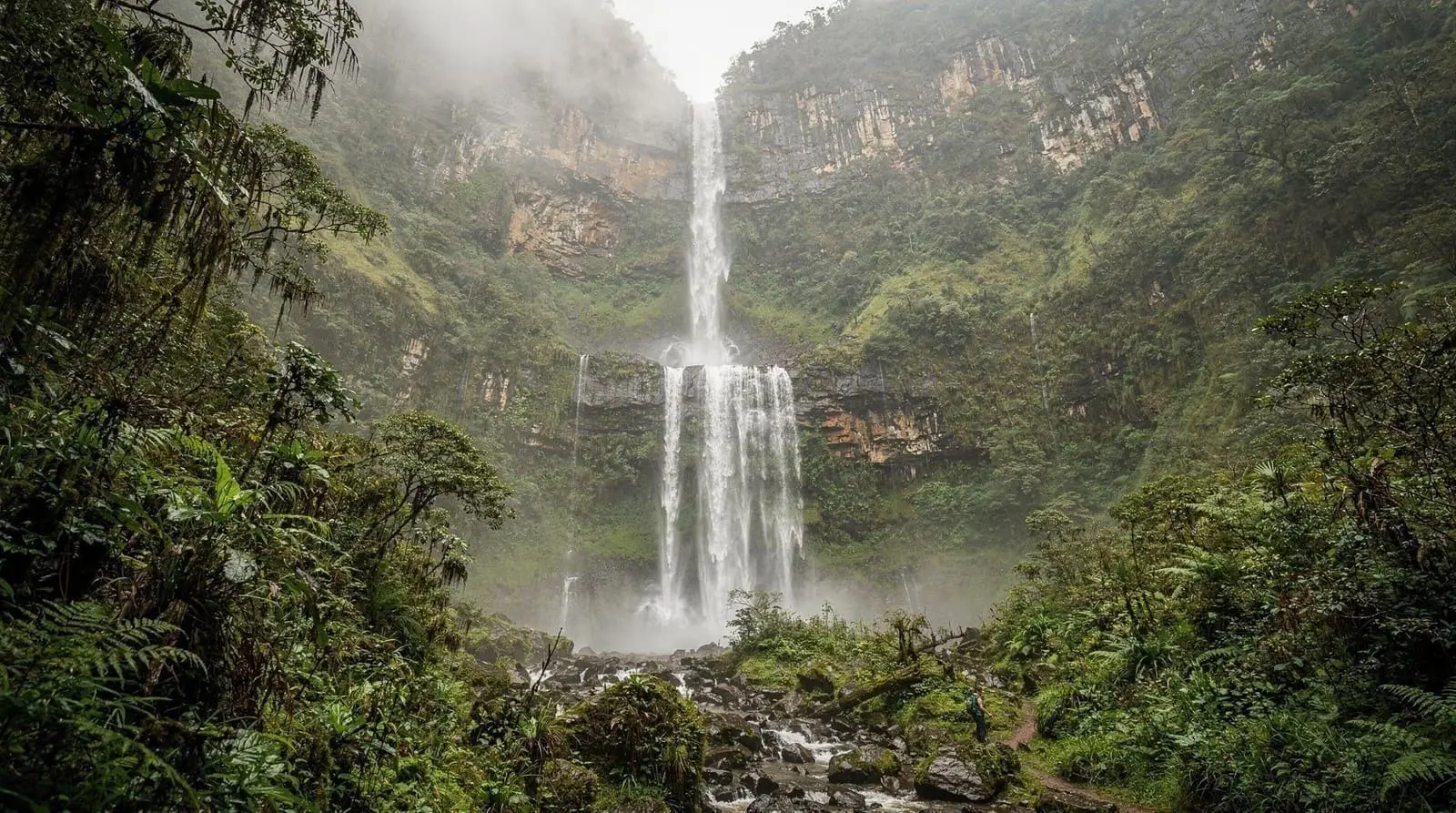
Gocta Waterfall
Gocta near Chachapoyas plunges 771 m through cloud forest. The honest guide to the hike: distance, difficulty, mud, costs, and which trailhead to choose.
Chachapoyas: Full Day to Gocta Waterfall, Amazon's Jewel
Quick facts
- Total height
- ~771 m (two tiers)
- Distance from Chachapoyas
- ~45 km, ~1.5 hours by road
- Hike (Cocachimba route)
- ~12 km round trip, 5-6 hours
- Trail fee
- ~S/10-15 community entry
- Best for
- Cloud-forest hiking, birdlife, a big waterfall payoff
The waterfall the world only “discovered” in 2006
Gocta is a striking lesson in how much of Peru remains genuinely off the map. The waterfall plunges roughly 771 m down a cloud-forest cliff in the Amazonas region, in two great tiers, making it by most accounts one of the tallest waterfalls on Earth. And yet the outside world only became aware of it in 2006, when a German engineer named Stefan Ziemendorff measured it and brought it to international attention. The local communities of Cocachimba and San Pablo de Valera, of course, had always known it was there — a local legend warned that a curse, or a mermaid, would befall anyone who revealed the falls, which may help explain the long silence.
Since then Gocta has become one of the signature attractions of the Chachapoyas region, and deservedly so. The hike to reach it winds through dense, dripping cloud forest alive with birds and orchids, opening at the end onto the full sweep of the falls thundering off the cliff into a pool below. It is a proper half-to-full-day’s effort rather than a roadside photo stop, and that effort is part of what makes the payoff land.
The 2006 “discovery” also brought real economic change to Cocachimba and San Pablo, which have grown modest tourism infrastructure — guesthouses, community-run trail fees, simple restaurants — around what for generations was simply the village’s own backyard waterfall.
This page lays out the practical reality of the hike honestly — the distance, the mud, the two trailhead options, and the seasonal trade-offs — so you arrive prepared rather than surprised.
| Where | ~45 km / 1.5h from Chachapoyas, Amazonas region |
| Time needed | Full day (5–6 hours hiking round trip from Cocachimba) |
| Cost | Guided day trip S/40–80; independent trail fee S/10–15 |
| Getting there | Guided tour (easiest) or colectivo + local transport |
| Best time | Dry (May–Sep) for easier trail; wet (Nov–Apr) for fuller falls |
Where it is and getting there
Gocta lies about 45 km from the town of Chachapoyas, roughly an hour-and-a-half drive through the Utcubamba valley and up into the cloud forest. There is no public transport directly to the trailheads, so visitors either join a guided day trip from Chachapoyas or arrange a private taxi/colectivo to one of the two gateway villages, Cocachimba or San Pablo.
For most travellers the organised tour is the straightforward option: it bundles the transport each way, the community trail fee, and a guide who knows the junctions and the birdlife.
Full-day Gocta waterfall tour from ChachapoyasA simpler excursion version covers the same falls if you want a more streamlined day.
Gocta waterfall excursion from ChachapoyasIndependent hikers can take a colectivo from Chachapoyas toward Pedro Ruiz and arrange onward transport to Cocachimba, then hike on the well-signed community trail; it’s doable but requires patience with connections and an early start to be back the same day.
Two trailheads: Cocachimba vs San Pablo
This is the decision that shapes your day, so it’s worth understanding. Gocta has two tiers, and two different villages give access from two different angles.
Cocachimba is the southern, more popular gateway. The trail from here leads to the base of the lower (and larger) tier, where you can stand near the pool with the full height of the falls towering above you — the classic Gocta view. It’s roughly 6 km each way (about 12 km round trip), with rolling ups and downs and a net climb on the way back. Allow five to six hours including time at the falls. The village also has the best viewpoint of the whole waterfall from a distance, near the start, which is worth a photo before you commit to the descent.
San Pablo de Valera is the northern gateway, giving access to the upper tier of the falls. The hike to the upper falls from San Pablo is generally shorter and a bit easier than the Cocachimba route, and some visitors who want a gentler day or who can’t manage the longer hike choose this side. The view is different — you’re nearer the top tier rather than gazing up the full drop.
If you only do one, most people choose Cocachimba for the dramatic bottom-up view of the main fall. Energetic hikers occasionally link both tiers in a longer day, but that’s a serious outing and usually needs a guide and a logistics plan for transport between the two villages.
| Cocachimba (lower tier) | San Pablo (upper tier) | |
|---|---|---|
| Distance | ~12 km round trip | Shorter |
| Difficulty | Longer, tiring climb back | Generally easier |
| View | Classic bottom-up full-drop view | Closer to the upper tier only |
| Best for | Most first-time visitors | Those wanting a gentler day |
How hard is the hike, honestly?
Set your expectations for a real hike, not a stroll. The Cocachimba route is roughly 12 km round trip with a fair amount of up-and-down through humid forest, and the return — climbing back up to the village — is the tiring part, usually in the afternoon heat and humidity. It’s well within the reach of anyone reasonably fit, but it is not flat and it is not short.
The defining feature is mud. This is cloud forest; the ground is wet much of the year, and even in the so-called dry season the trail can be slick and muddy in shaded sections. Waterproof or grippy footwear you don’t mind getting filthy is essential, and trekking poles genuinely help on the slippery descents and climbs. Expect to be damp from a mix of trail moisture, humidity, and the spray near the falls.
Altitude is not a significant factor here — the trail runs at cloud-forest elevations well below the Cordillera Blanca’s punishing heights — so unlike the Huaraz hikes, you don’t need an acclimatisation programme. Basic fitness and the right footwear matter far more than altitude conditioning.
For those who find the full walk too much, horses (and a handler) can usually be hired in Cocachimba to carry you part of the way along the wider sections of trail — a reasonable option, though the path near the falls is walked on foot regardless.
Pace yourself on the return climb rather than trying to match a guide’s speed — most of the fatigue on this hike comes on the way back, not the way in, and there is no shame in stopping for water breaks on the steeper switchbacks. Starting early in the morning, ideally by 8 am, avoids the worst of the midday humidity on the ascent.
Wildlife, the falls, and what to expect at the end
The hike is as much about the cloud forest as the waterfall. The trail passes through dense, dripping greenery thick with bromeliads, orchids, and ferns, and the birdlife is excellent: the Andean cock-of-the-rock (Peru’s vivid orange national bird), tanagers, hummingbirds, and — with luck and a guide’s eye — glimpses of monkeys. Spectacled (Andean) bears live in this forest, though sightings are rare. A guide makes a real difference for the wildlife, since the cloud forest hides far more than the untrained eye picks out.
At the base of the lower falls, the water free-falls hundreds of metres and arrives as a roaring column with a permanent cloud of spray. You can get close to the pool; swimming is cold and the spray strong, but standing at the foot of an 771-metre cascade is the kind of scale that’s hard to photograph and easy to remember. The volume varies dramatically by season (see below), so the falls you see may be a thundering torrent or a more slender ribbon depending on when you come.
A wide-angle lens or phone panorama mode is genuinely useful here — the falls are tall enough that a standard shot from close to the pool struggles to capture the full drop. Stepping back toward the viewpoint near the trailhead, where you first glimpse the whole cascade from a distance, often produces a better sense of scale than the close-up shots most visitors default to.
Seasons, costs, and what to bring
When to go: Gocta is a year-round attraction, but with a genuine trade-off. The wet season (roughly November to April) makes the falls fullest and most powerful, but the trail is muddiest, the cloud often thickest (sometimes hiding the upper falls entirely), and afternoon rain likely. The drier months (May to September) bring better trail conditions, clearer views of the full drop, and easier hiking, but a lower water volume. There’s no perfect answer — for sheer power, go wet; for clearer views and an easier walk, go dry. Mornings generally have the best light and the least cloud whatever the season.
Costs: A guided day trip from Chachapoyas typically runs S/40-80 (about $11-22 USD). Independently, you’ll pay a community trail-entry fee of around S/10-15 at the village, plus your transport. Horse hire in Cocachimba is an extra negotiated on the spot.
What to bring: Waterproof or grippy footwear you don’t mind ruining, a rain jacket or poncho (regardless of season), insect repellent, water, snacks or a packed lunch, sun protection for the open village sections, and a dry bag for cameras and phones given the spray and humidity. Trekking poles help. There are basic food stalls and toilets in the gateway villages but little on the trail itself.
Bring more water than you think you need — the humidity means you sweat steadily even without direct sun, and there is nowhere to refill along most of the trail. A litre and a half per person is a reasonable minimum for the Cocachimba round trip.
Combining Gocta with the rest of the region
Gocta pairs naturally with the other headline sites around Chachapoyas. A balanced few days might combine the cloud-forest fortress of Kuélap, the Karajía cliff sarcophagi, the Leymebamba mummy museum, and Gocta itself — a strong mix of pre-Inca archaeology and dramatic nature that very few foreign travellers ever reach. Pushing further into northern Peru, the region links (slowly, by road) toward Cajamarca and the north coast.
For routing, timing, and how to fit the northern highlands into a wider Peru trip, see the itineraries page and the guides hub, and browse bookable excursions on the tours page. For the how-to-get-there logistics of reaching Chachapoyas itself, see the how to get to Chachapoyas guide, and the Gocta waterfall guide for a deeper trip-planning breakdown.
Frequently asked questions about Gocta Waterfall
How tall is Gocta Waterfall?
Gocta falls roughly 771 m in two main tiers, which by most measurements ranks it among the tallest waterfalls in the world. The exact ranking is debated because different surveys measure waterfalls differently, but its scale is undeniable — and remarkably, the wider world only learned of it in 2006.
How long and how hard is the hike to Gocta?
From Cocachimba, the most popular trailhead, it’s about 12 km round trip taking five to six hours, with rolling ups and downs through cloud forest and a tiring climb back to the village. It’s manageable for anyone reasonably fit but is a real hike, not a short walk. The trail from San Pablo to the upper falls is generally shorter and easier.
Which Gocta trailhead is better, Cocachimba or San Pablo?
Cocachimba leads to the base of the lower (larger) tier for the classic bottom-up view of the full drop, and it has the best distant viewpoint of the whole falls — but it’s the longer, harder hike. San Pablo gives access to the upper tier on a shorter, gentler trail. Most first-timers choose Cocachimba for the dramatic main view.
What’s the best time of year to visit Gocta?
It’s a year-round destination with a trade-off. The wet season (November to April) makes the falls fullest and most powerful but brings mud, thick cloud, and frequent rain. The dry season (May to September) offers clearer views and easier hiking but lower water volume. Go early in the day for the best light and least cloud whatever the season.
Do I need a guide for Gocta?
Not strictly — the community trails are well-signed and you can hire entry and even a horse at the village. But a guided day trip from Chachapoyas handles the transport (there’s no direct public bus), navigates the junctions, and greatly improves your chances of spotting cloud-forest wildlife like the cock-of-the-rock. Most visitors find the tour the easiest option.
How much does it cost to visit Gocta?
A guided day trip from Chachapoyas typically costs S/40-80 (about $11-22 USD). If you go independently, expect a community trail-entry fee of around S/10-15 plus your own transport, with optional horse hire as an extra. Bring cash, as card payment isn’t available at the trailheads.
Top experiences
Bookable activities with verified prices and instant confirmation on GetYourGuide.
