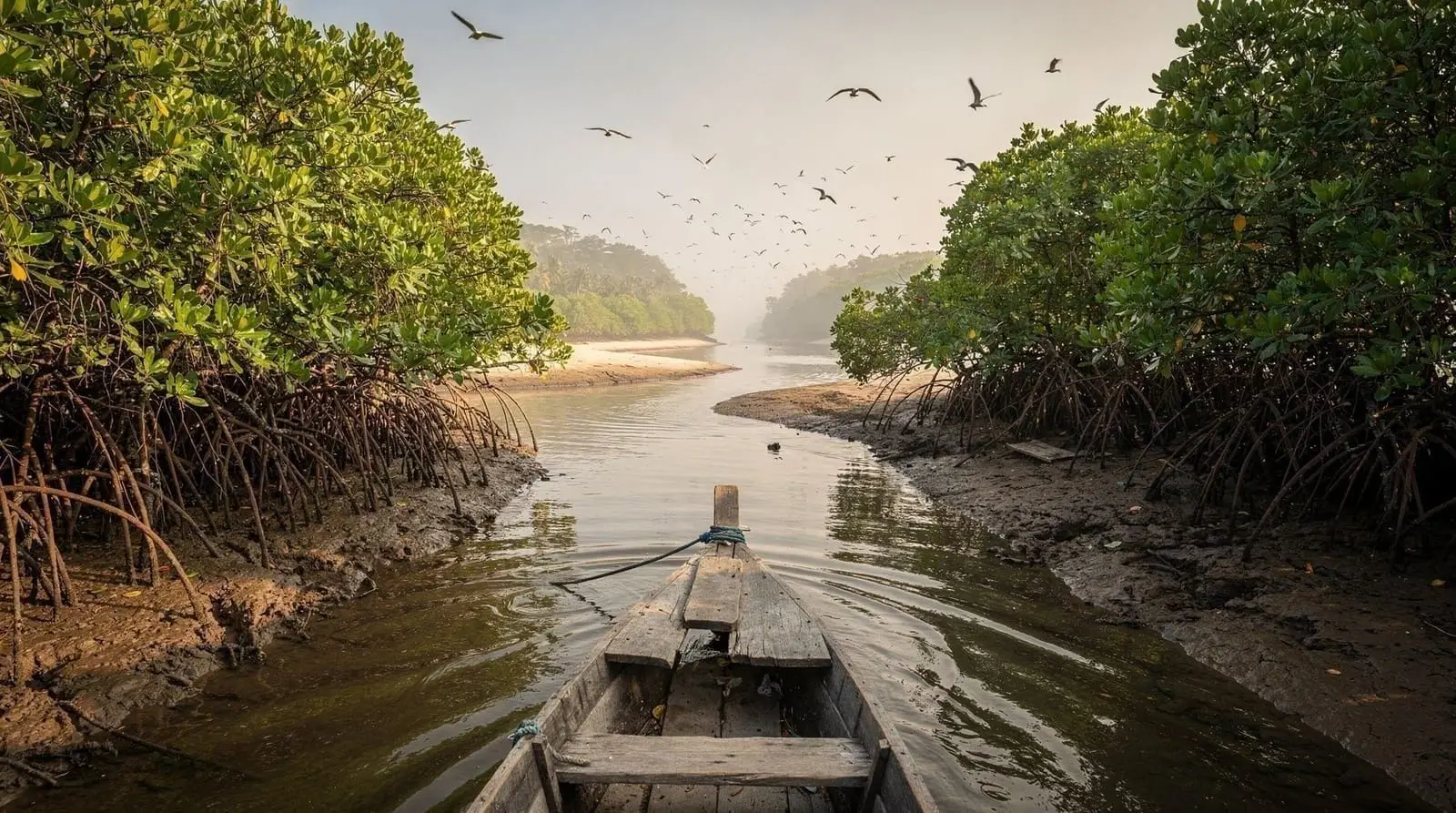
Tumbes mangroves and Puerto Pizarro
The mangroves of Tumbes and Puerto Pizarro in far-northern Peru — boat tours, crocodile sanctuary, birdlife, island sandbars, prices and how to visit.
Tumbes: Puerto Pizarro Mangroves and Islands Tour
Quick facts
- Location
- Puerto Pizarro, ~15 km north of Tumbes city
- Ecosystem
- Peru's only major tropical mangroves
- Activity
- Boat tour through channels, islands & crocodile centre
- Best for
- Birdwatching, mangrove ecology, a calm coastal break
Peru’s tropical corner
Tumbes is the last province before Ecuador, a humid, palm-fringed sliver of coast that feels almost nothing like the rest of Peru. The cold Humboldt Current that keeps Lima grey and Huanchaco chilly peters out up here, and warm tropical waters take over. The land turns green, the air turns sticky, and a unique ecosystem appears that exists nowhere else in the country at this scale: mangroves.
The Santuario Nacional Los Manglares de Tumbes protects roughly 2,900 hectares of these tidal forests, and the gateway to seeing them is Puerto Pizarro, a small fishing port about 15 km north of Tumbes city. From there, motorboats thread the labyrinth of brackish channels between the mangrove roots, stopping at sandbar islands and a crocodile breeding centre. It is a low-key, half-day outing rather than a headline attraction — most travellers who come here are either passing between the beaches of Máncora and the Ecuadorian border, or specifically chasing the birdlife.
This page is honest about what the Tumbes mangroves are and are not, what a boat tour involves, and how to fit it into a far-northern itinerary.
| Where | Puerto Pizarro, ~15km north of Tumbes city |
| Cost | Around S/60-120 per boat (small group), plus a small entry fee |
| Time needed | Half a day |
| Getting there | Colectivo or taxi (S/20-30) from Tumbes city |
| Best time | Dawn or late afternoon for birds; Dec-Apr for warm sun |
Why the mangroves matter
Mangroves are among the most productive ecosystems on earth, and the Tumbes stands are a botanical outlier for Peru — the country’s only significant tropical mangrove forest, sustained by the warm Equatorial waters and the freshwater of the Tumbes River delta. The tangle of stilt-like roots traps sediment, shelters the coast from storms, and acts as a nursery for fish, crabs, and molluscs.
The signature species here is the concha negra (black ark clam), harvested by local conchero divers from the mud around the roots and prized in regional cooking. The forest is also a magnet for birds: herons, egrets, ibises, frigatebirds, cormorants, and the rarer mangrove specialists draw birdwatchers who consider this one of the better coastal birding spots in Peru. If wildlife is your reason for coming, bring binoculars and ask for a guide who knows the channels and the tides.
A note of honesty: this is a working, lived-in landscape, not a pristine wilderness reserve. You will see fishing boats, harvesters, and the occasional litter line at high water. Manage expectations and you will enjoy it more.
There are actually two protected areas in the Tumbes region worth distinguishing. The Santuario Nacional Los Manglares de Tumbes covers the coastal mangroves near the Ecuadorian border and is what most boat tours from Puerto Pizarro show you. Further inland and up into the hills lies the much larger Parque Nacional Cerros de Amotape and the Reserva Nacional de Tumbes, which protect a rare Pacific tropical dry forest — home to spectacled bears, white-winged guans, and Tumbes-endemic birds. That dry-forest reserve is a serious wildlife destination requiring a guide and more time, and it is quite separate from the easy half-day mangrove trip described on this page. If a guide or operator conflates the two, ask exactly where you are going.
Why this corner of Peru feels different
The abrupt change in climate and ecology at Tumbes is one of the more striking transitions in South America. For most of Peru’s coast, the cold Humboldt Current sweeping up from the south produces a near-rainless desert and chilly grey seas — the conditions that define Huanchaco and the beaches further south.
Around the latitude of Tumbes, the warm Equatorial counter-current takes over, sea temperatures jump several degrees, humidity climbs, and genuine tropical vegetation appears. This is why the far north has Peru’s only warm-water swimming beaches and its only mangroves, and why the food, the pace, and even the architecture feel closer to coastal Ecuador than to Lima. Travellers arriving from the south often describe a sense of having crossed an invisible border well before reaching the political one.
What a Puerto Pizarro boat tour includes
A standard mangrove tour leaves from the Puerto Pizarro jetty in a motorised launch and runs for roughly 1.5 to 2.5 hours, weaving through the channels and typically taking in three or four stops:
- The mangrove channels themselves — slow cruising between the roots, with the guide pointing out birds, crabs, and the structure of the forest.
- Isla de los Pájaros (Bird Island), a roosting island where, at the right time of day, large numbers of seabirds gather. Early morning and late afternoon are best for activity.
- A crocodile sanctuary (the Tumbes crocodile, Crocodylus acutus, is critically endangered in Peru and the centre runs a breeding programme). This is a conservation enclosure rather than a wild sighting.
- Isla del Amor or a sandbar island, where boats often pause so passengers can wade, swim in the warm shallows, or buy a drink and grilled fish from informal stalls.
Tours are flexible and weather- and tide-dependent; the exact stops vary by operator and water level.
Tumbes: Puerto Pizarro Mangroves and Islands TourPractical information
Costs. Boat tours are usually priced per boat rather than per person, so the per-head cost drops sharply if you fill the launch. Reckon on roughly S/60–120 (USD 16–32) for a private boat for a small group, less per person if you join others; there is also a small protected-area or jetty fee. Bring cash in soles — card payment is not reliable at the port.
Timing. Tide and time of day matter. Higher water lets boats reach more channels, and dawn or late afternoon are far better for birds than the dead of midday. If birdwatching is the point, ask your operator about tides when you book.
What to bring. It is hot, humid, and exposed on the water. Bring sun protection, a hat, water, insect repellent (mosquitoes and sandflies are real here, especially around dusk), and binoculars if you have them. A dry bag for cameras is wise on a small open boat.
Health. Tumbes sits in a tropical zone where mosquito-borne illness (dengue, and historically malaria) occurs. Use repellent, cover up at dusk, and check current health advice before travelling.
Choosing an operator and avoiding traps. Because boats are priced per launch, solo travellers and couples pay disproportionately unless they share. It is worth asking at the jetty whether other visitors are heading out, or pre-booking a scheduled group departure. Be clear about what is included before you board — some cheaper “tours” are little more than a quick out-and-back through one channel with no guiding, while a proper trip includes the bird island, the crocodile centre, and time on a sandbar. Wildlife is not guaranteed; reputable operators will not promise crocodile sightings in the wild or specific birds. As elsewhere on the coast, agree the price and the route before the engine starts.
What else is around Tumbes
The mangroves are rarely the only reason people are in this corner. Tumbes city itself is a workaday provincial capital with a pleasant restored Plaza de Armas and riverside promenade but few sights; most travellers treat it as a transit point rather than a stop. The real draw of the wider area, beyond the mangroves, is the string of warm-water beaches running south toward Máncora — Punta Sal, Zorritos, and Acapulco among them — which are quieter and often cheaper than Máncora itself while sharing the same Equatorial warmth.
For the more adventurous, the inland Cerros de Amotape dry forest and the hot springs at Hervideros offer day trips with a local guide, and the Tumbes coastline is one of the few places in Peru where you might see humpback whales offshore during the July-to-October migration season, usually on dedicated boat trips out of Punta Sal or Máncora. None of these is a marquee attraction on a Peru bucket list, but together they make the far north a relaxed, off-the-beaten-track region for travellers who have already done the headline circuit.
Taken together, this corner of Peru rewards travellers who have already ticked off Cusco, Machu Picchu and the classic archaeology circuit and are looking for something slower and less structured. Nobody plans a trip around Tumbes alone, but as the final stretch of a longer coastal itinerary, or a deliberate pause before or after crossing into Ecuador, it earns its place.
Getting to Puerto Pizarro and Tumbes
Tumbes is the practical hub. Its airport, Capitán FAP Pedro Canga Rodríguez (TBP), has direct flights from Lima in around 2 hours, which is by far the fastest way in — the overland trip from Lima is exhausting (18-plus hours by bus). Many travellers instead reach Tumbes overland from the beach hub of Máncora, about 1.5–2 hours south by bus or colectivo.
From Tumbes city, Puerto Pizarro is around 15 km north. Colectivos and combis run there for a few soles, or a taxi costs roughly S/20–30 (USD 5–8). At the port, boat operators are easy to find at the jetty, though pre-booking a tour removes the haggling and guarantees an English-speaking guide where that matters.
Tumbes is also the last stop before the Ecuadorian border crossing at Aguas Verdes/Huaquillas, which is why a fair number of overland travellers between Peru and Ecuador pass through and fit the mangroves in along the way.
Tumbes: Islands and Mangroves of Puerto PizarroHow the mangroves fit a northern itinerary
The Tumbes mangroves are a destination for travellers already committed to far-northern Peru — they are a long way from the country’s headline sights. The natural pairing is with Máncora, the warm-water beach resort 1.5–2 hours south, which most people use as their base for this corner of the coast. A common pattern is several days of beach and sun at Máncora with a half-day mangrove excursion up to Puerto Pizarro folded in, or a final stop on the way to the Ecuadorian border.
If you are working your way up the whole coast, Tumbes is the northern end of a run that begins with the ruins around Trujillo and Chiclayo and the surf village of Huanchaco. For how to sequence all of it sensibly without backtracking, see the northern Peru route guide.
Tumbes: Bewitching Islands & Mangroves of Puerto PizarroWhat else to do while based in Máncora
Because most travellers reach the mangroves via Máncora rather than staying in Tumbes itself, it is worth planning the mangrove half-day alongside Máncora’s other signature activities rather than in isolation. The Máncora complete guide covers the beach town’s full range, but two experiences pair especially well with a mangrove trip on the same broader visit: the whale-watching season, which overlaps loosely with the mangroves’ warm-season appeal from July to October, and the region’s surf breaks, a good contrast for the days you are not out on the water in a mangrove launch.
Several travellers structure a week around Máncora as a base, with the mangroves as a single change-of-pace day trip among beach days — see this Máncora beach week diary for how that balance actually looks in practice.
A note on birdwatching seriousness
If birds are the main reason you are coming this far north, it is worth distinguishing between a casual boat tour and a dedicated birding trip. A standard Puerto Pizarro tour will show you herons, egrets, frigatebirds and the more visible waterbirds without much specialist commentary.
A birder chasing mangrove specialists and regional endemics should specifically request (and likely pay a little more for) a guide who knows bird calls and can navigate to the quieter side channels away from the main tourist route, ideally timing the trip for the early morning rather than a mid-morning group departure. The reward, on a good morning, is a genuinely long list for a half-day’s effort — this stretch of coast, from the mangroves down through the dry forest, is one of Peru’s most overlooked birding regions precisely because so few visitors treat it seriously.
Frequently asked questions about the Tumbes mangroves
What are the Tumbes mangroves and where are they?
They are Peru’s only significant tropical mangrove forest, protected within the Santuario Nacional Los Manglares de Tumbes in the far north near the Ecuadorian border. The usual access point is Puerto Pizarro, a fishing port about 15 km north of Tumbes city, where boats run tours through the tidal channels and islands.
What does a Puerto Pizarro boat tour include?
A typical 1.5–2.5 hour tour cruises the mangrove channels and stops at Bird Island (a seabird roost), a crocodile breeding sanctuary, and a sandbar island where you can wade or swim. Stops vary with the tide and operator. Tours are usually priced per boat (around S/60–120 for a small group) plus a small protected-area fee.
Is it worth visiting the Tumbes mangroves?
It depends on your interests. For birdwatchers and anyone curious about mangrove ecology it is a worthwhile, calm half-day, and a genuinely different landscape from the rest of Peru. For others it is a minor stop best combined with the beaches of Máncora or an Ecuador border crossing rather than a destination in its own right. It is a working coastal environment, not pristine wilderness.
When is the best time to go?
December to April is warm and sunny, and the tropical north stays warm year-round. For wildlife, the time of day matters more than the season: go at dawn or late afternoon for the best bird activity, and ask about tides, since higher water lets boats reach more channels.
How do I get to Tumbes?
The fastest route is a direct flight from Lima to Tumbes airport (TBP), about 2 hours. Overland from Lima takes 18-plus hours by bus, so most travellers arrive from Máncora 1.5–2 hours south. From Tumbes city, reach Puerto Pizarro by colectivo (a few soles) or taxi (S/20–30).
Are there crocodiles in the Tumbes mangroves?
Yes — the critically endangered Tumbes (American) crocodile lives here, and the boat tours visit a breeding sanctuary that runs a conservation programme. Sightings are at the managed centre rather than freely in the wild, where the species is now very rare.
Top experiences
Bookable activities with verified prices and instant confirmation on GetYourGuide.
