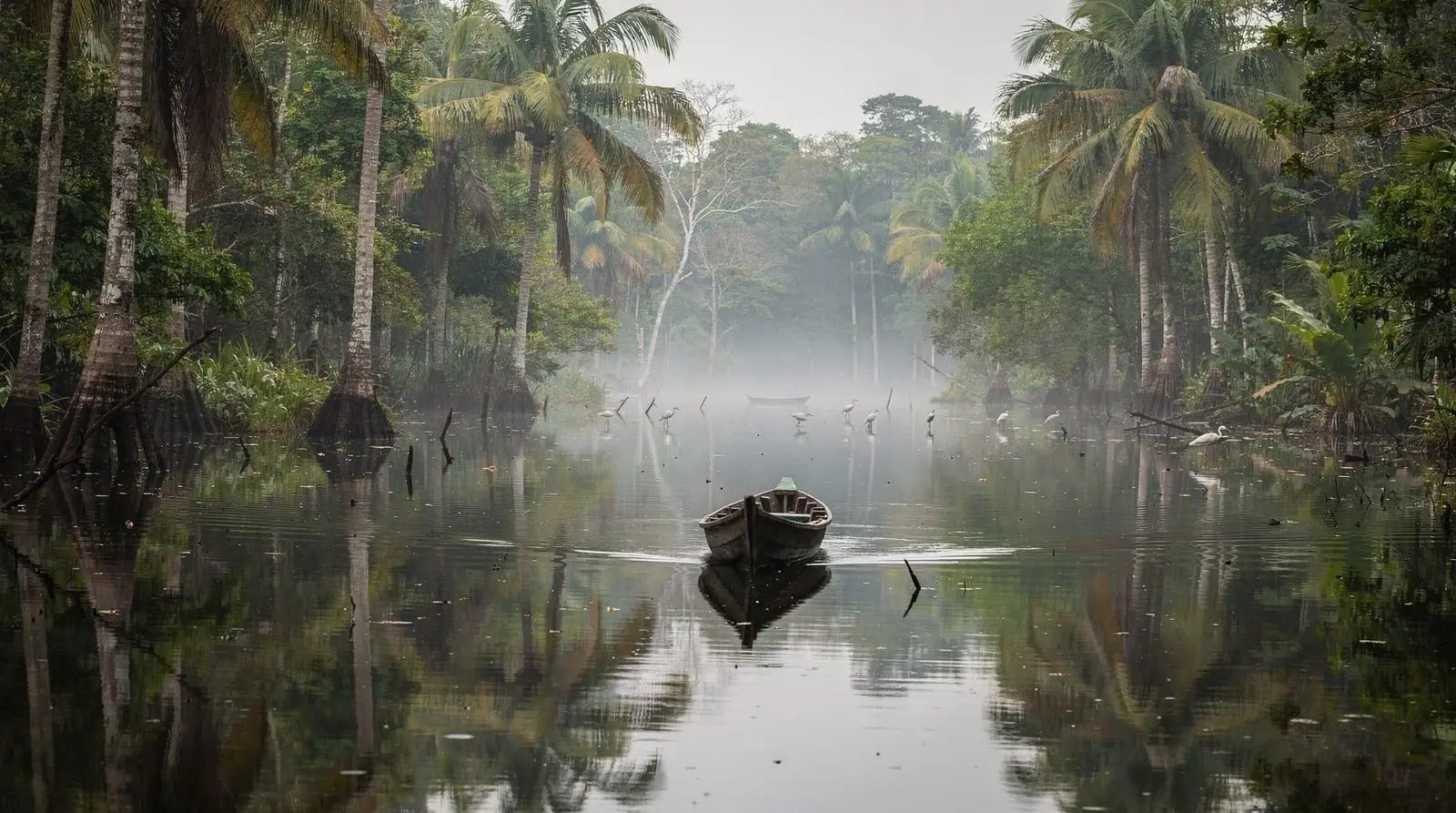
Pacaya-Samiria National Reserve
Pacaya-Samiria is Peru's largest protected wetland — a flooded-forest Amazon reserve of dolphins, manatees, and birds, reached by river from Iquitos.
From Iquitos: 3-Day Pacaya-Samiria National Reserve Tour
Quick facts
- Country
- Peru (Loreto region)
- Size
- Over 2 million hectares — Peru's largest protected wetland
- Access
- By river from Iquitos or Nauta; licensed operator required
- Best for
- Flooded-forest wildlife, river dolphins, birds, multi-day cruises
Peru’s great flooded forest
While the southern Amazon reserves of Tambopata and Manu draw the bulk of attention, Pacaya-Samiria in the northern Loreto region is, by area, Peru’s largest protected wetland — and one of the most extraordinary. It covers more than two million hectares, roughly the size of a small country, protecting the seasonally flooded forest between the Marañón and Ucayali rivers, north and west of Iquitos. This is várzea, or whitewater flooded forest: low-lying jungle that spends much of the year partly underwater, creating a labyrinth of channels, oxbow lakes, and inundated woodland that you explore by boat rather than on foot.
| Where | Loreto region, northern Amazon, reached via Iquitos and Nauta |
| Cost | Tour price plus a modest per-person, per-day entry fee |
| Time needed | 3 days minimum; 5–7 days to reach the interior lakes |
| Getting there | Fly to Iquitos, then road to Nauta and river onward |
| Best time | June to October, low water for reliable wildlife |
That aquatic character makes Pacaya-Samiria a different Amazon from the trail-walking reserves of the south. Here the experience is paddling silent channels at dawn, drifting under flooded canopy, and watching the waterline for the surface of a dolphin or the wake of a caiman. The reserve shelters river dolphins, manatees, giant otters, black caiman, anacondas, hundreds of bird species, and a long list of fish including the giant paiche. It is also far less visited than the southern parks, which is part of its appeal for travellers who want wildness without crowds — and part of the reason it requires more effort and planning to reach.
How the reserve works: access and permits
Pacaya-Samiria is a strictly managed national reserve, and you cannot simply turn up and wander in. Entry requires a licensed operator and the appropriate permits, which the operator arranges, plus an entry fee paid per person per day (a modest sum on top of the tour cost). This system exists to protect a fragile ecosystem and to channel some benefit to the communities living in and around the reserve, several of which run community-based tourism.
There are two broad ways in. The main visitor access is from Iquitos, usually by combining a road transfer to the town of Nauta (about two hours south of Iquitos) with onward river travel into the reserve, or by a longer river journey directly. From there, trips work either as ranger-station-based stays — sleeping at a guard post or community lodge and making daily excursions by canoe — or as boat-based itineraries that move through the channels. The deeper, more pristine interior, including the famous lakes around the Pacaya and Samiria rivers, takes more days to reach and rewards the effort with wilder country and better wildlife.
A practical note: because the reserve is large and access is regulated, day trips only scratch its edges. A genuine Pacaya-Samiria experience really wants three days at minimum, and five to seven days reveals far more of the interior.
From Iquitos: 3-day Pacaya-Samiria National Reserve tourWater levels: the rhythm that governs everything
More than almost anywhere else in the Peruvian Amazon, Pacaya-Samiria is ruled by the annual flood cycle, and understanding it is essential to planning a worthwhile trip.
Low water (roughly June to October) is the recommended window. As the rivers recede, beaches and banks emerge, fish concentrate in shrinking lagoons, and wildlife gathers around the remaining water — making dolphins, caiman, birds, and other animals far easier to find. Fishing, including for piranha, improves, and the interior lakes become accessible by canoe. This is when most operators run their fuller itineraries and when wildlife watching is at its most rewarding.
High water (roughly December to May) transforms the reserve into a vast flooded forest. The water rises metres up the tree trunks, and you can paddle through inundated woodland that is dry land in other months — an eerily beautiful experience with its own appeal. But wildlife disperses into the flooded forest and becomes harder to spot, and mosquito numbers climb. It is not a wasted trip, and the flooded-canopy paddling is genuinely special, but for reliable wildlife viewing the low-water months are clearly better.
Iquitos: full-day Pacaya-Samiria National Reserve tourWhat lives here
Pacaya-Samiria is one of the most biodiverse wetlands on the planet, and the wildlife is the reason to make the effort.
The reserve’s signature animals are its river dolphins — both the pink (boto) and the smaller grey species — which are seen reliably in the channels and lakes, the pink dolphin’s strange rosy colouring deepening with age. Manatees, shy and increasingly rare, live here too, and the reserve runs a manatee rescue and rehabilitation programme; wild sightings are uncommon but possible.
Giant otters patrol some of the lakes, black caiman bask on the banks and surface at night, and anacondas inhabit the wetlands, though seeing one is a matter of luck. Above the water, the birdlife is exceptional — herons, kingfishers, macaws, hoatzins, raptors, and hundreds more species. In the water swims the paiche (arapaima), one of the largest freshwater fish on Earth.
As ever in the Amazon, honesty about expectations serves travellers well. Dolphins, caiman, and abundant birds are reliable with a good guide in the low-water season; manatees, giant otters, and anacondas are bonuses, not guarantees. The reward of Pacaya-Samiria is not a checklist of charismatic mammals but the immersion in a vast, little-visited wetland where the wildness feels intact.
Choosing a trip and an operator
Because the reserve is reached almost entirely from Iquitos and requires licensed access, choosing a reputable operator is the most important decision you will make. Trips range from modest community-based stays at ranger posts to comfortable river cruises that incorporate Pacaya-Samiria into a broader Amazon-and-Ucayali itinerary.
Iquitos: Amazon-Ucayali 4-day cruiseWhen comparing options, ask the same hard questions that apply across the Peruvian Amazon: Is the guide a certified naturalist with real ecological knowledge rather than only a boatman? How deep into the reserve does the itinerary actually go — the edges, or the interior lakes? What is the group size? And how does the operator handle waste and minimise its footprint, given the fragility of the wetland? Be cautious of unusually cheap offers, which often mean shorter time inside the reserve, larger groups, or weaker guiding. As with all Iquitos-based trips, the practical logistics — flights to Iquitos, what to pack, health precautions — are covered in detail on the Iquitos page.
Pacaya-Samiria vs the southern reserves
| Pacaya-Samiria | Tambopata / Manu | |
|---|---|---|
| Landscape | Flooded forest, explored by boat | Terra-firme jungle, trail walks |
| Signature wildlife | River dolphins, manatees, birds | Macaw clay licks, monkeys, birds |
| Access | Iquitos only, northern Amazon | Cusco/Puerto Maldonado, pairs with Machu Picchu |
| Crowds | Far less visited | Better established tourist infrastructure |
| Minimum time | 3 days | 3–4 days |
For a fuller side-by-side, see the Iquitos vs Puerto Maldonado guide and Tambopata vs Manu guide, and the broader Peru Amazon complete guide for how the regions compare overall.
What to pack
Amazon packing rules apply here as much as anywhere in Peru’s rainforest: quick-dry long sleeves and trousers for dawn and dusk, a light rain jacket even in low-water season, closed shoes that can get wet, a dry bag for cameras and electronics on the boat, and a strong head torch for night excursions. Binoculars matter more here than in most jungle reserves, since dolphins and birds are often spotted at a distance across open water rather than close up on a trail. The what to pack for the Amazon guide has the full checklist, and it applies equally to a Pacaya-Samiria river trip.
When to go and health notes
To summarise the timing: June to October (low water) is the recommended season for wildlife and interior access; December to May (high water) offers the dramatic flooded-forest experience but harder wildlife spotting and more mosquitoes. The shoulder months around the transitions vary year to year with the flood.
The Loreto lowlands carry the usual Amazon health considerations, and it is worth stating them plainly rather than glossing over them. A yellow fever vaccination is recommended for this region — get it at least 10 days before travel and carry the international certificate, which can be requested at regional borders. Malaria risk exists in Loreto, and whether to take antimalarial prophylaxis is a decision to make with a travel-health doctor, not from a web page. Dengue is also present. None of this is cause for alarm; it is simply the standard preparation a trip to this part of the Amazon involves — high-DEET repellent, long sleeves at dawn and dusk, and ideally permethrin-treated clothing.
Community-based tourism and conservation
Several communities living along the reserve’s edges run lodges and guide services in partnership with the reserve authority, and choosing one of these community-based operators channels tourism income directly to the people who depend on Pacaya-Samiria’s resources — a meaningful difference in an area where subsistence fishing and hunting still compete with conservation goals.
These stays tend to be simpler than the river-cruise option, with basic ranger-post-style accommodation, but they usually come with the most knowledgeable local guides, since many have spent their lives on these same waterways. Ask any operator you are considering whether the trip includes a community-run component, and how the entry fees and guiding income are distributed — a straight answer is itself a good sign.
Where Pacaya-Samiria fits in a Peru trip
Pacaya-Samiria is firmly a northern Amazon experience, reached through Iquitos, which is itself accessible only by air (a two-hour flight from Lima) or by multi-day boat. That makes it a natural pairing with an Iquitos river-cruise trip rather than with the southern Cusco circuit. Travellers weighing the northern Amazon against the south will find the southern reserves of Tambopata and Manu National Park easier to combine with Machu Picchu and the Andes, while Pacaya-Samiria and Iquitos suit those drawn to the great river, dolphins, and flooded forest who can route through Lima.
For suggested routes and how to weave the Amazon into a wider Peru trip, see the itineraries section, and for flight search and planning, the tools page.
Frequently asked questions about Pacaya-Samiria
How do I get to Pacaya-Samiria National Reserve?
The reserve is reached from Iquitos in northern Peru, usually via the town of Nauta (about two hours south by road) and onward river travel, or by a longer direct river journey. Entry requires a licensed operator and permits, which the operator arranges, plus a per-day entry fee. Iquitos itself is reached by a two-hour flight from Lima or by multi-day boat, so a Pacaya-Samiria trip is part of a northern Amazon journey.
When is the best time to visit Pacaya-Samiria?
The low-water season, roughly June to October, is best for wildlife: receding rivers concentrate animals around remaining water, the interior lakes become accessible, and dolphins, caiman, and birds are easier to find. The high-water season, December to May, floods the forest for a striking canopy-paddling experience but disperses wildlife and brings more mosquitoes. For reliable wildlife watching, choose the low-water months.
What wildlife can I see in Pacaya-Samiria?
Reliable sightings with a good guide in low-water season include pink and grey river dolphins, black caiman, and abundant birdlife such as herons, kingfishers, macaws, and hoatzins. Manatees, giant otters, and anacondas live in the reserve but are uncommon, lucky encounters. The reserve also holds the giant paiche fish. The real reward is immersion in a vast, little-visited wetland rather than a guaranteed list of large mammals.
How many days do I need for Pacaya-Samiria?
Day trips only reach the edges of this enormous reserve. A genuine visit wants three days at minimum, and five to seven days allows you to reach the wilder interior lakes around the Pacaya and Samiria rivers, where the wildlife is richest. Longer trips also give the patience that wildlife watching rewards and time to settle into the rhythm of the flooded forest.
Is Pacaya-Samiria better than Tambopata or Manu?
It is a different kind of Amazon. Pacaya-Samiria is a flooded-forest wetland explored by boat, rich in river dolphins and birds and far less visited, but reached only through Iquitos in the north. Tambopata and Manu are southern terra-firme reserves with clay licks and trail walks, easier to combine with Cusco and Machu Picchu. Choose Pacaya-Samiria for the river, dolphins, and quiet wetland wildness; choose the southern reserves for an easier add-on to the classic circuit.
Do I need a permit to enter Pacaya-Samiria?
Yes. Pacaya-Samiria is a strictly managed national reserve, and entry requires a licensed operator and permits, which your operator arranges, plus a per-person, per-day entry fee on top of the tour cost. You cannot visit independently. This regulated access protects a fragile ecosystem and channels benefit to the communities living in and around the reserve.
What health precautions does Pacaya-Samiria require?
A yellow fever vaccination is recommended for the Loreto lowlands; get it at least 10 days before travel and carry the international certificate. Malaria risk exists in the region, and whether to take antimalarial prophylaxis is a decision for a travel-health doctor. Dengue is also present. Use a repellent with at least 30% DEET, wear long sleeves at dawn and dusk, and consider permethrin-treated clothing.
Top experiences
Bookable activities with verified prices and instant confirmation on GetYourGuide.
