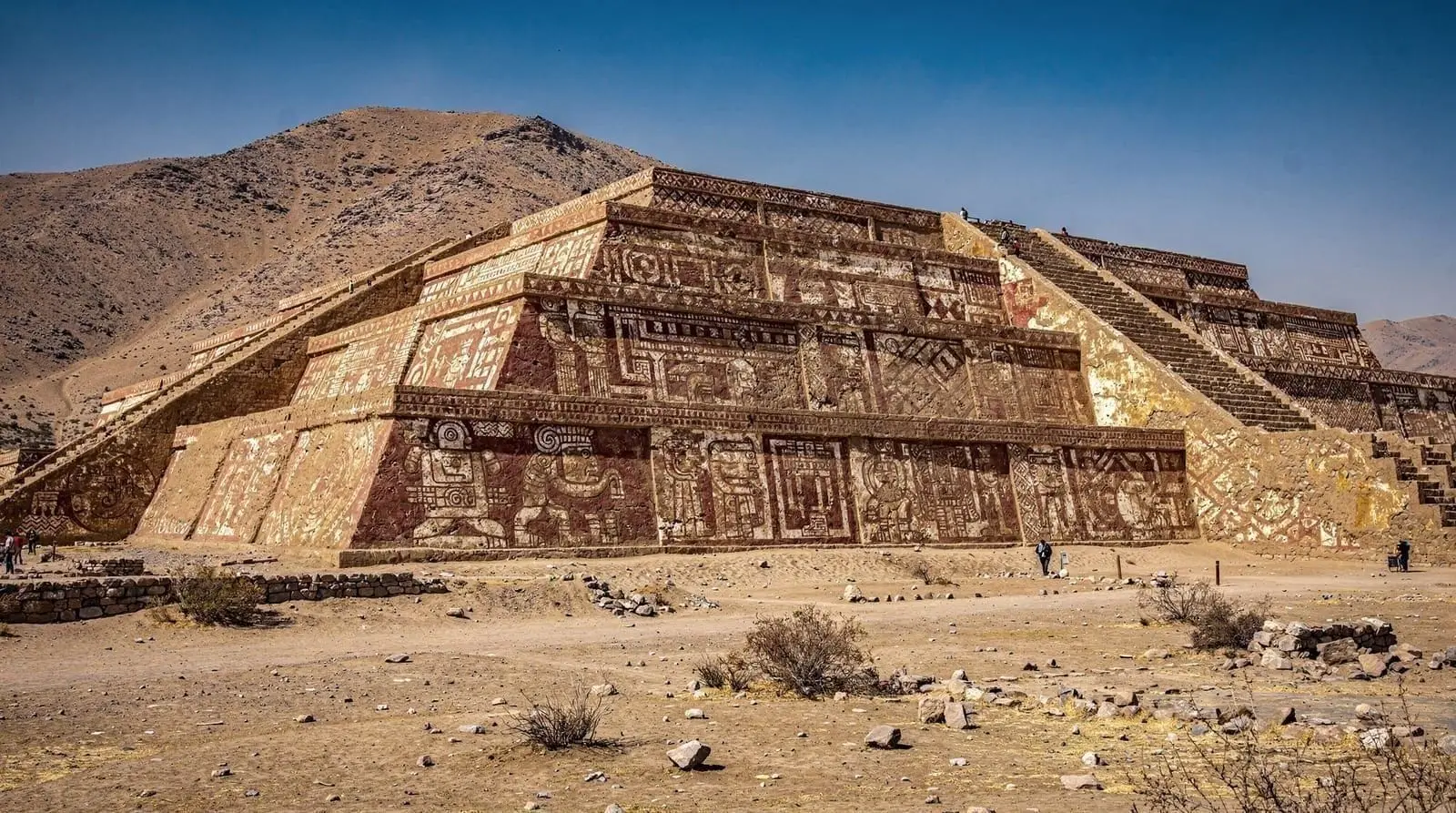
Huacas de Moche
Visit the Huaca del Sol and Huaca de la Luna near Trujillo — Moche pyramids with painted friezes, ticket prices, hours, and how to get there.
Trujillo: Huacas de Moche, Chan Chan & Huanchaco Beach
Quick facts
- Location
- 8 km south of Trujillo, at the foot of Cerro Blanco
- Civilisation
- Moche (c. 100–800 CE)
- Entrance
- S/15 (~USD 4), guided circuit included
- Time needed
- 2–2.5 hours including the site museum
Painted pyramids older than the Inca
Long before the Inca built Machu Picchu, the Moche people raised two enormous adobe pyramids in the desert south of present-day Trujillo. The Huaca del Sol and Huaca de la Luna — the Pyramids of the Sun and Moon — sit roughly 500 metres apart at the base of Cerro Blanco, the conical hill that dominates the valley. Between them once spread an urban centre that archaeologists believe housed 10,000 to 15,000 people at its height, somewhere around 600 CE.
| Where | 8 km south of Trujillo, at the foot of Cerro Blanco |
| Cost | Around S/15 / about $4, guided circuit included |
| Time needed | 2–2.5 hours including the site museum |
| Getting there | Taxi from central Trujillo, around S/20–30 one way |
| Best time | May to November for cooler, drier coastal weather; arrive before 2pm |
What makes the Huacas de Moche worth a detour is not the scale alone but the survival of colour. The desert that buried these temples for a thousand years also preserved their painted friezes in red, white, yellow, and black — geometric registers, processions of warriors and prisoners, and the recurring fanged face of Ai Apaec, the Moche supreme deity. Walking the excavated levels of the Huaca de la Luna, you see pigment that was applied by hand over a millennium ago and is still legible. Very few archaeological sites in the Americas offer that.
This page covers what you can actually visit, how much it costs, when to come, and how the two pyramids fit into a wider Trujillo itinerary alongside Chan Chan and the Lady of Cao.
Huaca de la Luna — the temple you actually tour
The Huaca de la Luna (Temple of the Moon) is the star of the site and the structure that delivers the visual payoff. It is not a single pyramid but a stack of temples: the Moche built a new ceremonial platform roughly every century, sealing the previous one inside with adobe bricks rather than demolishing it. Excavation since the early 1990s has peeled back these layers, exposing successive painted facades that would otherwise have stayed hidden forever.
The guided circuit takes you up through the platforms and along the great northern facade, where seven superimposed registers climb the wall — each one a different ceremonial scene, with Ai Apaec repeated dozens of times across the surface. The deity appears as a wide-eyed face with fanged jaws and snake-like appendages, framed by stylised waves and spider motifs. Lower registers show bound captives and the so-called “warrior priests” who feature throughout Moche iconography. Your guide will point out the ceremonial plaza where, according to the excavated evidence, prisoners were sacrificed during El Niño events to appease the gods who controlled the desert rains.
The visit ends near a sheer rock outcrop of Cerro Blanco that the Moche incorporated directly into the temple — a reminder that the hill itself was sacred, not just the pyramid built against it.
One detail your guide will likely dwell on is the burial evidence found inside the platforms. Excavators have uncovered the skeletons of dozens of young men in the ceremonial plaza, many showing cut marks consistent with ritual killing, alongside the bones of sacrificial llamas. The painted iconography on the walls — captives being led by ropes, blood being collected in goblets, the so-called “Sacrifice Ceremony” — turns out to describe events that physically took place a few metres away. It is rare for the art and the archaeology to corroborate each other this directly, and it is part of why the Huaca de la Luna is so important to Moche scholarship.
Who were the Moche?
It helps to arrive with a little context, because the Moche are far less famous than the Inca despite being, in artistic terms, arguably the more accomplished culture. They were not a single empire but a network of valley-based polities sharing a religion, an art style, and remarkable engineering skills, spread along the northern Peruvian coast from roughly 100 to 800 CE. They never developed writing, yet they recorded their world in extraordinary detail through ceramics — moulded portrait vessels of individual faces, scenes of hunting, healing, warfare, music, and ritual sacrifice, rendered with a realism unmatched anywhere else in the pre-Columbian Americas.
They were also master metallurgists and irrigation engineers, channelling rivers across the desert to farm maize, beans, and squash, and harvesting the Pacific with the same reed boats you can still see at Huanchaco. Their decline, around 600–800 CE, is usually linked to a sequence of catastrophic El Niño floods followed by prolonged drought — climate shocks that may explain the increasingly desperate sacrificial rituals recorded in the temple’s final layers. Understanding this arc makes the friezes legible: you are looking at a society negotiating with the forces that ultimately overwhelmed it.
Huaca del Sol — bigger but closed
The Huaca del Sol is the larger of the two, and at roughly 340 metres long and originally 40-plus metres tall it ranks among the biggest adobe structures ever built in the Americas. An estimated 130 million mud bricks went into it, many stamped with maker’s marks that suggest different communities supplied bricks as a form of labour tribute.
The bad news for visitors: the Huaca del Sol remains closed to the public. Spanish colonists diverted the Moche River in the 1600s to wash through the pyramid in search of grave goods, destroying perhaps two-thirds of the original structure and leaving the rest fragile and unexcavated. You will see it across the plain from the Huaca de la Luna and from the museum, but you cannot climb it. Do not let a tour operator imply otherwise — only the Luna and the urban zone between the two are open.
The Museo Huacas de Moche
The on-site museum, opened in 2010, sits across the access road and is genuinely good — one of the better-presented archaeological museums on the north coast. It displays ceramics, metalwork, and textiles recovered from the excavations, with reconstruction drawings that show what the painted walls looked like when they were freshly plastered and the ceremonies were live.
The Moche are famous among archaeologists for their pottery, particularly the startlingly realistic portrait vessels and the explicit erotic ceramics that scholars still argue about. A good selection is on display here, though the most spectacular pieces are held at the Larco Museum in Lima. Budget 30–40 minutes for the museum either before or after the pyramid; doing it first gives you the context to read the friezes properly.
The museum also explains the excavation itself, which is one of the great archaeological projects of modern Peru. Work led by Santiago Uceda and Ricardo Morales of the Universidad Nacional de Trujillo began in 1991 and continues to this day, deliberately slow and conservation-led.
Rather than stripping the pyramid down to a single dramatic level, the team has exposed the successive temple skins carefully enough to preserve the pigment, which is why what you see is genuinely original colour rather than reconstruction. The project also pioneered a community-tourism model that channels visitor income into the surrounding village of Campiña de Moche, where artisans reproduce Moche ceramics — a far healthier dynamic than the looting that destroyed so many other sites.
The ancient city between the pyramids
The flat ground between the two huacas is easy to overlook, but it was once a dense urban zone — workshops, courtyards, storerooms, and residential compounds laid out in a grid. Excavations here have shown that the Moche centre was a real city, not merely a pair of empty temples, with social stratification visible in the size and decoration of the houses.
Specialist craft production happened on site: pottery kilns, metalworking debris, and weaving tools have all been found. As you walk between the pyramids your guide can point out the excavated foundations and explain how the living city related to the ceremonial structures looming over it. It is a useful corrective to the temptation to see these sites as purely religious monuments rather than functioning communities.
Trujillo: Huacas de Moche, Chan Chan & Huanchaco BeachPractical information
Entrance and hours. A combined ticket covering the Huaca de la Luna and the museum costs S/15 (about USD 4) for foreign adults, with discounts for students and children. The site is open daily from roughly 09:00 to 16:00, with the last guided entry around 15:30. Hours shift slightly by season and during restoration, so aim to arrive before 14:00 to be safe.
Guides. A guide is included in the ticket and the circuit is only walkable with one — you cannot wander the pyramid unaccompanied. English-language guided slots run less frequently than Spanish ones; if your Spanish is limited, ask at the ticket desk when the next English group leaves, or join an organised tour that guarantees an English guide. Tours typically last 45–60 minutes.
What to bring. There is almost no shade on the pyramid and the coastal sun is strong even when the sky is grey. Bring a hat, sunscreen, and water. The walk involves ramps and uneven adobe surfaces; trainers are fine, sandals less so.
Photography. Photos are allowed throughout, and the friezes photograph well in the flat overcast light that often hangs over the coast in the morning. Tripods may need permission; ask at the desk. The colours read best when the sun is not directly overhead, which is another argument for an earlier visit.
A word on tourist traps. The site itself is honestly priced and run by the university, so there is little to scam here. The friction comes from transport and from informal “guides” who approach independent visitors near the car park offering services that are already included in your ticket — you do not need to hire a separate freelance guide for the Huaca de la Luna. The only legitimate guides are the ones assigned at the ticket office. Similarly, the artisan stalls in Campiña de Moche sell decent reproductions, but the same pieces are cheaper in central Trujillo’s markets; buy them as souvenirs of the visit, not as investments.
Getting to the Huacas de Moche from Trujillo
The pyramids are about 8 km southeast of central Trujillo, in the Moche district, and getting there independently is the one genuinely awkward part of the visit. Public transport does not run to the entrance itself.
- Taxi: The simplest option. A one-way taxi from the city centre costs S/20–30 (USD 5–8) and takes 15–20 minutes. Ask the driver to wait (negotiate around S/40–60 round-trip including waiting time) since finding a return taxi at the site can be slow.
- Combi plus walk: Combis marked “Campiña de Moche” leave from near the Ovalo Larco area for around S/2, but they drop you on the main road a kilometre or more from the entrance, leaving a dusty walk. Most independent travellers find this more hassle than it saves.
- Organised tour: By far the most common choice. Half- and full-day tours bundle the Huacas de Moche with Chan Chan and Huanchaco, sort out transport and the English guide, and remove the return-taxi problem entirely.
Because the three north-coast sites cluster within 20 km of Trujillo, a full-day combination tour is the efficient way to see them all in one go.
Trujillo: Sun & Moon, Chan Chan & Huanchaco with LunchHow the Huacas fit a north-coast itinerary
The Moche pyramids pair naturally with the Chimú capital at Chan Chan, 9 km on the other side of Trujillo. Together they bracket two distinct chapters of north-coast history: the Moche (roughly 100–800 CE) and the Chimú (roughly 900–1470 CE), separated by centuries and a very different artistic style. Seeing both in a single day is comfortable and makes the contrast vivid — Moche pyramids painted with deities versus Chimú palaces carved with sea creatures.
If you have a second day, add the El Brujo complex and the Lady of Cao north of the city, where a female Moche ruler was discovered in 2006. For the wider regional picture — including Chiclayo’s Lord of Sipán — see the Moche and Chimú civilisations guide and the northern Peru route guide. Trujillo travellers also use Huanchaco as their lunch and beach stop; the Huanchaco page covers the reed-boat fishermen and where to eat.
Trujillo: Chan Chan, Huaca de la Luna & HuanchacoFrequently asked questions about the Huacas de Moche
Can you visit both the Huaca del Sol and the Huaca de la Luna?
Only the Huaca de la Luna is open to visitors, along with the museum and the urban zone between the two pyramids. The Huaca del Sol is larger but remains closed and unexcavated after Spanish colonists deliberately flooded part of it in the 1600s. You will see the Sol from a distance but cannot enter or climb it.
How much does it cost and how long does it take?
Entry is S/15 (about USD 4) for foreign adults, including the guided circuit and the on-site museum. Allow 2 to 2.5 hours in total — roughly an hour for the guided pyramid tour and 30–40 minutes for the museum.
Are the Huacas de Moche the same as Chan Chan?
No. The Huacas de Moche are Moche pyramids (around 100–800 CE), built of adobe and decorated with painted friezes. Chan Chan, 9 km away on the other side of Trujillo, is the much later Chimú capital (around 900–1470 CE), a sprawling adobe city carved with sea creatures. They are different cultures, centuries apart, and most visitors see both in one day.
Do I need a guide?
Yes — you cannot tour the Huaca de la Luna without one, and a guide is included in the ticket price. English slots are less frequent than Spanish, so if you do not speak Spanish, either time your arrival to an English group or book an organised tour that guarantees an English-speaking guide.
How do I get to the Huacas de Moche from Trujillo?
The pyramids are 8 km southeast of the city. The easiest independent option is a taxi (S/20–30 one way, 15–20 minutes), ideally asking the driver to wait for the return. Public combis only reach the main road, leaving a long walk. Most visitors join a full-day tour that combines the Huacas with Chan Chan and Huanchaco.
When is the best time to visit?
May to November is the coolest and driest period on the north coast. Mornings between June and September can be grey with coastal garúa drizzle, usually burning off by midday. Arrive before 14:00 to be sure of catching a guided entry, as the last circuits leave in the mid-afternoon.
Top experiences
Bookable activities with verified prices and instant confirmation on GetYourGuide.
