Miraflores guide
Lima: Huaca Pucllana Site Museum Private Tour with Tickets
Is Miraflores the best place to stay in Lima?
For most first-time visitors, yes. Miraflores is the safe, walkable cliff district with the best concentration of restaurants, the coastal promenade, the Huaca Pucllana pyramid, and easy transport to the rest of Lima. Barranco is the more atmospheric alternative.
What Miraflores is and why you will probably stay here
Miraflores is the clifftop district where most visitors to Lima base themselves, and for good reason. It sits on the bluffs above the Pacific in the southern, coastal half of the city, roughly 12 kilometres from the colonial historic centre and 15 minutes from bohemian Barranco. It is clean, walkable, well-policed, and packed with restaurants, and it has the city’s signature sight — a 1,500-year-old adobe pyramid — sitting in the middle of its residential streets. If you are visiting Lima for the first time and want the path of least resistance, this is where you sleep.
This guide covers Miraflores honestly: the genuine highlights, where to stay by budget, how to walk the cliffs, where to eat, and the handful of things that consume time without rewarding it. For the district overview, see /destinations/miraflores/; for the wider city, /guides/lima-complete-guide/.
| Where | Clifftop district, southern coastal Lima |
| Cost | Hostels S/120-200, mid-range S/250-450 |
| Time needed | Half to full day sightseeing, 2-3 nights as a base |
| Getting there | 45-60 min / S/60-90 taxi from the airport |
| Best time | Nov-Apr for clear skies and paragliding |
Where to stay
Miraflores covers most budgets within a compact, walkable area:
- Budget: Hostels around Calle Berlín and the streets near Parque Kennedy run S/120–200 / about $32–53 for a private room. Pariwana and Kokopelli are the established backpacker names.
- Mid-range: Boutique and chain hotels near the Malecón and Parque Kennedy run S/250–450 / about $67–120. Staying within a few blocks of Parque Kennedy keeps everything walkable.
- Upscale: Cliffside properties near Larcomar and the Belmond Miraflores Park run S/700+ / $185+, with ocean views that justify the premium only in the clear-sky season.
The sweet spot for most travellers is a mid-range hotel within a 10-minute walk of Parque Kennedy and the Malecón — close to restaurants, the cliff walk, and taxi pickups.
Huaca Pucllana: the pyramid in the city
The single most distinctive thing in Miraflores is Huaca Pucllana (General Borgoño block 8), a fully excavated adobe-and-clay pyramid built by the Lima Culture around 400 CE and later used by the Wari. It rises in tiers right among the apartment blocks — one of the most surreal urban-archaeology sights anywhere. Entry is S/15 / about $4, and guided visits leave every 30–40 minutes (you cannot enter without a guide). The evening torchlit tours from 7 pm are the standout, and the on-site restaurant overlooking the floodlit ruins is a genuinely good, if pricey, dinner setting.
For depth, the private Huaca Pucllana tour with tickets pairs you with a trained guide who explains the construction technique, the occupation layers, and the sacrificial finds far beyond the standard rotation — worthwhile if archaeology interests you. The site is detailed at /destinations/huaca-pucllana/.
The Malecón cliff walk
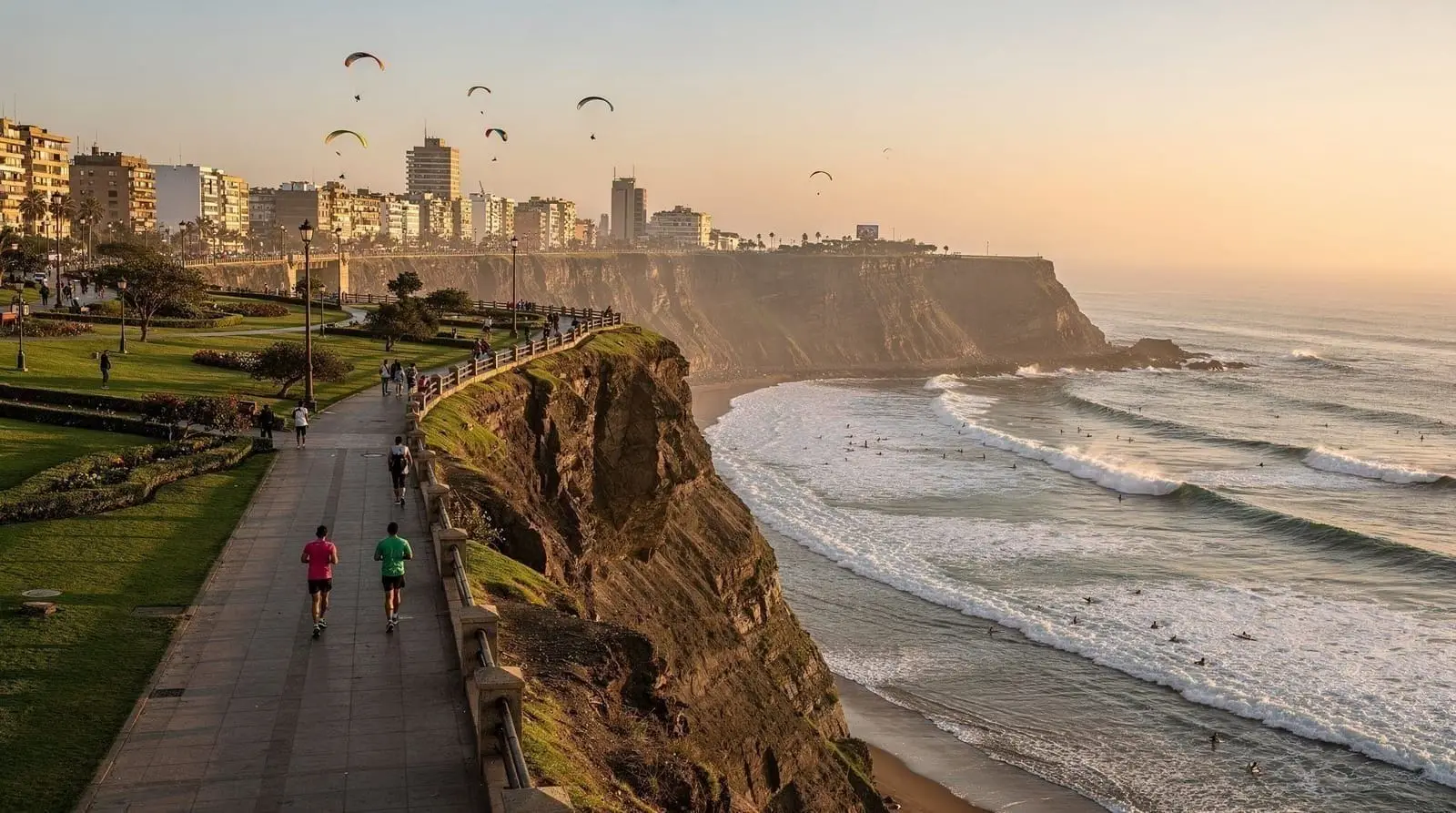
Miraflores’s free showpiece is the Malecón — a chain of clifftop parks running about six kilometres along the bluffs above the Pacific. Walk the central stretch through Parque del Amor, with its Gaudí-inspired mosaic wall and the giant kissing-couple sculpture, and on to Parque María Reiche and Parque Salazar beside Larcomar. On clear days (November–April) the views stretch along the coast and paragliders launch directly off the cliff edge; during the garúa season the same walk is atmospheric but grey. The promenade connects all the way to Barranco — a 40–50 minute coastal walk if you want to combine the two districts on foot.
Paragliding over the Costa Verde
The cliffs above the Costa Verde are one of the few urban paragliding spots in the world, and on a clear day a tandem flight is Miraflores’s standout splurge. You launch from the clifftop park near Larcomar and soar over the coastline and the apartment towers for roughly 10–15 minutes at S/280–350 / about $75–95. The tandem paragliding flight in Miraflores uses licensed pilots and provides the gear; book it for a confirmed clear day, because during the garúa flights are flat and frequently cancelled.
Larcomar and Parque Kennedy
Larcomar (Malecón de la Reserva 610) is a shopping mall built into the cliff face below the Malecón — more interesting for its architecture and the terrace view than its shops. The food court is forgettable; go for the vista, not the meal.
Parque Kennedy, at the heart of Miraflores between Avenida Larco and Diagonal, is the district’s social hub. Its most famous residents are the dozens of stray cats that have lived there for decades, fed and cared for by the municipality. Evenings bring street painters, food carts, and locals on walks. It is also the most pickpocket-prone spot in an otherwise safe district, so keep your phone away.
Eating in Miraflores
Miraflores has the densest concentration of good restaurants in Lima. The headline acts:
- Ceviche at lunch: La Mar (Av. La Mar 770) is the famous benchmark; Punto Azul (Calle San Martín 595) is the reliable walk-in. See /guides/best-ceviche-in-lima/.
- Nikkei: Maido (Calle San Martín 399), the world-ranked Peruvian-Japanese flagship — book weeks ahead.
- Sandwiches and casual: La Lucha Sanguchería near Parque Kennedy for chicharrón and butifarra at S/18–22.
Beyond the headliners, Miraflores is full of solid everyday options: the cafés around Parque Kennedy for coffee and a quick lunch, the menús del día tucked on side streets for S/15–20, and the artisan ice-cream and juice spots along Avenida Larco. The district also has the largest concentration of vegetarian and international options in Lima, useful on a longer stay.
To orient your palate on a first day, the broader /guides/lima-food-scene-guide/ maps out the markets, chifa, and tasting menus. A guided way to see Miraflores alongside the other coastal districts is the small-group tour of Miraflores, Barranco and San Isidro, which connects the three southern districts and explains how they differ.
The garúa in Miraflores
Because Miraflores sits right on the cliff, it is the part of Lima where the garúa fog matters most to your experience. From May to October the persistent grey-white sky settles over the coast, the ocean horizon vanishes, and the cliffside views that are Miraflores’s main draw turn flat. The paragliders ground themselves, and that cinematic sunset over the Pacific simply does not appear.
Inside the district, though, the fog changes little — the restaurants, Huaca Pucllana, Parque Kennedy, and the markets are all just as good, and hotel rates drop noticeably. The practical takeaway: if the coastal views and outdoor activities are central to your plan, schedule your Lima leg for the clear months of November to April; if you are here primarily to eat and explore, winter Miraflores is perfectly fine and cheaper. Either way, pack a light layer, since the cliff breeze keeps Miraflores cooler than the inland districts year-round.
A note on families and older travellers
Miraflores works particularly well for families and travellers who want fewer surprises. The Malecón’s flat, paved paths suit strollers and anyone unsteady on their feet far better than the cobbled, hilly streets of Barranco or the historic centre, and Parque Kennedy’s cats are a reliable hit with children who need a break from sightseeing.
Restaurants here are used to foreign visitors and generally accommodate dietary requests without fuss, and the concentration of pharmacies and clinics nearby is reassuring if a minor health issue comes up early in a trip. None of this makes Miraflores boring — it simply front-loads the parts of Lima that are easiest to enjoy without local knowledge, which is exactly why it remains the default first stop for so many visitors.
San Isidro: the quieter neighbour
Just inland and north of Miraflores sits San Isidro, the leafy financial district that some travellers consider as a base. It is calmer, greener (the El Olivar olive grove, a colonial-era park, is its centrepiece), and home to good hotels and upmarket restaurants like Osaka. The trade-off is that it has far less street life and is a little further from the coast and the main sights. It suits business travellers and those who prize quiet over buzz, but for a first leisure visit, Miraflores or Barranco give you more to walk to. The small-group tour linked above covers San Isidro alongside the two coastal districts so you can see the contrast without basing there.
Getting around and beyond
Within Miraflores, walk. To reach the rest of Lima, use app taxis (Cabify, InDriver, Uber): the historic centre is S/25–35, Barranco S/15–20, the airport S/60–90. The Metropolitano express bus runs along the eastern edge of the district toward the centre for S/3.50 / under $1. For airport specifics, see /guides/lima-airport-to-city-guide/.
Miraflores is also a launchpad. Pachacámac is 31 km south, and the southern desert — Paracas, the Ballestas Islands, and Huacachina — branches off Lima as an overland loop. See /guides/lima-day-trips/.
A half-day Miraflores walking route
If you want to see the district on foot, here is a logical loop of about three to four hours. Start at Parque Kennedy for the cats and a coffee. Walk southwest down Avenida Larco toward the sea, detouring two blocks to Huaca Pucllana (book the next guided slot) before continuing to the cliff. Join the Malecón at Parque Salazar beside Larcomar, then walk northwest along the clifftop through Parque del Amor and Parque María Reiche, pausing for the views and, on clear days, the paragliders. Loop back inland to Avenida La Mar for a ceviche lunch. The whole route is flat, well-paved, and safe, and it strings together the district’s essentials without a single taxi.
Practicalities in Miraflores
Money: ATMs from BCP, Scotiabank, and Interbank cluster around Parque Kennedy and Avenida Larco; use these over the airport machines. Pay in soles, not your home currency.
Supermarkets and pharmacies: Wong and Vivanda supermarkets and InkaFarma and Mifarma pharmacies are scattered through the district for water, snacks, and basics.
Safety specifics: Parque Kennedy and the busy avenues are the spots to watch for pickpockets; keep your phone away on the street. The district is well-policed and fine to walk in the evening, but take an app taxi for late-night trips outside it.
Connectivity: Cafés around Parque Kennedy have reliable Wi-Fi, and a local SIM bought at any pharmacy keeps you online for S/20–30 a month.
Day trips and onward travel from Miraflores
Miraflores is the natural launchpad for everything south of Lima. Pachacámac, the vast pre-Columbian coastal city, is 31 km away and an easy half-day. The southern desert loop — Paracas with its pelican-filled bay, the wildlife-rich Ballestas Islands, and the sandboarding oasis of Huacachina — branches off as a full day or, better, an overnight from the city, with the Nazca lines reachable if you extend further.
Comfortable long-distance buses (Cruz del Sur) and tour vans depart from terminals a short taxi ride from Miraflores. For travellers continuing to the Andes, Lima’s airport is the hub for flights to Cusco, Arequipa, and beyond — see /guides/lima-day-trips/ and /guides/peru-2-week-itinerary-guide/ for how Miraflores fits the wider route.
What to skip in Miraflores
A few honest cuts. The Larcomar food court is overpriced — eat in the district instead. The souvenir shops along Avenida Petit Thouars sell mass-produced alpaca goods at marked-up prices; save craft shopping for Barranco’s galleries or the Sacred Valley. And while the “Indian Market” (Mercado Indio) on Petit Thouars is fine for last-minute gifts, it is not the artisan experience some guides imply. Costs trip-wide are in /guides/peru-trip-cost-guide-2026/.
How many days is enough, and what comes next
For a first visit, two full days based in Miraflores covers the district itself plus a day trip to the historic centre or Barranco without feeling rushed — the Lima in 2 days guide lays out a realistic version of that schedule. Travellers on a tighter timeline sometimes ask whether Lima is even worth the time against jumping straight to Cusco; the honest answer is in is Lima worth visiting.
Most itineraries treat Miraflores as the first and last stop of a Peru trip, bookending the Andes and jungle legs, since Lima to Cusco flights are frequent and short. If the southern desert loop appeals, the Lima to Paracas and Nazca itinerary builds directly on the day-trip options above, and the things to do in Lima guide rounds out options beyond Miraflores itself for a longer stay.
Frequently asked questions about Miraflores
Is Miraflores safe?
How far is Miraflores from the airport?
What is there to do in Miraflores?
How many days do I need in Miraflores?
Is Miraflores expensive?
Miraflores or Barranco: which should I choose?
Can I walk from Miraflores to Barranco?
Top experiences
Bookable activities with verified prices and instant confirmation on GetYourGuide.


