Things to do in Lima
Lima: Historical, Colonial, and Modern City Tour
What are the best things to do in Lima?
The strongest picks are the Larco Museum, the Huaca Pucllana pyramid, the colonial historic centre, the Miraflores cliff walk, a ceviche lunch, and an afternoon in Barranco. Paragliding over the Costa Verde is the standout splurge on a clear day.
How to think about a Lima activity list
Lima rewards a small number of well-chosen things done properly more than a long checklist sprinted through. The city is large and traffic-heavy, so each cross-town move costs real time. The smart approach is to cluster activities geographically: one day on the coast (Miraflores, Barranco, the cliffs), one day inland (historic centre, Larco, Pueblo Libre), with a ceviche lunch anchoring whichever day suits.
This list ranks by genuine payoff, not popularity, and is honest about what underdelivers. For where these fit in a tighter schedule, see /guides/lima-in-2-days/; for the broader plan, /guides/lima-complete-guide/.
| Top picks | Larco Museum, Huaca Pucllana, cliff walk, ceviche lunch, Barranco |
| Splurge | Paragliding, S/280-350 (Nov-Apr for clear skies) |
| Free | Malecón walk, Parque del Amor, Barranco street art |
| Full-day budget | Roughly S/180-280 per person, mid-range |
| Getting around | App taxis (Uber/InDriver); traffic is heavy, cluster by area |
The archaeology: Larco Museum and Huaca Pucllana
Museo Larco (Av. Bolívar 1515, Pueblo Libre, about 20 minutes west of Miraflores by taxi at S/20 / about $5) is the most rewarding single visit in Lima. It holds one of the world’s finest pre-Columbian collections, displayed in a colonial mansion wrapped in bougainvillea. The famous “erotic ceramics” room gets the attention, but the real revelation is the open storerooms, where tens of thousands of Moche pots sit on visible shelving — an honest display of the collection’s depth that no curated case could match. Entry S/35 / about $9; allow two to three hours. Full detail in /guides/larco-museum-guide/.
Huaca Pucllana (General Borgoño block 8, Miraflores) is an excavated adobe pyramid from around 400 CE, sitting incongruously among apartment blocks. Entry is S/15 / about $4 and guided visits leave every 30–40 minutes. The evening torchlit tours from 7 pm are the most atmospheric option in the city. For expert commentary, the private Huaca Pucllana tour with tickets brings a trained guide who walks you through the Lima and Wari occupation layers in far more depth than the standard rotation.
The colonial centre
The UNESCO-listed historic centre, about 12 kilometres northeast of Miraflores, is a half-day. Anchor it on the Plaza Mayor and the Convento de San Francisco, whose catacombs hold the arranged bones of roughly 25,000 people (entry S/20 / about $5) — sobering rather than ghoulish. The surrounding streets, the cathedral, and the yellow Palacio de Gobierno are all within walking distance.
The centre is the one part of Lima where a guide earns their fee, because the murals, religious art, and colonial history need context. The historical, colonial and modern city tour connects the centre with the contrasting modern coast in one outing, which is the most efficient way to cover both halves of the city on a first day. Ignore the street touts offering “free” tours; they steer you toward commission shops and expect heavy tips.
The coast: cliff walk, parks, and Larcomar
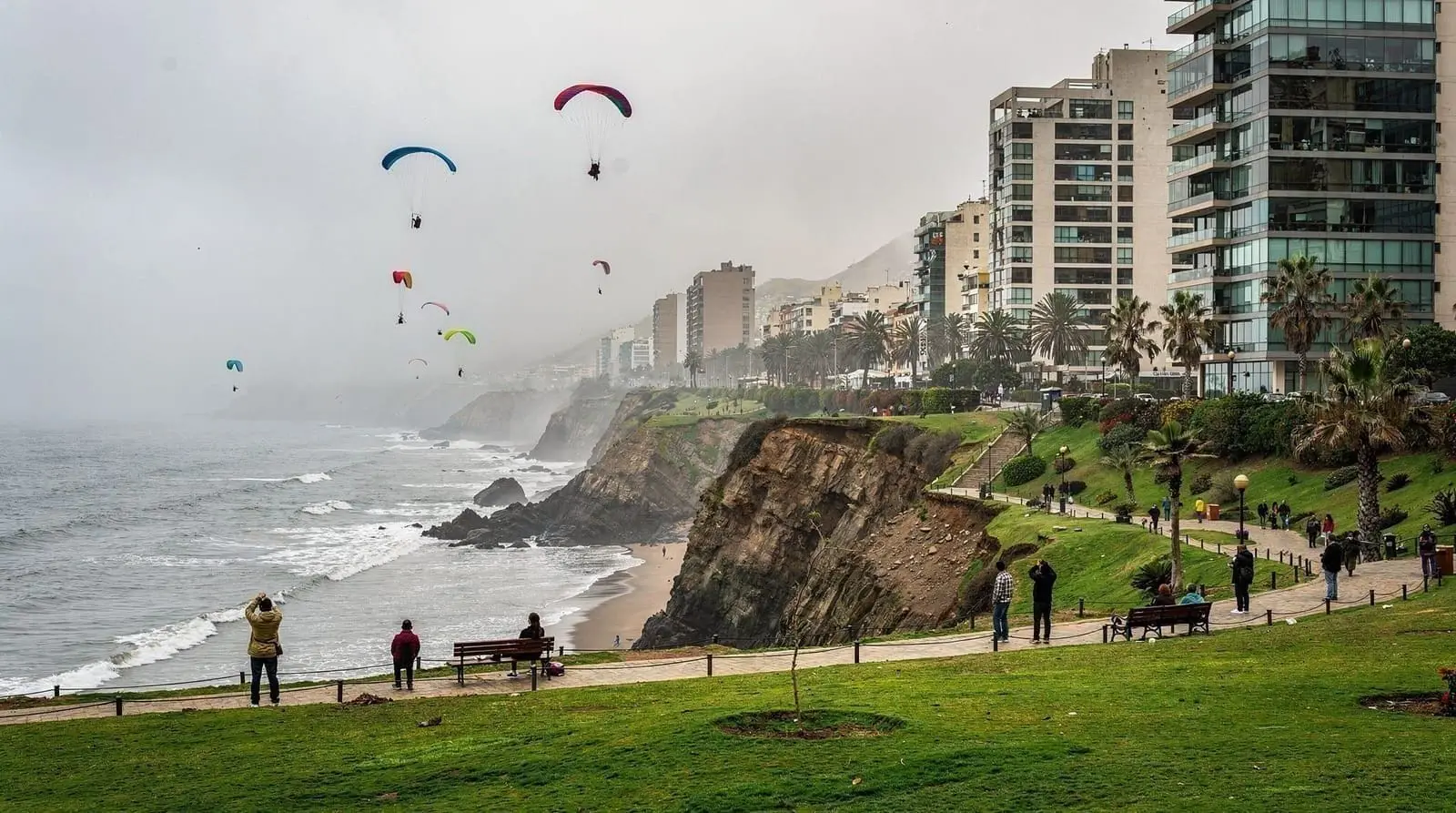
The Malecón clifftop promenade runs roughly six kilometres above the Pacific through Miraflores and on toward Barranco — Lima’s best free activity. Walk the central stretch past Parque del Amor, with its Gaudí-inspired mosaic wall and the giant kissing-couple sculpture, and Parque María Reiche. On clear days you can watch paragliders launch directly off the cliff edge and see container ships anchored offshore.
Larcomar (Malecón de la Reserva 610) is a mall built into the cliff face. Skip the food court but use the terrace for the view. Parque Kennedy, in the heart of Miraflores, is the city’s social living room — full of the famous resident stray cats fed by the municipality, plus street artists and food carts most evenings.
Paragliding over the Costa Verde
On a clear day, tandem paragliding off the Miraflores cliffs is Lima’s standout splurge — you launch from the clifftop park and soar over the coastline and the apartment towers with the Pacific below. Flights last roughly 10–15 minutes and run S/280–350 / about $75–95. The tandem paragliding flight in Miraflores uses licensed pilots and provides the harness and helmet; book it for a confirmed clear day from November to April, because during the garúa season flights are flat or cancelled outright.
Barranco and the bohemian south
Barranco, 15 minutes south by taxi, is the city’s artistic district: painted republican mansions, the Puente de los Suspiros (Bridge of Sighs), galleries, and dense street art. Spend an afternoon walking from the bridge along Calle Domeyer to the Plaza de Barranco, then stay for the bars — this is Lima’s nightlife centre. A relaxed way to cover both coastal districts is the bike tour through Miraflores, the Malecón and Barranco street art, which strings the murals, cliffs, and plazas together at a pace that suits the flat coastal terrain. Full detail in /guides/barranco-guide/.
The food experiences
Eating is itself a top activity in Lima. The headline acts:
- A ceviche lunch at a serious cevichería — order it at midday, budget S/35–60. See /guides/best-ceviche-in-lima/.
- A food tour to orient your palate, covering markets, huariques, and juice bars.
- A Nikkei dinner to understand the Japanese-Peruvian fusion that defines modern Lima cooking.
The full breakdown, including the world-ranked restaurants and how to book them, lives in /guides/lima-food-scene-guide/.
Day trips from Lima
If you have a spare day, the strongest escapes are Pachacámac (31 km south, a vast pre-Columbian coastal city, half a day) and the southern desert loop toward Paracas, the Ballestas Islands, and Huacachina. The full menu of options is in /guides/lima-day-trips/, and the southern desert specifically in /guides/paracas-complete-guide/.
Museums beyond Larco
If the Larco Museum whets your appetite, Lima has more. The Museo Nacional de Arqueología, Antropología e Historia in Pueblo Libre, next door to the Larco, covers Peru’s full archaeological sweep from the earliest cultures through the Inca and colonial periods (entry around S/15 / about $4) — drier in presentation than the Larco but broader in scope.
In Barranco, MATE — Museo Mario Testino (around S/30 / about $8) shows the fashion photographer’s work in a restored mansion, and the Museo Pedro de Osma holds an excellent colonial-art collection. The Museo de Arte de Lima (MALI), near the historic centre in the Parque de la Exposición, is the city’s main fine-art museum and worth an hour for those interested in Peruvian painting. None of these is essential on a short trip, but they fill a foggy afternoon well.
Cooking classes and markets
A cooking class is among the most rewarding things to do in Lima, because you take the skill home. Classes typically start with a market visit to choose ingredients, then teach staples like ceviche, lomo saltado, and the pisco sour in a hands-on session, running S/150–300 / about $40–80 for two to three hours. Even without a class, a self-guided wander through Mercado de Surquillo — 10 minutes from Miraflores — is a free education in Peru’s biodiversity, with dozens of potato varieties, Amazonian fruits, and fresh ají pastes on display, plus cooked lunches for S/12–18. The food angle is covered fully in /guides/lima-food-scene-guide/.
What to skip
Three honest cuts. The Larcomar food court is overpriced and unremarkable — eat elsewhere. The Magic Water Circuit fountain show (S/8 / about $2) is cheerful but minor; worth it only with children or a genuinely free evening. And the bone-dry “miracle” souvenir markets along the tourist strips sell the same mass-produced alpaca goods at inflated prices — buy artisan work in Barranco’s galleries or wait for Cusco and the Sacred Valley.
A further caution: the so-called “free walking tours” advertised by touts in the historic centre are not really free — guides work for tips and often steer groups into commission-paying shops and restaurants, so a properly booked tour or a self-guided walk usually serves you better. Costs across the trip are in /guides/peru-trip-cost-guide-2026/.
Walking the coast: the Malecón in detail
The clifftop Malecón deserves more than a passing mention, because it is the single best free thing to do in Lima and the spine that connects Miraflores to Barranco. Running roughly six kilometres along the bluffs, it is a chain of landscaped parks linked by a continuous paved path, popular with joggers, dog-walkers, and cyclists. The most rewarding stretch starts at Parque Salazar beside Larcomar and runs northwest.
You pass Parque del Amor, where a giant sculpture of an embracing couple sits on a Gaudí-inspired mosaic wall inscribed with Peruvian love poetry; Parque María Reiche, named for the German mathematician who devoted her life to the Nazca lines; and a string of smaller gardens with benches angled at the Pacific. On clear days the paragliders launching off the cliff edge are a constant presence overhead, and the sunset over the ocean is genuinely good. The path continues, with a couple of road crossings, all the way to Barranco — a 40–50 minute walk that is one of the nicest ways to move between the two districts. Bring a layer; the sea breeze keeps the cliffs cooler than the streets behind them.
Half-day and full-day excursions
If you have built in extra time, Lima opens onto some worthwhile escapes. Pachacámac (31 km south, half a day) is the closest and most rewarding — a vast pre-Columbian coastal city with temples spanning a thousand years. Callao, the historic port, has been partly reinvented around the Callao Monumental street-art district, where murals cover a once-rough neighbourhood now dotted with galleries and cafés.
Further afield, the southern desert toward Paracas and the Ballestas Islands — sometimes called Peru’s “poor man’s Galápagos” for their sea lions and seabirds — and the sandboarding oasis of Huacachina make a full-day push or, better, an overnight loop. These are detailed in /guides/lima-day-trips/ and the destination pages.
A sample two-day plan
Day 1 (coast): Morning at Huaca Pucllana, ceviche lunch in Miraflores, afternoon cliff walk and Parque del Amor, evening in Barranco for dinner and bars.
Day 2 (inland): Morning at the Larco Museum, lunch at its garden café, afternoon in the historic centre with the catacombs, evening back on the coast — paragliding if skies are clear, or the Magic Water Circuit if travelling with kids.
Browse ready-made routes at /itineraries/ and plan logistics with /tools/.
Things to do by interest
To make the list easier to use, grouped by what you care about:
- History and archaeology: Larco Museum, Huaca Pucllana, the historic centre and catacombs, Pachacámac, the National Archaeology Museum.
- Food: a ceviche lunch, a food tour, a Nikkei dinner, a cooking class, the Surquillo market.
- Outdoors and views: the Malecón cliff walk, Parque del Amor, paragliding, the bike tour, and the coastal walk to Barranco.
- Art and culture: Barranco’s murals and galleries, MATE, the Pedro de Osma museum, MALI.
- Family-friendly: the Magic Water Circuit, Parque Kennedy’s cats, the catacombs, the cliff parks, watching the paragliders.
- Nightlife: Barranco’s bars, peñas with live Afro-Peruvian music, and a night food tour.
Pick one or two from a couple of categories per day rather than trying to tick every box. The strongest single-day combination for first-timers is archaeology plus food plus a coastal sunset — it captures what makes Lima distinctive without exhausting you in traffic.
Getting between the districts
Lima’s traffic is the main planning constraint behind this whole list, which is why clustering by geography matters more than in most cities. Miraflores and Barranco sit close enough to walk or take a short taxi between; the historic centre and Pueblo Libre (Larco Museum) are a genuinely separate cross-town trip, typically 20-40 minutes each way depending on traffic. App taxis — Uber, InDriver or Cabify — are the standard way to move around and are far more reliable than hailing a street taxi. Budget extra time at rush hour (roughly 7-9am and 5-8pm), and avoid scheduling a tight cross-town connection during those windows if you can help it.
Where to stay for easy access to this list
Most of what’s on this list clusters around Miraflores and Barranco, so basing yourself in one of the two puts almost everything within a short taxi ride. Miraflores is the more polished, central choice, with easy access to Huaca Pucllana, the Malecón and paragliding on your doorstep. Barranco suits travellers prioritising nightlife, art and a slightly more local feel, at the cost of a short taxi to reach the historic centre and Larco. Staying in the historic centre itself saves the cross-town trip for that half-day but puts you further from the coast and the best restaurants — a trade-off worth weighing against your priorities from this list.
Weather and what it changes
Lima’s climate is unusual for a coastal capital: rain is rare year-round, but a persistent grey coastal fog called garúa blankets the city roughly May to November, keeping temperatures mild but skies flat and views hazy. From December to April the sky clears, temperatures climb, and the coastline looks its best for photos, paragliding and the Malecón walk. Neither season should stop you visiting — the museums, food and historic centre are indoors or unaffected either way — but if paragliding or a scenic cliff walk matters to your trip, favour the December-April window and check the forecast a day or two ahead during garúa months.
Frequently asked questions about Things to do in Lima
What is the single best thing to do in Lima?
What can you do in Lima for free?
Is paragliding in Lima safe and worth it?
What is there to do in Lima at night?
What should I skip in Lima?
Can I do Lima's main sights without a tour?
How much do Lima activities cost?
How many days should I spend in Lima?
Is Lima worth visiting or just a stopover before Cusco?
Top experiences
Bookable activities with verified prices and instant confirmation on GetYourGuide.


