Barranco guide
Lima: Barranco Art and Culture Tour
Is Barranco worth visiting in Lima?
Yes. Barranco is Lima's bohemian district — painted republican mansions, the Bridge of Sighs, street murals, art galleries, and the city's best bars. Spend at least an afternoon and evening; stay here if you want atmosphere over the convenience of Miraflores.
What Barranco is
Barranco is the bohemian heart of Lima — a small, walkable district perched on the cliffs just south of Miraflores, full of brightly painted 19th-century republican mansions, art galleries, street murals, and the densest concentration of good bars in the city. It was a seaside resort for Lima’s elite in the late 1800s, and that faded-grandeur character survives in its ornate houses and its leafy ravines running down to the sea. Today it is where artists, musicians, and night owls gravitate, and where the world-ranked restaurant Central sits.
If Miraflores is where you sleep efficiently, Barranco is where Lima has the most character per block. This guide covers it honestly: the genuine highlights, where to stay and eat, the best of the nightlife, and the handful of overhyped spots. For the district overview see /destinations/barranco/; for the city, /guides/lima-complete-guide/.
| Where | Cliffside district just south of Miraflores, Lima |
| Time needed | Half a day minimum; a full day for museums + nightlife |
| Cost | Free to walk; museums around S/30 each; drinks S/20–40 |
| Getting there | 15-min taxi (S/15–20) or 40–50 min walk from Miraflores |
| Best time | Late afternoon into evening, dry season (Nov–Apr) for clear skies |
The Bridge of Sighs and the heart of Barranco
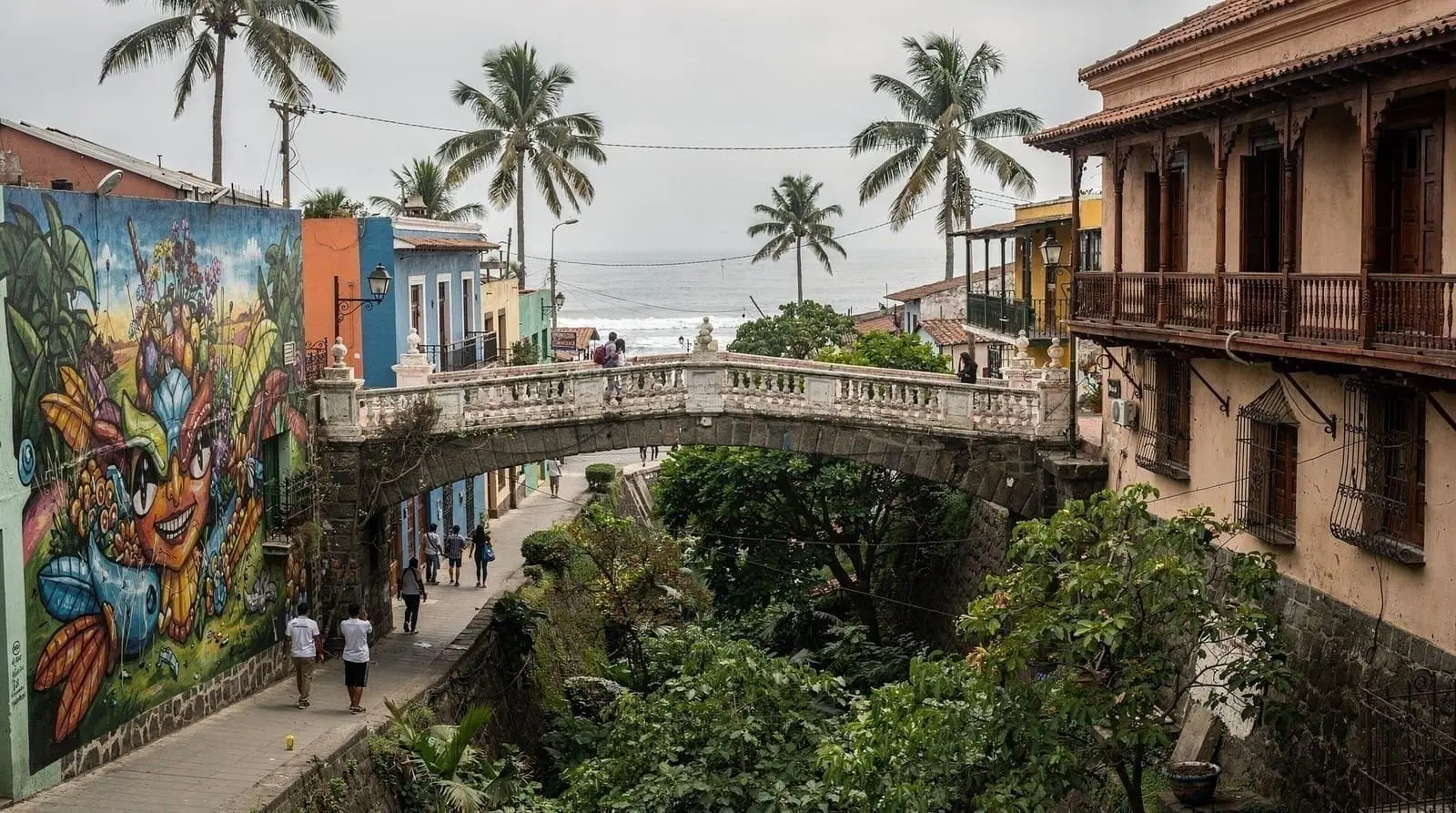
The symbolic centre is the Puente de los Suspiros (Bridge of Sighs), a small wooden footbridge from 1876 spanning a leafy ravine, wrapped in the romantic legend that holding your breath as you first cross it grants a wish. It is Lima’s most photographed spot and inevitably busy, but the surrounding area rewards lingering: the Bajada de Baños, the cobbled path running from the bridge down through the ravine toward the old fishing cove and the sea, is lined with bars, viewpoints, and street musicians. Just inland sits the Plaza de Barranco with its red municipal building and the Iglesia La Ermita, a roofless ruined church on the cliff edge.
Street art and galleries
Barranco is Lima’s open-air gallery. Murals cover walls throughout the district, from large commissioned pieces to small stencils, and the concentration around the Bajada de Baños and Calle Domeyer is the best. The district also holds Lima’s most interesting museums: MATE — Museo Mario Testino (Av. Pedro de Osma 409, entry around S/30 / about $8), the photographer’s foundation, and the Museo Pedro de Osma (Av. Pedro de Osma 423, around S/30), a colonial-art collection in a beautiful mansion.
To see the murals and galleries with context, the Barranco art and culture tour walks you through the street-art scene, the historic houses, and the galleries that are currently open — useful because gallery hours in Barranco are erratic and a guide knows which doors will actually be unlocked. For a wider sweep that includes the cliffs and Miraflores, the bike tour through Miraflores, the Malecón and Barranco street art covers both districts at a relaxed pace suited to the flat coastal terrain.
Where to stay
Barranco’s accommodation skews boutique and characterful rather than corporate:
- Budget: Kaminu and other hostels near the plaza run S/100–180 / about $27–48 for a private room, with sociable common areas.
- Mid-range to boutique: Restored mansions and design hotels run S/300–550 / about $80–145 — this is where Barranco shines, with properties full of period detail and art.
- Upscale: A handful of high-end boutique stays push past S/600 / $160.
The trade-off versus Miraflores: more atmosphere and better nightlife, but fewer early-breakfast options, a slightly longer haul to the historic centre, and quieter mornings. Decide based on whether you value character or convenience — compared in the Miraflores guide.
Eating in Barranco
Barranco punches well above its size on food. At the top sits Central (Av. Pedro de Osma 301), Virgilio Martínez and Pía León’s restaurant ranked among the world’s best, with Kjolle beside it — both require booking weeks ahead, detailed in /guides/lima-food-scene-guide/. At the everyday end, Canta Rana (Calle Génova 101) is the beloved football-memorabilia cevichería serving generous ceviche and seafood at S/40–60 — order it at lunch, as always (see /guides/best-ceviche-in-lima/). For casual bites, La 73 and the cafés around the plaza do solid Peruvian comfort food, and Burrito Bar and the artisan-ice-cream spots near the bridge are reliable quick stops.
For an evening that combines eating with the district’s atmosphere, the gourmet food tour by night through Miraflores and Barranco threads together the ceviche bars, cocktail spots, and artisan stalls across both districts — a good way to find the small places that are hard to spot alone.
Nightlife
Barranco is the nightlife capital of Lima, and the scene runs from polished to gritty within a few blocks. Ayahuasca (Av. San Martín 130), a sprawling bar in a restored republican mansion, is the landmark cocktail spot. Victoria Bar and Barranco Beer Company cover the craft-beer end. For live music, the district’s peñas stage Afro-Peruvian and creole performances — a tradition rooted in Barranco’s history — and small venues around the plaza host live bands most weekends. Drinks run S/20–40 / about $5–11; the scene gets going late, after 10 pm, and the central streets stay busy and safe well into the night. Take an app taxi home rather than walking far late.
A half-day Barranco walking route
A logical loop of about three hours, best started in the late afternoon so it rolls into the evening. Begin at the Plaza de Barranco with its red municipal palace and the ruined Iglesia La Ermita on the cliff edge. Walk to the Puente de los Suspiros, cross it (hold your breath), and follow the Bajada de Baños down through the ravine toward the old fishing cove and the sea, taking in the murals and viewpoints along the way.
Climb back up and wander Calle Domeyer and the surrounding streets for the densest street art, ducking into any galleries that are open. Finish at the MATE or Pedro de Osma museum if time allows, then settle in for dinner and drinks around the plaza as the bars come to life. The district is small enough that none of this involves a taxi.
History and character
Barranco’s faded-resort feel is not an accident. In the late 19th century it was the seaside retreat of Lima’s wealthy, who built the ornate republican mansions that still line its streets and rode a funicular down the Bajada de Baños to bathe in the sea. The 1879–1883 War of the Pacific damaged the district, and 20th-century growth eventually swallowed it into greater Lima, but its bones — the wide-eaved houses, the leafy ravines, the cliff-edge church — survived.
That layered history is why Barranco feels different from the planned modernity of Miraflores: it is an old resort town that became an artists’ quarter, and both phases are still visible. It is also a centre of Afro-Peruvian culture, which is why the peñas here stage some of Lima’s best live creole and Afro-Peruvian music.
Getting there and around
From Miraflores, Barranco is a 15-minute taxi (S/15–20 / about $4–5) or a 40–50 minute walk along the Malecón cliff promenade — the walk is lovely in the clear-sky months from November to April. Within Barranco, everything is walkable; the district is small and flat on top, with the ravine and the Bajada de Baños being the only real slopes. App taxis (Cabify, InDriver, Uber) are the way to get home late. For the wider transport picture, see /guides/lima-complete-guide/.
The cliffs and the sea below
Barranco shares the same clifftop position as Miraflores, and its coastal edge is quieter and more atmospheric. The Bajada de Baños path runs from the Bridge of Sighs down through the ravine toward the old fishing cove at the bottom, where a small bridge crosses to the seafront and the Costa Verde road. On clear days the descent gives you ocean views without the crowds of the Miraflores Malecón, and the cliff edge near the Iglesia La Ermita is one of the better sunset spots in the city.
The cove itself, the Playa Barranco, is more for the view than for swimming — Lima’s coastal water is cold and the beaches are pebbly and exposed — but the walk down and back is a worthwhile half-hour and a different angle on the district than the bridge and plaza. As in Miraflores, the garúa fog from May to October flattens these coastal views, so the clear summer months reward the walk most.
Shopping and crafts
Barranco is the best place in Lima to buy genuine craft and design rather than mass-produced souvenirs. The district’s galleries and design shops — clustered around the plaza and Avenida Sáenz Peña — stock contemporary Peruvian art, ceramics, textiles, and jewellery from named makers, a real contrast to the alpaca-jumper stalls of the Miraflores tourist strips. Dédalo (Av.
Sáenz Peña 295), a craft-and-design shop set in a rambling old mansion with a café in the garden, is the landmark — worth a browse even if you buy nothing. Prices are higher than the markets but the quality and originality justify it, and you are supporting working artisans rather than importers. For larger or cheaper textile shopping, many travellers wait for Cusco and the Sacred Valley, but Barranco is where Lima itself does craft properly.
What to skip
A few honest cuts. The crowd crush on the Bridge of Sighs at peak times makes the photo a scrum — go early morning or late evening for the atmosphere without the queue. The overpriced cafés right at the foot of the bridge trade on location; walk a block for better value. And some tourist-trap “peñas” on the main strips charge steep cover for mediocre shows — ask your hotel or a local which venues have genuine live music that night. None of this should stop you; Barranco is one of the best things in Lima. Trip-wide costs are in /guides/peru-trip-cost-guide-2026/.
Fitting Barranco into a Lima itinerary
Most visitors slot Barranco into a Lima in 2 days plan as the evening half of day one or two, pairing it with a Miraflores morning and a Barranco sunset-into-dinner block. If you have longer, the wider Lima day trips guide covers how to combine a Barranco evening with a daytime excursion to Pachacamac or the historic centre without feeling rushed. Coming straight from the airport, see /guides/lima-airport-to-city-guide/ for the fastest route to either Miraflores or Barranco — taxi times are similar, so pick your base on atmosphere rather than proximity to the runway.
Barranco vs Miraflores at a glance
| Barranco | Miraflores | |
|---|---|---|
| Atmosphere | Bohemian, artsy, faded-grand | Polished, commercial, safe |
| Nightlife | Lima’s best, later and louder | Quieter, more restaurant-focused |
| Hotels | Boutique mansions, fewer options | Widest choice, all budgets |
| Breakfast/cafés | Fewer early options | Abundant |
| Best for | Atmosphere-first travellers | First-timers, convenience |
Many travellers solve this by sleeping in Miraflores and spending evenings in Barranco — see the full comparison in the Miraflores guide and the Lima complete guide for how the districts fit together.
A note on Lima’s coastal fog and Barranco
Like the rest of coastal Lima, Barranco sits under the garúa, a persistent low cloud that grips the city from roughly May to October. It rarely rains, but the sky stays a flat grey-white, and the clifftop views along the Bajada de Baños and from the Iglesia La Ermita lose much of their drama under it. None of this affects the bars, the galleries, or the food — Barranco’s real draws are largely weather-proof — but if you are chasing the postcard cliffside light for photos, the December-to-April window rewards you far more than a garúa-season evening. Either way, the nightlife scene runs at full strength year-round, so a grey afternoon simply means starting your bar-hopping a little earlier.
Weekday vs weekend Barranco
The character of the district shifts noticeably by day of the week. Weekend evenings, especially Friday and Saturday, bring the biggest crowds to the Bridge of Sighs and the bar strip, along with a livelier, more chaotic energy that some travellers love and others find overwhelming. Weeknight visits are calmer: easier to get a table at Canta Rana or Morena without a wait, a quieter photo at the bridge, and a more relaxed gallery-browsing pace along Calle Domeyer. If your schedule is flexible, a Tuesday or Wednesday evening gives you the same highlights with noticeably more breathing room, while a Saturday night delivers the fullest, most electric version of Barranco’s nightlife reputation.
Frequently asked questions about Barranco
Is Barranco safe at night?
How do I get from Miraflores to Barranco?
What is the Bridge of Sighs?
Should I stay in Barranco or Miraflores?
What is there to do in Barranco?
Is Barranco good for nightlife?
How long do I need in Barranco?
Top experiences
Bookable activities with verified prices and instant confirmation on GetYourGuide.

