Ballestas Islands
The full guide to the Ballestas Islands boat tour from Paracas — wildlife, prices, timings, sea conditions and how it really compares to the Galápagos.
Paracas: Ballestas Islands and National Reserve
Quick facts
- Location
- 12 km offshore from Paracas, south coast
- Access
- Boat only — landing prohibited
- Tour length
- About 2 hours round trip
- Boat fare
- S/55–70 (~$15–19) plus port fees
- Best for
- Sea lions, Humboldt penguins, sea birds
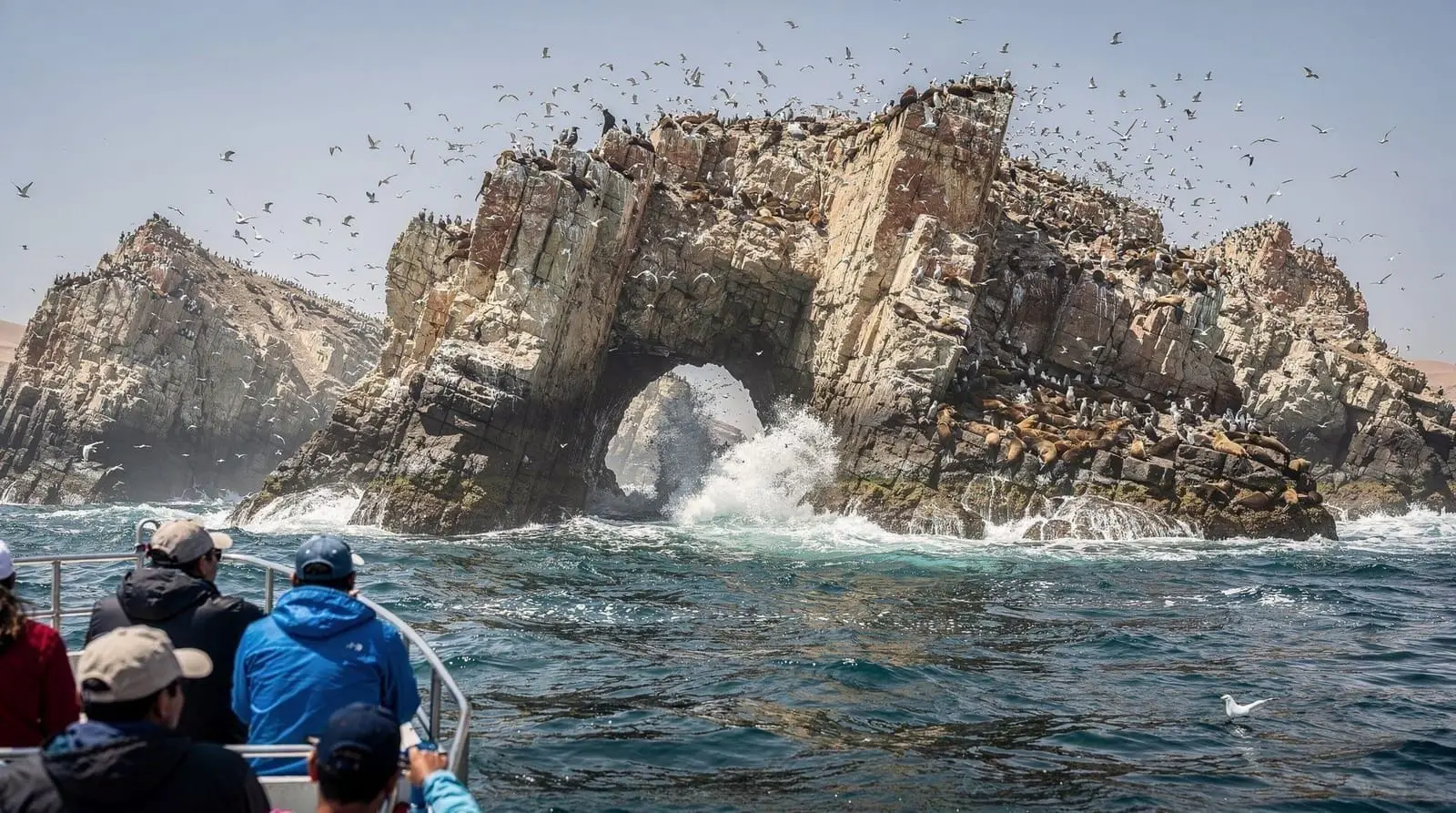
The Ballestas Islands are a cluster of granite arches, sea stacks and caves sitting about 12 km off the coast of Paracas, and they are the single reason most travellers detour off the Panamericana Sur on their way south. There is no Inca ruin here, no colonial plaza, nothing built by human hands — just rock, sea spray and an extraordinary density of wildlife. You cannot set foot on the islands. The entire experience happens from an open speedboat that circles the formations while the engine idles and a guide points out what is breeding, basking or diving around you. Done with the right expectations, it is one of the best-value wildlife outings in South America. Done with Galápagos-sized hopes, it can feel brief.
| Where | 12 km off Paracas, south coast |
| Time needed | Half day (~2-hour boat tour) |
| Cost | S/55–70 boat fare, plus S/16–22 in port/reserve fees |
| Getting there | Boats leave from El Chaco waterfront, Paracas |
| Best time | April–November, morning departures only |
What you actually see on the water
The headline residents are the South American sea lions, which haul out in barking, jostling colonies on the lower ledges. Pups are born between December and February, so the rookeries are loudest and most crowded in the southern summer. Above them, the cliffs are stained white with guano and packed with seabirds: Peruvian boobies in the thousands, Guanay cormorants in dense black rafts, Peruvian pelicans, red-legged cormorants, and the Inca tern, whose slate-grey body and curling white moustache make it the most photogenic bird on the rocks.
The crowd favourite is the Humboldt penguin. A small colony nests in crevices on the north-facing slopes, and they are present year-round, though you will usually see a handful rather than a crowd. Bring a telephoto lens or binoculars — penguins on a distant ledge are easy to miss with the naked eye. Between roughly June and November, Chilean flamingos sometimes appear in the bays near the peninsula, though these are more reliably seen inside the Paracas National Reserve than on the boat itself.
The water itself is the reason for all this life. The Humboldt Current drives cold, nutrient-rich water up the coast, fuelling one of the most productive marine ecosystems on the planet. That same current is why the crossing is cold and often choppy even on a sunny day.
El Candelabro on the way out
Roughly fifteen minutes into the crossing, the boat slows beside the northern cliffs of the Paracas Peninsula, where a 150-metre geoglyph called El Candelabro is carved into the slope facing the sea. Like the Nazca Lines, it was made by scraping away dark surface stones to expose paler ground beneath, but unlike the Nazca figures it sits on a hillside and is clearly visible from sea level. Its age and meaning are genuinely unknown — estimates run from the Paracas culture (centuries BCE) to the colonial era, and theories range from an astronomical marker to a navigational beacon for sailors to a symbol linked to a hallucinogenic cactus. Whatever it is, it photographs well from the deck of a passing boat.
Booking the boat: prices and timings
Tours leave from the El Chaco waterfront in Paracas town, almost all of them in the early morning. First departures are around 07:00–08:00 and the last boats usually go out by 10:00–11:00, because afternoon winds make the sea uncomfortable. The full outing runs about two hours: roughly 25 minutes out, 30–40 minutes circling the islands, and 25 minutes back.
The boat fare is S/55–70 per person (around $15–19 USD) for a standard shared speedboat holding 15–35 passengers. On top of that you pay two small fixed charges at the dock: a port embarkation fee and the reserve entrance fee, together usually S/16–22. Some agencies quote an all-in price that includes these; others spring them on you at the pier, so ask before you hand over money.
Paracas: Ballestas Islands and National ReserveIf you only want the boat ride without the reserve add-on:
From Paracas: Ballestas Islands Boat Ride TourYou rarely need to book far ahead. Boats are plentiful and only sell out on Peruvian holiday weekends (late July around Fiestas Patrias is the worst). Booking online or the night before mainly buys you a guaranteed early slot and a fixed price, which protects you from the dock haggling. For most travellers, reserving a morning departure in advance is the path of least friction.
How rough is the crossing, really
This is the question people forget to ask. The Humboldt swell means there is almost always motion, and the open speedboats slap across it at speed. On a calm morning it is bracing and fun; on a windy one it is genuinely jolting, with spray over the bow. If you are at all prone to seasickness, take medication 30–45 minutes before boarding — there is no turning back once you are out there. Sit toward the middle-rear of the boat, where the ride is smoother, and keep your eyes on the horizon. Children generally cope fine, but very young kids and anyone with a bad back should think twice on a windy day.
What to bring
- A windproof jacket. The crossing is cold and wet even when the town is warm. This is the item people most regret leaving behind.
- Sunscreen and sunglasses. The glare off the water is intense, and there is no shade on the boat.
- A telephoto lens or binoculars. Much of the wildlife is on ledges 20–50 metres away. A phone camera captures the scenery but not the penguins.
- A dry bag or zip pouch for your phone and documents — spray is constant.
- Closed shoes you don’t mind getting wet. The dock and boat floor are usually slick.
- A hat with a chin strap, or none at all. Loose hats end up in the Pacific.
How it compares to the Galápagos
The Ballestas are often sold as “the poor man’s Galápagos,” which is both a useful shorthand and a slightly misleading one. The density of sea lions and seabirds genuinely is reminiscent of the Galápagos, and for a fraction of the cost — a Galápagos cruise runs into the thousands of dollars, while the Ballestas cost under twenty.
But the Galápagos offer species you simply will not find here (marine iguanas, giant tortoises, Darwin’s finches), and they allow you to walk among the animals and snorkel with them. The Ballestas keep you on a boat the whole time. Think of them as a brilliant, affordable two-hour wildlife show rather than a substitute for a Galápagos trip. For travellers crossing South America on a budget, that trade is well worth making.
Combining the islands with the reserve
The single best way to spend a day in Paracas is to pair the morning Ballestas boat with an afternoon in the Paracas National Reserve — a vast desert peninsula of ochre cliffs, fossil beds and flamingo lagoons that most island-hoppers skip entirely. A combined tour handles both in one logistics-free package:
Paracas: Ballestas Islands & Paracas Reserve Full-DayThe boat alone takes only your morning, so unless you are sprinting straight on to Ica or Huacachina, the reserve is the obvious way to fill the rest of the day before continuing the south-coast circuit.
Where the islands fit in a south-coast trip
The Ballestas are not a destination in their own right — they are a half-day highlight reached from a base in Paracas or, slightly further out, Pisco. Most people arrive from Lima in the afternoon, do the boat the next morning, see the reserve after lunch, and push on south. From Paracas it is about an hour by colectivo to Ica and the Huacachina oasis, and three to three and a half hours to Nazca for the Nazca Lines overflight.
For step-by-step routing through the whole desert coast, see the itineraries hub and the south-coast guides. To compare the various Paracas and Nazca tour packages side by side, the tours hub lays out durations and inclusions.
Wildlife by month
| Months | What’s most likely |
|---|---|
| Dec–Feb | Sea lion pups born; rookeries loudest and busiest; hotter, windier crossings |
| Mar–May | Transitional; generally calmer seas begin |
| Jun–Nov | Calmest, driest mornings; Chilean flamingos sometimes visible near the peninsula |
| Year-round | Humboldt penguins present in small numbers; seabird colonies always active |
No month is a bad time to go — the wildlife is resident, not migratory in the way that would make a visit pointless outside a narrow window. The seasonal differences are about sea conditions and crowd levels more than what you’ll actually see.
Choosing a boat operator
Nearly every agency in Paracas and the connected south-coast towns sells essentially the same product — a shared speedboat licensed to run the same fixed route past the same formations — so the differences between operators are mostly about comfort and reliability rather than what you see. A few things worth checking before booking:
- Life jackets for everyone, fitted before departure. Reputable boats insist on this; if a crew skips it, that is a warning sign about their general standards.
- A boat that isn’t overloaded. Licensed capacity is usually 15–35 passengers; an operator crowding more people aboard is cutting corners.
- A guide who narrates in your language, or at least English alongside Spanish — much of the value of the tour is knowing what you’re looking at as the boat passes.
- Clarity on the all-in price upfront, including the port and reserve fees, so there’s no surprise charge at the dock.
Practical planning
Where to base yourself. Paracas town (El Chaco) is the closest launch point, a five-minute walk from the dock to most hotels. Pisco, 15 minutes north, is cheaper but means an early taxi to the boats.
Best months. April through November brings drier mornings and calmer seas. December to March is hotter and windier, with more chance of a rough or delayed crossing, though the sea lion pups make it lively.
Time of day. Always go in the morning. Afternoon boats are rare precisely because the wind picks up; if an operator offers a midday departure, expect a rougher ride.
Accessibility. Boarding involves stepping down into a low boat from a floating dock. Crew assist, but it is not suitable for travellers with serious mobility limitations or wheelchairs.
Frequently asked questions about the Ballestas Islands
Can you land on the Ballestas Islands?
No. Landing is prohibited to protect the breeding wildlife and the guano harvest. Every tour observes from the boat, which circles the main arches and caves at close range — usually near enough to photograph sea lions and penguins clearly.
How long does the Ballestas boat tour take?
About two hours in total: roughly 25 minutes out, 30–40 minutes circling the islands, and 25 minutes back. Add 15–20 minutes at the dock for the port fee and boarding.
How much does it cost?
The boat fare is S/55–70 (around $15–19). On top of that you pay a port embarkation fee and a reserve entrance charge at the dock, together usually S/16–22. Always confirm whether these are included before booking.
Are the Ballestas worth it compared to the Galápagos?
For wildlife density and value, yes — you see large sea lion and seabird colonies plus penguins for under twenty dollars. But the Galápagos offer unique species and the chance to walk and snorkel among the animals. The Ballestas are a short boat-bound experience, not a replacement for a Galápagos trip.
Will I get seasick on the boat?
Possibly. The Humboldt Current keeps a swell running even on calm days, and the open boats move fast. If you are prone to motion sickness, take medication beforehand and sit toward the middle-rear. Morning departures are calmer than later ones.
Do I need to book in advance?
Usually not, except on Peruvian holiday weekends. Booking ahead mainly guarantees an early slot and a fixed all-in price, sparing you the dock haggling and the surprise of separately charged port fees.
What is the best time of year to visit?
April to November offers calmer seas and drier mornings. Penguins are present year-round; sea lion pups arrive December to February; flamingos are most likely between June and November, though usually in the reserve rather than at the islands.
Can I combine the Ballestas with Nazca or Huacachina in one day?
Not comfortably in a single day — the boat tour takes your whole morning and you’ll want the early departure. Most travellers do the Ballestas one morning, add the Paracas National Reserve that afternoon, then move on to Huacachina or Nazca the following day. Trying to stack all three into 24 hours usually means rushing each one.
What should I look for in a boat operator?
Confirm life jackets are provided and fitted before departure, that the boat isn’t overloaded beyond its licensed capacity, and that the price quoted includes the port and reserve fees rather than adding them as a surprise at the dock. Beyond that, most licensed operators run the same fixed route, so differences are mostly about comfort and guide quality.
Top experiences
Bookable activities with verified prices and instant confirmation on GetYourGuide.
