Lima in 2 days: a realistic itinerary
Lima: City Tour, Larco Museum and Huaca Pucllana
Can you see Lima in 2 days?
Yes. Two full days cover the colonial centre, Miraflores, the Larco Museum, Huaca Pucllana, Barranco, and a proper ceviche lunch. Day one focuses on history and Miraflores; day two on museums, the cliffs, and Barranco by night.
How this two-day plan works
This itinerary assumes you are based in Miraflores, the practical home base for a first Lima visit, and that you have two full days on the ground — not a half-day on arrival and a dawn flight out. It is paced for someone who wants to see the city properly without sprinting: two anchor sights per day, one substantial sit-down lunch each day, and evenings spent in the neighbourhoods rather than back at the hotel.
A few ground rules shape the plan. Ceviche is a lunch dish in Lima, so the food highlights land at midday. Taxis are app-based only (Cabify, InDriver, Uber) — never street-hailed — and traffic is worst from 7-9 am and 5-8 pm, which is why the museum-and-cliffs afternoon on day two avoids long cross-town hops at rush hour. Prices below are in soles with a rough dollar equivalent at around S/3.7 to the dollar; treat them as 2026 ballparks, not guarantees.
For the question of whether Lima deserves these two days at all, see /guides/is-lima-worth-visiting/. The short answer: yes, increasingly so.
| Base | Miraflores |
| Day 1 | Historic centre + Huaca Pucllana + ceviche strip |
| Day 2 | Larco Museum + Malecon cliff walk + Barranco |
| Budget (no hotel) | S/250-450 ($65-120) per person |
| Getting around | App taxis only (Cabify, Uber, InDriver) |
Before you start: a few practicalities
A handful of things are worth sorting on arrival so the two days run smoothly. Download the taxi apps (Cabify is the most reliable in Lima; Uber and InDriver also work) and set up payment before you need a ride at a busy moment. Buy a local SIM (Claro or Entel, around S/20-30 with a month of data) at the airport or any pharmacy — having mobile data makes the apps, maps, and translation far easier. Withdraw soles from a bank-branded ATM (BCP, Interbank, Scotiabank) rather than relying on dollars, which earn a poor exchange rate everywhere.
On safety, the rules are simple and they hold for both days: use app taxis rather than street-hailing, keep your phone out of sight while walking, do not flash valuables, and avoid late-night street walking outside the immediate Miraflores and Barranco cores. Follow those and Lima is a comfortable city to move around. For the airport-to-hotel leg specifically, see /guides/lima-airport-to-city-guide/.
One more timing note that shapes everything below: Lima’s worst traffic is 7-9 am and 5-8 pm. This plan front-loads the cross-town hops (the colonial centre, the Larco Museum) into mid-morning and keeps the evenings within walkable neighbourhoods to avoid sitting in gridlock at the end of a long day.
Day 1: colonial centre and Miraflores
Morning — the historic centre
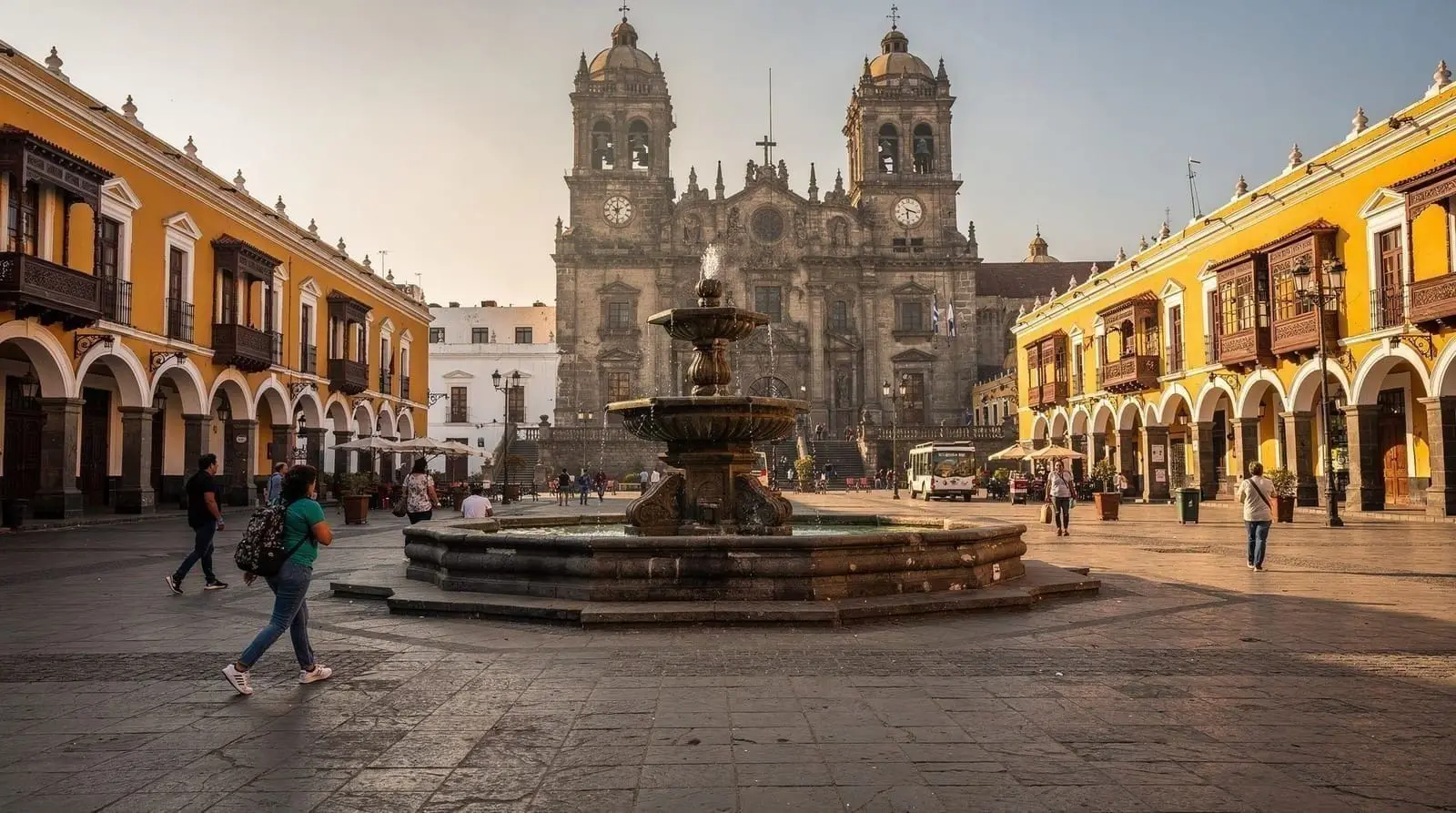
Start early and beat the traffic to the Centro Histórico, Lima’s UNESCO-listed Spanish colonial core, about 12 km northeast of Miraflores (taxi S/25-35, 25-40 minutes). Begin at the Plaza Mayor, framed by the Cathedral, the Archbishop’s Palace, and the Government Palace (whose changing-of-the-guard happens around noon). Walk to the Convento de San Francisco (entry S/15 / about $4), where the catacombs beneath the church hold the arranged bones of an estimated 25,000 people — genuinely striking, and the standout of the centre.
If you would rather have the murals, religious art, and colonial history explained as you walk, the historic centre walking tour with pisco sour tasting covers the main sights in about three hours and finishes with a hands-on pisco sour workshop — a tidy way to anchor the morning.
For lunch in the centre, La Lucha Sangucheria on Jirón de la Unión serves excellent Peruvian sandwiches (chicharrón, butifarra) for around S/18-22. It is fast, cheap, and reliably good.
Afternoon — Huaca Pucllana
Taxi back to Miraflores (S/25-35) and spend the early afternoon at Huaca Pucllana, a fully excavated adobe pyramid from around 400 CE marooned among apartment blocks on General Borgoño block 8. Entry is S/15 (about $4) and visits are guided, running every 30-40 minutes. It takes about an hour and is one of the most surprising sights in the city — a 1,500-year-old monument surrounded by modern Miraflores.
Evening — Parque Kennedy and a ceviche-strip dinner
Walk to Parque Kennedy in the heart of Miraflores, Lima’s social hub (and home to its famous resident stray cats). From there, Avenida La Mar is the city’s ceviche-and-seafood strip. If you saved your big ceviche for tomorrow’s lunch, keep tonight casual; if not, La Mar (Av. La Mar 770) is the famous option, though it is lunch-focused — budget S/70-100 for a full meal. Otherwise, the cevicherias and anticucho stalls around the park feed you well for far less.
Day 2: museums, the cliffs, and Barranco
Morning — the Larco Museum
Start at the Museo Larco (Av. Bolívar 1515, Pueblo Libre; taxi S/18-25, 20-30 minutes), Lima’s finest pre-Columbian collection and the single best museum in the city. Allow two hours for the chronological halls, the open storerooms, and the gold gallery. Entry is S/35 (about $9). The full breakdown is in the /guides/larco-museum-guide/.
If you prefer a guide to handle both museum and logistics, the city tour combining Larco, Huaca Pucllana, and the colonial centre bundles the archaeological highlights into one day — useful if you would rather compress the history into a single guided block and free up day one.
Lunch — your big ceviche
This is the day for a proper ceviche lunch. Punto Azul (Calle San Martín 595, Miraflores) is a dependable, well-priced choice (S/35-60) that takes walk-ins; Pescados Capitales is worth a reservation for something more polished. Order ceviche, eat it at its midday best, and pair it with a Cusqueña or a chicha morada.
To turn lunch into an education, the ultimate Peruvian food tour walks you through Miraflores markets, traditional huariques, and juice bars over about three hours — a strong option if food is the reason you came to Lima.
Afternoon — the Malecón cliff walk
Walk off lunch along the Malecón clifftop promenade above the Pacific. The Parque del Amor, with its Gaudí-inspired mosaic wall and ocean views, and Larcomar, the cliffside shopping centre, are the landmarks. On clear days (November-April) the paragliders launching off the cliffs are part of the scene. This stretch is free, pleasant, and the most photogenic part of central Lima.
Evening — Barranco
Taxi south to Barranco (S/15-20, 15-20 minutes), Lima’s bohemian district of painted republican mansions, street murals, and the city’s best bar strip. See the Puente de los Suspiros (Bridge of Sighs) and the viewpoint below it at dusk, then settle in around the Plaza de Barranco for dinner and drinks. To make sense of the galleries and the better bars on a first visit, the gourmet food tour by night through Miraflores and Barranco hits the ceviche bars, cocktail spots, and artisan stalls that are hard to find independently.
A short food primer for your two lunches
Lima is a world food capital, and on a two-day trip your two big lunches are the meals that matter most, so it helps to know what to order. Ceviche — raw fish cured in lime, chilli, and onion, served with sweet potato and corn — is the dish to prioritise, and it is freshest at lunch. Tiradito is its Nikkei (Japanese-Peruvian) cousin, sliced sashimi-style. Beyond seafood, look for lomo saltado (stir-fried beef with the Chinese chifa influence), ají de gallina (creamy chilli chicken), causa (layered potato terrine), and anticuchos (grilled beef-heart skewers, a great street snack around Parque Kennedy in the evening).
To drink, try chicha morada (a non-alcoholic purple-corn drink), an Inca Kola at least once for the experience, and of course a pisco sour — best made fresh at a proper bar rather than poured from a mix. If you want one structured food experience to anchor the trip, slot a guided market-and-huarique walk into day two’s lunch slot rather than trying to add it as a separate event; it doubles as a meal and an education. The fuller picture of Lima’s food scene, including the high-end tasting-menu restaurants, is in the /guides/lima-complete-guide/.
Stretching to three days
If you find you have a third day — or you build one in deliberately — the two strongest additions are Pachacámac and a Barranco-focused slow morning. Pachacámac, the great oracle city 31 km south, is a half-day excursion that pairs the colonial and museum history of days one and two with a substantial out-of-town archaeological site. Alternatively, a relaxed third day spent properly in Barranco — galleries, the artisan market, a long lunch, and a bike or street-art tour — suits travellers who would rather go deeper into one neighbourhood than tick another box.
A third day also opens up the south coast: an early start gets you to Paracas and the Ballestas Islands for wildlife, though that is a very long day from Lima. The realistic options, with distances and travel times, are ranked in /guides/lima-day-trips/.
What to skip on a two-day trip
- Pachacamac: Worth it, but it eats most of a day. Save the Pachacamac ruins for a third day if you have one.
- Larcomar beyond the view: The mall is fine for the terrace vista, not for shopping or its food court.
- The Magic Water Circuit as a meal: The fountains are a cheerful S/8 evening if you have spare time, but do not plan dinner around them.
- A second pre-Columbian museum: Larco is enough for most people in two days; do not double up unless you are an enthusiast.
Where to stay for this itinerary
This plan is built around a Miraflores base, and for a first two-day visit that is the right call. Miraflores is central, safe to walk by day and evening, dense with restaurants and supermarkets, and well-connected by taxi to every sight in the itinerary. It also puts the Malecón cliff walk, Parque Kennedy, and Huaca Pucllana within walking distance of most hotels, so you spend less on taxis. Hotels range from backpacker hostels around S/40-70 a night to comfortable mid-range options at S/200-400 and a handful of upscale cliff-front properties well above that.
Barranco is the appealing alternative for travellers who want a more bohemian, boutique feel and do not mind being slightly further from the colonial centre. It has fewer early-morning breakfast options and is a touch quieter for first-timers, but it is more atmospheric and has the better nightlife on your doorstep. San Isidro, the business district, is leafy, quiet, and convenient but less characterful — a sensible choice if you value calm over buzz. Wherever you stay, having a fixed base in one of these three districts is what makes a tight two-day plan work; spreading yourself across the city wastes hours in traffic.
Adapting the plan to your interests
The skeleton above suits a balanced first visit, but it flexes easily:
- Food-first travellers should swap one museum block for a cooking class or a longer market-and-huarique food tour, and book one high-end tasting menu (Maido, Central, or Kjolle) weeks ahead — it can become the centrepiece of the trip rather than an afterthought.
- History buffs can add the colonial-centre churches and convents beyond San Francisco, spend longer at the Larco Museum, and slot in the nearby national archaeology museum in Pueblo Libre.
- Families will find Huaca Pucllana, the Magic Water Circuit, the Parque Kennedy cats, and the Malecón parks all kid-friendly, while the catacombs may suit older children better than young ones.
- Slow travellers should resist cramming both districts into the evenings and instead pick one neighbourhood per night to settle into properly.
Costs, logistics, and timing
A realistic non-accommodation budget for two days, per person, is roughly S/250-450 (about $65-120): taxis (S/120-160), museum and site entries (S/65), two big lunches (S/80-160), casual dinners and snacks (S/60-100), and one guided activity. Tasting-menu dinners at Lima’s world-ranked restaurants (Maido, Central, Kjolle) sit well above this and need booking weeks ahead.
If you are arriving from a long-haul flight and continuing to Cusco, use Lima as your acclimatisation buffer: rest, hydrate, and avoid alcohol the night before flying to altitude. For airport logistics, see /guides/lima-airport-to-city-guide/. For the bigger national picture, the /guides/peru-2-week-itinerary-guide/ and the /guides/how-many-days-in-peru/ guide place these two Lima days in context, and the /itineraries/ hub has full multi-stop routes.
If it rains, or the garua rolls in
Lima’s garúa fog runs roughly May to October, and even outside that window an overcast morning is possible. This itinerary is built to survive it without losing much: the Larco Museum, the historic centre churches and catacombs, and any cooking class or food tour are entirely indoor-friendly and lose nothing to grey skies. What suffers is the Malecón cliff walk and Parque del Amor, which are far more atmospheric under clear November-April skies with paragliders overhead than under a flat winter haze.
If your two days land in garúa season, consider swapping the order slightly — front-load the cliff walk for the first clear-looking morning you get, and treat the museums and colonial centre as your default fallback. Either way, the food does not change: ceviche, Nikkei, and chifa taste exactly the same whether the sky is blue or grey.
Solo travellers versus couples versus groups
The skeleton itinerary above works for any travel style, but a few adjustments help. Solo travellers should lean on the guided options (the historic-centre walking tour, the food tour) both for company and because splitting a private guide’s cost alone is poor value; app taxis and casual restaurant seating suit solo travel well in Lima.
Couples get the most from this plan as written — it balances history, food, and a romantic Barranco evening without needing modification. Groups of three or more should book restaurant tables ahead, especially for Punto Azul or Pescados Capitales at peak lunch hours, and consider a private guided day (rather than joining a small-group tour) since splitting the cost across several people brings it close to the small-group price while buying more flexibility on timing.
Evenings, drinks, and after-dark Lima
Both evenings in this plan stay within walkable neighbourhood cores, which is deliberate — it keeps you out of rush-hour traffic and in the safest, liveliest parts of the city after dark. Day one’s evening belongs to Miraflores: Parque Kennedy buzzes until late, the anticucho and picarones street stalls fire up, and the cevicherías and bars along Calle Berlín and Calle Manuel Bonilla fill with a mixed local-and-visitor crowd. Day two’s evening is Barranco’s, the better night out of the two — start with sundowners near the Bridge of Sighs, work along the bars around the Plaza de Barranco, and finish at one of the craft-cocktail or pisco bars the district is known for.
A pisco sour is the obvious drink to anchor an evening, and Lima takes it seriously; have at least one made fresh at a proper bar rather than a hotel pour. If you would rather have the better spots curated than hunt for them, a guided night food-and-drinks walk across both districts removes the guesswork. Whichever way you do it, take an app taxi back to your hotel at the end of the night rather than walking long distances after dark — the standard Lima caution applies most after midnight.
Frequently asked questions about Lima in 2 days: a realistic itinerary
Is 2 days enough for Lima?
Where should I stay for a 2-day Lima trip?
How much does 2 days in Lima cost?
When should I eat ceviche in Lima?
What should I skip in Lima on a short trip?
What if my two days in Lima land during the garua fog season?
Top experiences
Bookable activities with verified prices and instant confirmation on GetYourGuide.

