Lima complete guide
Lima: City Tour, Larco Museum and Huaca Pucllana
How many days do you need in Lima?
Two full days is the honest minimum to see the colonial centre, Miraflores, and eat well. Three days lets you add Pachacámac or Barranco without rushing. Stay in Miraflores or Barranco, not the historic centre.
What Lima actually is
Greater Lima holds roughly 11 million people spread across 43 districts and 60 kilometres of Pacific coastline. That scale matters for planning, because most travellers only ever interact with a sliver of it: the coastal cliff districts of Miraflores and Barranco, the business hub of San Isidro between them, and the colonial historic centre some 12 kilometres inland. Everything else — the vast working-class districts, the desert hills covered in self-built housing, the industrial port of Callao — is real Lima too, but it is not where your trip happens.
This guide treats Lima as a two-to-three-day city you build around food, archaeology, and coastal walking. It is honest about the garúa fog, the airport scams, and the sights that consume time without rewarding it. If you only read one section, make it the one on how long to stay, because over-allocating days to Lima at the expense of the Andes is the single most common Peru planning mistake.
| Where to base yourself | Miraflores (first-timers) or Barranco (character) |
| Minimum stay | 2 full days |
| Cost per day | around S/250-400 ($65-105) mid-range |
| Getting in | Jorge Chavez (LIM), 45-60 min from Miraflores |
| Best weather | November-April, clear skies |
| Currency | Sol (S/); ATMs at BCP, Interbank, Scotiabank |
How many days you really need
Two full days is the honest minimum. That gives you one day for the colonial centre plus an afternoon archaeology sight, and a second day for the Larco Museum, the cliff walk, and a proper sit-down ceviche lunch. Three days adds Pachacámac or a relaxed afternoon and evening in Barranco. Four or more days only makes sense if you are specifically here for the restaurants, in which case Lima can easily fill a week.
What you should not do is treat Lima as a single overnight stop. Travellers routinely land late, sleep, and fly to Cusco the next morning, then wonder why everyone raves about the city. They never saw it. If your schedule is genuinely that tight, build the buffer night anyway — it doubles as insurance against the frequent flight delays on the Lima–Cusco route, and it gives your body a sea-level rest before Andean altitude. See /guides/how-many-days-in-peru/ for how Lima fits into the wider trip, and /guides/lima-in-2-days/ for a tighter version.
Where to base yourself
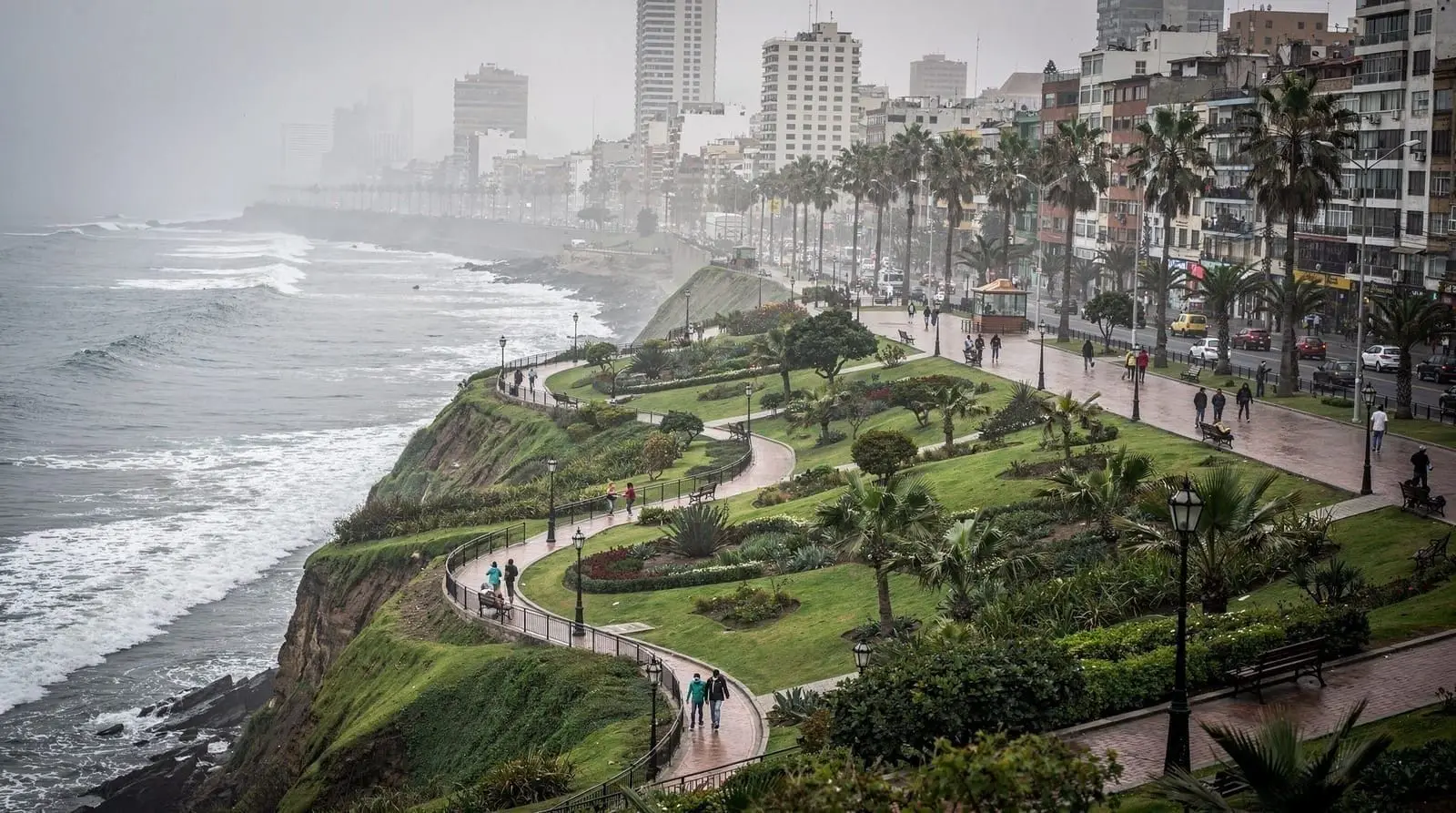
Miraflores is the default and, for most first-timers, the correct one. It is the upscale clifftop district: clean, safe, walkable, with a dense cluster of cevicherías and Nikkei restaurants, the Larcomar mall built into the cliff face, the Huaca Pucllana pyramid in the middle of residential streets, and the Malecón cliff promenade. Hotels range from S/120 / about $32 hostels to S/700+ / $185+ boutique properties. If you want the path of least resistance, stay here.
Barranco, 15 minutes south by taxi (S/15–20 / about $4–5), is the bohemian alternative: painted republican mansions, art galleries, street murals, and the best bar strip in the city. It is quieter in the mornings, has fewer early breakfast options, and sits slightly further from the historic centre, but it has more character per block than anywhere else in Lima. Best for travellers who want atmosphere over convenience. Full detail at /guides/barranco-guide/.
San Isidro is the financial district between the two — leafy, safe, well-served by good hotels, but corporate and short on street life. Convenient if business brings you here; otherwise skip it.
The one thing nearly everyone agrees on: do not stay in the historic centre. It empties out and feels unsafe after dark, and the morning commute back is long. Visit it; sleep on the coast.
| District | Vibe | Best for | Downside |
|---|---|---|---|
| Miraflores | Upscale, walkable | First-timers, restaurants | Can feel touristy |
| Barranco | Bohemian, artsy | Character, nightlife | Fewer breakfast spots |
| San Isidro | Corporate, leafy | Business, calm | Short on street life |
| Historic centre | Colonial, dense | Sightseeing by day | Empties out, avoid at night |
Getting around
App taxis are the rule. Use Cabify, InDriver, or Uber, all of which quote a fixed fare before you confirm. Never take an unlicensed taxi flagged on the street — door-to-door scams and short-changing are well documented. Typical fares: Miraflores to the historic centre S/25–35; Miraflores to Barranco S/15–20; Miraflores to the airport S/50–70.
The Metropolitano express bus runs along Paseo de la República from the centre south through Miraflores. A trip costs S/3.50 / under $1 with a rechargeable card bought at any station, and during rush hour it genuinely beats taxis along that corridor. It is crowded and pickpockets work it, so keep bags in front of you.
Walking works beautifully within Miraflores, within Barranco, and along the entire cliff Malecón connecting them, but the districts are too far apart to walk between comfortably.
For the full airport breakdown, see /guides/lima-airport-to-city-guide/.
The garúa: Lima’s weather reality
From roughly May to October, Lima sits under the garúa, a persistent coastal fog produced by the cold Humboldt Current meeting warm air. The sky does not storm; it simply stays a flat, luminous grey-white for weeks at a time, and temperatures settle around 14–16 °C. Cliff views vanish, photographs come out washed-out, and the damp seeps into everything.
Here is the honest reframe: the garúa does not ruin Lima. The food is identical, museums are indoors, hotels are cheaper, restaurants are quieter, and the city is arguably more atmospheric under fog. What suffers is only the postcard — those cinematic cliffside sunsets and the paragliders over the Costa Verde. If photography is your priority, plan your Lima leg for November to April, when skies clear reliably and daytime temperatures reach the high 20s °C. Otherwise, winter Lima is a perfectly good Lima, and your wallet will notice the difference. More at /guides/best-time-to-visit-peru/.
What to actually do
A realistic anchor list for two to three days:
- The colonial centre. Plaza Mayor, the Convento de San Francisco with its catacombs (S/20 / about $5), and the surrounding UNESCO-listed streets. Half a day.
- Huaca Pucllana (General Borgoño block 8, Miraflores). An excavated adobe pyramid from around 400 CE in the middle of the city. Entry S/15 / about $4; the evening torchlit visits from 7 pm are the standout.
- Museo Larco (Av. Bolívar 1515, Pueblo Libre). One of the world’s great pre-Columbian collections, with open visible storerooms. Entry S/35 / about $9. Detailed in /guides/larco-museum-guide/.
- The Malecón cliff walk and Parque del Amor in Miraflores — free, best at sunset on clear days.
- Barranco for an afternoon and evening — the Puente de los Suspiros, galleries, and bars.
If you want a guide to stitch the main sights together, the historical, colonial and modern city tour covers the centre, the residential coast, and the contrast between old and new Lima in a single sweep — useful on a first day when you are still orienting yourself. For the deeper version that bundles the museum and the pyramid, the city tour with Larco Museum and Huaca Pucllana handles the logistics of three sights that are otherwise three separate taxi rides apart.
For the full activity rundown, see /guides/things-to-do-in-lima/.
Eating in Lima
This is the real reason to stay. Lima’s food scene runs from S/12 market lunches to S/600 tasting menus at restaurants ranked among the world’s best. The non-negotiables:
- Ceviche at lunch. It is culturally a midday dish; dedicated cevicherías open around noon and close by late afternoon. Budget S/35–60 for a full plate. See /guides/best-ceviche-in-lima/.
- Nikkei — the Japanese-Peruvian cuisine born of a community that arrived from the 1890s. Maido in Miraflores is the flagship.
- Market food at Mercado de Surquillo, where Limeño cooks shop and stalls serve cooked lunches for S/12–18.
To orient your palate early, the ultimate Peruvian food tour is a three-hour walk through markets, traditional huariques, and juice bars — practical on a first day before you start eating independently. The full picture, including the famous restaurants and how to book them, is in /guides/lima-food-scene-guide/.
Money, safety, and practicalities
Money. Withdraw soles from BCP, Scotiabank, or Interbank ATMs (lower fees than the airport machines). Always pay in soles, not your home currency, to dodge dynamic conversion. USD is accepted at hotels and tour operators but at a poor rate of around 3.55–3.65 when the official rate sits near 3.70.
Safety. Miraflores and Barranco are the safe walking zones. Keep your phone hidden on the street, do not stand on the pavement texting, and use app taxis only. The historic centre and public transport are the main pickpocket areas. None of this should deter you — millions visit Lima every year without incident — but casual carelessness gets punished.
Altitude prep. Lima is at sea level. If you are heading to Cusco next, treat your Lima nights as your last proper rest before altitude. Hydrate, sleep, and avoid alcohol the day before flying up. See /guides/peru-travel-safety-2026/.
Connectivity. A Claro or Entel SIM costs S/20–30 / about $5–8 for a month of data, sold at the airport and pharmacies. Café and hotel Wi-Fi is generally solid.
Tipping. Service is not automatically included, though some restaurants add a 10 percent “servicio” line — check the bill. A 10 percent tip at sit-down restaurants is standard and appreciated; round up taxi fares modestly; tip guides S/20–40 per person for a half-day tour. Tipping in USD is fine but soles are preferred and easier for staff to use.
Health. Lima’s tap water is not reliably safe for visitors — drink bottled or filtered water and avoid ice from unknown sources, though reputable restaurants use filtered ice. Pharmacies (InkaFarma, Mifarma) are everywhere and well-stocked. The main hospitals used by travellers are Clínica Anglo Americana and Clínica Ricardo Palma in San Isidro and Miraflores. Travel insurance that covers Andean altitude later in your trip is worth arranging before you leave home.
What to skip
A few honest cuts. The Larcomar food court is forgettable — go for the cliff view, not the meal. Street tour touts in the historic centre offering “free” walking tours expect aggressive tips and often funnel you to commission shops; book a proper tour or self-guide. And the much-photographed Circuito Mágico del Agua fountain show (S/8 / about $2) is cheerful but minor — fine as a last-evening filler with kids, skippable otherwise. Costs across your whole trip are broken down in /guides/peru-trip-cost-guide-2026/.
A practical first-timer’s three-day plan
To make the abstractions concrete, here is a workable structure most travellers can adapt.
Day 1 — orientation and the coast. Start late and gentle if you have flown in overnight. Mid-morning, visit Huaca Pucllana in Miraflores, which is a 10-minute walk from most central hotels. Have a ceviche lunch at a serious cevichería around 1 pm. Spend the afternoon walking the Malecón cliff promenade through Parque del Amor, and watch the sunset from the cliffs if skies are clear. In the evening, take a taxi to Barranco for dinner and a couple of bars.
Day 2 — inland history. Morning at the Museo Larco in Pueblo Libre (open from 9 am; arrive early to beat tour groups), with lunch at its garden café. Early afternoon, taxi to the colonial historic centre for the Plaza Mayor, the cathedral, and the Convento de San Francisco catacombs. Return to the coast by late afternoon. Dinner in Miraflores at a Nikkei or mid-range restaurant.
Day 3 — flexible. Either an archaeology half-day at Pachacámac south of the city, a deeper food day (market breakfast, a marquee restaurant lunch if you booked one, an evening food tour), or a day trip toward the southern desert if you have started early. Keep this day loose so it can absorb a delayed Cusco flight if Lima is your last stop.
This is a template, not a prescription — shorten it to two days by merging the morning of Day 2 into Day 1 and dropping Pachacámac, or stretch it across four for a food-focused trip. The tighter version is mapped in /guides/lima-in-2-days/.
Seasons and what to pack
Lima has two practical seasons that shape what you bring. The clear, warm summer runs December to April, with daytime highs in the high 20s °C, strong sun, and reliable blue skies — pack light layers, sunscreen, and sunglasses, and book the cliffside and paragliding experiences then. The garúa winter runs May to October, grey and damp at 14–18 °C — bring a light jacket and a warmer layer for evenings, and reset your expectations toward indoor sights and food rather than coastal views.
Lima sees almost no real rain in either season; the desert coast is one of the driest inhabited places on earth, and the “wet” you feel in winter is fog and drizzle, not rainfall. Whatever the season, evenings near the cliffs run cooler than the inland districts, so a layer is always useful. Cross-reference with /guides/best-time-to-visit-peru/ to align Lima with the Andean weather windows.
First-time mistakes worth avoiding
A few honest patterns show up again and again in traveller feedback. Booking a single overnight and flying to Cusco the next morning is the single biggest regret — it treats a genuinely good food and culture city as a mere connection point and leaves you with no buffer if the domestic flight is delayed. Trying to fit the historic centre, the Larco Museum, and Barranco into one rushed day produces a lot of taxi time and not much enjoyment; spread them across two days instead.
Skipping ceviche because it looks like “just” a starter misses the meal most visitors remember longest — treat it as a proper sit-down lunch, not a snack. And assuming Lima is unsafe because of outdated reputation leads some travellers to over-restrict themselves to the hotel; Miraflores and Barranco are genuinely comfortable to walk by day and evening with normal urban caution.
A short history that explains the layout
Understanding why Lima is shaped the way it is helps the logistics make sense. The Spanish founded Lima in 1535 as the “City of Kings,” the administrative capital of the entire Viceroyalty of Peru, which is why the historic centre carries such a dense concentration of colonial churches, convents, and the Government Palace — for nearly three centuries this was the seat of Spanish power across most of South America.
The coastal districts that visitors actually stay in today, Miraflores and Barranco, only urbanised in the 19th and early 20th centuries as seaside retreats for wealthy Limeños escaping the crowded centre, which explains their republican mansions, cliffside layout, and greater distance from the colonial core. Callao, where the airport sits, has been Lima’s port since the colonial era and still functions as a separate, working-class city within the metropolitan area. Knowing this timeline — colonial centre first, coastal districts later, Callao always separate — makes the city’s geography click into place rather than feeling arbitrary.
How Lima fits the bigger trip
Most travellers use Lima as a hinge: a day or two on arrival, then a flight to Cusco for Machu Picchu and the Andes, sometimes returning through Lima before flying home. The southern desert — Paracas, the Ballestas Islands, Huacachina, and the Nazca lines — also branches off Lima as a two-to-three-day overland loop. See /guides/lima-day-trips/ for the day-trip options and /guides/peru-2-week-itinerary-guide/ for the full route. Browse pre-built routes at /itineraries/ and plan logistics with /tools/.
Frequently asked questions about Lima complete
Is Lima worth visiting or should I skip straight to Cusco?
When does the garúa fog affect Lima?
Which district should I stay in?
Is Lima safe for tourists?
How do I get from the airport to the city?
Do I need to speak Spanish in Lima?
How much does a day in Lima cost?
Why is Lima called the City of Kings?
Top experiences
Bookable activities with verified prices and instant confirmation on GetYourGuide.


