Lima food scene guide
Lima: Ultimate Peruvian Food Tour
Why is Lima considered a great food city?
Lima blends Andean, Spanish, Japanese, Chinese, and African traditions into a distinct national cuisine, and three or four of its restaurants regularly rank in the world's top fifty. You can eat brilliantly at a S/12 market stall or a S/600 tasting menu, all in the same week.
Why Lima eats the way it does
Lima’s food is the product of five centuries of layering. The Andean base of potatoes, corn, ají chillies, and quinoa met Spanish wheat, citrus, and livestock; then waves of Japanese, Cantonese Chinese, Italian, and West African influence each added a technique or an ingredient that stuck. The result is a national cuisine with genuine range — and a capital where three or four restaurants routinely place in the World’s 50 Best list while a market stall two kilometres away serves a S/12 lunch that locals would defend just as fiercely.
This guide covers both ends honestly: the marquee restaurants worth the planning, the everyday eating that defines the city, and the practical mechanics of prices, bookings, and timing. For ceviche specifically, the dedicated /guides/best-ceviche-in-lima/ goes deeper.
| Book ahead | Central & Maido: 1-3 months; Kjolle: a few weeks |
| Tasting menu cost | around S/700-950 ($185-255) per person |
| Everyday eating | Menu del dia S/12-20; huariques S/25-45 |
| When to eat ceviche | Lunch only, noon-4pm |
| Best neighbourhoods | Miraflores (density), Barranco (top tables) |
The famous restaurants: Central, Maido, Kjolle
These are the temples, and the honest truth is that you do not need them to eat brilliantly in Lima — but if you want them, they require planning.
Central (Av. Pedro de Osma 301, Barranco), run by Virgilio Martínez and Pía León, builds its tasting menu around Peru’s ecosystems by altitude — courses representing the coast, the Andes, the high plateau, and the Amazon. It has held the world’s top spot and is the hardest table in the country. The tasting menu runs roughly S/850–950 / about $230–255 per person, with optional pairings on top. Reservations open one to three months ahead and vanish within hours; set a reminder for the booking window.
Maido (Calle San Martín 399, Miraflores), Mitsuharu Tsumura’s flagship, is the definitive Nikkei restaurant — Japanese technique applied to Peruvian and Amazonian ingredients. Its tasting menu is around S/750–880 / about $200–235. It has also topped the global rankings and books out as fast as Central.
Kjolle (also at Av. Pedro de Osma 301, Barranco), Pía León’s own restaurant beside Central, is the slightly more attainable of the three — à la carte as well as tasting, with a strong focus on overlooked Peruvian ingredients. Mains run S/90–160 / about $24–43; a few weeks’ notice usually suffices.
If you strike out on reservations, ask your hotel concierge to chase cancellations, which surface more often than you would expect. And do not treat missing them as a failure — the restaurants below will feed you superbly for a fraction of the cost.
Nikkei: the Japanese-Peruvian strand
Nikkei cuisine grew from the Japanese community that arrived in Lima from the 1890s, adapting sashimi technique to Peruvian fish, lime, and ají. Its signature is tiradito — raw fish sliced sashimi-thin and dressed in citrus and chilli, ceviche’s more delicate cousin. Beyond Maido, accessible Nikkei spots include Edo Sushi Bar and Osaka (Av. Conquistadores 999, San Isidro), where you can eat the cuisine without the tasting-menu commitment, with dishes around S/45–90.
Chifa: the Chinese-Peruvian strand
Chifa — Peruvian-Cantonese cooking — is the everyday counterpoint to the fine-dining headlines, and it is genuine food culture, not a footnote. Cantonese immigrants from the 19th century gave Peru arroz chaufa (Peruvian fried rice) and helped shape lomo saltado, the wok-fried beef-and-chip stir-fry that is now a national dish. Lima’s Barrio Chino, near the historic centre on Calle Capón, is the heartland; Wa Lok and Salón Capón are the long-standing names. A generous plate runs S/25–45 / about $7–12, often enough for two.
Markets: where the city really shops
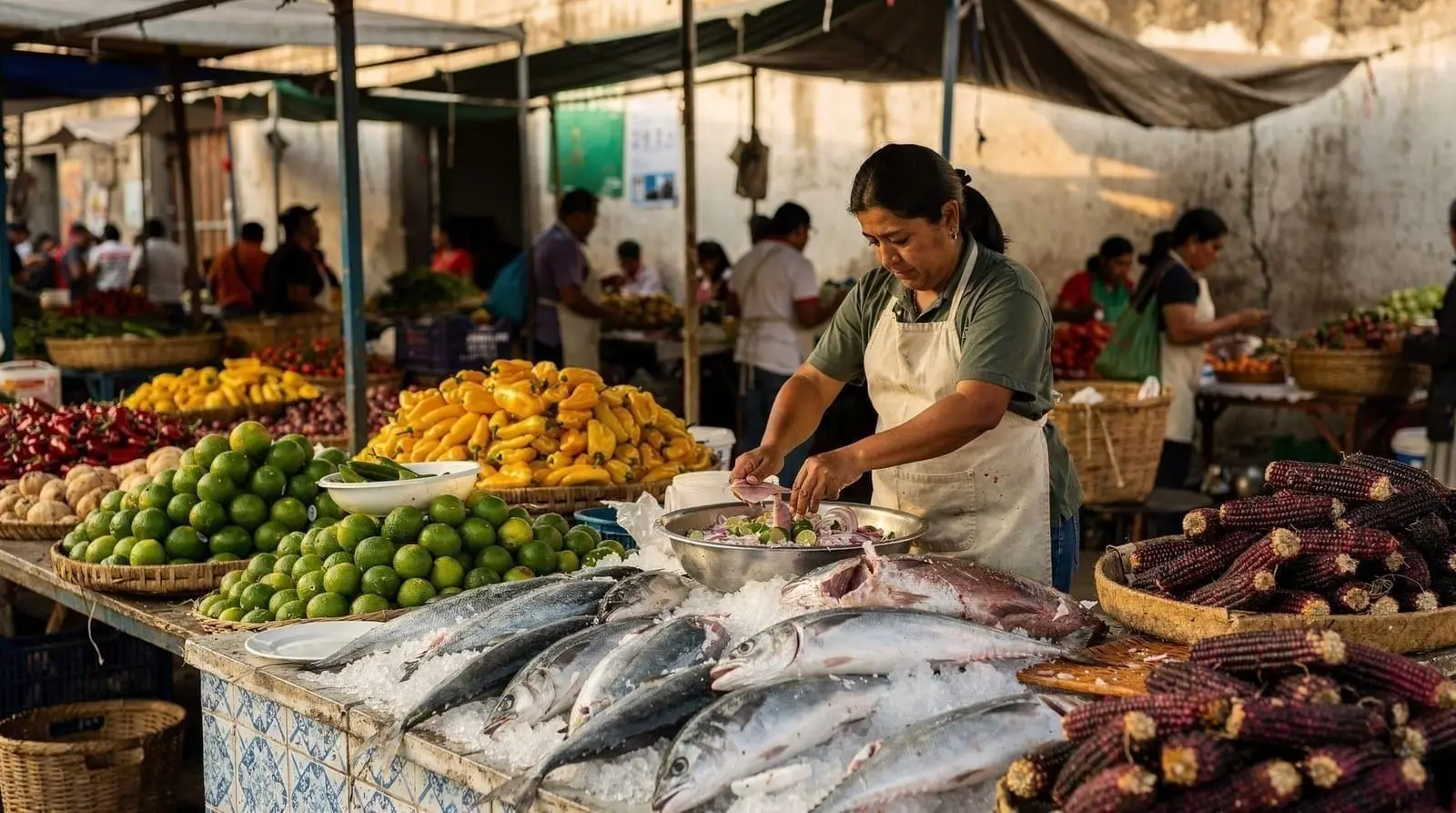
The honest centre of Lima eating is its markets. Mercado de Surquillo (one block from Av. Paseo de la República, about 10 minutes from Miraflores) is where Limeño home cooks and restaurant chefs buy, and the inner stalls serve cooked lunches for S/12–18 / about $3–5. Wandering it is a crash course in Peru’s biodiversity — Andean potatoes in dozens of varieties, Amazonian fruits you will not recognise, fresh ají pastes, and seafood landed that morning.
Mercado N.º 1 de Surquillo and the smaller Mercado de Magdalena offer the same education with fewer tourists. To navigate a market with context, the ultimate Peruvian food tour walks you through stalls, traditional huariques, and juice bars over about three hours — the most efficient way to decode Lima’s ingredients before you start eating on your own.
Everyday eating: huariques and the menú del día
Beyond markets, the real texture of Lima food is the huarique — a small, often family-run hole-in-the-wall serving one or two things exceptionally well — and the menú del día, a fixed-price lunch set (starter, main, drink) for S/12–20 / about $3–5 served at lunchtime across the city. These are where Limeños actually eat day to day, and they are how you eat well on a budget. Standout cheap dishes to seek out: anticuchos (grilled beef-heart skewers, S/8–15 from street grills in the evening), causa (layered potato terrine), and a butifarra or chicharrón sandwich at La Lucha Sanguchería (multiple branches; around S/18–22).
Cooking classes and food tours
If you want to take the cuisine home, a cooking class is the best souvenir. The cooking class with a local Peruvian family teaches staples like ceviche, lomo saltado, and a proper pisco sour in a home kitchen — more personal than the polished commercial classes and a window into how Limeños actually cook.
For an evening that combines eating with neighbourhood atmosphere, the gourmet food tour by night through Miraflores and Barranco hits ceviche bars, craft-cocktail spots, and artisan stalls across both coastal districts — useful for finding the small places that are hard to spot alone.
The dishes you should know
A short field guide to ordering, beyond ceviche:
- Lomo saltado — the national stir-fry: strips of beef wok-fried with onion, tomato, and ají, splashed with soy sauce and vinegar, served with both chips and rice. A chifa-Andean hybrid and the dish most travellers fall for. S/30–50 at a good restaurant.
- Ají de gallina — shredded chicken in a creamy, mildly spicy yellow ají and walnut sauce over rice and potato. Comfort food, S/25–40.
- Causa — a chilled layered terrine of mashed yellow potato bound with lime and ají, filled with chicken, tuna, or avocado. A classic starter.
- Anticuchos — marinated, grilled beef-heart skewers, smoky and tender, sold from evening street grills for S/8–15. Better than they sound; a Limeño institution.
- Papa a la huancaína — boiled potato in a creamy cheese-and-ají sauce, the ubiquitous starter.
- Tacu tacu — a pan-fried cake of leftover rice and beans, often topped with a steak or seafood.
- Suspiro a la limeña — the city’s signature dessert, a rich caramel custard topped with port-spiked meringue.
Ordering two or three of these across a couple of meals gives you a real cross-section of Limeño cooking beyond the famous raw fish.
The Amazonian influence
A strand the marquee restaurants have pushed to the forefront: Amazonian ingredients. Peru’s eastern rainforest supplies fruits like camu camu, aguaje, and cocona, river fish such as paiche and doncella, and the heart-of-palm chonta. Restaurants like Central built whole courses around them, and you will increasingly find Amazonian dishes and juices in Lima even though the jungle itself is a flight away around Iquitos. Trying an aguaje juice or a paiche dish in Lima is the easiest way to taste the rainforest without travelling to it.
Pisco, drinks, and the pisco sour
Peru’s national spirit is pisco, a clear grape brandy, and its emblematic drink is the pisco sour — pisco, lime, simple syrup, egg white, and bitters. A good one runs S/22–35 / about $6–9 in a Miraflores or Barranco bar. The chilcano (pisco, ginger ale, lime) is the lighter everyday version. For non-alcoholic options, chicha morada (purple-corn drink) and fresh juices from market stalls are everywhere. Note that pisco production sits in the southern desert around Ica, an easy add-on if you continue south.
Prices and how to budget
A realistic food budget by tier, per person:
- Market and menú del día: S/12–25 / about $3–7 per meal.
- Solid mid-range cevichería or chifa: S/40–70 / about $11–19 per meal.
- Upmarket à la carte (Kjolle, Osaka): S/120–220 / about $32–59 per person.
- Flagship tasting menu (Central, Maido): S/750–950 / about $200–255 per person.
You can eat memorably in Lima for S/60–90 a day at the market-and-huarique end, or spend that on a single cocktail at the top. Plan one or two splurges and fill the rest with mid-range and market eating. Trip-wide costs are in /guides/peru-trip-cost-guide-2026/.
Coffee, juice, and the sweet side
Lima’s drinks culture goes beyond pisco. Peru grows excellent coffee in the highlands, and a wave of specialty cafés in Miraflores and Barranco — names like Tostaduría Bisetti in Barranco and Origen Tostadores de Café — serve single-origin Peruvian beans properly brewed, a welcome change from the instant coffee that still dominates many homes. Fresh juice is a national habit: market jugo stalls blend everything from orange and papaya to Amazonian camu camu and aguaje for a few soles.
On the sweet side, seek out picarones (ring-shaped fried squash-and-sweet-potato doughnuts in spiced syrup) from street carts, suspiro a la limeña (caramel custard with meringue), and mazamorra morada (a purple-corn pudding), often eaten together as the classic Limeño dessert combo. None costs much, and all are part of the everyday food culture the tasting menus draw from.
What to skip
A few honest cuts. The Larcomar mall food court trades on its view, not its kitchen — eat almost anywhere else. Tourist-strip restaurants on the busiest Miraflores avenues with multilingual menus and photos of every dish tend to be mediocre and overpriced; walk two blocks off the main drag. And be wary of ceviche at dinner in non-specialist restaurants — if a place is not a dedicated cevichería and it is evening, the fish has likely been sitting since lunch.
Where to eat by neighbourhood
The geography of Lima eating, district by district:
Miraflores has the densest concentration for visitors — La Mar and Pescados Capitales for ceviche on Avenida La Mar, Maido for Nikkei, La Lucha for sandwiches, and dozens of cafés around Parque Kennedy. It is the easy default and where most of your meals will happen if you base here. See /guides/miraflores-guide/.
Barranco punches above its size: Central and Kjolle at the very top, Canta Rana for unfussy ceviche, and a cluster of cafés and bars around the plaza. It is also the place to eat and then stay out, since it is the nightlife centre. See /guides/barranco-guide/.
San Isidro is the upmarket business district, home to Osaka and a number of polished restaurants catering to expense accounts — good food, less atmosphere.
The historic centre and Barrio Chino are where to go for chifa (Calle Capón) and for old-school Limeño classics, though you would not eat dinner here given the journey back to the coast.
Surquillo and Pueblo Libre hold the markets and the unpretentious neighbourhood spots where the city actually eats day to day.
Drinking culture beyond the pisco sour
Lima’s bar scene has grown up alongside its restaurants, and there is more to it than the signature cocktail. Craft cocktail bars in Barranco and Miraflores now experiment with native Peruvian spirits and ingredients — infusions with Amazonian fruits, Andean herbs, and aged pisco variants — pushing well past the standard sour-and-chilcano repertoire. Barra Chalaca and a cluster of speakeasy-style bars around Barranco’s plaza are worth seeking out for this.
Craft beer has also taken hold, with breweries like Barbarian and Candelaria producing IPAs and stouts that pair surprisingly well with the city’s bolder dishes; look for taprooms in Barranco and San Isidro. For something distinctly Peruvian and alcohol-free, a proper chicha morada made from scratch (boiled purple corn, pineapple, cinnamon, clove) tastes nothing like the bottled supermarket version, and the best versions are found at market stalls and traditional restaurants rather than tourist-facing ones.
Dietary restrictions and vegetarian eating
Lima’s food culture is built heavily around seafood and meat, but it is more workable for vegetarians and vegans than its reputation suggests, provided you plan a little. Causa (the layered potato terrine) is easily ordered without the meat or fish filling, and many market stalls sell excellent tacu tacu and bean-based dishes that are naturally vegetarian. A small but growing number of dedicated plant-based restaurants have opened in Miraflores and Barranco, serving reimagined versions of ceviche (using hearts of palm or mushrooms in place of fish) and lomo saltado.
For gluten concerns, note that lomo saltado typically contains soy sauce, which is not automatically gluten-free in Peru, so ask specifically if that matters to you. Chifa restaurants are a reasonably safe bet for vegetarians thanks to their wok-vegetable dishes, though cross-contamination with meat stock is common in less formal kitchens, so speak up if you have a strict allergy rather than a preference.
How to plan a Lima food itinerary
A practical day-by-day approach for a food-focused stay:
- Breakfast: a market visit at Surquillo, fresh juice, and a tamal or pan con chicharrón.
- Lunch: ceviche at a serious cevichería, always at midday. This is the meal to prioritise.
- Afternoon: an anticucho or picarones (fried squash doughnuts) from a street stall as a snack.
- Dinner: rotate between Nikkei, chifa, and a marquee restaurant if you have a booking. Save the tasting menus for evenings when you have nothing scheduled after.
Spread the splurges out — one big meal a day at most — and let the markets and huariques carry the rest. Two days of this captures the essentials; four lets you cover ceviche, Nikkei, chifa, a market, and a tasting menu without rushing. Tie it into the wider visit with /guides/lima-complete-guide/ and the things-to-do list at /guides/things-to-do-in-lima/.
Frequently asked questions about Lima food scene
Do I need to book Central, Maido, or Kjolle in advance?
How much does a tasting menu in Lima cost?
What is Nikkei food?
What is chifa?
Where do locals actually eat in Lima?
When should I eat ceviche in Lima?
Is the food in Lima safe to eat?
Is Lima easy for vegetarians and vegans?
Top experiences
Bookable activities with verified prices and instant confirmation on GetYourGuide.

