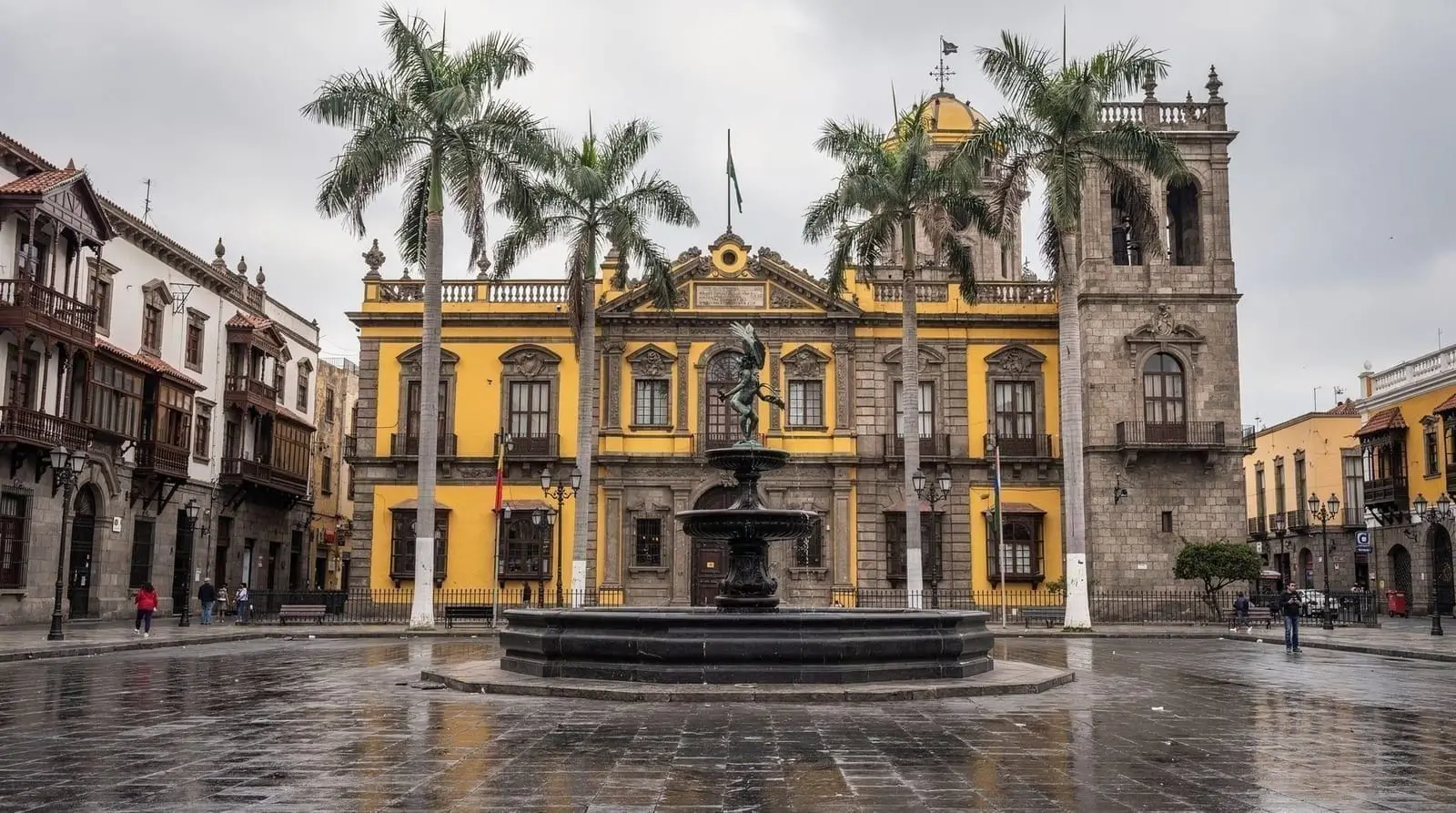
Historic Center of Lima
Honest guide to Lima's UNESCO colonial centre: Plaza Mayor, San Francisco catacombs, real entry prices, opening hours, safety, and what to skip.
Lima: Historic Center Walking Tour with Pisco Sour Tasting
Quick facts
- District
- Cercado de Lima (Centro Histórico)
- Status
- UNESCO World Heritage Site (since 1991)
- Distance from Miraflores
- ~12 km / 25-40 min by taxi
- Currency
- Peruvian sol (S/) — carry small notes
- Best for
- Colonial architecture, baroque churches, catacombs, museums
Why the colonial centre still matters
Most travellers stay in Miraflores and treat Lima as a launch pad for Cusco. That is a reasonable plan, but it skips the one part of the city that explains how Lima came to exist at all. The Centro Histórico — formally the Cercado de Lima — is the original colonial core founded by Francisco Pizarro in 1535 as the Ciudad de los Reyes, the City of Kings. For nearly three centuries it was the most important Spanish city in South America, the seat of a viceroyalty that governed everything from Panama to Patagonia. The wealth that funded its churches and mansions came from Potosí silver, and you can still read that history in the gilded altarpieces and the carved wooden balconies that line the streets.
UNESCO listed the centre in 1991. What you get today is roughly fifteen walkable blocks of plazas, baroque churches, convents, and government buildings, anchored by the Plaza Mayor. It is not a polished open-air museum like Cusco’s centre — it is a working downtown with traffic, street vendors, and money changers — but that is precisely what makes it honest. You are walking through a living city, not a stage set.
Quick answer: is the historic centre worth visiting?
Yes, for a half-day if you have any interest in colonial history or architecture. The Plaza Mayor, the Convento de San Francisco with its catacombs, and a couple of the baroque churches are genuinely worth seeing and cost very little to enter. Skip it only if your Lima time is tight and your interests are purely food and coastline — in which case Miraflores and Barranco deliver more.
| Where | Cercado de Lima, ~12 km northeast of Miraflores |
| Time needed | Half day to a full day |
| Cost | Plaza free; San Francisco catacombs ~S/20; cathedral ~S/30 |
| Getting there | App taxi (S/25–35) or Metropolitano bus (S/3.80) |
| Best time | Weekday mornings, before crowds and before it empties at dusk |
Getting there from Miraflores
The centre sits about 12 km northeast of Miraflores, and depending on Lima’s notoriously variable traffic, the journey time can more than double at peak hours. Your options:
App-based taxi (Cabify, InDriver, Uber): the most reliable choice. Expect S/25–35 / about $7–9 and 25–40 minutes depending on traffic. Never flag an unlicensed street taxi in Lima — fare scams and short-changing are well documented, and they are worse downtown than anywhere else in the city.
Metropolitano bus: Lima’s express bus corridor runs along Paseo de la República straight from Miraflores to the edge of the centre. Get off at Estación Jirón de la Unión or Estación Central. The fare is S/3.80 / under $1 with a rechargeable card bought at any station. During morning and evening peaks it is genuinely faster than a taxi, and it drops you a short walk from the Plaza Mayor.
A practical note: arrive in the morning. The centre empties of office workers by early evening, and the quieter side streets are not where you want to be wandering after dark with a camera out. Most sights close between 5 pm and 6 pm anyway.
Combining with a taxi driver’s local knowledge: if you book a driver for the round trip rather than one-way, many are happy to wait and act as an informal guide to parking and safe streets near your final stop, which is useful if you plan to walk several of the churches listed below rather than sticking to the plaza alone. Confirm the wait fee up front rather than negotiating it after the fact.
Plaza Mayor and the government buildings
Start at the Plaza Mayor (also called the Plaza de Armas), the literal and symbolic heart of colonial Lima. The square is bordered by four landmark buildings:
- The Cathedral of Lima — built on the site Pizarro himself laid out in 1535. Inside is a chapel said to hold his remains, plus a museum of religious art. Entry to the cathedral and its museum runs S/30 / about $8. The choir stalls and the Churrigueresque altarpieces are the highlights.
- The Palacio de Gobierno — the presidential palace, fronting the Rímac River. The changing of the guard takes place daily at around noon, complete with a brass band; it is free to watch from the railings and worth timing your visit around. Interior tours exist but require advance booking through the palace’s official channels and are often suspended.
- The Municipal Palace (Palacio Municipal) — Lima’s city hall, with a notable library and balcony.
- The Archbishop’s Palace (Palacio Arzobispal) — famous for its intricately carved cedar balcony, one of the finest surviving examples of the Moorish-influenced balcony style that defines the centre’s architecture.
The plaza is free and open at all hours, but it is busiest and most pleasant in the morning light. A licensed guide adds a great deal here, because the buildings look handsome but say little without the colonial backstory. A historic centre walking tour with pisco sour tasting covers the plaza, the main churches, and the balconied streets in about three hours, then ends with a hands-on pisco sour workshop — a sensible way to learn the cocktail’s correct ratios rather than guessing.
For a shorter, lower-cost introduction to the same sights, the half-day small-group Lima city tour is a simpler alternative to the walking tour above.
Convento de San Francisco and the catacombs
If you visit one paid attraction in the centre, make it the Basílica y Convento de San Francisco de Asís, two blocks northeast of the Plaza Mayor. The 17th-century baroque complex survived Lima’s major earthquakes thanks to its flexible construction, and it holds two things you will not see elsewhere in the city:
- The library — a colonial-era reading room with roughly 25,000 antique texts, some predating the Spanish conquest of the printing techniques used.
- The catacombs — underground ossuaries that served as Lima’s main cemetery until the early 19th century. The bones of an estimated 25,000 people are arranged in geometric patterns in circular wells and corridors. It is sobering rather than gruesome, and it is the single most memorable thing in the historic centre.
Entry is S/20 / about $5, and you must go with one of the timed guided groups (English and Spanish departures throughout the day, every 30–40 minutes). Allow 60–75 minutes. Photography is not permitted inside the catacombs — respect this, as staff enforce it. Opening hours are roughly 9 am to 5:30 pm daily, with the last tour leaving around 5 pm.
The convent’s cloisters above ground are worth lingering in even before you descend — Sevillian azulejo tilework, a beautifully restored library ceiling, and a hush that contrasts sharply with the traffic just outside the walls. Guides typically walk the cloisters and library first, building context on the Franciscan order’s role in colonial Lima before taking the group down into the ossuaries, so the catacombs land with more weight by the time you reach them.
Combination tours that bundle San Francisco with the wider city are good value if you also want to see the Larco Museum and prefer a single guide for the day. The Larco Museum and city tour with the catacombs and lunch joins the colonial centre, the catacombs, and the pre-Columbian art collection in one circuit, which removes the taxi logistics between districts.
Jirón de la Unión and the balconied streets
Running south from the Plaza Mayor is Jirón de la Unión, a pedestrianised shopping street that was the city’s most fashionable promenade a century ago. Today it is a mix of chain stores, sneaker shops, and a few survivors of older Lima. Two things merit a stop:
- La Merced church, midway down, with a lavish baroque facade and a side altar dedicated to a venerated cross where worshippers queue to touch it.
- La Lucha Sanguchería, a reliable local sandwich chain near Plaza San Martín. A chicharrón or butifarra sandwich runs S/18–22 / about $5–6 and is the honest lunch choice down here, far better value than the tourist cafés ringing the Plaza Mayor.
At the southern end of Jirón de la Unión sits Plaza San Martín, a graceful early-20th-century square with the grand Gran Hotel Bolívar on its corner. The hotel’s old bar is famous for its “Catedral” — an oversized pisco sour — and is a pleasant, slightly faded place for a single drink, though service is slow and it trades heavily on nostalgia.
Look up as you walk these streets: the carved wooden enclosed balconies (balcones) are the defining feature of colonial Lima, designed so residents could watch the street unseen. The Casa de Aliaga, near the Plaza Mayor, is the oldest such mansion still occupied by descendants of the original colonial family; it opens for guided visits by appointment.
The balcony style is not purely decorative. The latticed wooden screens (celosías) allowed the women of a colonial household to observe street life, processions, and passers-by without being seen themselves — a reflection of the strict social conventions of the era. Some of the finest surviving examples combine Moorish lattice patterns brought via Spain with distinctly Peruvian carved detailing, making them a genuine architectural hybrid rather than a straightforward import. A slow walk down Jirón de la Unión with your eyes on the upper storeys, rather than the shopfronts at street level, reveals far more of this than a quick pass-through does.
Beyond the obvious: churches, mansions, and museums
The Plaza Mayor and San Francisco are the headline sights, but the centre rewards anyone willing to spend an extra hour or two on its lesser-known interiors.
Santo Domingo (Jirón Camaná, two blocks from the plaza) holds the tombs of three Peruvian saints — Santa Rosa de Lima, San Martín de Porres, and San Juan Macías — and has a quieter, less rushed atmosphere than San Francisco. Its cloisters, tiled in Sevillian azulejos, are among the prettiest in the city. Entry to the convent and tower is around S/15 / about $4, and you can climb the bell tower for a rooftop view across the colonial roofline.
San Pedro (corner of Jirón Ucayali and Jirón Azángaro) is the former Jesuit church and the best-preserved baroque interior in Lima — gilded altars, Moorish-tiled chapels, and a richly carved pulpit. It is free to enter and frequently overlooked, which means you often have it nearly to yourself.
The Casa de la Literatura Peruana, housed in the beautifully restored former Desamparados railway station behind the Palacio de Gobierno, is a free museum of Peruvian literature with rotating exhibitions and a calm reading room. Even if you read no Spanish, the building itself — all iron, glass, and tilework — is worth the ten-minute detour.
The Museo del Banco Central de Reserva (Jirón Lampa, near Plaza Bolívar) is a genuinely good and entirely free museum of pre-Columbian gold, ceramics, and 19th- and 20th-century Peruvian painting. It is air-conditioned, never crowded, and an excellent place to escape the midday street heat for an hour.
If your interest is the macabre side of colonial history, the Museo de la Inquisición on Plaza Bolívar occupies the building where the Spanish Inquisition tried heresy cases until 1820. Entry is free, and the reconstructed torture chambers and the original carved wooden ceiling of the tribunal room are both striking. It is small — 45 minutes is plenty.
Given that four of these five extra stops are free, a genuinely good half-day is possible on a near-zero budget beyond transport: San Pedro, the Casa de la Literatura, the Museo del Banco Central de Reserva, and the Museo de la Inquisición cost nothing to enter, and only Santo Domingo’s tower climb charges a small fee. Travellers on a tight budget should not assume the centre requires spending; the free museums here are genuinely on par with some paid attractions elsewhere in the city.
A short history, so the buildings make sense
It helps to carry a thumbnail timeline as you walk. Pizarro founded Lima in 1535 on the banks of the Rímac, deliberately siting the new Spanish capital on the coast rather than in the Inca highlands so it could be supplied and defended by sea. For the next 280 years Lima was the seat of the Viceroyalty of Peru, the administrative and commercial hub through which Andean silver flowed to Spain. That wealth built the churches, funded the religious orders, and paid for the carved balconies that mark the merchant houses.
Lima was also one of the most earthquake-prone capitals in the Americas, and its architecture reflects this. The great quakes of 1687 and especially 1746, which levelled much of the city and its port at Callao, forced builders to abandon heavy stone vaulting in favour of quincha — a lightweight lattice of cane and plaster over timber frames. Many of the “stone” facades you see are in fact painted quincha, which is why so much of the centre survived later tremors. When a guide points at a soaring church ceiling and tells you it is essentially basketwork, they are not joking.
Independence came in 1821, when José de San Martín declared it from the balcony of the Municipal Palace on the Plaza Mayor — the reason the southern square bears his name. The 20th century brought decline as the wealthy moved south to Miraflores and San Isidro, and the centre slid into neglect until restoration efforts and the UNESCO listing began to reverse it in the 1990s.
The restoration has been uneven and is still ongoing: some blocks around the Plaza Mayor and Jirón de la Unión are immaculately maintained, while streets just a few hundred metres away can look markedly more worn. That patchiness is itself informative — it shows a real city mid-restoration rather than a finished heritage product, and it is part of why the centre feels lived-in rather than curated for tourists.
Where to eat and refuel
The honest rule downtown is to eat where office workers eat, not where tour buses stop. Beyond La Lucha Sanguchería, a few reliable options:
Tanta (a Gastón Acurio chain with a branch near the Plaza Mayor) is a safe, mid-priced sit-down lunch with classic Peruvian dishes — lomo saltado and ají de gallina around S/35–50 / about $9–13. Not adventurous, but consistent and clean.
El Cordano, a century-old café-bar opposite the Desamparados station, is a Lima institution where presidents and writers have eaten for generations. The butifarra sandwich and a chilcano make a good light meal in a room that has barely changed in decades. It is touristy now but earns its reputation.
For a quick standing snack, the picarones (Andean squash-and-sweet-potato doughnut rings in spiced syrup) sold from carts around the plazas are cheap, hot, and genuinely good — S/5–8 for a portion.
Street-cart emoliente — a warm, herbal barley-based drink sold from thermos flasks by vendors near the plaza in the early morning and evening — is a local ritual worth trying at least once. It costs a couple of soles and is a genuine slice of everyday Lima life rather than a tourist food, which is exactly its appeal.
Avoid the full-service restaurants directly on the Plaza Mayor with menus in four languages and waiters touting from the door. They charge a premium for the location and the food rarely justifies it.
What to skip and the honest warnings
Skip the money changers’ rates on the street. The blue-vested cambistas around Plaza San Martín are legal and often fine, but downtown is exactly where short-change and counterfeit-note tricks happen. Change money at a casa de cambio with a counter, or simply use an ATM in Miraflores before you come. If you do use a street cambista, count the notes yourself in front of them before walking away, and use a currency-conversion app to sanity-check the rate on the spot.
Skip the over-restored “colonial” restaurants on the Plaza Mayor. They charge double for mediocre food on the strength of the view. Eat at La Lucha or wait until you are back in your home district.
Be deliberate about your belongings. Pickpocketing is the real risk here, not violent crime in daylight. Keep your phone in a front pocket, do not stand on the pavement filming with it held out, and carry a day bag worn on the front in crowds. The streets a few blocks beyond the tourist core — particularly toward the Mercado Central and Barrios Altos — are not for casual wandering.
None of this should be read as reason to skip the centre; the risk profile is similar to any dense downtown core in a major Latin American city, and thousands of visitors walk it safely every day by following exactly these basic precautions.
Tourist trap check: street performers and costumed “Inca” characters around the Plaza Mayor will pose with you and then demand payment aggressively. Decline before any photo is taken if you are not willing to pay S/5–10.
How it fits into a Lima itinerary
The historic centre is a classic morning. Pair it with an afternoon at the Museo Larco in Pueblo Libre (about 15 minutes away by taxi), or return to Miraflores for the cliff walk and the Huaca Pucllana pyramid. If you have a full extra day, the centre also combines naturally with Callao Monumental, the regenerated old port district, which is a different and grittier slice of Lima’s history.
For the bigger picture of how many days Lima deserves and where it sits in a longer trip, see the main Lima destination guide, browse the guides hub, or check the sample routes under itineraries. To compare specific guided options side by side, the tours hub lists the city’s main operators, and the tools section has the planning calculators. For more on the city’s best food beyond the centre’s honest lunch counters, see things to do in Lima and the Lima food scene guide.
Frequently asked questions about the Historic Center of Lima
How long do you need in the historic centre?
A focused half-day covers the Plaza Mayor, the Convento de San Francisco with its catacombs, and a walk down Jirón de la Unión to Plaza San Martín. If you add the Cathedral museum and a sit-down lunch, plan a full leisurely morning into early afternoon. There is no need to stay overnight in the centre — base yourself in Miraflores or Barranco and come in for the day. Travellers with a genuine appetite for the smaller free museums (San Pedro, the Casa de la Literatura, the Banco Central de Reserva collection) should budget closer to a full day to do them justice without rushing.
Is the historic centre safe for tourists?
In daylight, along the main tourist route between the Plaza Mayor and Plaza San Martín, yes — but it requires normal big-city caution. Pickpocketing is the main risk, so keep your phone and wallet secure and avoid displaying valuables. The blocks beyond the core toward Barrios Altos and around the Central Market are not recommended for casual exploring. After dark the centre empties out; head back to your district by early evening.
What are the opening hours and entry prices?
The Plaza Mayor itself is free and always open. The Convento de San Francisco charges around S/20 / about $5 and runs guided tours roughly 9 am to 5:30 pm. The Cathedral and its museum cost around S/30 / about $8. Hours can shift on public holidays and during religious events, so check the same week if your schedule is tight.
Can I visit the catacombs without a guide?
No. Access to the San Francisco catacombs is only via the convent’s timed guided groups, which leave every 30–40 minutes in Spanish and English. Photography is prohibited underground. The guided format is part of the price and is worth it, because the guides explain the burial practices and the engineering that kept the complex standing through major earthquakes.
How do I get to the centre from Miraflores?
Take an app-based taxi (Cabify, InDriver, Uber) for S/25–35 / about $7–9 and 25–40 minutes, or ride the Metropolitano express bus along Paseo de la República for S/3.80 with a rechargeable card. The bus is often faster at peak hours and drops you near the Plaza Mayor. Avoid flagging unlicensed street taxis downtown.
Is a guided tour worth it for the historic centre?
For most visitors, yes. The colonial buildings are handsome but cryptic without context, and a guide turns a pleasant walk into a coherent story of viceregal Lima. A half-day walking tour also handles the safer routing for you. If you would rather go independently, the San Francisco convent’s own guided catacomb visit is the one piece you genuinely cannot do alone.
When is the best time of day to visit?
Mornings on weekdays. The light on the balconied facades is best before noon, the office crowds thin out the queues at the churches, and you can time your visit to catch the noon changing of the guard at the Palacio de Gobierno. Sunday afternoons draw the largest local crowds, which is atmospheric but slower for sightseeing.
Top experiences
Bookable activities with verified prices and instant confirmation on GetYourGuide.

