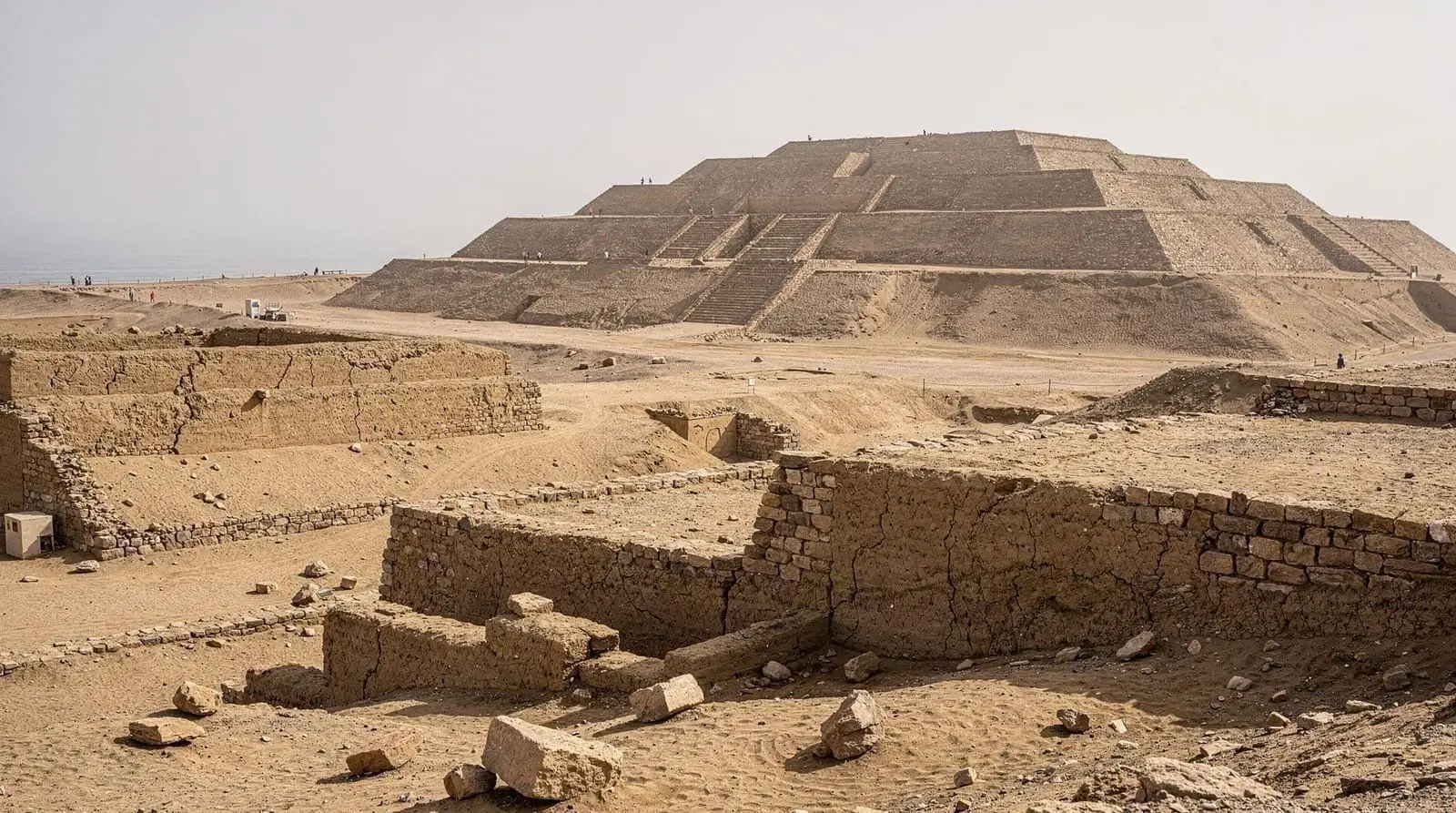
Pachacámac
Pachacámac is one of South America's largest ancient cities, 31 km south of Lima — a half-day trip worth adding to any Peru coastal itinerary.
From Lima: Pachacamac Archaeological Site Guided Tour
Quick facts
- Country
- Peru
- Altitude
- 100 m / 330 ft (coastal desert)
- Currency
- Peruvian sol (S/) — USD widely used
- Best for
- Pre-Columbian archaeology spanning 1,000 years of occupation, coastal desert scenery
Is Pachacámac worth the half-day detour from Lima?
Yes, and it is often overlooked. Most visitors to Lima run the same circuit — Huaca Pucllana, Larco Museum, colonial centre — and miss one of the most significant archaeological sites on the Pacific coast of South America. Pachacámac is not a single monument but an entire ceremonial city: pyramids, plazas, palace complexes, and a pilgrimage quarter that received worshippers from across the Andes for nearly a thousand years.
| Where | 31 km south of Miraflores, on the Panamericana Sur |
| Cost | S/15 (~$4) entry including the site museum |
| Time needed | Half day, 3 hours on site |
| Getting there | App-based taxi from Miraflores, ~45–60 min |
| Best time | Weekday mornings before 11am, year-round |
The site sits 31 km south of Miraflores, about 45–60 minutes by road, and a well-paced half-day visit (leaving Lima by 9 am, returning by 2 pm) fits neatly into a Lima itinerary without consuming a full day. If you are continuing south to Paracas or Ica, Pachacámac is directly on the Panamericana Sur and can be a logical stop en route.
What is Pachacámac?
Pachacámac was a major religious and political centre on the central Peruvian coast, occupied continuously from roughly 200 CE to the Spanish conquest in the 1530s. Multiple cultures built and expanded the site over that millennium: the Lima Culture established the early ceremonial core; the Wari empire added administrative structures during their expansion along the coast around 600–1000 CE; and the Inca incorporated Pachacámac as a prestigious oracle sanctuary in the 1470s, building the Temple of the Sun and expanding the pilgrimage infrastructure.
The oracle of Pachacámac — a carved wooden idol kept in the innermost sanctuary of the main temple — was one of the most important in the Andean world. Pilgrims arrived from Cusco, Trujillo, Nazca, and as far south as the Lake Titicaca region to consult it. When Spanish conquistador Hernando Pizarro arrived in 1533 demanding the oracle’s gold, he found a wooden idol smeared with blood from sacrificial offerings and reportedly little treasure — the gold, if any, had been removed or hidden.
The site covers approximately 600 hectares of coastal desert, with some 17 major architectural complexes in varying states of preservation.
What to see at Pachacámac
Site museum — start here. The on-site museum (included in the entry ticket, S/15 / about $4) houses the wooden Pachacámac idol itself: a forked post carved with two pairs of facing figures, found buried beneath the main temple in 1938. It is one of the most important artefacts ever excavated in Peru. The museum also holds mummy bundles, ceramics, textiles, and architectural reconstructions that provide essential context for the ruins outside.
Temple of the Sun (Templo del Sol) — the highest point of the site and the best preserved of the Inca-period constructions. Built from adobe bricks with painted red, yellow, and white friezes in some sections. The temple terrace gives a panoramic view across the entire archaeological zone and the Pacific beyond. On clear days (November–April) the view extends to the Chorrillos headland and, sometimes, the Lima skyline.
Temple of Pachacámac (Templo Pintado, “Painted Temple”) — the oldest surviving structure on the site, from the Lima Culture period (around 200–600 CE). Partially restored by the Inca, it retains traces of painted geometric friezes on some exterior panels. The climb to the summit is straightforward.
Pilgrimage quarter (mamacona and elite residences) — a series of walled compounds adjacent to the main temples where pilgrims were housed according to status and origin. The Inca-period mamacona compound, where selected women lived and produced textiles and chicha for the oracle cult, is visible from the access path.
Usnhu and Inca plazas — the large open ceremonial spaces used for assembly and redistribution ceremonies during the Inca period.
The site is spread over a significant area and the walking paths are not shaded. Bring water (at least 1.5 litres per person), apply sunscreen generously, and wear a hat. The coastal desert climate means temperatures can reach 28–32 °C on summer afternoons (December–March) even though Lima itself often feels cooler.
Guided tour vs independent visit
The site’s interpretation signage is adequate but uneven: some complexes are well labelled, others have only minimal information. For a first visit, a guided tour adds significant value.
The Pachacámac guided tour from Lima provides transport, an archaeologist or historian guide, and entry ticket — saving you the hassle of taxi negotiations and giving chronological context for the multiple cultural layers. Duration is typically four to five hours including transport. Alternatively, the direct site visit from Lima offers transport and a more compact self-guided experience suited to travellers who prefer to explore independently.
If you go independently: take an app-based taxi (Taxi Beat, InDriver, Cabify) from Miraflores for approximately S/50–60 one way to the site entrance. The return taxi is harder to arrange on site; ask the entrance staff about local radio taxi numbers, or arrange for your Miraflores driver to wait (typically S/15–20 extra per hour).
Combining Pachacámac with Miraflores and Barranco
Pachacámac works best as a morning excursion followed by an afternoon back in Lima. A practical half-day structure:
- 8:30 am — Taxi from Miraflores to Pachacámac (~S/55, 45–55 min)
- 9:30 am–12:30 pm — Site museum + Temple of the Sun + Painted Temple + pilgrimage quarter
- 12:30 pm — Return taxi to Lima (~S/55, 45–60 min)
- 2:00 pm — Late ceviche lunch in Miraflores (most cevicherías serve until 4 pm)
- Evening — Barranco for street art, galleries, and dinner
This leaves time for a meaningful three-hour visit without rushing. If you have more time, the on-site café serves basic Peruvian lunches at S/25–35.
Travellers building a broader Lima day-trips plan around Pachacámac often pair it with a Lurín seafood lunch on the way back, or extend the day with a stop at Barranco for the evening rather than heading straight back to Miraflores. The Lima day trips guide covers Pachacámac alongside the other worthwhile excursions from the city, useful if you have more than one spare half-day.
Pachacámac also sits directly on the Panamericana Sur heading south. Travellers continuing to Paracas (260 km south) or Huacachina can stop here en route without significant detour — just confirm the logistics with your bus company or private driver in advance.
What first-time visitors get wrong
The most common mistake is treating Pachacámac like a single photogenic pyramid rather than a sprawling multi-era city — visitors who rush straight to the Temple of the Sun for photos and skip the museum miss the context that makes the site make sense, since the temple alone doesn’t explain who built what, or why the Inca built theirs directly beside a nine-centuries-older sanctuary rather than on top of it.
A second common error is underestimating the walking distance and the sun: the complexes are spread across roughly 600 hectares with almost no shade, and travellers who arrive without water or a hat in the December–March heat cut their visit short. Finally, some visitors assume Spanish-only signage means a guide is essential; in practice, reading the museum panels first and picking up a simple printed site map at the entrance is enough for an independent visitor prepared to piece the chronology together.
The site in context: why Pachacámac matters
Most Peru visitors focus their archaeological attention on the Inca: Machu Picchu, the Sacred Valley, Cusco. Pachacámac is a useful corrective to that Inca-centric view. The site’s most important periods predate Inca expansion by centuries — the Lima Culture pyramid at its core was already 900 years old when the Inca arrived.
Understanding Pachacámac also illuminates the political strategy of the Inca empire. Rather than destroying the existing oracle cult, the Inca incorporated it: they built a new Temple of the Sun immediately adjacent to the original sanctuary, establishing symbolic Inca authority without erasing the local religious tradition. The oracle continued to operate and receive pilgrims throughout the Inca period and right up to the Spanish conquest. This pattern of incorporation rather than suppression was a defining feature of Inca imperial expansion and is visible across many sites — but Pachacámac is one of the clearest surviving examples.
If you are continuing to Cusco or the Sacred Valley after Lima, Pachacámac gives you a foundation for understanding the pre-Inca world that Cusco’s own museums largely take for granted. The Larco Museum in Miraflores covers the broader coastal cultures in more depth; the two visits are complementary rather than repetitive.
Pachacámac vs Lima’s other archaeology
| Site | Scale | Best for | Time needed |
|---|---|---|---|
| Pachacámac | ~600 hectares, 17 complexes | Multi-culture context, the wooden idol | Half day |
| Huaca Pucllana | Single pyramid | Evening visits, restaurant on site | 1–2 hours |
| Larco Museum | Museum collection | Ceramics, erotic gallery, gardens | 2 hours |
Travellers with only one afternoon in Lima for archaeology often default to Huaca Pucllana simply because it sits inside Miraflores; Pachacámac requires the extra half-day, but the Larco Museum guide and things to do in Lima guide both make the case that the three sites tell complementary rather than repetitive stories.
Practical details
Entry: S/15 / about $4 per person; includes site museum. Open daily 9 am–5 pm (last entry 4 pm).
Getting there: App-based taxi from Miraflores, ~S/50–60 one way, 45–60 minutes. No direct public transport from the tourist districts; the collective microbuses running along the Panamericana work for experienced Lima bus users but are not recommended for first-time visitors with luggage.
On-site facilities: Small café and drink kiosk near the museum; basic toilets at the site entrance. No ATM. Bring cash for incidental purchases.
Photography: Permitted throughout the site including the museum, with restrictions on flash photography near the wooden idol. The late-afternoon light (3–5 pm) is excellent for the Temple of the Sun, but that timing risks a rush-hour return to Lima. Morning light is better for the Painted Temple’s western face.
Children: The site walking paths are firm and relatively flat between monuments. Manageable for children over 5 with appropriate sun protection; the museum’s mummy and textile displays engage older children well.
For the full Lima visitor context — including how Pachacámac fits into a two- or three-day Lima itinerary — see /destinations/lima/. For planning the wider Peru trip, see /guides/peru-2-week-itinerary-guide/ or browse /itineraries/.
Frequently asked questions about Pachacámac
How far is Pachacámac from Lima?
31 km south of Miraflores via the Panamericana Sur. In normal traffic the drive takes 45–55 minutes; in Lima rush hour (7–9 am or 5–8 pm) it can stretch to 75–90 minutes. Plan departures for 8–9 am to arrive before the midday heat and tour group buses.
Is Pachacámac better than Huaca Pucllana?
They are different in scale and character. Huaca Pucllana in Miraflores is a single pyramid with excellent evening visits and a good restaurant; it is intimate and easy to combine with the rest of a Miraflores afternoon. Pachacámac is a vastly larger multi-culture site with an outstanding museum holding the wooden idol — more significant archaeologically, but requiring a dedicated half-day excursion. If you have time for both, do both; if you have to choose, Pachacámac rewards the greater investment.
Can I visit Pachacámac without a guide?
Yes. The entry fee includes the museum and access to all open areas of the site. Interpretation signage is present at the main structures in Spanish and partial English. The experience is richer with a guide for the stratigraphic and cultural context — particularly for understanding the shift from Lima Culture to Wari to Inca occupation — but independent visitors who read the museum carefully first can navigate the site effectively.
What should I bring?
Water (at least 1.5 litres per person), sunscreen, a hat, and comfortable closed-toe shoes. The paths are dry coastal desert; there is no shade between monuments. A light layer for the morning coastal chill (it can be 15–18 °C at 9 am even in summer) that you can shed by 11 am.
Is Pachacámac included in the Lima Boleto Turístico?
No. Pachacámac is managed separately by the Ministerio de Cultura and has its own entry fee (S/15 / about $4). The Lima Boleto Turístico covers some museum and colonial-era sites in the historic centre but not this site. Check /tools/ for current combined ticket options.
How does Pachacámac compare to pre-Columbian sites near Trujillo?
Trujillo’s Chan Chan (Chimu, c. 850–1470 CE) and the Huacas del Sol y de la Luna (Moche, c. 100–700 CE) are both larger and in some respects more dramatically preserved than individual Pachacámac monuments. However, Pachacámac’s exceptional site museum, particularly the wooden idol, and the multi-culture layering of over a millennium of occupation make it uniquely informative. If your Peru itinerary includes Trujillo, do not skip Pachacámac on the assumption that the north coast will cover your pre-Columbian interest — the sites tell fundamentally different stories.
Does the site get crowded?
Weekdays before 11 am are reliably quiet. Weekend mornings see domestic Lima families — the site is popular with Peruvian school groups on Saturdays. Tour group buses typically arrive between 10 am and noon, peaking around 11:30 am. If you arrive at 9 am on a weekday, you will often have the main monuments to yourself for the first hour. The site museum can feel cramped when a school group is moving through, but they generally spend less time at the ruins themselves, so the outdoor areas stay manageable throughout the day.
Is there food on site?
A small café near the museum entrance serves Peruvian set lunches (S/25–35) and cold drinks. The selection is basic — fried rice, simple stews, packaged snacks. If you want a proper meal, return to Lima or, if you are heading south, stop in Lurín (the small town adjacent to the site) where there are several seafood restaurants along the Panamericana serving fresh fish ceviche at S/25–40 for a full plate.
Top experiences
Bookable activities with verified prices and instant confirmation on GetYourGuide.

