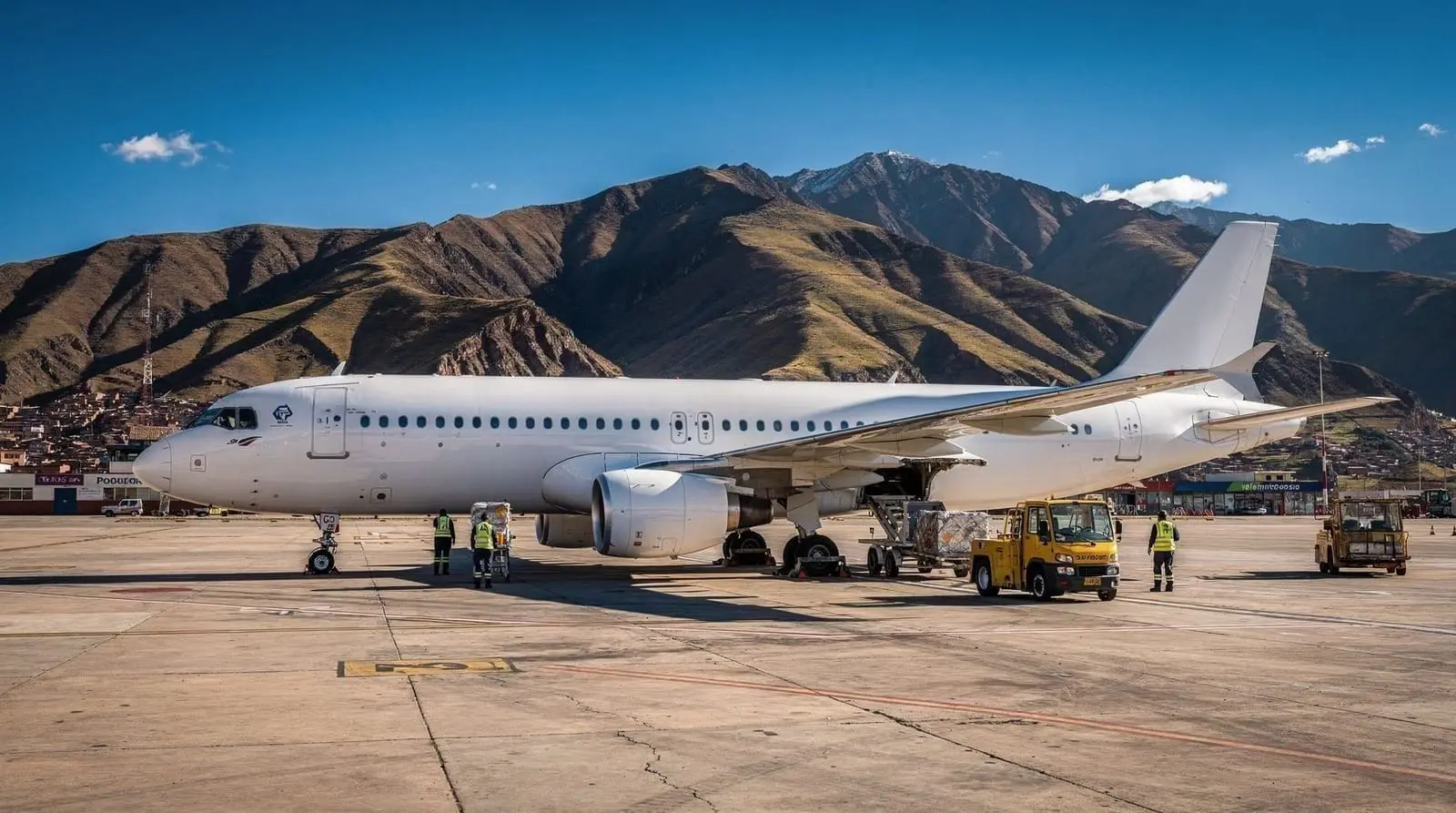
Lima to Cusco flights: airlines, prices and how to fly smart
Cusco: Half-Day City Tour with Sacsayhuaman and Q’enco
How do you fly from Lima to Cusco?
The Lima to Cusco flight takes about 1 hour 20 minutes and is operated mainly by LATAM, Sky Airline and JetSmart, with dozens of daily departures. Book a morning flight for the best weather and lowest cancellation risk, expect one-way fares of roughly $40 to $130 depending on timing and baggage, and plan to take it easy on arrival because Cusco sits at 3,400 m.
The one flight almost every Peru trip includes
If you are visiting Cusco, Machu Picchu, the Sacred Valley or Rainbow Mountain, you will almost certainly fly Lima to Cusco at some point — it is the busiest tourist air route in the country and the practical front door to the Andes. Getting it right saves money, avoids the dreaded afternoon cancellation, and starts your altitude adjustment on the correct foot. Getting it wrong means a blown budget, a lost day, or a brutal first night gasping at 3,400 m.
This guide covers the airlines, the real fares, the timing that actually matters, the baggage traps that catch first-timers, and the altitude reality of going from sea level to high Andes in 80 minutes. It is editorial and independent — no flight is sold here, just the planning you need. For the wider picture of reaching the region, pair it with our getting to Cusco guide and the Cusco airport guide.
| Flight time | ~1 hour 20 minutes |
| Fare range | around $40-160 one-way |
| Best time to fly | Morning, earliest available |
| Airlines | LATAM, Sky Airline, JetSmart |
| Arrival altitude | 3,400 m — rest, hydrate, no alcohol |
The route in numbers
- Flight time: roughly 1 hour 20 minutes in the air.
- Distance: about 590 km, but the relevant fact is vertical, not horizontal — you climb from Lima at sea level to Cusco at 3,400 m.
- Frequency: dozens of daily departures across the carriers, clustered heavily in the early morning.
- From: Jorge Chávez International Airport (LIM) in Callao, near Lima.
- To: Alejandro Velasco Astete International Airport (CUZ), a 10-minute drive from Cusco’s centre.
Cusco’s airport is small, hemmed in by mountains, and handles enormous tourist volume through a single short runway. That geography is the source of most of the route’s quirks, especially the afternoon weather problems.
The airlines, compared honestly
Three carriers dominate the route, and the choice is a classic trade-off between reliability and price.
LATAM. The largest operator, with the most frequencies, the best on-time record, and the most generous standard fares (a carry-on plus often a checked bag included on full fares). It is also the most expensive. If a missed connection or a cancelled flight would wreck your itinerary — for instance, if you have a fixed Machu Picchu or Inca Trail date the next day — LATAM’s reliability is worth paying for.
Sky Airline. A low-cost carrier with competitive base fares and a decent network on the route. Expect to pay separately for checked bags, seat selection and sometimes carry-on weight. Service is no-frills but the planes get you there.
JetSmart. The other ultra-low-cost option, often with the cheapest headline fares. Same model as Sky: a bare base price, then add-ons for everything. Watch the carry-on rules closely, as the allowance is strict and enforced.
The honest rule: compare the all-in price, not the teaser fare. A $40 JetSmart base fare can climb past a LATAM fare once you add a checked bag, a seat and a carry-on. For travellers with only a backpack and flexible plans, the low-cost carriers genuinely save money. For anyone with a tight, fixed itinerary or checked luggage, LATAM’s full fare is frequently better value than it looks. Our Peru domestic flights guide covers how these carriers behave across the whole country.
What you will actually pay
Fares swing widely, but as a realistic 2026 guide for one-way Lima–Cusco:
- $40–70 — low-cost carrier, no checked bag, booked a few weeks ahead, off-peak.
- $70–110 — typical mid-range fare with a bag, or a LATAM economy seat booked in advance.
- $120–160+ — last-minute bookings, peak season (June to August), or full-flex LATAM fares.
The levers that move the price:
- Book ahead. Two to six weeks out hits the sweet spot. Same-week fares spike hard.
- Avoid the June–August peak. Dry-season high tourism pushes fares up across all carriers.
- Be flexible on time of day for price — but not at the cost of the morning-flight reliability rule below.
- Price in the bags. A low-cost fare without luggage is a different product from a full fare; do the full sum.
One pricing note: some travellers report seeing slightly different fares for Peruvian residents versus foreigners on certain promotions. Book through the airline’s own site in a consistent currency and read the fare conditions rather than chasing a third-party “deal.”
Timing: why morning flights win
This is the most important practical advice in the guide. Fly to Cusco in the morning, ideally the earliest departure you can stomach.
Cusco’s airport sits in a mountain bowl where, as the day warms, cloud, wind and afternoon storms build — especially in the wet season (November to March) but to some degree year-round. Pilots need decent visibility to land on that short, high-altitude runway. The result is a clear pattern: afternoon and evening flights face a far higher chance of delay, diversion or outright cancellation than morning ones. When Cusco weather closes the airport, knock-on cancellations cascade through the rest of the day.
Booking the first or second flight of the morning does three things: it maximises your odds of actually arriving on schedule, it gives you a buffer to rebook if your flight is the rare morning casualty, and it lands you in Cusco with the whole afternoon to rest and start acclimatising. If your plan depends on being in Cusco by a certain time — a connecting Sacred Valley transfer, a next-day trek start — never trust an afternoon flight to deliver you.
Bus and train alternatives, briefly
For completeness: you can reach Cusco overland, but for this specific route it rarely makes sense.
- Bus: Direct Lima–Cusco buses (Cruz del Sur and others) take a punishing 20 to 22 hours over the mountains. Given how modestly more a flight often costs, the bus only appeals to the very budget-conscious or those breaking the trip at stops like Nazca, Ica and Arequipa. Our Peru bus travel guide covers how to do it well if you choose this.
- Train: There is no direct train from Lima to Cusco. Rail in this region runs within the Sacred Valley to Machu Picchu, not from the coast.
For nearly all travellers, the 80-minute flight is the obvious choice.
Arriving: the altitude reality
Here is the part the airlines never mention. You will go from sea level in Lima to 3,400 m in Cusco in under two hours. Your body gets no time to adjust during the flight, so you step off the plane into roughly 35 percent less oxygen than you are used to. A real share of travellers feel altitude sickness — headache, breathlessness, nausea, poor sleep — on their first night in Cusco precisely because of this abrupt jump.
Rules for arrival day:
- Do nothing strenuous. No hauling bags up stairs, no rushing off to Sacsayhuamán. Rest.
- Hydrate hard — three or more litres of water.
- Skip alcohol for the first day or two; that arrival-night pisco sour is the classic mistake.
- Eat light and let your body register the elevation.
- Consider the counter-intuitive move: rather than sleeping in Cusco on night one, transfer straight down to the lower Sacred Valley (Urubamba 2,870 m, Ollantaytambo 2,790 m) and acclimatise there first. It is genuinely easier on the body.
Our altitude sickness guide and Cusco altitude vs Sacred Valley comparison go into the detail. The short version: the flight is the easy part — the altitude on arrival is what catches people out.
Getting from the airport into Cusco
Velasco Astete (CUZ) is barely 10 minutes from the Plaza de Armas, which makes the transfer mercifully simple after the altitude jolt.
- Official airport taxi: S/20–30 to the centre. Use the marked desks inside; drivers loitering outside quote more.
- App taxis (InDriver, Cabify) work and remove the haggling.
- Hotel pickup: Many Cusco hotels arrange a driver for a fixed, fair fare — worth booking when you are likely to feel rough on arrival.
Agree the fare before you get in, and carry small soles notes. The airport is compact and chaotic at the morning-arrival rush, so don’t expect a serene exit.
Baggage: the trap that catches first-timers
The most common way travellers overpay on this route is baggage. The low-cost carriers — Sky and JetSmart — advertise headline fares that include only a small personal item, not a full carry-on and certainly not a checked bag. Add those at booking and the cheap fare often rises to within a few dollars of LATAM’s full fare, which frequently includes more generous allowances. Add them at the airport instead, and you pay a steep penalty.
A few rules keep you out of trouble:
- Add bags when you book, never at the gate. Airport baggage fees on the low-cost carriers are punishing compared with the online price.
- Weigh your carry-on at home. The low-cost carriers enforce carry-on weight and size strictly, and a bag pulled at the gate gets the expensive treatment.
- Watch the regional baggage culture. Many travellers underestimate how much the budget model unbundles; treat the base fare as a starting point, not the price.
- Trekkers, factor in gear. If you are carrying boots, poles and cold-weather kit for Salkantay, Lares or the Inca Trail, the baggage maths can tip the balance toward a full fare with included luggage.
The honest bottom line on baggage is that the cheapest fare is only cheap for travellers with very little to carry. Do the full sum including everything you will actually bring, and the real best value often turns out to be a mid-tier fare rather than the rock-bottom one. Our Peru domestic flights guide goes deeper on how the carriers’ baggage rules play out across the country.
What to do (and not do) once you land
Assuming you followed the advice above and landed on a morning flight, resist the urge to fill the rest of the day with sightseeing. The single best use of your first afternoon in Cusco is rest — check into your hotel, drink water steadily, and take a short, flat walk around the Plaza de Armas at most. Sacsayhuamán and the steep San Blas streets can wait a day. Once you have had a full night’s sleep at altitude and feel reasonably normal, an easy, guided half-day is a good way to ease into sightseeing without overexerting yourself: something like a half-day Cusco city tour keeps the pace gentle and lets a guide handle the logistics while your body finishes adjusting.
Connecting flights and multi-leg routing
Not every Lima–Cusco flight is a simple point-to-point hop. Many travellers book it as one leg of a longer domestic routing — Lima to Cusco, then later Cusco to Puno or Cusco to Arequipa — and it is worth booking these with the same care as the Lima leg. The same morning-flight rule applies at every leg that touches Cusco’s weather-sensitive airport, not just the first one.
If your itinerary has you flying back through Lima later in the trip (for example, before an international departure), build in the same buffer-day discipline: never schedule a same-day connection between a Cusco flight and an international flight, since a single weather delay can cascade into a missed connection. Our Peru domestic flights guide covers how the multi-city routing works across LATAM, Sky and JetSmart’s networks.
Delays, cancellations and how to protect your trip
Because Cusco’s airport is weather-sensitive, delays and cancellations are a normal part of this route rather than a rare disaster — and the travellers who cope best are the ones who planned for the possibility. The chain reaction is predictable: morning fog or afternoon storms close the runway, flights back up, and by evening the schedule is in disarray. A cancelled flight is rebooked onto the next available seat, which in high season can be the following day.
To protect yourself:
- Build a buffer day. Never schedule your Lima–Cusco flight for the same day as a fixed, non-refundable commitment like an Inca Trail start or a timed Machu Picchu entry. Arrive a day early.
- Fly in the morning. It is worth repeating — the early flights have the best weather odds and leave you the rest of the day to rebook if yours is the rare casualty.
- Keep your bookings flexible where you can, and know your airline’s rebooking policy before you need it.
- Consider travel insurance that covers domestic flight disruption, especially if your itinerary is tight or expensive downstream.
- Don’t book the last flight of the day for anything important — if it cancels, there is no same-day alternative.
The point is not to be anxious about the route, which carries enormous traffic safely every day, but to respect that mountain weather occasionally wins. A single buffer day removes almost all the risk that a weather cancellation could derail the expensive, hard-to-rebook parts of your trip. For the broader logistics of reaching the region by any means, see our getting to Cusco guide.