Nazca Lines complete guide
From Nazca: 30-Minute Flight over Nazca Lines
What is the best way to see the Nazca Lines?
A 30-to-35-minute light-aircraft overflight is the only way to see the famous figures properly. Flights leave from Nazca (cheapest, closest), Ica (mid-priced) and Pisco/Paracas (longest, dearest). The roadside viewing tower shows just three figures and is a poor substitute.
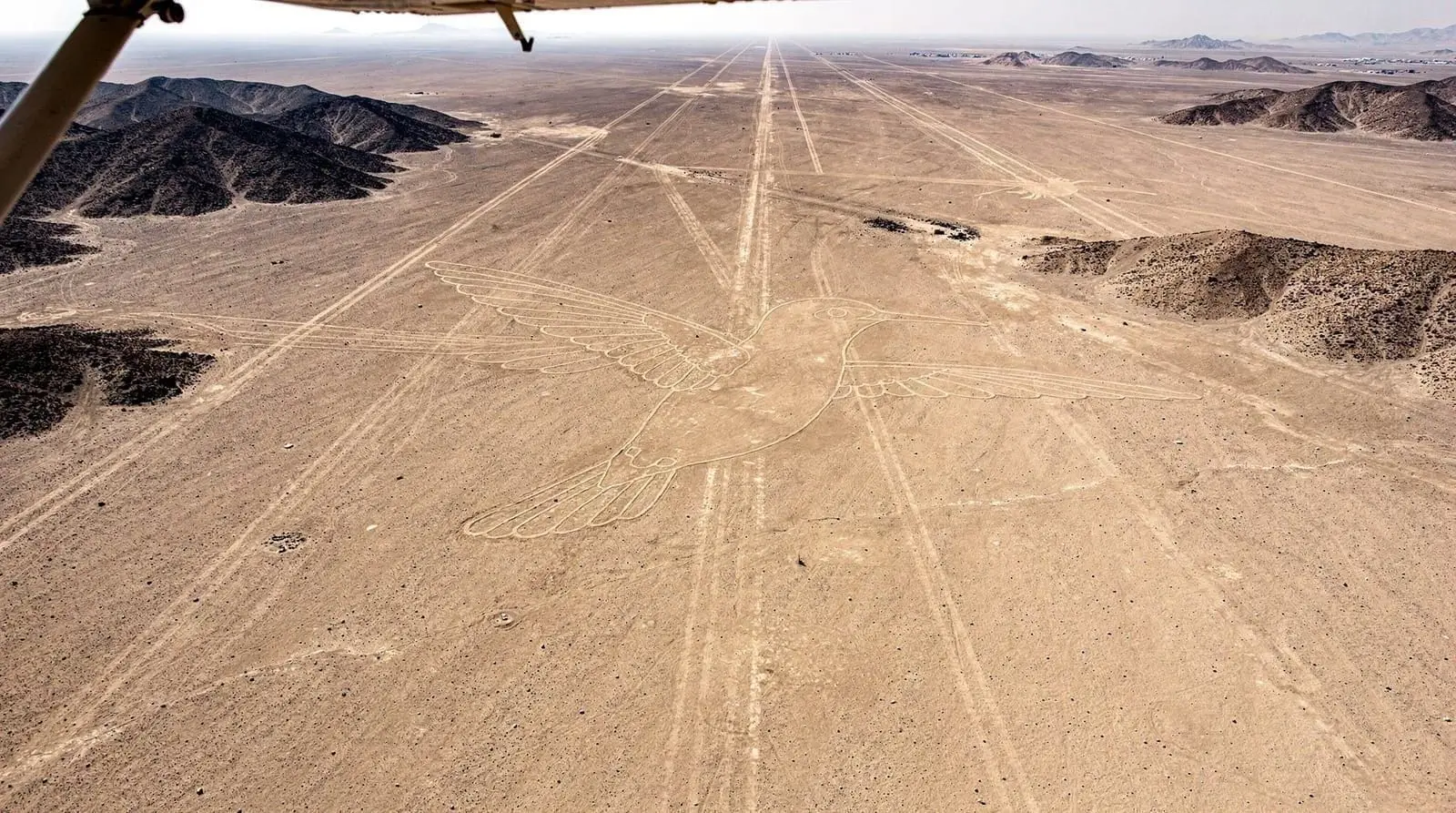
The Nazca Lines are several hundred geoglyphs — straight lines, geometric shapes and figurative drawings of a monkey, a hummingbird, a spider, a condor and more — etched into the desert floor across roughly 450 square kilometres south of the town of Nazca. They were made between about 500 BCE and 500 CE by removing the dark, iron-oxide surface stones to expose the pale ground beneath, and the bone-dry, windless climate has preserved them for two millennia. Almost all of them are only legible from the air, which is the central practical fact of any visit: to see the Nazca Lines properly, you have to fly.
This guide covers the three places you can fly from, what each costs and how long it takes, the limited ground alternatives, the air-sickness reality nobody warns you about, and how to slot the lines into a south-coast trip. For the operator-by-operator safety record, read the companion Nazca Lines flight safety guide; for the candid “is it worth it” verdict, see is the Nazca flight worth it.
| Where to fly from | Nazca (closest/cheapest), Ica, or Pisco/Paracas |
| Cost | Around $80-120 from Nazca, more from Ica or Pisco |
| Flight time | 30-35 min from Nazca; 60-90 min total from Ica/Pisco |
| Best time | Earliest slot of the day, before heat and turbulence build |
| Book ahead | Yes, ideally the day before for the first departure |
| Ground-only view | Mirador tower shows 3 figures only — a poor substitute |
The three places you can fly from
Nazca (Maria Reiche Aerodrome)
This is the closest airfield to the geoglyphs and the default choice. Flights are the shortest and most efficient — about 30 to 35 minutes in the air, almost all of it directly over the figures — and the cheapest, roughly $80 to $120 USD depending on operator and season, plus an airport tax of around S/30 paid on the day. The named tour is the standard 30-minute circuit:
From Nazca: 30-Minute Flight over Nazca LinesThe drawback is that you have to get to Nazca, a long bus ride (around 7 to 8 hours from Lima, 3 to 3.5 from Ica).
Ica
Ica’s airfield is north of the geoglyph field, so flights add roughly 25 minutes of transit flying each way. They cost more than the Nazca departures and the total airborne time is longer, but they suit travellers basing themselves at the Huacachina oasis who do not want to continue south to Nazca town.
From Ica: Flight over the Nazca LinesPisco / Paracas
The Pisco San Andrés airfield is the farthest north, so these are the longest and most expensive flights — often 60 to 90 minutes total — but they are the natural pick if you are already in Paracas and want the lines without backtracking south. The extra cost buys you the saved bus legs.
Nazca Lines Flight from Pisco AirportThe honest rule of thumb: fly from wherever you already are. The flying experience over the figures themselves is similar from each; what differs is price, total air time and how much overland travel you avoid. The full cost-benefit breakdown is in is the Nazca flight worth it.
The three departure points compared
| Nazca | Ica | Pisco/Paracas | |
|---|---|---|---|
| Distance to figures | Closest | ~25 min transit | Farthest |
| Flight time | 30-35 min | ~60 min total | 60-90 min total |
| Cost | Cheapest | Mid | Highest |
| Best for | Anyone routing through Nazca town | Huacachina-based travellers | Paracas-based travellers avoiding backtrack |
What the flight is actually like
The aircraft are small high-wing Cessnas seating around 6 to 12 passengers plus two pilots. To give both sides of the cabin a view, the pilot banks the plane hard left, then hard right, over each figure in turn. The result is a sequence of steep, repeated turns at low altitude — and this is the part nobody mentions in the brochures: a large share of passengers feel air-sick. The combination of small plane, banking, desert thermals and craning your neck to spot figures is a recipe for nausea.
Mitigate it the same way you would any motion sickness: take medication 30 to 60 minutes before, eat lightly beforehand (not nothing — an empty stomach is worse), book the earliest flight of the day before the desert heats and the air gets bumpy, sit near the wing, and look out at the horizon between figures rather than down the whole time. Even with all that, expect the turns to be intense.
The flight order typically covers the whale, the trapezoids, the astronaut/owl-man on a hillside, the monkey, the dog, the hummingbird, the spider, the condor, the heron, the parrot, the hands and the tree. The pilots call out each figure and which side to look. You get one or two passes per figure, so have your camera ready and shoot fast.
Who made the lines, and why
Knowing a little of the backstory makes the flight land harder. The geoglyphs are the work of the Nazca culture, which flourished in this valley between roughly 100 BCE and 800 CE — the same people who built the underground Cantalloc aqueducts and the adobe pyramids of Cahuachi. They made the figures by lifting the dark, oxidised surface pebbles to expose the pale gypsum-rich ground a few centimetres below, an astonishingly durable technique in a region that gets almost no rain and little wind at ground level.
The “why” remains genuinely open. The German mathematician Maria Reiche spent some fifty years from the 1940s surveying, mapping and physically protecting the lines, and argued they formed a vast astronomical calendar tracking solstices and star risings. Later researchers have leaned toward a water-and-fertility reading: many lines point to sources of water in a desperately dry land, and the long straight paths may have been ritual walkways used in ceremonies pleading for rain.
Others note the figures echo motifs on Nazca pottery and textiles. No single theory has won, which is part of the appeal — you are flying over a two-thousand-year-old question nobody has fully answered. The Maria Reiche Planetarium in Nazca lays out the competing ideas clearly and is the best primer before or after a flight.
A practical booking and arrival checklist
A little organisation prevents the two classic Nazca disappointments — a cancelled flight you cannot rebook, and a nauseating midday slot.
- Book the earliest slot the operator offers, ideally the day before so you can be at the aerodrome at opening.
- Carry the airport tax separately — roughly S/30 at Nazca, collected at the airfield in soles, on top of the ticket price.
- Eat a light breakfast, not nothing, and take motion-sickness medication 30 to 60 minutes before.
- Leave a buffer. Never schedule the flight on a day you must catch an onward bus right after; delays of an hour or two are routine and weather cancellations happen.
- Weigh-in is normal. Small aircraft balance passengers by weight, so do not be surprised if you are weighed and assigned a seat for trim.
Seeing the lines without flying
You can see a small fraction from the ground, and it is worth tempering expectations.
- The mirador (viewing tower): a metal tower on the Panamericana, about 20 km north of Nazca, gives a low-angle view of three figures — the hands, the tree, and a lizard the highway was unfortunately cut straight through in the 1930s before anyone realised what it was. Entry is a few soles. It is a fine free-ish stop but no substitute for flying.
- Natural hill viewpoints (cerros): a couple of low hills near the Panamericana offer slightly elevated views of some lines, but again only a handful of figures and at a poor angle.
There is also the Maria Reiche Planetarium in Nazca, named for the German mathematician who spent decades surveying and protecting the lines, which explains the leading theories about who made them and why (astronomical calendar, water-cult ritual pathways, and others). It is a good evening complement to a flight.
A realistic expectation-setter: from the mirador you see the hands, the tree and the side-on lizard, and that is essentially it. It costs only a few soles and is a worthwhile stop if you are driving past on the Panamericana anyway, but nobody who has seen the figures from the air would call it a substitute. Treat it as context, not the main event.
Season, weather and cancellations
The Nazca desert is dry almost year-round, so rain rarely cancels a flight, but wind and visibility do. The steadiest flying conditions are in the cooler, drier months from roughly May to September, when mornings are calm and clear before the desert heats up. Flights can still be delayed or cancelled for wind, low cloud, or an aircraft going into maintenance, and operators will rebook you rather than refund where possible — which is exactly why building a buffer day into your Nazca stop matters more than the flight cost itself. If you are travelling in the shoulder or wetter months (November to March), treat the first available morning as provisional and avoid booking an onward bus for the same afternoon.
Getting to Nazca and where to stay
Nazca town is a long way down the Panamericana Sur, and the journey is the real cost of the flight.
- From Lima: 7 to 8 hours by bus (Cruz del Sur, Oltursa and Civa run the comfortable overnight and daytime services; roughly S/60 to S/120 by class).
- From Ica / Huacachina: 3 to 3.5 hours, the common approach if you are already on the south coast.
- From Paracas: about 3.5 to 4 hours, though many travellers based here choose to fly the lines from Pisco instead and skip the drive.
Nazca itself is a functional desert town that exists largely to service the flight, so set expectations low and stay one night. Reliable mid-range options include the Hotel Nazca Lines (the historic property where Maria Reiche herself lived for years, with a pleasant pool) and the DM Hoteles Nazca; budget travellers have Kunan Wasi and assorted hostels near the Plaza de Armas. A double runs S/120 to S/300, a dorm bed S/35 to S/70. Eat around the plaza rather than at the bus terminal, where prices and quality both suffer.
Some travellers instead do Nazca as a long day trip without an overnight, flying in from Lima or Ica and flying or busing straight back out. This works if your schedule is genuinely tight, but it leaves no slack for a weather delay and skips Chauchilla and the planetarium — an overnight stay is the more comfortable and more resilient plan.
What else is around Nazca
Most travellers pair the overflight with the Chauchilla cemetery, an open desert burial ground 30 km south where pre-Columbian mummies sit in their tombs, hair and textiles preserved by the arid climate. Combined with the Cantalloc aqueducts (still-functioning pre-Inca spiral wells) and the Cahuachi ceremonial mounds, Nazca town can fill a full day beyond the flight itself.
From Ica: Flight over the Nazca LinesCosts at a glance
- Nazca flight: ~$80 to $120 USD + ~S/30 airport tax
- Ica flight: higher than Nazca (extra transit flying)
- Pisco/Paracas flight: highest (longest transit)
- Mirador tower: a few soles
- Planetarium: ~S/20 to S/30
- Chauchilla cemetery tour: ~S/40 to S/60 plus entry
Prices move with season and demand; the dry, high-season months bring more flights and steadier pricing.
The major figures you will see
It helps to know the headline geoglyphs before you board, because the pilots call them out fast and you only get a pass or two each:
- The hummingbird (about 93 metres long) — the most reproduced figure, clean-lined and instantly recognisable.
- The monkey — a spiral-tailed figure that reads clearly from the air and appears on much Nazca pottery.
- The spider (around 46 metres) — precise and geometric, often cited in the astronomical-calendar theories.
- The condor — the largest of the bird figures, wings spread across the desert floor.
- The astronaut or “owl-man” — a humanoid figure cut into a hillside, the only major one on a slope, so it is visible from the ground as well.
- The hands and the tree — the two figures beside the roadside mirador, the only ones non-fliers can glimpse.
The whale, the dog, the heron, the parrot and dozens of straight lines and trapezoids fill out the circuit. Knowing the order and roughly what to look for turns a blur of “where? where?” into a series of clear sightings.
A practical camera tip: use a wide-angle setting or your phone’s standard lens rather than zooming in, since the figures are large and the plane banks quickly — by the time you have framed a tight shot the moment has often passed. Burst mode helps more than careful composition here.
How it fits a south-coast trip
The lines are the southern anchor of the Lima-to-Paracas-Nazca itinerary. A clean run does Paracas and the Ballestas, then Ica and Huacachina, then south to Nazca for the flight and Chauchilla, before returning north or continuing inland. The south coast 2-day guide compresses it; the how many days in Peru guide helps you decide whether the detour earns its place. Browse packaged loops on the tours hub and build your own on the itineraries hub.
Frequently asked questions about Nazca Lines complete
Can you see the Nazca Lines without flying?
Where should I fly the Nazca Lines from?
How long is the Nazca Lines flight?
How much does the Nazca Lines flight cost?
Is the Nazca Lines flight safe?
Top experiences
Bookable activities with verified prices and instant confirmation on GetYourGuide.
