Paracas
Boat tours to the Ballestas Islands, the wild Paracas National Reserve and El Candelabro — what to see, when, and how to get there.
Paracas: Ballestas Islands and National Reserve
Quick facts
- Country
- Peru
- Altitude
- Sea level
- Currency
- Peruvian sol (S/) — USD widely used
- Best for
- Wildlife, sea birds, sea lions, remote desert coast
Four hours south of Lima, where the Andes drop to the sea and the Humboldt Current sweeps north with cold, nutrient-rich water, Paracas is the kind of place that makes you reconsider what Peru means. This is not Inca stonework or colonial churches — it is barking sea lions, vast colonies of Humboldt penguins, pelicans in formation, and a desert peninsula so stark and lunar that it was used as a stand-in for Mars in a television production. The Ballestas Islands are the main draw, but the national reserve behind the town rewards those who spend the afternoon exploring.
| Where | South coast, ~4hrs south of Lima on the Panamericana Sur |
| Cost | Ballestas boat ~S/55–70; reserve entry S/25 |
| Time needed | 1 full day; 2 for reserve + kayaking/cycling |
| Getting there | Bus from Lima (Soyuz/Peru Bus) or via Pisco taxi |
| Best time | April–November, morning boats for calmer seas |
The Ballestas Islands: Peru’s “poor man’s Galápagos”
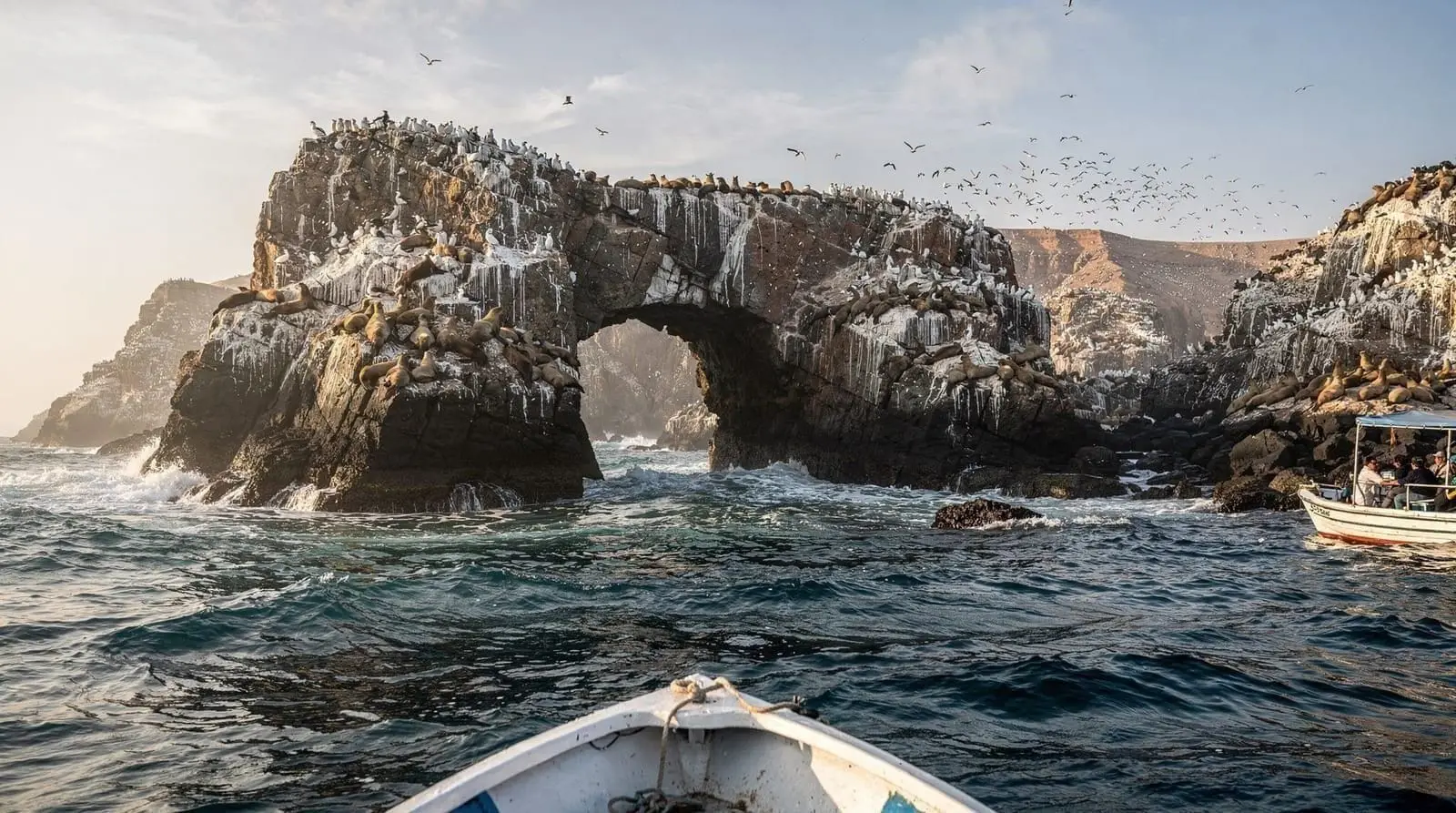
The Islas Ballestas are a cluster of rock arches and sea caves about 12 km offshore from the Paracas harbour. The nickname — poor man’s Galápagos — undersells them slightly and oversells them slightly. You will not find the same biodiversity as the Galápagos, and the experience is entirely from a boat (landing on the islands is prohibited to protect the wildlife). But the sheer density of animals is extraordinary: Humboldt penguins nesting in rock crevices, sea lions hauled out on every available ledge, Inca terns with their operatic red beaks, Peruvian boobies in the thousands, and — between June and November — Chilean flamingos in the shallow bays.
The guano layer on the rocks explains the whitish colouring of everything. Peru’s guano islands have been commercially harvested since the 19th century (the “guano boom” financed much of Lima’s architecture), and the Ballestas are still periodically harvested by licensed companies. The smell, on a warm day, is significant.
Tours depart from the Paracas waterfront from about 07:00 to 11:00, taking roughly two hours total including the 20-minute crossing each way. Price: S/55–70 per person (approximately $15–19 USD) for the standard boat, which holds 15–30 passengers. Book the night before or that morning — boats are plentiful and rarely sell out except during Peruvian holiday weekends.
You cannot land on the islands. The boats circle the main formations and pause while passengers photograph the wildlife. A guide on board narrates. Water, a light jacket, and seasickness medication if you are prone — the Humboldt Current means these are often choppy waters.
Paracas: Ballestas Islands and National ReserveFor a morning Ballestas boat followed by an afternoon in the reserve:
From Paracas: Ballestas Islands Boat Ride TourWhat to bring on the boat: A light windproof jacket (the sea crossing is cold and windy even on warm days), sunscreen, sunglasses, and a camera with a telephoto lens if you have one. Binoculars are worth the bulk — penguins on a distant ledge become a vivid scene through 8×42 glasses. Sea sickness medication if you are susceptible; the Humboldt swell is present year-round.
El Candelabro
On the approach to the Ballestas, the boat passes close to the Paracas Peninsula’s northern cliffs where El Candelabro — a 150-metre geoglyph etched into the hillside — is visible. Like the Nazca Lines, it was created by removing dark surface stones to expose lighter soil. Unlike the Nazca figures, it can be seen from sea level. Its age and purpose are disputed: estimates range from 200 BCE to the colonial era, and interpretations include a pre-Inca astronomical marker, a beacon for mariners, and a symbol associated with the Candelabra cactus. Whatever its origins, it is striking — large enough to see clearly from a moving boat 400 m offshore.
Paracas National Reserve
The Paracas National Reserve covers 335,000 hectares of peninsula and sea, making it Peru’s largest marine reserve. Most visitors skip it in favour of the islands, which is a mistake. The reserve contains the same raw desert landscape that made the South American coast famous for extreme environments — ochre cliffs, flamingo-inhabited lagoons, fossil beds 40 million years old, and beaches the colour of ash.
The most-visited section is La Catedral, a rock arch formation that partially collapsed in the 2007 earthquake (the original arch is gone; what remains is still photogenic). The Cathedral Beach area and the Mirador de Los Lobos are accessible by car or mototaxi from Paracas town.
Driving yourself (or hiring a taxi for S/60–90 for a 2–3 hour loop) gives more flexibility than the guided reserve tours, but a guide adds considerable context — particularly at the flamingo lagoon (Laguna de los Flamencos) and the archaeological display at the Julio Tello Museum at the reserve entrance.
Paracas National Reserve Guided TourThe Paracas culture (distinct from the later Nasca culture) flourished on this peninsula from roughly 700 BCE to 200 CE. They are primarily known for extraordinarily fine textiles — now distributed among museums in Lima, Berlin, and elsewhere — and for cranial trepanation: surgical modification of the skull that is documented in skeletal remains from this area. The Julio Tello Museum at the reserve entrance has a small but well-curated display.
Ballestas boat vs reserve tour: which to prioritise
| Ballestas boat | Reserve tour (car/taxi loop) | |
|---|---|---|
| Time | ~2 hours | 2–3 hours |
| Cost | ~S/55–70 | S/60–90 for taxi hire, plus S/25 entry |
| Highlights | Penguins, sea lions, El Candelabro | La Catedral, flamingo lagoon, fossil beds |
| Landing allowed | No | Yes, at designated viewpoints |
| Best for | Wildlife density in a short window | Desert landscape and archaeology |
Most travellers do both in a single day — boat in the morning, reserve loop in the afternoon — since the two are complementary rather than redundant. The Paracas vs Ballestas guide and the Ballestas Islands guide go deeper on booking logistics for each if you are short on time and must choose one.
The town of Paracas
Paracas town is a seafront strip of restaurants, hostels, and tour operators that has grown considerably in the past decade. It is functional rather than charming. The malecón (waterfront promenade) has decent ceviche restaurants where the catch was swimming that morning — fish and shellfish are fresher here than almost anywhere else in Peru at comparable prices. A full ceviche with choclo and sweet potato costs S/35–55 at a decent restaurant.
The accommodation runs from S/50-dorm backpacker places to S/900-night design hotels with reserve views. For the Ballestas tour, you only need to be in town for one or two nights at most. Most travellers arrive from Lima in the afternoon, do the Ballestas the following morning, and continue south to Ica or Huacachina after lunch.
Getting to Paracas
From Lima, Paracas is 3.5–4 hours by bus on the Panamericana Sur. Soyuz/Peru Bus serves this route directly and cheapest (S/25–40). Cruz del Sur and Oltursa serve nearby Pisco (15 minutes north) from their main Lima terminals; from Pisco, a taxi to Paracas costs S/15–20. Some operators offer Lima-to-Paracas direct services.
Alternative: Nazca Lines flight from Pisco airport. Travellers based in Paracas or Pisco can take the Nazca Lines overflight from Pisco’s San Andrés Airport, which is closer to the geoglyphs than Ica and avoids the extra bus journey south. This option is particularly useful if you are already in Paracas and want to add the Nazca flight without backtracking. Check the Nazca Lines guide for operator comparisons between the Pisco and Nazca departures.
For the full south-coast circuit without the fuss of individual bus tickets, a guided two-day tour from Lima covers Paracas, the Ballestas, Huacachina, and a Nazca Lines flight:
From Lima: Paracas, Huacachina & Nazca Lines 2 Days/1 NightParacas with kids and non-swimmers
Paracas suits families better than most Peru wildlife destinations because the Ballestas tour requires no walking, no altitude adjustment, and no swimming — you stay seated on the boat the whole time, making it accessible for young children, older travellers, or anyone with mobility limitations. The main consideration is the boat’s motion; if seasickness is a concern for a child, medicate beforehand and choose a morning departure when the water is calmer.
The reserve loop by taxi is similarly low-effort, with short walks from the vehicle to viewpoints like La Catedral rather than any real hiking. Combined with the fact that Paracas requires no altitude acclimatisation at all, it is one of the easiest wildlife-focused days to build into a family Peru itinerary.
Paracas as a base
Paracas is the natural starting point for the south-coast circuit. Ica is 60 km to the east (1 hour by colectivo, S/10–15), giving access to the pisco bodegas and Huacachina oasis. Nazca is 230 km southeast (3–3.5 hours). A logical 4-day south-coast itinerary runs: arrive Paracas (afternoon ceviche, evening stroll), Ballestas and reserve (morning/afternoon), transfer to Ica/Huacachina (afternoon buggy), Nazca (overflight + Chauchilla), return north.
For fuller route planning, see the south coast itinerary guide and the south coast things to do page. You can also connect Paracas northward to Lima and southward through the desert to Cusco by bus.
Eating and drinking in Paracas
The freshest seafood on the entire south coast is in Paracas. Boats unload catches of corvina (sea bass), lenguado (sole), pulpo (octopus), and various shellfish directly at the waterfront, and the cevicherías on the malecón serve it within hours of landing. The standard Paracas ceviche uses corvina with fresh lime (leche de tigre), red onion, coriander, ají amarillo, and is served with choclo (Peruvian giant corn) and sweet potato. Expect to pay S/35–55 for a generous portion.
El Chorrillo on the malecón is reliably excellent for ceviche and fish dishes. El Chorito and El Refugio are solid alternatives. Avoid places that quote prices in USD only and display menus in English at the door — these tend to charge 40% more for the same fish.
Paracas has grown a craft cocktail scene alongside the pisco-sour staple. Several bars now serve pisco from Ica bodegas in modern formats — pisco tonics, spiced macerations, fruit-forward sours with Peruvian ingredients like aguaymanto (goldenberry). The quality is higher than a few years ago.
Kayaking and cycling in the reserve
Beyond the standard boat and taxi loop, Paracas town has grown a small adventure-tourism scene worth knowing about if you have a second day. Sea kayaking trips launch from the malecón and paddle along sheltered stretches of the peninsula’s coastline, giving a closer, quieter wildlife encounter than the Ballestas speedboats — though they do not reach the islands themselves, which remain boat-tour-only. Bicycle rental shops near the waterfront rent mountain bikes for exploring the reserve’s flatter tracks independently, a good option if you want to set your own pace at the flamingo lagoon or the fossil beds rather than following a fixed taxi itinerary. Both activities are best done in the morning before the afternoon wind picks up.
The Paracas culture and Julio Tello
Before the Nasca culture flourished in the desert interior, the Paracas culture occupied this peninsula for nearly a thousand years (roughly 700 BCE to 200 CE). They are best known to archaeologists for their textiles — the finest pre-Columbian woven cloth anywhere in the Americas. The Paracas Textiles held in the Gothenburg Museum, the Brooklyn Museum, and the Textile Museum in Washington show embroidery work of astonishing complexity: hundreds of distinct figures rendered in wool on cotton cloth, using thread so fine it requires a magnifying glass to count the stitches.
The Peruvian archaeologist Julio Tello excavated the peninsula in the 1920s and discovered the burial bundles (fardos) that contained these textiles. The mummies were seated in a foetal position and wrapped in successive layers of textiles, some bundles containing dozens of garments. Tello’s finds are displayed at the museum that bears his name at the reserve entrance, and in the national museum in Lima. A visit to the Julio Tello Museum before entering the reserve gives context that transforms the landscape from picturesque to historically resonant.
Practical planning
Wind: The name Paracas derives from the Quechua word for “sand rain” — a strong desert wind. Afternoon winds on the peninsula can be fierce, particularly between October and March. Morning visits to the reserve are generally calmer and cooler.
Entrance fee: The national reserve charges S/25 (approximately $7) for foreign visitors. Keep the ticket; wardens check it at multiple points.
Wildlife seasons: Penguins are present year-round. Flamingos appear in the lagoons mainly between June and November. Sea lion pups are born between December and February and the colonies are rowdier during this period. Marine birds are present all year.
Frequently asked questions about Paracas
Can you land on the Ballestas Islands?
No. Landing is prohibited to protect the wildlife and the guano-harvesting operation. All tours observe from the boat, circling the main rock formations at close range. This is usually close enough to photograph penguins and sea lions clearly.
How is Paracas different from the Galápagos?
Paracas has comparable bird density and sea lion colonies but lacks the Galápagos’ full range of endemic species (marine iguanas, giant tortoises, Darwin finches). It is far cheaper — a full two-day Paracas–Huacachina–Nazca circuit costs less than a single day in the Galápagos. For travellers on a South America trip who cannot afford the Galápagos, the Ballestas deliver genuine wildlife drama at a fraction of the price.
How rough is the boat to the Ballestas?
The Humboldt Current means swells are present even on calm days. The crossing is 20–25 minutes each way in an open speedboat. If you are prone to sea sickness, take medication beforehand. Morning departures are generally calmer than later trips.
Is the Paracas National Reserve worth visiting in addition to the Ballestas?
Yes, especially if you have the afternoon free. The desert landscape is dramatic and genuinely different from the usual Peruvian tourist circuit. The flamingo lagoon, fossil beds, and Julio Tello Museum add depth that the boat tour cannot provide.
What is the best time of year to visit Paracas?
April through November is generally optimal: drier, calmer seas, and flamingos in the lagoons. The December-to-March period brings the paracas wind, more humidity, and occasionally rough sea conditions that can delay Ballestas departures.
How do I get from Paracas to Ica and Huacachina?
Shared colectivos depart from near the main roundabout on the Paracas road and run to Ica for S/10–15 (about 1 hour). From Ica’s main terminal or the city centre, a taxi to Huacachina costs S/8–10. The journey is straightforward and does not require a guide.
Is one day enough in Paracas?
One full day covers the Ballestas tour (morning) and the national reserve (afternoon). Travellers arriving from Lima the previous afternoon get the most out of this format. Those who want to spend more time in the reserve or take the kayaking and cycling tours available in town benefit from a second day.
Top experiences
Bookable activities with verified prices and instant confirmation on GetYourGuide.


