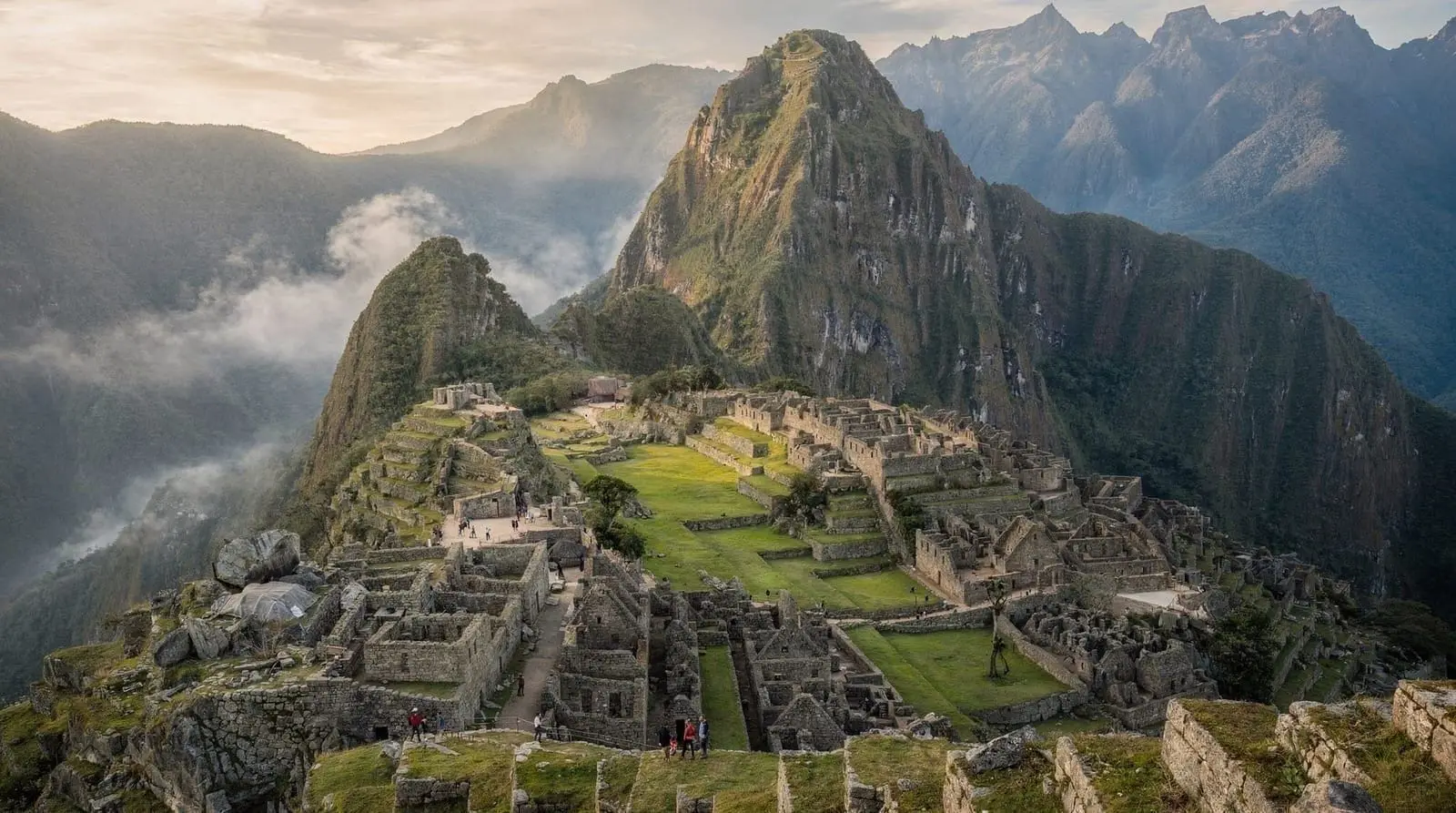
Machu Picchu: the complete planning guide
Cusco: Machu Picchu + Tourist Train + Entrance Ticket
What do I need to plan a Machu Picchu visit?
Four bookings, in this order: a timed entry ticket on a numbered circuit from the Ministry of Culture, a train to Aguas Calientes (board at Ollantaytambo), the Consettur shuttle bus up to the gate, and accommodation. In dry season book the entry ticket and afternoon return train weeks to months ahead. There is no walk-up entry and no road in.
Why Machu Picchu is the one trip you cannot improvise
Machu Picchu is the single place in Peru where showing up and figuring it out on arrival does not work. There is no walk-up gate. Entry is controlled by the Ministry of Culture through numbered circuits, fixed timed slots, and a daily quota. The town at the foot of the mountain, Aguas Calientes, has no road — you reach it by train or on foot only. And the final 400 metres up to the gate is either a 25-minute shuttle bus or a steep 90-minute climb. Every one of these links sells out, and they sell out in a specific order.
This is the master guide that ties the whole thing together. It covers the four bookings you need and the sequence to make them in, the costs in soles and dollars, the scams, and the on-the-ground practicalities. Where a topic deserves its own deep dive — the circuits, the trains, the budget route, the day-trip logistics — this page points you to the dedicated guide. Treat it as the map; the linked pages are the detail.
| Where | Aguas Calientes, reached only by train or foot |
| Cost | Around $250–400/person all-in (2-day, train route) |
| Time needed | 2 days recommended (16-hour day trip possible) |
| Getting there | Train from Ollantaytambo, or Hidroeléctrica by road+walk |
| Booking order | Entry ticket → train → Consettur bus → hotel |
The four bookings, in the order that matters
The whole trip rests on four reservations, and the order is not optional:
- Entry ticket and circuit — the fixed point everything else fits around.
- Train — must arrive in time for your entry slot.
- Consettur bus — gets you from the town up to the gate.
- Accommodation — last, because it is the most flexible.
Get this order wrong — booking a hotel before you have a confirmed entry slot, say — and you can end up with a room but no way into the citadel on your dates.
Step 1: the entry ticket and circuit system
Since 2024 the Ministry sells entry under three numbered circuits, each split into sub-routes. You buy one circuit and one entry time, enter within your slot, and walk the route in a single direction with no switching and no re-entry.
- Circuit 1 — Panoramic / Upper routes. The high terraces and the classic postcard view near the Guardian’s House (sub-route 1-C). For photographers.
- Circuit 2 — Classic / Designed routes. The fullest walk, descending past the Temple of the Sun, the Intihuatana, and the Temple of the Condor. The first-timer’s default, and the first to sell out.
- Circuit 3 — Royal / Lower routes. The quieter lower route and the only gateway to the two mountain climbs.
Prices (2026, foreign adult): the standard citadel ticket is S/152 / about $41; Circuit 3 with a Huayna Picchu or Machu Picchu Mountain add-on is S/200 / about $54. Nationals and CAN-community citizens pay roughly half; ISIC students get a discount; under-threes are free.
Which to pick depends entirely on your priority — the circuits compared guide makes the recommendation, and the circuits explained guide describes every sub-route and the structures along it. If you are climbing a peak, a Machu Picchu Circuit 3 entry ticket is the base ticket the mountain add-ons attach to.
Step 2: avoiding ticket scams
The only official seller is the Ministry of Culture portal (tuboleto.cultura.pe). The popular slots are released in a rolling window and disappear fast.
The scam to know. Street agencies and unofficial sites in Cusco and Aguas Calientes resell tickets at a markup, sometimes for slots that do not exist or are already used, and fake “official” sites mirror the government portal. If you book independently, use only the cultura.pe domain or a reputable platform that issues a genuine Ministry ticket. A suspiciously cheap price or a street agent waving a “last available” cash ticket is a red flag — walk away. The real ticket carries your name and passport number and is checked against your ID at the gate, so a mismatched name is refused entry. For more on this, see the fake Machu Picchu tickets guide.
Step 3: getting there by train
There is no road to Aguas Calientes. Two operators, PeruRail and IncaRail, run the same line down the Urubamba canyon. Most travellers board at Ollantaytambo — about two hours by road from Cusco — because that leg is the shortest, cheapest, and most frequent; direct Cusco (Poroy) departures are pricey and often suspended.
Round-trip prices from Ollantaytambo (2026):
- Expedition / The Voyager (standard tourist class): roughly $130–170.
- Vistadome / The 360 (glass-roof panoramic): around $160–220.
- Hiram Bingham / IncaRail First Class (luxury dining): $500+.
Book the train the moment your entry ticket is confirmed, and match your arrival to about 90 minutes before your gate time to absorb the bus queue. The early-afternoon return trains (1–3 pm) sell out first because they fit a same-day-back-to-Cusco plan. The full detail — classes, schedule quirks, which operator — is in the Machu Picchu by train guide. If you would rather not assemble the legs yourself, a Machu Picchu day trip with the tourist train and entrance ticket bundles train, bus, and timed entry into one booking.
The cheap alternative is the Hidroeléctrica budget route: a long minivan ride and an 11 km riverside walk that skips the train and roughly halves transport cost, at the price of two travel-heavy days.
Step 4: the Consettur bus to the gate
From Aguas Calientes the gate is a 25-minute ride up a zigzag dirt road. A single concessionaire, Consettur, runs the shuttle; there is no other vehicle option.
Fare (2026, foreign adult): about $24 / S/90 round trip, or $12.50 one way, paid in soles or dollars at the booth on Avenida Hermanos Ayar near the river. Buy in advance in peak season. Buses start at 5:30 am and run continuously; the first-light queue can be 30–45 minutes in June and July. The gate enforces your entry slot, not your bus time, so queue earlier than you think. Walking up instead takes 80–100 minutes of steep stone steps and only makes sense if you are well acclimatised and want to save the fare.
What to see, and the two mountains
The citadel rewards a slow walk. On Circuit 2 you pass the Temple of the Sun, the Intihuatana ritual stone, the Sacred Plaza, and the Temple of the Condor. Circuit 1’s upper route delivers the framed terrace view near the Guardian’s House.
Two peaks rise above the site, both reached via Circuit 3. Huayna Picchu is the steep pinnacle behind the citadel in every photo — a strenuous, exposed 45–75 minute climb with a separate permit. Machu Picchu Mountain is the taller, gentler summit opposite, a 1.5–2 hour ascent with a wider trail. Both need a combined ticket booked alongside Circuit 3.
Because signage inside is almost nonexistent, a Machu Picchu entry with an exclusive guided experience is the simplest way to both satisfy the guide-required rule and actually understand the ruins as you walk them.
Costs: a realistic budget
Per person, for a typical two-day train trip:
- Entry ticket: S/152 / $41 (S/200 / $54 with a mountain add-on).
- Train: $130–220 round trip from Ollantaytambo, by class.
- Consettur bus: $24 round trip.
- Guide: roughly $15–40 if shared, more for private.
- Accommodation: $15–25 for a basic Aguas Calientes room, far more at the upper end.
An all-in two-day trip lands around $250–400 per person on the train, or roughly half that via the Hidroeléctrica route. For a full Peru budget breakdown see the Peru trip cost guide.
Day trip or overnight?
You can do Machu Picchu as a single long day from Cusco — about 16 hours door to door — but it is tiring and you lose the quiet early gate. Staying one night in Aguas Calientes lets you take the first buses and beat the day-trippers. The full case for each is in the day-trip guide. For a Sacred Valley–based two-day version, the 2-day Machu Picchu tour from Ollantaytambo handles the train, overnight, bus, and entry as one booking.
When to go
Machu Picchu sits at 2,430 m in a cloud-forest transition zone, lower and more humid than Cusco. The dry season (May–September) brings the clearest mornings and the reliable postcard views, but the biggest crowds and highest prices — June to August is peak. May and September are the sweet spot. The wet season (November–March) means cloud and afternoon rain but real discounts and space; the classic Inca Trail closes every February for maintenance, though the citadel and trains stay open. Mornings beat afternoons year-round, so book an early slot. The full seasonal breakdown is in the best time to visit Machu Picchu.
Getting to Cusco in the first place
Everything above assumes you have reached Cusco, the staging point for the whole region. Most international visitors fly into Lima and connect on a domestic flight to Cusco (about 1 hour 20 minutes), the standard and fastest approach. Overland buses from Lima, Arequipa, or Puno are cheaper but long and only make sense if you are travelling slowly through the country. Whichever way you arrive, factor in acclimatisation time before tackling the citadel — the getting to Cusco guide and the Cusco airport guide cover the logistics, and the Cusco acclimatization plan lays out a sensible first few days.
Combining Machu Picchu with the rest of Peru
Few people travel all this way to see only the citadel, and Machu Picchu slots naturally into a wider Cusco-region trip. The Sacred Valley — Pisac, Ollantaytambo, the Maras salt pans, Moray — is the obvious pairing, and many travellers spend two or three nights there both to acclimatise and to break up the journey, since the train to Aguas Calientes leaves from Ollantaytambo anyway. Cusco itself deserves a couple of days for its colonial centre, San Blas, and the nearby Inca sites.
Beyond that, the citadel anchors longer loops taking in Rainbow Mountain, the Salkantay or Inca Trail treks, Lake Titicaca, or the Amazon. For how the pieces fit by trip length, see how many days in Peru and the broader best day trips from Cusco. If you would rather have a multi-day package handle the routing, the operator catalogue includes combined Sacred Valley, Rainbow Mountain, and Machu Picchu itineraries.
Reaching the citadel on foot: the trek alternatives
You do not have to take the train at all. Several multi-day treks finish at Machu Picchu, arriving on foot rather than by rail, and for many hikers the approach is the highlight. The classic Inca Trail is the famous four-day route that enters the citadel through the Sun Gate at dawn; it requires a permit booked months ahead and closes every February. The Salkantay trek is the popular alternative — wilder, higher, and bookable without the Inca Trail permit scramble. Shorter two-day options combine a stretch of original Inca path with the train.
These routes still feed into the same circuit and ticket system once you reach the gate, so the planning in this guide applies. The best treks to Machu Picchu compares the options by difficulty, cost, and what each delivers.
Practical information
Acclimatise first. The citadel is lower than Cusco, but most people arrive after days at Cusco’s 3,400 m. Spend two to three nights in the Sacred Valley or Cusco first.
Bag rules. Large backpacks are barred inside; there is a left-luggage office at the gate. Bring a small daypack with water, a rain layer, sun protection, and your passport. Drones, tripods, and selfie sticks are restricted.
Bathrooms and food. Toilets are at the entrance only, none inside — go before you enter. No food is sold inside; eat beforehand.
Keep three tickets handy. Passport plus entry ticket at the gate, bus ticket at the Consettur booth, train ticket at the station. Screenshot all three for the patchy signal.
For trekking approaches see the best treks to Machu Picchu; for the citadel itself the Machu Picchu destination page collects the essentials.
Visiting with children or limited mobility
Families and travellers with mobility concerns should factor in the physical demands separately from the logistics chain above. The citadel itself involves a great many uneven stone stairs and terraces regardless of which circuit you book, so a slow, unhurried pace matters more than which route you choose. The Consettur bus removes the steepest access climb, and it is worth paying for even if you would otherwise walk to save the fare.
Circuit 1’s upper route is comparatively flatter underfoot than Circuit 2’s descent through the urban sector, which can matter with young children or unsteady walkers. None of the mountain climbs (Huayna Picchu, Machu Picchu Mountain) suit young children or anyone with vertigo concerns — stick to the standard circuits for a family visit.
The three ways in, side by side
With the full logistics chain now laid out, it helps to see the three routes to the citadel compared directly rather than one at a time:
| Route | Time | Cost per person | Best for |
|---|---|---|---|
| Train (Ollantaytambo) | 1h40 each way | $130–220 round trip | Comfort, day trips, families |
| Hidroeléctrica (road + walk) | 2 days, ~9–10hrs travel | $120–160 total | Budget, time-rich travellers |
| Trek (Inca Trail / Salkantay) | 2–5 days | $600–900+ (guided, permit incl.) | Hikers wanting the journey itself |
None of these changes the citadel experience once you are inside — same circuits, same tickets, same gate — so pick based on your time, budget, and appetite for physical effort rather than any difference in what you will see.
Altitude planning most people get backwards
A detail that surprises almost every first-time visitor: Machu Picchu itself, at 2,430 m, is nearly 1,000 m lower than Cusco at 3,400 m. The altitude work of a Peru trip happens in Cusco and the Sacred Valley, not at the citadel. This means the smart sequencing is to acclimatise in Cusco or the lower Sacred Valley first, then descend to Machu Picchu — comfortably the easiest-breathing part of the whole circuit — before tackling higher add-ons like Rainbow Mountain at 5,200 m. Our Machu Picchu altitude explained guide breaks down the full elevation profile and why the citadel is the gentle reward rather than the challenge.
Frequently asked questions about Machu Picchu: the complete planning
How far in advance should I book Machu Picchu?
How much does a Machu Picchu trip cost?
Do I need a guide for Machu Picchu?
Can I visit Machu Picchu in one day from Cusco?
How do I avoid Machu Picchu ticket scams?
Is Machu Picchu higher altitude than Cusco?
Which is better, the train or the Hidroeléctrica route?
Top experiences
Bookable activities with verified prices and instant confirmation on GetYourGuide.
