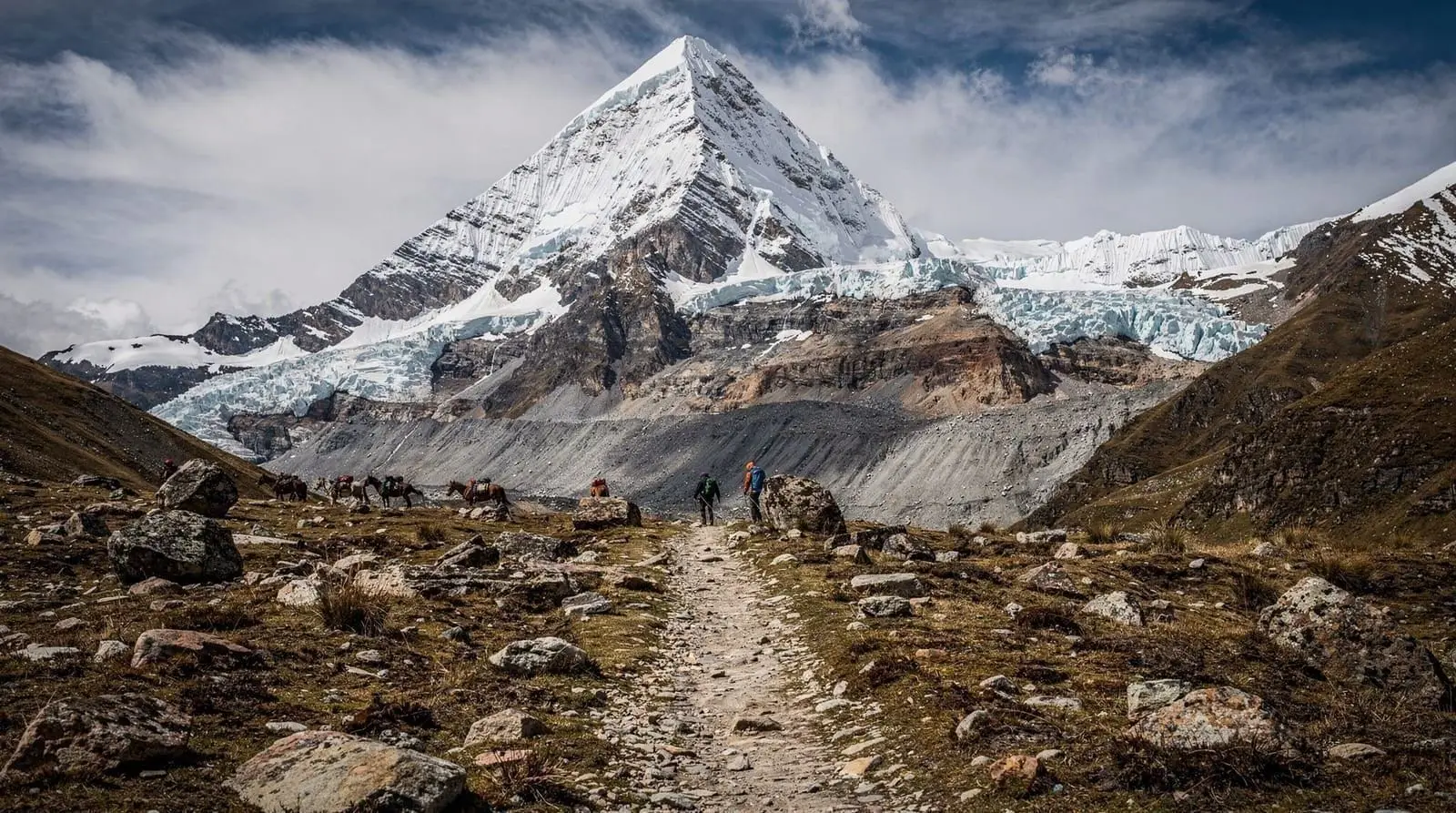
Salkantay Trek
The Salkantay trek is the popular permit-free alternative to the Inca Trail: 4-5 days over a 4,600 m pass to Machu Picchu. Honest difficulty and planning.
From Cusco: Salkantay Route and Machu Picchu – 4D/3N Tour
Quick facts
- Highest pass
- Salkantay Pass, 4,630 m / 15,190 ft
- Duration
- 4 days / 3 nights or 5 days / 4 nights
- Distance
- ~60-74 km depending on route
- Permit
- None required (unlike the Inca Trail)
- Ends at
- Machu Picchu via Aguas Calientes
Why the Salkantay trek exists, and who it suits
The Salkantay trek owes much of its popularity to a simple problem: the classic Inca Trail sells out months ahead because of strict permit quotas, and a lot of travellers find out too late. Salkantay is the answer. It needs no permit, it can be booked far closer to your travel dates, and it reaches Machu Picchu through scenery that many seasoned trekkers rate as more spectacular than the Inca Trail’s — crossing a glacier pass at 4,630 m beneath the towering peak of Nevado Salkantay (6,271 m) before descending into cloud forest.
It is not, however, an easy substitute. Salkantay is a real high-altitude trek: four or five days of walking, long days, a brutal pass, and nights camping or in basic lodges at altitude. People who choose it as the “easy option” because they couldn’t get an Inca Trail permit sometimes have a hard time. If you are fit, willing to acclimatise properly, and ready for genuine effort, it is one of the great walks in the Andes. If you want a gentle hike, this is not it.
| Where | Vilcabamba range, west of Cusco |
| Cost | Around $200-350 USD for a guided 4-5 day package |
| Time needed | 4-5 days plus prior acclimatisation |
| Getting there | Trailhead transfer from Cusco (included in tours) |
| Best time | May to September (dry season) |
The Salkantay trek guide has a fuller day-by-day breakdown if you want more detail before committing, and train vs trek to Machu Picchu is worth reading if you are still deciding whether to walk in at all.
What the Salkantay route is
Salkantay (Salkantay or Salqantay, an apu — a sacred mountain) lies in the Vilcabamba range west of Cusco. The trek starts near Mollepata and Soraypampa — the same trailhead as the Humantay Lake day hike — and works its way over the Salkantay Pass before descending dramatically from high alpine puna into humid cloud forest and finally to the valley town of Aguas Calientes, the gateway to Machu Picchu. The route covers roughly 60-74 km depending on the operator’s variation, and the contrast of landscapes — glacier to jungle in a few days — is its signature.
Most itineraries also fold in Humantay Lake on the first day, so you get the turquoise lagoon as a bonus before the serious climbing begins.
The trek, day by day (4-day version)
A typical 4-day / 3-night itinerary runs roughly like this:
- Day 1: Cusco to Soraypampa, then the side hike up to Humantay Lake (4,200 m) and back. First night camping or in lodges around 3,900 m. A demanding start at altitude.
- Day 2: The big one. Climb to the Salkantay Pass at 4,630 m — cold, thin air, often windy — then a long descent into the cloud forest. This is the hardest day, frequently 7-10 hours of walking.
- Day 3: Continue down through humid jungle, often with a stop at hot springs or a coffee farm, ending near Hidroeléctrica or Aguas Calientes.
- Day 4: Early visit to Machu Picchu, then return to Cusco by train and road.
The Salkantay route and Machu Picchu 4D/3N tour packages this version with camping or lodges, meals, a guide, porters or pack animals for the heavy gear, and the Machu Picchu logistics. The 5-day variant adds a day to ease the pace and add more cloud-forest walking; the 5-day Salkantay ultimate trek to Machu Picchu is the slower, more comfortable option for those who would rather not compress the hardest sections.
How hard is it, really?
The honest assessment: Salkantay is moderately to seriously hard, with the difficulty concentrated on day two. The Salkantay Pass at 4,630 m is the crux — a long, slow climb in thin air followed by a knee-punishing descent of well over 1,000 vertical metres. Days routinely run 6-10 hours. The cumulative effect of consecutive long days at altitude, cold nights, and basic facilities is what catches people out, more than any single section.
You do not need technical mountaineering skills — there is no scrambling or rope work — but you do need genuine hiking fitness and stamina. Train beforehand with hill walking and long days on your feet. The reward for the effort is real: the pass crossing beneath Salkantay’s glaciers is one of the most dramatic moments on any Cusco-region trek.
Altitude and acclimatisation
Salkantay’s high point is 4,630 m, and the first two days work above 3,900 m, so altitude is a central concern.
- Acclimatise before you start. Spend at least two to three days at Cusco or Sacred Valley altitude beforehand — ideally with a day hike like Humantay or Pisac to test how your body copes. Do not start Salkantay fresh off a flight into Cusco.
- Pace day two carefully. The pass is where altitude bites. Walk slowly, hydrate constantly, and tell your guide immediately if you feel worse than a mild headache.
- Be ready for cold and heat. Nights near the pass drop below freezing; the cloud-forest days are warm and humid with mosquitoes. Pack for both, plus a windproof shell, gloves, hat, sunscreen, and insect repellent.
- Coca tea and leaves help many people; acetazolamide is an option to discuss with a doctor before the trip.
Choose your operator with care. A good company supplies oxygen, a first-aid-trained guide, an emergency horse for anyone who cannot continue, and properly maintained gear. The remoteness of day two means a poorly equipped budget operator is a real risk.
Salkantay vs the Inca Trail vs Ausangate
The three big trek choices around Cusco serve different travellers:
- vs the Inca Trail: the Inca Trail needs a permit booked months ahead and follows original Inca stonework to the Sun Gate above Machu Picchu — its appeal is archaeological as much as scenic. Salkantay needs no permit, is bookable late, is usually cheaper, and is arguably more spectacular as pure mountain scenery, but it lacks the Inca ruins along the way and enters Machu Picchu by the standard route, not the Sun Gate.
- vs Ausangate: Ausangate is more remote, higher, and harder, and does not end at Machu Picchu. Salkantay is more supported, more popular, and finishes at the famous citadel.
For most travellers who miss the Inca Trail, Salkantay is the natural and excellent alternative.
It is worth briefly noting two other treks in the same region that get less marketing weight but suit specific travellers. The Lares trek is gentler and more culturally focused, threading through weaving villages rather than glacier passes, and does not end at Machu Picchu by trail — you take the train in afterwards. Choquequirao is the serious alternative for travellers who want a genuinely remote, Inca Trail-scale ruin with almost no crowds, at the cost of a much longer, harder trek. Neither replaces Salkantay for most first-time trekkers, but both are worth knowing about if the big three don’t fit your interests.
For a fuller roundup of every option, see best treks to Machu Picchu, and a first-hand account in the Salkantay trek diary captures what the day-two pass crossing actually feels like better than any spec sheet.
Gear and what to pack
Layer for a dramatic range: freezing pre-dawn starts and pass crossings, warm midday sun at lower elevations, and humid, buggy cloud forest lower down. A good sleeping bag rated to at least -10°C matters if you are camping rather than in lodges — check which your operator provides versus expects you to bring.
Waterproof hiking boots, trekking poles (essential for the day-two descent), a headlamp, sun protection, insect repellent for the lower days, and a dry bag for electronics all matter. Porters or pack animals typically carry the bulk of your gear, but confirm the weight limit for your daypack before you go. The general what to pack for the Inca Trail guide covers similar ground and is a useful cross-check even though the treks differ.
How Salkantay fits a Peru trip
Salkantay needs four or five dedicated days plus your acclimatisation time, so it shapes the whole Cusco leg of a trip. Most people slot it after a few days exploring Cusco, the Sacred Valley, and Ollantaytambo, using those days both to sightsee and to acclimatise. Because it ends at Machu Picchu, it neatly combines the region’s headline trek and its headline site in one continuous experience.
To plan the sequencing, season, and acclimatisation around Salkantay, see the /itineraries/, the planning /guides/, and the seasonal /tools/ page. If permits are still available for your dates, weigh it against the Inca Trail before deciding.
Frequently asked questions about the Salkantay trek
Is the Salkantay trek harder than the Inca Trail?
They are comparable in difficulty, and which feels harder depends on the person. Salkantay’s high point (4,630 m) is higher than the Inca Trail’s Dead Woman’s Pass (4,215 m), and its day-two pass crossing followed by a long descent is brutal. The Inca Trail has more sustained stone-step climbing. Both demand good fitness and acclimatisation; neither is a beginner’s stroll.
Do I need a permit for the Salkantay trek?
No, and this is its main practical advantage. Unlike the Inca Trail, which has a strict daily permit quota that sells out months ahead, Salkantay requires no permit and can be booked much closer to your travel dates. That makes it the standard fallback for travellers who missed Inca Trail permits.
How high is the Salkantay trek?
The highest point is the Salkantay Pass at 4,630 m, crossed on the second day beneath the glaciated peak of Nevado Salkantay (6,271 m). The first two days also work above 3,900 m. This altitude makes prior acclimatisation in Cusco or the Sacred Valley essential.
When is the best time to do the Salkantay trek?
May to September, the dry season, offers the most reliable weather, firm trails, and clear mountain views. The rainy season from December to March makes the trail muddy and slippery and the pass crossing dangerous; February is the worst month for it. June to August are the most popular and the coldest at night.
How many days does the Salkantay trek take?
Most itineraries are 4 days / 3 nights or 5 days / 4 nights, both ending with a visit to Machu Picchu. The 4-day version is more intense, compressing the hardest sections; the 5-day version adds a day to ease the pace and include more cloud-forest walking. Budget extra days in Cusco beforehand for acclimatisation.
Does the Salkantay trek end at Machu Picchu?
Yes. The trek descends from the high pass through cloud forest to Aguas Calientes, the town below Machu Picchu, and the final day is a visit to the citadel. Unlike the Inca Trail, it enters Machu Picchu by the standard route rather than through the Sun Gate, but you still see the full site.
Do I need special gear I don’t already own?
Most trekkers can get by hiring or buying a few key items rather than a full kit: a warm sleeping bag if camping, trekking poles, and waterproof boots are the ones worth prioritising. Everything else — layers, a headlamp, sun protection — is standard travel gear you likely already have. Reputable operators can rent sleeping bags and poles for a small daily fee if you would rather not travel with them.
Top experiences
Bookable activities with verified prices and instant confirmation on GetYourGuide.
