Machu Picchu on a budget: the Hidroeléctrica route
From Cusco: Machu Picchu 2-Day Budget Tour by Car
What is the cheapest way to reach Machu Picchu?
The Hidroeléctrica route: a 6–7 hour minivan from Cusco to the Hidroeléctrica station, then an 11 km (2.5–3 hour) flat walk along the railway to Aguas Calientes. It cuts out the expensive tourist train and brings the door-to-door cost to roughly $120–180 for two days instead of $300+.
The back-door route that skips the tourist train
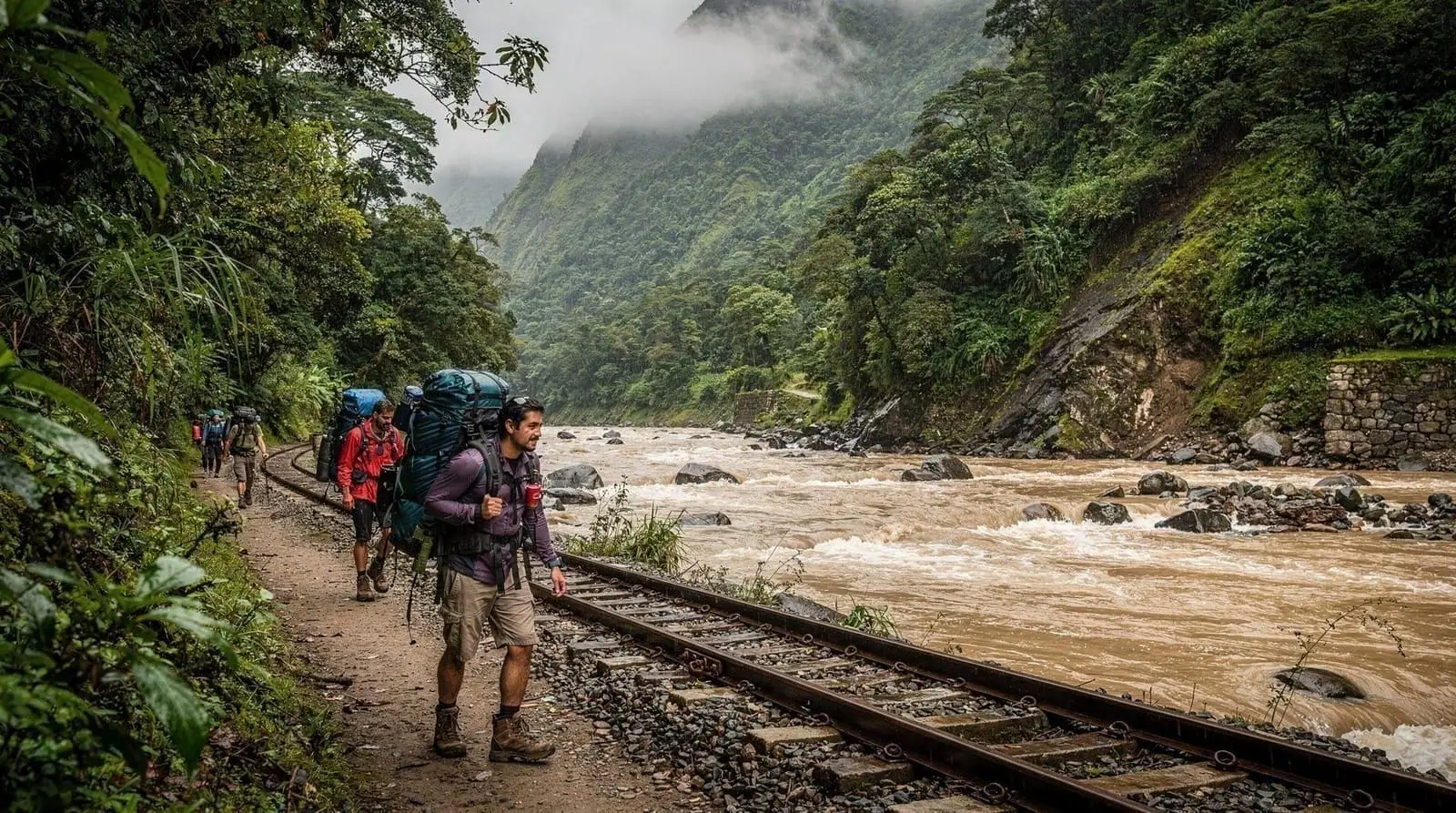
There are two ways to reach Machu Picchu. One is the railway, which is comfortable, scenic, and expensive: a round-trip tourist train from Ollantaytambo runs $130 or more, and that is before tickets and buses. The other is the “Hidroeléctrica” route, named after the hydroelectric plant deep in the Urubamba canyon where the road finally runs out. From there you walk the last 11 kilometres into Aguas Calientes along the train tracks. It is the route every backpacker on the gringo trail eventually hears about, and for travellers with more time than money it is the single biggest saving on a Machu Picchu trip.
This page covers how the route actually works, what it costs in soles and dollars in 2026, who it suits, and the trade-offs nobody mentions when they sell you the “cheap Machu Picchu tour” on a Cusco street corner. If you want the full picture of the site itself — circuits, entry slots, the bus — read the complete Machu Picchu guide alongside this one. This page is strictly about getting there cheaply.
| Where it starts | Cusco, by road to the Hidroeléctrica trailhead |
| Cost | Around S/450–600 ($120–160) per person, all-in |
| Time needed | 2 days (road + 11 km walk each way) |
| Getting there | Minivan over Abra Málaga pass, then flat riverside walk |
| Best for | Time-rich, budget-conscious travellers |
How the Hidroeléctrica route works, step by step
The route has three legs, and understanding them is the whole game.
Leg one: Cusco to Hidroeléctrica by road (6–7 hours). A minivan leaves Cusco early, usually between 7 and 8 am, and climbs over the Abra Málaga pass at around 4,300 m before dropping into the cloud forest via Santa María and Santa Teresa. It is a long, winding mountain road, paved most of the way but slow. Most budget operators stop for lunch in Santa María. You arrive at the Hidroeléctrica car park in the early afternoon.
Leg two: the walk to Aguas Calientes (11 km, 2.5–3 hours). From the Hidroeléctrica station the path runs flat along the railway beside the Urubamba river. It is not a hike in the mountaineering sense — there is barely any gradient — but it is a solid two-and-a-half to three hours on uneven sleepers and gravel. You pass the Aobamba checkpoint where you may be asked to show ID, and you get your first glimpse of Machu Picchu Mountain rising above the trees. You reach Aguas Calientes by late afternoon.
Leg three: up to the citadel the next morning. You sleep in Aguas Calientes, then either take the Consettur shuttle bus (about $24 / S/90 round trip) or walk the 400 m of switchbacks on foot (80–100 minutes) to the gate for your timed entry slot. After visiting, you reverse the whole journey: walk back to Hidroeléctrica and catch the afternoon minivan to Cusco, arriving late evening.
The cleanest way to book all of this without arranging each leg yourself is a packaged tour. A 2-day Machu Picchu budget tour by car from Cusco bundles the round-trip road transfer, the guided walk, a night in Aguas Calientes, and the entry ticket into one price, which removes the risk of being stranded by a no-show minivan operator.
What it actually costs in 2026
The appeal of the Hidroeléctrica route is the maths. Here is a realistic per-person breakdown for two days, in soles with dollar equivalents (S/1 ≈ $0.27):
- Round-trip minivan Cusco–Hidroeléctrica: S/130–170 ($35–46) if booked locally; sometimes as low as S/110 in low season.
- Machu Picchu entry ticket: S/152 ($41) for the standard foreign-adult circuit, bought from the Ministry of Culture.
- One night in Aguas Calientes: S/40–80 ($11–22) for a basic hostel dorm or budget double.
- Consettur bus (optional): S/90 ($24) round trip, or free if you walk up and down.
- Food: S/60–100 ($16–27) for two days if you eat at menú-del-día spots, not the tourist restaurants on the main drag.
That puts the all-in cost around S/450–600 ($120–160) per person if you walk up to the gate, or S/540–700 with the bus. Compare that with the train route, where the round-trip rail alone is $130–220 before tickets and buses, easily pushing a two-day trip past $350. The Hidroeléctrica route roughly halves the bill.
If you want a slightly more comfortable version with a shared minivan run by a vetted operator, the 2-day Machu Picchu budget tour by minivan sits in the same price bracket and includes the entry ticket, which saves you the separate Ministry booking.
The trade-offs nobody mentions
Budget tours are sold hard on Cusco’s streets, and the pitch always leaves out the costs that are not financial.
It is two travel-heavy days. You spend roughly 12–14 hours on the road across the two days and another 5–6 hours walking. The citadel itself is a few hours sandwiched in the middle. If your idea of a Machu Picchu trip is a relaxed dawn at the ruins, this is not it.
The road is long and the operators vary wildly. The cheapest street agencies cut corners: overloaded vans, exhausted drivers doing the round trip in a single day, vague pickup times. Pay slightly more for an operator with a real office and reviews, or book a packaged tour where the transfer is contracted. The road over Abra Málaga is genuinely tiring and you want a driver who is not on his third trip of the week.
Rain changes everything. In the wet season (November–March) the river runs high, the tracks can flood in sections, and landslides occasionally close the road near Santa Teresa. The walk is still usually fine, but build in a buffer day if you travel then, and check the route is open before you commit.
You still need every other booking. The Hidroeléctrica route only replaces the train. You still need a timed entry ticket booked weeks ahead in peak season — the budget route does not get you around the daily quota or the circuit system. If you are climbing a peak, a Machu Picchu Circuit 3 entry ticket is the one that pairs with the Huayna Picchu and Machu Picchu Mountain trails.
Who should take this route — and who shouldn’t
The Hidroeléctrica route is right for you if you are travelling on a real backpacker budget, you have the two days to spare, and a long minivan ride plus a flat 11 km walk sounds fine rather than grim. It is popular with younger travellers, gap-year crowds, and anyone already in deep-cut budget mode after weeks on the road.
It is wrong for you if your time is tight, if you are travelling with young children or anyone with mobility issues, if you are prone to motion sickness on winding roads, or if comfort matters more than the saving. In those cases the train route is worth every dollar, and a day trip from Cusco gets you there and back in one go.
One honest middle path: some travellers take the train down and walk out via Hidroeléctrica on the way back, or vice versa. You get the scenic comfort one way and the cheap adventure the other. It is more fiddly to arrange but splits the difference nicely.
Choosing a budget operator without getting burned
The Hidroeléctrica route is sold by dozens of agencies in Cusco, and quality ranges from solid to alarming. Because the road section is long and the corners that get cut are the ones you cannot see until you are on the mountain, picking the operator carefully matters more here than on almost any other Peru excursion.
Red flags to avoid: an agency that only exists as a sandwich-board tout on the Plaza de Armas with no fixed office; a price far below the going rate (the road, fuel, and driver have real costs, and a rock-bottom price means something is being skimped); a van doing the full Cusco–Hidroeléctrica–Cusco round trip in a single day with one driver; and any operator vague about exactly what is and is not included, especially whether the entry ticket is part of the price.
What good looks like: a real office you can return to, written confirmation of the inclusions, a driver who is not doing back-to-back trips, and clarity on the pickup time and where the van waits at Hidroeléctrica for the return. Reviews on a recognised platform are worth more than a persuasive sales pitch.
This is precisely the case where a packaged tour earns its small premium. A 2-day Machu Picchu budget tour by car or the equivalent budget tour by minivan contracts the transfer, the guide, the night, and usually the entry ticket through a single vetted operator, which removes the worst of the street-agency lottery for a price barely above the cheapest local deal.
How the budget route compares to the alternatives
It is worth being honest about where this route sits relative to the other two ways in.
Against the train, the Hidroeléctrica route saves roughly half the transport cost but spends an extra slab of time and comfort to do it. The train is faster, far less tiring, and scenic in its own right; the budget route is an adventure that happens to also be cheap. If your budget can absorb the train, read the Machu Picchu by train guide before defaulting to the cheap option out of habit.
Against the day trip, the budget route is the opposite trade. A day trip spends money to save time — train there and back in one long day. The Hidroeléctrica route spends time to save money — two days, but at half the cost. Neither is “better”; they suit different constraints. If your scarce resource is days, the day trip wins; if it is cash, this route does.
Whichever way you go, the citadel experience at the top is identical — same circuits, same tickets, same gate. The route only changes how you arrive and what it costs you to get there.
Practical tips for the walk
Footwear. Trainers or light trail shoes are fine — you do not need boots. The path is flat but the railway sleepers and gravel are hard on thin soles over three hours.
Water and sun. There are a few small stalls along the path selling drinks and snacks, but they are overpriced. Carry your own water and sun protection; the canyon is humid and the sun is strong even when it feels overcast.
Timing the walk. Leave Hidroeléctrica with enough daylight to reach Aguas Calientes before dusk — the last stretch into town is unlit. Most afternoon arrivals from Cusco give you just enough time if you do not dawdle over lunch.
Trains do run. This is an active railway. Stay on the worn footpath beside the tracks, not on the rails, and step well clear when you hear a horn. Trains are slow here but they are real.
Cash. Bring soles in small notes. Hostels, the Consettur booth, and roadside food stops in this corridor are cash-only, and Aguas Calientes ATMs charge high fees and sometimes run dry.
For where to sleep and eat once you arrive, see the Aguas Calientes guide, and for how the citadel visit itself works, the complete Machu Picchu guide covers circuits, entry slots, and the gate in full.
Doing it solo versus booking it as a package
Independent travellers sometimes ask whether they can skip the packaged tour entirely and arrange each leg themselves — a shared minivan booked at a Cusco agency, the walk unguided, a hostel picked on arrival, and the entry ticket booked separately online. It is entirely possible and shaves a further S/20–40 off the total, since you are not paying for the bundling.
The trade-off is logistics risk: if the minivan operator you booked independently no-shows or changes the pickup time (which happens more often with the cheapest street-corner agencies), you have no one to call. Solo booking suits confident, flexible travellers who speak enough Spanish to sort out problems on the spot; a packaged option, such as the 2-day budget tour by car, suits everyone else, since the small premium buys a single point of accountability for the whole two days.
How this compares with the acclimatisation picture
One underrated advantage of the Hidroeléctrica route is altitude. The trailhead and the walk both sit below 2,100 m, and Aguas Calientes itself is the lowest overnight stop on most Cusco-region itineraries — genuinely easier on the lungs than a night in Cusco at 3,400 m. If you are combining this budget route with a longer trip through the Sacred Valley or onward to Rainbow Mountain, doing the Hidroeléctrica leg early, before you tackle the higher altitude days, is a sensible sequencing choice rather than an afterthought.
Frequently asked questions about Machu Picchu on a budget: the Hidroeléctrica route
Is the Hidroeléctrica walk dangerous?
Can I do the Hidroeléctrica route in one day?
Do I still need a Machu Picchu entry ticket on the budget route?
How much does the budget route really cost?
Is the budget route worth it over the train?
Can I book the Hidroeléctrica route independently instead of as a package?
Is the Hidroeléctrica route easier on altitude than staying in Cusco?
Top experiences
Bookable activities with verified prices and instant confirmation on GetYourGuide.
