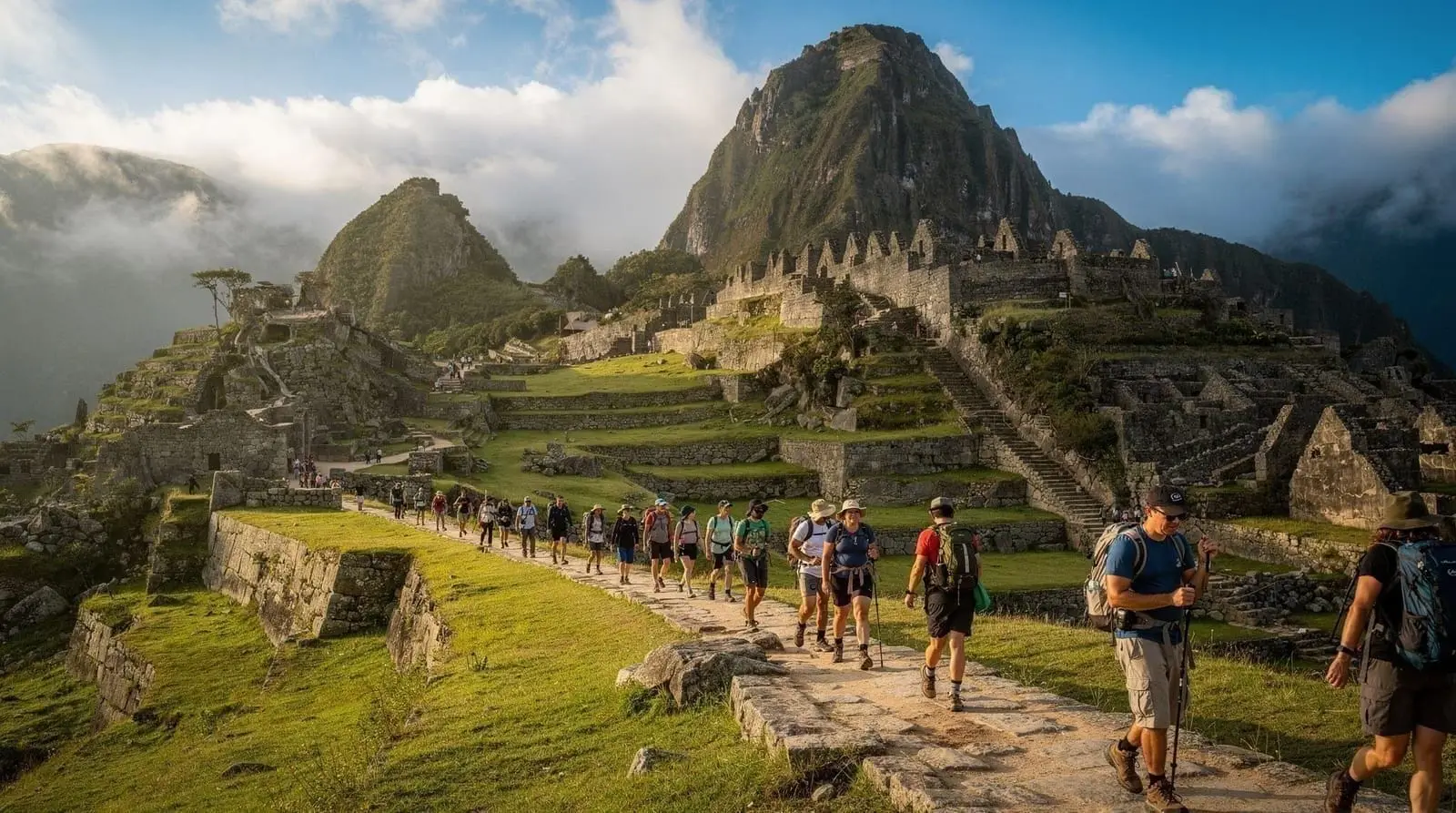
Machu Picchu circuits compared: which to book
Machu Picchu: Circuit 3 Entry Ticket
Which Machu Picchu circuit should I book?
For a first visit wanting the full citadel, book Circuit 2. For the single classic postcard photo, book Circuit 1 (sub-route 1-C). For the Huayna Picchu or Machu Picchu Mountain climb, book Circuit 3 with the matching mountain ticket. Circuit 2 is the most complete but sells out first.
The one booking decision that shapes your whole visit
Since 2024, the Peruvian Ministry of Culture has sold Machu Picchu entry by numbered circuit. You pick one circuit and one entry slot, you walk that route in one direction, and you cannot switch circuits inside the site or re-enter once you leave. That means the circuit you choose at booking is, in practice, the visit you get. Get it wrong and you arrive expecting the postcard view and find yourself on a lower route that never reaches it.
This guide compares the circuits head-to-head so you can match the right one to what you actually want — the famous photo, the fullest walk, the quietest route, or a mountain climb. If you want a structure-by-structure description of what each route contains, that lives in the circuits explained guide. This page is about the decision, not the geography.
| Cost | S/152 ( |
| Time needed | 2–3 hours on the citadel walk itself |
| Best for postcard photo | Circuit 1, sub-route 1-C |
| Best for completeness | Circuit 2 |
| Only route to the peaks | Circuit 3, with Huayna Picchu or Mountain add-on |
The three circuits at a glance
| Circuit | Best for | View | Crowds | Peak access |
|---|---|---|---|---|
| Circuit 1 | Photographers | Best — the postcard overview | Moderate | None |
| Circuit 2 | First-time visitors | Good overview + temple detail | Busiest (sells out first) | None |
| Circuit 3 | Hikers, returning visitors | Least — lower angle only | Quietest | Huayna Picchu / Machu Picchu Mountain |
The system has three circuits, each split into sub-routes. Here is the short version of what each one is for:
- Circuit 1 — Panoramic / Upper routes. The high terraces and the framed overview. Sub-route 1-C reaches the classic postcard viewpoint near the Guardian’s House. Best for photographers and anyone whose top priority is the iconic image.
- Circuit 2 — Classic / Designed routes. The fullest walk, descending into the urban sector past the major temples. Best for first-time visitors who want to see the most. Sells out first.
- Circuit 3 — Royal / Lower routes. The quieter lower terraces and urban sector, and the only gateway to the two mountain hikes. Best for hikers and crowd-avoiders.
Side-by-side comparison
By view. Circuit 1’s upper route wins for the framed postcard shot — the citadel laid out below with Huayna Picchu behind. Circuit 2 gives a good overview from a slightly lower angle plus the close-up temple detail. Circuit 3 sits lowest and gets the least of the classic panorama, though its angle on the citadel from below has its own appeal.
By completeness. Circuit 2 is the clear winner. It threads through the urban sector and passes the highest number of named structures. Circuit 1 stays high and skips most of the interior; Circuit 3 covers the lower interior but not the upper terraces.
By crowds. Circuit 3 is generally quietest because most first-timers default to Circuit 2. Circuit 1 sits in the middle. On any circuit, your entry slot matters more than the route — the first morning slots are far calmer than midday.
By hikes. Only Circuit 3 connects to the peaks. The Huayna Picchu add-on and the Machu Picchu Mountain add-on both pair with a Circuit 3 base ticket. You cannot bolt a mountain onto Circuit 1 or Circuit 2.
By price. The standard Circuit 1, 2, or 3 ticket is S/152 / about $41 for a foreign adult. Adding Huayna Picchu or Machu Picchu Mountain to Circuit 3 raises it to S/200 / about $54.
Which circuit suits which traveller
First-time visitor, one shot at it: Circuit 2. If this is your only visit and you want the most complete experience — temples, the Intihuatana, the Condor, plus a serviceable overview photo — book Circuit 2. It is the popular choice for good reason, which is also why you must book it weeks ahead in the June–August peak.
Photographer chasing the postcard: Circuit 1. If the single framed image of the citadel is the whole point, Circuit 1’s sub-route 1-C is the cleaner shot. Pair it with an early slot for soft light and thinner crowds.
Hiker adding a peak: Circuit 3. If you want to climb Huayna Picchu — the steep pinnacle in every photo — or the gentler, taller Machu Picchu Mountain, you need Circuit 3 with the matching add-on. A standalone Machu Picchu Circuit 3 entry ticket is the base, and the Huayna Picchu entry ticket adds the climb.
Returning visitor or crowd-avoider: Circuit 3. If you have seen the citadel before, or you simply want a calmer walk and do not mind missing the upper-terrace panorama, the lower royal route is the quiet pick.
A closer look at each circuit’s trade-offs
It helps to think of each circuit as a deliberate compromise rather than a ranking, because the Ministry designed them to spread visitors across the site and protect the fragile structures from foot traffic. None is objectively “best” — each gives up something to gain something else.
Circuit 1 trades interior for elevation. By keeping you on the upper agricultural terraces, it hands you the widest, highest view of the whole citadel and the cleanest line on Huayna Picchu behind it. What you give up is proximity: you never walk among the temples, so the Intihuatana, the Temple of the Condor, and the fine masonry of the Temple of the Sun stay distant. If you have already seen the citadel up close on a previous visit, or you simply care more about the sweeping image than the stonework, this is a rational pick rather than a consolation prize.
Circuit 2 trades quiet for completeness. It is the only route that gives you both a serviceable overview and the full descent through the urban sector, which is exactly why it is the default and exactly why it is crowded. The compromise is the bunching that happens at the temple stops around midday, when several entry slots converge in the same narrow lanes. The fix is not a different circuit but an earlier slot.
Circuit 3 trades the panorama for calm and the mountains. Sitting lowest, it sees the least of the famous postcard view, but it rewards you with the quietest walk and, crucially, the only access to the two peaks. For a hiker, that access is not a trade-off at all — it is the whole point. For a non-hiker who books it by accident expecting the classic photo, it is a disappointment. Know which camp you are in before you book.
How the seasons change the circuit calculus
Your circuit choice interacts with when you visit. In the dry season (May–September), clear mornings make the upper-terrace views on Circuit 1 and the overview on Circuit 2 genuinely worth chasing — book an early slot to catch them before cloud builds. In the wet season (November–March), the upper viewpoints are often socked in by cloud, which quietly tilts the value toward Circuit 2’s temples and Circuit 3’s lower route, where the experience is the architecture and atmosphere rather than the distant panorama. If you are gambling on a misty-season visit, a circuit that depends on a long view is the riskier bet. The full seasonal picture is in the best time to visit Machu Picchu.
Crowds also shift by season, and the circuit that feels calm in October can feel packed in July. In peak months, Circuit 3’s relative quiet is more valuable; in the shoulder months the difference between circuits narrows because the whole site is thinner.
How the circuit interacts with the rest of your booking
The circuit is only one of several reservations, and they have a strict order. Book the entry ticket and circuit first, because the timed slot is the fixed point everything else fits around. Then book the train, then the Consettur bus, then accommodation. The complete Machu Picchu guide walks the whole chain in order.
One thing the circuit does not give you is context. There is almost no signage inside the citadel, so on any route you are looking at beautiful stone walls with little explanation unless you have a guide. A Machu Picchu entry with an exclusive guided experience pairs your timed circuit ticket with a licensed guide, which also satisfies the official guide-required-for-first-entry rule.
What the circuits cost, side by side
Price rarely decides the circuit, because the three standard tickets cost the same, but it is worth seeing the figures together. For a foreign adult in 2026:
- Circuit 1 (standard): S/152 / about $41.
- Circuit 2 (standard): S/152 / about $41.
- Circuit 3 (standard, lower route only): S/152 / about $41.
- Circuit 3 + Huayna Picchu: S/200 / about $54.
- Circuit 3 + Machu Picchu Mountain: S/200 / about $54.
Peruvian nationals and Andean Community (CAN) citizens pay roughly half these figures, ISIC student-card holders get a reduction, and children under three enter free. The only meaningful price gap is the mountain add-on, which buys you a peak climb on top of the lower route — so the choice between the circuits is about the experience, not the cost, unless you are weighing whether a peak is worth the extra S/48.
How crowding actually plays out across the circuits
It is tempting to pick a circuit purely to dodge crowds, but the bigger lever is almost always the entry slot rather than the route. A Circuit 2 ticket at the first morning slot is calmer than a Circuit 3 ticket at midday. That said, at equal slots the lower royal route of Circuit 3 does see fewer feet, simply because the herd defaults to Circuit 2. If a quiet walk genuinely matters more to you than seeing the temples, combine Circuit 3 with an early slot for the calmest possible visit. If you want the temples and a thinner crowd, the answer is Circuit 2 at the earliest slot you can book, not a different circuit.
Common circuit mistakes to avoid
Assuming any ticket reaches the postcard view. It does not. Only the Circuit 1 upper route and, to a lesser degree, Circuit 2 reach a clean overview. A Circuit 3 ticket will not.
Booking a mountain on the wrong circuit. Huayna Picchu and Machu Picchu Mountain only attach to Circuit 3. If you booked Circuit 2 and then decided you want the climb, you will need a separate Circuit 3 ticket.
Leaving Circuit 2 too late. It is the first to sell out. In dry season, a same-week booking for Circuit 2 is often impossible. Book the moment you fix your date.
Underestimating the one-way rule. Circuits run in a single direction with no backtracking and no re-entry. Plan your time on the route accordingly — you cannot loop back for a photo you missed.
A simple decision checklist
If you want a single rule of thumb, run through this in order and stop at the first match:
- Do you want to climb a peak? If yes, book Circuit 3 with the Huayna Picchu or Machu Picchu Mountain add-on. The mountain decides the circuit.
- Is the classic postcard photo your top priority above all else? If yes, book Circuit 1, sub-route 1-C, and take an early slot for the light.
- Is this your first and probably only visit, and you want to see the most? If yes, book Circuit 2 — and book it early, because it sells out first.
- Have you been before, or do you mainly want a calm walk? If yes, Circuit 3’s lower route is the quiet pick.
Most first-time visitors who are not hiking land on Circuit 2, and that is the right instinct. The mistake is treating the circuit as an afterthought you sort out at the gate — by then the slot you wanted is long gone.
For the full descriptive breakdown of every sub-route and the structures along it, continue to the circuits explained guide. For how it all fits into the wider trip, the complete Machu Picchu guide covers tickets, train, and bus in order.
Traveling with kids or mixed-ability groups
Family groups and travellers with a range of fitness levels have an extra factor to weigh: the circuits differ noticeably in stairs and uneven footing, not just view and crowd level. Circuit 2’s descent through the urban sector involves the most steps and narrow stone passages, which can be slow going with young children or anyone unsteady on uneven ground.
Circuit 1’s upper route is comparatively flatter underfoot, which makes it a reasonable compromise for a family that wants a good view without the full stair workout. Circuit 3, while the quietest, includes some of the steepest sections near the lower agricultural terraces. Whichever you choose, pace the walk rather than the clock — none of the circuits can be rushed on tired legs, and the one-way rule means there is no shortcut back if someone needs to turn around early.
Booking timeline: how far ahead each circuit fills up
Circuits do not sell out at the same rate, and knowing the pattern helps you prioritise your booking effort. Circuit 2 is the tightest: in June–August, it commonly sells out for popular morning slots four to six weeks ahead, sometimes more for peak dates around national holidays. Circuit 1 sells out more slowly, typically two to four weeks ahead in high season, since fewer visitors specifically seek the postcard route.
Circuit 3 has the most room, often bookable one to two weeks out even in peak months, except for the Huayna Picchu add-on, which has its own tighter daily quota and should be treated with the same urgency as Circuit 2. If your dates are fixed and not flexible, book whichever circuit you actually want the moment your travel dates are confirmed, rather than assuming you can decide once you arrive in Cusco.
Frequently asked questions about Machu Picchu circuits compared: which to book
Which circuit has the classic postcard view?
Which Machu Picchu circuit is least crowded?
Can I see everything on one circuit?
Which circuit do I need for Huayna Picchu?
Is Circuit 2 worth it if it sells out so fast?
Which circuit is best for young children or unsteady walkers?
How far ahead do the different circuits sell out?
Top experiences
Bookable activities with verified prices and instant confirmation on GetYourGuide.

