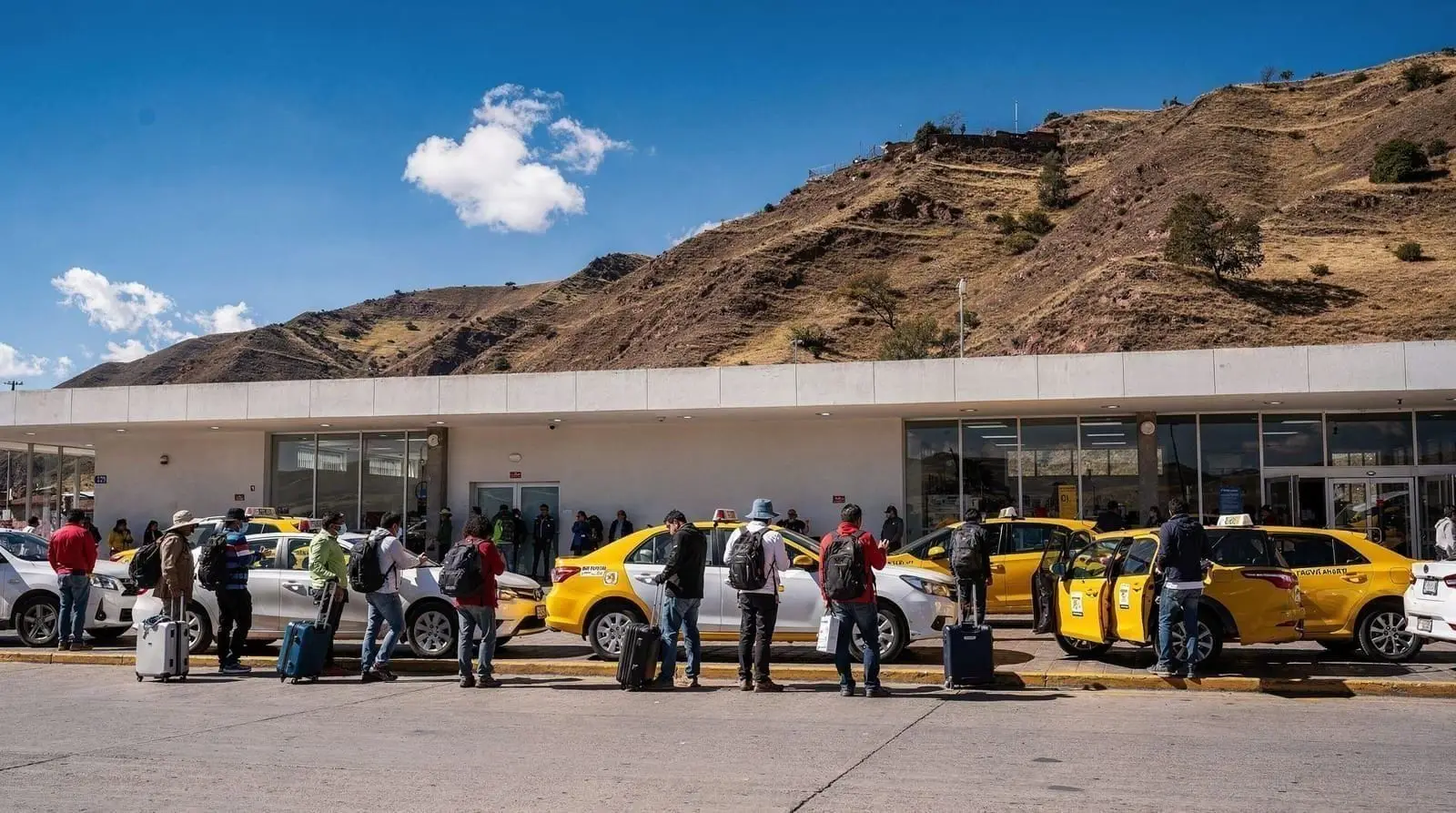
Cusco airport (CUZ): arrivals, taxis, and the altitude reality
How do I get from Cusco airport to the city centre?
Alejandro Velasco Astete airport (CUZ) is barely 10 minutes from the Plaza de Armas. An official taxi runs S/20 to S/30, a pre-booked hotel transfer S/30 to S/60, and a shared shuttle less. Agree the fare before you get in, and take it easy on arrival because you have just landed at 3,400 m.
A tiny airport in a thin-air bowl
Alejandro Velasco Astete International Airport, known by its code CUZ, is one of the busiest and most central airports in Peru — and one of the more weather-sensitive. It sits just southeast of the city, ringed by mountains, at the same punishing 3,400 m (11,150 ft) as Cusco itself. That central location is a gift: you can be at the Plaza de Armas within fifteen minutes of stepping off the plane. It is also a warning, because you reach full Cusco altitude before you have so much as found your bag.
| Where | 10-15 min southeast of the Plaza de Armas |
| Cost | Official taxi S/20-30; hotel transfer S/30-60 |
| Getting there | Domestic flight from Lima (~75 min) |
| Best time | Morning flights; afternoon weather worsens |
| On arrival | Rest, hydrate, no strenuous activity day one |
This guide covers the practical reality of arriving and departing: what the terminal is like, how to get into town without overpaying, why morning flights dominate the schedule, and how the altitude shapes everything from the moment you land. It is written for the typical traveller flying in from Lima, which is how the overwhelming majority of visitors reach the city.
Getting in: flights from Lima and beyond
For nearly everyone, Cusco begins with a domestic hop from Lima. The flight takes about 75 minutes, and several carriers — LATAM, Sky Airline, JetSMART, and others — run it many times a day. Because Cusco is the gateway to Machu Picchu, demand is high and fares swing wildly: book early and a one-way Lima–Cusco leg can be cheap, but leave it late in peak season and it climbs steeply.
A few practical notes on the flight in:
- Morning flights dominate, and for good reason. Cusco’s mountain weather tends to worsen through the afternoon, so airlines front-load the schedule. Earlier flights are also less prone to the day’s accumulated delays.
- International arrivals route through Lima. There have been occasional limited regional international services to Cusco, but the reliable plan is to land at Lima’s Jorge Chávez airport and connect onward. If you are arriving internationally, give yourself a comfortable buffer in Lima rather than booking the tightest possible connection.
- Window seats reward you. On a clear morning the descent over the Andes into the Cusco bowl is spectacular.
The terminal itself
CUZ is small and straightforward. There is a single passenger terminal with a compact arrivals hall, a handful of cafés and shops, ATMs, and car-rental and tour-operator desks. Domestic security and boarding are quick by international standards, but the airport gets congested at the morning peak when many flights cluster together, so leave time on departure days.
Facilities are functional rather than luxurious. There are basic eateries airside, but do not count on a wide choice; if you want a proper meal before a flight, eat in town first. Wi-Fi exists but can be patchy. An ATM in the terminal dispenses soles — useful, since you will want small notes for the taxi and your first day.
Getting from the airport to the city
The good news is the distance: the centre is barely 10 to 15 minutes away in normal traffic. The thing to manage is the fare, because the airport is a classic spot for overcharging.
Your options, roughly cheapest to dearest:
- Official airport taxi: use the official taxi desk inside the terminal, which sets a fixed fare to the centre, usually around S/20 to S/30 (about $5 to $8) to the Plaza de Armas. This is the simplest honest option.
- Pre-booked hotel transfer: many hotels will send a driver who waits with your name on a sign. It costs more, roughly S/30 to S/60, but removes all friction on a day when you may be feeling the altitude — arguably the best choice for a first arrival.
- Ride-hailing apps: InDriver and Cabify operate in Cusco and remove haggling, though airport pickup rules and pickup points can be fiddly; you may need to walk a short distance from the terminal.
- Drivers who approach you: inside and just outside the terminal, drivers will offer rides at inflated prices. If you use one, agree the fare before getting in, in soles, and do not accept a vague “we’ll sort it out later.”
Whichever you choose, pay in soles. Dollars are accepted but at a poor rate, and you simply lose money. Keep small notes handy for the fare.
Transfer options compared:
| Option | Cost | Best for |
|---|---|---|
| Official airport taxi | S/20-30 | Simplest honest option for most arrivals |
| Pre-booked hotel transfer | S/30-60 | First arrivals, feeling the altitude, no haggling |
| Ride-hailing app (InDriver/Cabify) | Similar to taxi | Confident travellers used to app pickup points |
| Driver approaching you outside | Inflated, negotiable | Avoid unless fare is agreed upfront |
The altitude reality on arrival
Here is the part that catches people off guard. You have just flown from sea level (or close to it) and landed at 3,400 m within an hour or two. Some travellers feel fine; others are breathless, light-headed, or headachy before they reach baggage claim. None of this is a sign of weakness — soroche is unpredictable and unrelated to fitness.
Treat the airport-to-hotel transition gently:
- Take a taxi, do not walk. Even the short distance is not worth hauling luggage uphill at altitude on minute one.
- Move slowly through the terminal. Rushing for the exit with heavy bags is exactly the kind of exertion that triggers symptoms.
- Plan a restful arrival day. Do not schedule a tour or a steep walk for the day you land. Drop your bags, rest, hydrate, and let your body register the elevation.
- Accept the coca tea your hotel will likely offer; it gives mild relief.
The full day-by-day approach is in our Cusco acclimatization plan, and if your itinerary is flexible, arriving via the lower Sacred Valley first is gentler than going straight up to the city — see Cusco altitude vs the Sacred Valley.
Departing from CUZ: build in a buffer
The single most important departure advice: never book a tight connection out of Cusco onto an international flight. Morning weather, the mountain approach, and congestion mean delays and the occasional cancellation are routine, especially in the November–March wet season. If you have an evening international flight out of Lima, take an early-morning Cusco departure, not a midday one, so a delay does not cascade into a missed long-haul.
Other departure-day practicalities:
- Arrive early. The morning peak makes check-in and security slower than the airport’s small size suggests.
- Reconfirm and watch your app. Schedule changes happen; keep your airline app and notifications on.
- Spend leftover soles in town, not airside, where choice is limited.
- Keep some cash for a departure-day taxi if your hotel does not include a drop-off.
Onward overland connections
Not everyone flies onward. Cusco’s airport is the hub, but the city also connects overland to the rest of the southern circuit. Trains to Machu Picchu leave mainly from Ollantaytambo in the Sacred Valley, about 1.5 to 2 hours from Cusco by road, so factor that transfer into your timing. Long-distance buses to Puno and Lake Titicaca, and onward to Arequipa, use the Terminal Terrestre south of the centre. If you are chaining destinations, the airport is your in-and-out point, but much of the regional movement happens by road and rail.
How the airport fits your Cusco plan
Think of CUZ as the front door to a city that asks for patience. The smart arrival is unglamorous: an early flight from Lima, an official or pre-booked taxi, a deliberately quiet first day, and respect for the altitude. Get those four things right and you avoid the most common ways a Cusco trip starts badly. From there the city opens up — the historic centre, the ruins above town, the Sacred Valley, and Machu Picchu.
For broader logistics and routing, see /guides/, /itineraries/, and the two-week Peru itinerary guide. For the Lima end of the journey, our Lima airport to city guide covers the connection you will likely make first.